Upgrade & Secure Your Future with DevOps, SRE, DevSecOps, MLOps!
We spend hours scrolling social media and waste money on things we forget, but won’t spend 30 minutes a day earning certifications that can change our lives.
Master in DevOps, SRE, DevSecOps & MLOps by DevOps School!
Learn from Guru Rajesh Kumar and double your salary in just one year.
Introduction
Navigating the legal landscape in India can feel complex and overwhelming. Whether you are an individual managing a family dispute, a property owner verifying land titles, a startup founder drafting employment contracts, or someone facing a criminal allegation, understanding your legal rights is the essential first step toward resolving any dispute. Finding the right legal representation early often prevents minor issues from turning into lengthy court litigation. However, many individuals struggle to identify which type of legal professional fits their specific situation, what factors to evaluate during consultation, and how to access reliable legal information. This comprehensive guide breaks down the Indian legal system into practical, clear concepts. It covers major legal practice areas, explains how to evaluate specialized advocates, outlines what to expect during an online or in-person consultation, and provides actionable frameworks to help you make informed choices. Platforms like WakilSahab simplify this process by acting as a structured legal discovery directory, enabling individuals and businesses across India to find suitable lawyers and access verified legal insights.
Understanding the Legal System & Legal Representation in India
India operates under a common law system structured around a hierarchical court system: the Supreme Court of India at the apex, High Courts at the state level, and District and Subordinate Courts at the local level. In addition, specialized tribunals such as the National Company Law Tribunal (NCLT), Debt Recovery Tribunal (DRT), and Consumer Disputes Redressal Commissions handle sector-specific matters.
                  ┌───────────────────────────────┐
                  │    Supreme Court of India     │
                  └──────────────┬────────────────┘
                                 │
                  ┌──────────────┴────────────────┐
                  │      State High Courts        │
                  └──────────────┬────────────────┘
                                 │
       ┌─────────────────────────┴────────────────────────┐
       │                                                  │
┌──────┴────────────────────────┐       ┌─────────────────┴─────────────┐
│ District & Subordinate Courts │       │     Specialized Tribunals     │
│ (Civil, Criminal, Family)     │       │ (NCLT, DRT, Consumer Commissions)│
└───────────────────────────────┘       └───────────────────────────────┘
When facing a legal matter, understanding whether your issue falls under civil law (disputes over rights, contracts, or property) or criminal law (offenses against public order or statutes) determines the correct court, legal procedures, and advocate specialization required.
Key Legal Practice Areas
- Civil Law: Deals with private disputes between individuals, organizations, or government entities. Examples include contract breaches, property boundary disputes, recovery of money, and tort claims.
- Criminal Law: Involves statutory offenses investigated by law enforcement agencies. It encompasses bail applications, trials, appeals, and defense representation.
- Family & Matrimonial Law: Governs personal relationships, personal status laws, marriage, divorce, child custody, maintenance, and inheritance.
- Corporate & Commercial Law: Covers business formation, regulatory compliance, employment frameworks, contract drafting, and intellectual property protection.
- Cyber & Digital Law: Focuses on digital offenses, online financial fraud, identity theft, data privacy violations, and IT Act compliance.
Why Seeking Professional Legal Guidance Matters
Attempting to resolve legal conflicts without professional support or relying entirely on generic internet search results can lead to missed statutory deadlines, flawed documentation, and loss of legal remedies.
  UNASSISTED LEGAL ACTION               PROFESSIONAL LEGAL GUIDANCE
┌─────────────────────────────┐       ┌─────────────────────────────┐
│ • Missed court deadlines    │  VS   │ • Timely statutory compliance│
│ • Unenforceable agreements  │       │ • Enforceable documentation │
│ • Heightened financial risk │       │ • Mitigated procedural risk │
└─────────────────────────────┘       └─────────────────────────────┘
Professional advocates bring specialized procedural knowledge, understand local court rules, and help draft precise legal documents such as legal notices, petitions, written statements, and commercial contracts. Early legal advice allows parties to assess risk, explore pre-litigation mediation, and make informed choices before incurring high litigation expenses.
Types of Legal Professionals in India
Not all lawyers handle every type of case. Advocates often specialize in specific legal domains to provide targeted representation.
┌─────────────────────────────────────────────────────────────────┐
│                     LEGAL PRACTICE AREAS                        │
├──────────────┬──────────────┬──────────────┬────────────────────┤
│  Criminal    │  Matrimonial │   Property   │ Corporate & Cyber  │
│  Advocates   │  & Family    │  Advocates   │    Consultants     │
│  (Bail, FIR) │ (Divorce)    │ (Title Checks│ (Contracts, IT Act)│
└──────────────┴──────────────┴──────────────┴────────────────────┘
1. Criminal Defense Lawyers
Criminal defense lawyers represent clients facing statutory allegations or investigations under provisions like the Bharatiya Nyaya Sanhita (BNS) or former Indian Penal Code (IPC). They draft anticipatory bail applications, regular bail petitions, represent clients during police inquiries, and handle trial defense in Magistrate or Sessions Courts.
2. Family & Matrimonial Lawyers
Family law advocates focus on personal status laws, handling mutual or contested divorce proceedings, child custody agreements, alimony/maintenance claims, and domestic violence protection petitions. They often emphasize mediation to settle disputes amicably.
3. Property & Real Estate Lawyers
Property advocates manage land and housing disputes, conduct property title verifications, draft sale deeds, lease agreements, partition suits, and represent clients before Revenue Courts or RERA (Real Estate Regulatory Authority).
4. Cybercrime Advocates
Specialists in information technology law handle online financial fraud, data breach litigation, identity theft, unauthorized access cases, and cyber harassment complaints under the Information Technology Act.
5. Corporate & Commercial Lawyers
Corporate lawyers assist startups, small businesses, and large enterprises with business formation, shareholder agreements, employment law compliance, statutory filings with the Ministry of Corporate Affairs (MCA), and intellectual property registrations.
Key Comparison Frameworks
Table 1: In-Person vs. Online Lawyer Consultation
| Feature | In-Person Consultation | Online Lawyer Consultation | Key Takeaway |
| Accessibility | Requires travel to office or court premises | Accessible remotely from home or office | Online fits initial evaluations; in-person fits complex trials |
| Document Sharing | Hard copy review during meeting | Digital upload (PDF, scanned images) prior to call | Online sharing requires clear, organized digital scans |
| Ideal Use Case | Finalizing court filings, trial prep, witness briefings | First opinions, document review, preliminary advice | Online consultations save time during early decision-making |
| Geographic Reach | Limited to local advocates in your city | Enables access to advocates across multiple states | Ideal for cross-border or multi-city disputes |
Table 2: Comparative Summary of Major Legal Domains
| Legal Practice Area | Primary Matters Handled | Key Governing Frameworks | Recommended Professional |
| Criminal Law | Bail, FIR, trial defense, fraud, assault | BNS, BNSS, Special Acts | Criminal defense advocate |
| Family Law | Divorce, child custody, maintenance, adoption | Hindu Marriage Act, Special Marriage Act | Family & matrimonial specialist |
| Property Law | Title search, partition, sale agreements, RERA | Transfer of Property Act, RERA | Property & land dispute lawyer |
| Corporate Law | Contract drafting, compliance, IP, incorporation | Companies Act, Contract Act | Corporate consultant / IP advocate |
| Cyber Law | Online fraud, identity theft, privacy breaches | Information Technology Act, DPDP Act | Cybercrime specialist |
Table 3: Pre-Litigation Steps vs. Court Litigation Proceedings
| Stage | Action Focus | Typical Documents | Primary Purpose |
| Pre-Litigation | Fact gathering, legal notice, negotiation | Legal Notice, Reply, Demand Letters | Settling disputes without formal court action |
| Pleadings | Filing petitions, statements, counter-affidavits | Plaint, Written Statement, Application | Defining legal arguments for the court record |
| Trial Phase | Evidence submission, cross-examination | Affidavits, Exhibits, Witness Testimony | Establishing facts and proving claims before a judge |
| Resolution | Final judgment, decree, settlement order | Court Order, Decree, Settlement Deed | Establishing binding legal resolution |
How to Choose the Right Lawyer in India
Selecting the right advocate requires systematic evaluation rather than relying solely on informal word-of-mouth recommendations.
┌─────────────────────────────────────────────────────────┐
│              LAWYER SELECTION CHECKLIST                 │
├─────────────────────────────────────────────────────────┤
│ [ ] Bar Council Enrollment Verification                 │
│ [ ] Specific Practice Area Expertise                    │
│ [ ] Relevant Court & Jurisdictional Experience          │
│ [ ] Clear Fee Structure & Engagement Terms              │
│ [ ] Communication Clarity & Accessibility               │
└─────────────────────────────────────────────────────────┘
- Verify Practice Specialization: Match your specific legal issue with an advocate who primarily practices in that field. A corporate lawyer may not be suited for a criminal bail hearing.
- Evaluate Jurisdictional & Court Experience: Confirm that the lawyer routinely practices before the relevant court or tribunal (e.g., District Court, High Court, NCLT, or RERA) where your matter will be heard.
- Check Bar Council Credentials: Ensure the professional is registered with a State Bar Council under the Advocates Act, 1961.
- Discuss Communication Methods: Confirm how updates will be provided during ongoing proceedings and whether the lawyer offers virtual follow-ups.
- Review Fee Transparency: Ask for a clear explanation of consultation charges, drafting fees, per-appearance costs, and court fee additions before signing an engagement agreement.
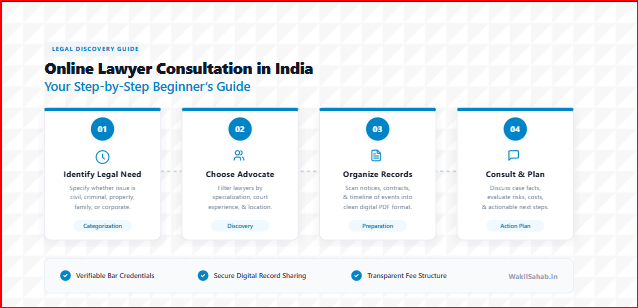
The Role of Online Lawyer Consultation
Digital legal consultation has become a convenient way to get preliminary legal advice across India. Through online channels, individuals and business owners can consult advocates located in different cities without traveling.
┌─────────────────────────────────────────────────────────┐
│            ONLINE CONSULTATION WORKFLOW                 │
├─────────────────────────┬───────────────────────────────┤
│ Step 1: Document Scans  │ Prepare digital copies of     │
│                         │ agreements, notices, or FIRs  │
├─────────────────────────┼───────────────────────────────┤
│ Step 2: Chronology      │ Draft a timeline of events    │
│                         │ and key factual details       │
├─────────────────────────┼───────────────────────────────┤
│ Step 3: Specific Questions│ List core objectives and    │
│                         │ financial/legal outcomes sought│
└─────────────────────────┴───────────────────────────────┘
To maximize an online consultation:
- Organize Digital Records: Convert key documents, contracts, correspondence, or notices into clear PDF format.
- Draft a Fact Sheet: Prepare a simple timeline listing dates, locations, involved parties, and actions taken so far.
- Define Key Questions: Focus your questions on actionable steps, potential risks, expected timelines, and statutory remedies.
When to Seek Professional Legal Assistance
You should consult a qualified legal professional promptly in situations such as:
- Receiving a formal legal notice or summons from a court or law enforcement agency.
- Entering into high-value real estate transactions requiring title verification and sale deed drafting.
- Starting a new business enterprise, drafting co-founder agreements, or issuing shares to investors.
- Experiencing domestic or matrimonial breakdown involving child custody or property division disputes.
- Facing online financial fraud, unauthorized bank transfers, or digital identity theft requiring cyber complaints.
- Being subject to police inquiries, investigation notices, or statutory allegations.
Understanding Legal Fees & Engagement Terms
Legal fees in India vary based on the nature of the matter, advocate seniority, jurisdiction, and procedural complexity. Common fee structures include:
- Fixed Consultation Fee: A set charge for an initial time-bound meeting (in-person or online).
- Per-Appearance Charges: Fees charged for every effective or non-effective hearing scheduled in court.
- Drafting Charges: Fixed rates for preparing specific documents like legal notices, petitions, or contracts.
- Retainer Agreements: Standard monthly or annual arrangements for businesses requiring continuous corporate and compliance assistance.
Note: Litigants should request a clear schedule of fees during their initial consultation to ensure complete financial transparency.
Common Legal Mistakes to Avoid
- Delaying Action: Waiting until statutory limitation periods expire or court deadlines pass can permanently compromise your legal rights.
- Ignoring Written Evidence: Failing to preserve communication records, receipts, messages, or signed contracts makes proving claims significantly harder.
- Public Discussion: Sharing details of ongoing legal disputes or criminal investigations on social media can harm your position in court.
- Selecting Based Only on Low Fees: Choosing an advocate solely on cost without evaluating their specialization or court experience often leads to inadequate representation.
- Relying on Unverified Online Advice: Treating general forum commentary or unverified articles as personalized legal advice can result in costly procedural errors.
Expert Tips for Managing Legal Matters
- Keep a Dedicated Case File: Maintain physical and scanned digital backup copies of all case-related documents in chronological order.
- Demand Written Retainership Terms: Ensure key engagement terms, professional fees, and scope of work are clearly stated in writing before starting representation.
- Focus on Fact-Based Communication: Present objective facts, dates, and evidence to your lawyer rather than emotional narratives or personal assumptions.
- Maintain Confidentiality: Discuss case details exclusively with your appointed advocate to protect client-attorney confidentiality.
- Review Documents Before Signing: Read through every petition, affidavit, or agreement carefully before adding your signature.
Best Practices for Selecting and Working with a Lawyer
           PREPARATION                     SELECTION                     ENGAGEMENT
┌─────────────────────────────┐   ┌─────────────────────────┐   ┌───────────────────────────┐
│ • Gather all evidence       │───│ • Verify practice area  │───│ • Agree on fee terms      │
│ • Write down incident dates │   │ • Review court exposure │   │ • Request regular updates │
│ • Define key objectives     │   │ • Confirm Bar enrollment│   │ • Keep formal record log  │
└─────────────────────────────┘   └─────────────────────────┘   └───────────────────────────┘
- Prioritize Specialization Over Proximity: It is better to engage a specialized corporate, property, or criminal lawyer slightly farther away than a general practitioner who lives nearby.
- Prepare a List of Focused Questions: Ask about procedural options, expected timeframes, alternative dispute resolution options, and total estimated expenses.
- Check Court Familiarity: Confirm whether the legal professional routinely handles matters in the specific court, tribunal, or forum presiding over your case.
- Follow Up Systematically: Keep a log of court dates, order sheets, and filing receipts provided by your legal counsel.
The Evolution of Legal Discovery & Technology in India
The Indian legal landscape is undergoing significant digital modernization. Initiatives like the e-Courts Integrated Mission Mode Project, virtual court hearings, online dispute resolution (ODR) mechanisms, and digital filing portals are transforming legal practice.
Similarly, legal discovery platforms like WakilSahab make it easier for individuals and small businesses to find appropriate legal resources. Rather than relying solely on informal networks, users can search organized online lawyer directories, filter professionals by location and practice area, and access structured legal guides to understand their options clearly.
Why Explore Legal Resources on WakilSahab
WakilSahab serves as an online legal discovery and information platform designed to make finding legal resources in India straightforward and transparent.
- Organized Lawyer Search: Browse legal professionals across major practice domains, including criminal defense, matrimonial disputes, property verification, cyber law, and corporate advice.
- Location-Based Discovery: Search for suitable advocates and legal consultants operating within your city, district, or state jurisdiction.
- Transparent Information Access: Review professional profiles, practice specializations, and service areas to make informed choices.
- Educational Legal Content: Access beginner-friendly legal articles, procedural guides, and frameworks to understand your rights before entering consultations.
Frequently Asked Questions (FAQs)
1. How do I find a qualified lawyer near me in India?
To find a qualified lawyer near you, identify your specific practice area requirement—such as criminal, property, or matrimonial law—and search organized directories like WakilSahab. Verify that the advocate is enrolled with your State Bar Council, review their court experience, and schedule an initial consultation to discuss your matter.
2. How does online lawyer consultation work?
An online lawyer consultation allows you to connect with an advocate remotely via phone or video call. You share scanned copies of relevant legal notices, agreements, or records prior to the call. The lawyer reviews your documents, evaluates your legal options, and advises you on practical next steps.
3. What is the difference between an advocate and a lawyer in India?
In India, a lawyer is anyone who holds a law degree (LL.B). An advocate is a law graduate who has officially registered with a State Bar Council under the Advocates Act, 1961, clearing the All India Bar Examination (AIBE). Only registered advocates hold the right to represent clients in court.
4. When should I consult a criminal lawyer?
You should consult a criminal defense advocate immediately if you are named in an FIR, receive a police investigation notice, face potential arrest, or need to file a criminal complaint. Early consultation helps you secure anticipatory bail, prepare appropriate replies, and protect your constitutional rights during inquiries.
5. What factors should I consider when hiring a divorce lawyer?
When hiring a matrimonial lawyer, evaluate their experience in family court proceedings, mutual consent and contested divorce processes, child custody arrangements, and maintenance applications. Look for an advocate who balances strong courtroom representation with effective mediation and negotiation skills.
6. When is title verification necessary from a property lawyer?
Title verification is essential before buying land, an apartment, or commercial property. A specialized property advocate inspects registry records at the Sub-Registrar’s office for the past 13 to 30 years to confirm clear ownership, check for encumbrances or mortgages, and verify land-use permissions before you sign sale deeds.
7. What does a cybercrime lawyer handle?
A cybercrime lawyer handles digital and internet-based legal disputes, including online financial fraud, identity theft, unauthorized access, hacking, data privacy breaches, and cyber harassment. They help victims file complaints with cyber crime police stations, navigate reporting portals, and secure remedies under the Information Technology Act.
8. How can a corporate lawyer assist small businesses and startups?
A corporate lawyer assists startups and businesses with drafting co-founder agreements, commercial contracts, employment frameworks, intellectual property registrations, regulatory filings with the MCA, and ongoing statutory compliance. Engaging corporate legal support early helps prevent costly shareholder or contractual disputes later.
9. What should I prepare before my first legal consultation?
Before your initial consultation, organize all relevant physical and digital documents chronologically. Prepare a clear timeline of events, write down specific questions regarding risks, fees, and expected timelines, and list your core objectives so the lawyer can assess your case accurately during the meeting.
10. How do lawyers in India charge for their services?
Lawyer fees vary based on experience, practice specialization, location, and case complexity. Charges may follow fixed rates per consultation, per-appearance fees for court dates, fixed drafting fees, or monthly retainers for corporate clients. Always ask for a clear fee schedule before formal engagement.
Conclusion
Understanding your legal rights and procedural options is fundamental to resolving disputes effectively in India. Whether you are dealing with a property title verification, navigating a sensitive family dispute, launching a corporate startup, or responding to a statutory legal notice, early legal guidance protects your personal and financial interests. Choosing the right legal professional involves checking practice specializations, verifying Bar Council credentials, confirming court experience, and setting clear fee expectations. Platforms like WakilSahab help bridge the gap between clients and advocates, offering a transparent, organized way to discover legal professionals and access educational resources. By taking a proactive approach, preparing your documentation carefully, and engaging qualified legal support, you can navigate the Indian legal system with confidence.
