Upgrade & Secure Your Future with DevOps, SRE, DevSecOps, MLOps!
We spend hours scrolling social media and waste money on things we forget, but won’t spend 30 minutes a day earning certifications that can change our lives.
Master in DevOps, SRE, DevSecOps & MLOps by DevOps School!
Learn from Guru Rajesh Kumar and double your salary in just one year.
Introduction
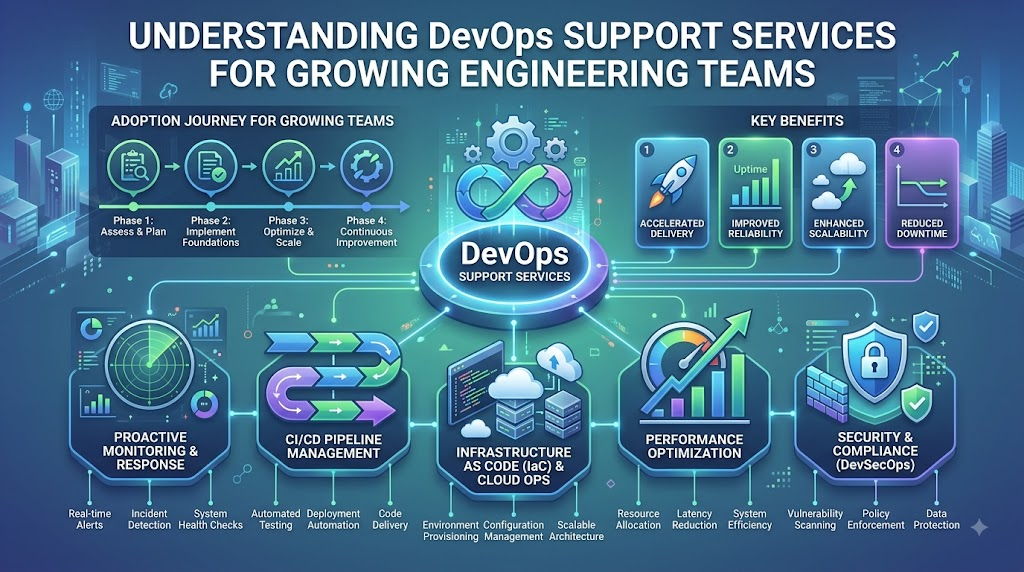
Modern software teams are expected to release applications quickly while keeping production environments stable, secure, and observable. As infrastructure grows, this becomes harder to manage with a small engineering team alone. Production incidents, cloud configuration issues, failed deployments, monitoring gaps, security updates, Kubernetes complexity, and increasing operational workloads can consume significant engineering time. This is where DevOps Support Services can become useful. Rather than treating DevOps as a one-time implementation project, ongoing support focuses on the continuous work required to operate and improve infrastructure, delivery pipelines, cloud environments, and production systems. Support can range from troubleshooting a failed deployment to monitoring infrastructure, managing automation, responding to incidents, maintaining Kubernetes clusters, and improving operational processes. The right model depends on the organization’s architecture, workload, internal skills, security requirements, and expected operational coverage. For many businesses, external support is not about replacing an internal engineering team. It can instead provide additional expertise and operational capacity where the existing team needs assistance.
What Are DevOps Support Services?
DevOps support services are ongoing technical and operational activities that help organizations maintain their software delivery and infrastructure environments. The work can begin after an initial DevOps implementation or operate alongside an existing engineering team.
Typical activities include infrastructure administration, CI/CD support, deployment troubleshooting, cloud operations, monitoring, incident response, automation, Infrastructure as Code, and production assistance.
A useful distinction is between implementation and support. An implementation project may establish a pipeline, configure infrastructure, or introduce Kubernetes. Support begins when those systems need regular maintenance, troubleshooting, upgrades, monitoring, optimization, and operational ownership.
For example, a deployment pipeline may work correctly when first created but later fail because of a changed dependency, expired credential, configuration difference, or infrastructure update. Ongoing support helps identify these issues and keep the delivery process usable.
Why Organizations Need Ongoing DevOps Support
Production infrastructure is not static. Applications change, traffic patterns evolve, cloud resources are modified, security requirements develop, and new deployment practices are introduced.
Internal teams may also have limited time. Developers need to build products, while operations engineers may be handling multiple environments simultaneously. During a production incident, routine engineering work can quickly become secondary.
Ongoing support can complement internal teams by taking responsibility for recurring operational activities. These may include infrastructure changes, monitoring, deployment assistance, cloud resource management, configuration maintenance, troubleshooting, and security-related operational tasks.
This model can be particularly useful when a company is growing faster than its operations function. Instead of waiting until infrastructure problems become major disruptions, teams can establish processes for monitoring, escalation, documentation, and preventive maintenance.
The goal is not simply to fix incidents. A mature support approach also looks for recurring causes and opportunities to automate repetitive work.
24/7 DevOps Support Services
24/7 DevOps Support Services are designed for organizations that require operational attention outside normal business hours. This can be relevant to globally distributed teams, SaaS platforms, online services, and other environments where incidents may occur at any time.
Round-the-clock support can involve continuous monitoring, infrastructure alerts, incident triage, production troubleshooting, deployment assistance, escalation procedures, and emergency operational response.
A practical 24/7 model needs more than people being available. There should be clear ownership, documented procedures, alert definitions, escalation paths, access controls, and communication processes.
For example, when an alert occurs at night, the support process should make it clear which system is affected, who investigates it, when the issue should be escalated, and what information should be captured for later analysis.
Organizations should also define their actual coverage requirements rather than assuming every system needs the same level of support.
Managed DevOps Services
Managed DevOps Services generally involve assigning recurring operational responsibilities to an external technical team. This differs from traditional consulting, where an expert may provide recommendations or assist with a specific project and then leave.
A managed model may cover CI/CD operations, infrastructure automation, cloud administration, configuration management, monitoring, release management, backups, security-related activities, and routine infrastructure maintenance.
This approach can be useful when a business has a small internal operations team or wants experienced assistance with recurring technical responsibilities.
However, managed support is not automatically the right choice for every organization. Companies with strong internal platform teams may prefer to retain complete ownership while using external specialists only for specific gaps or complex projects.
Clear boundaries are important in either model. Responsibilities, access, escalation, documentation, change management, and knowledge transfer should be defined before operational work begins.
Kubernetes Support Services
Kubernetes provides powerful capabilities for running containerized workloads, but production Kubernetes environments can introduce substantial operational complexity. Cluster administration is only one part of the challenge.
Kubernetes Support Services may include cluster maintenance, workload management, scaling, networking troubleshooting, security configuration, monitoring, resource management, upgrades, and production optimization.
Teams may operate Kubernetes through platforms such as AWS EKS, Azure AKS, or Google GKE. Each environment introduces different cloud integrations and operational considerations.
Common support situations include pods repeatedly restarting, resource limits causing instability, networking problems, failed deployments, insufficient monitoring, or upgrade-related issues.
Good Kubernetes support should therefore focus on both immediate troubleshooting and long-term maintainability. Documentation, resource policies, observability, access controls, upgrade planning, and automation are important parts of keeping clusters manageable.
AWS DevOps Support Services
AWS environments can involve many infrastructure and delivery components, including EC2, EKS, ECS, Lambda, networking, storage, identity, monitoring, and deployment systems.
AWS DevOps Support Services can help teams operate these environments by supporting infrastructure automation, deployment pipelines, cloud monitoring, configuration management, and production operations.
Infrastructure as Code tools such as Terraform and CloudFormation can make infrastructure changes more repeatable. CI/CD automation can reduce manual deployment steps, while monitoring helps teams understand resource and application behavior.
The appropriate AWS architecture depends on the workload. A containerized application may have different requirements from an event-driven serverless workload, while a large enterprise platform may require several deployment and infrastructure patterns.
Support should therefore focus on operational requirements rather than assuming that one AWS service or architecture is suitable for every application.
Azure DevOps Support Services
Organizations operating on Microsoft Azure may need support across infrastructure, deployment automation, monitoring, and production operations.
Azure DevOps Support Services can involve Azure Pipelines, AKS, Azure infrastructure, release management, CI/CD automation, monitoring, and infrastructure maintenance.
Recurring operational tasks can include investigating failed releases, managing infrastructure changes, reviewing deployment configurations, monitoring production environments, and supporting application delivery processes.
For teams already using Azure, external support can complement internal engineers by handling defined operational responsibilities while allowing product teams to concentrate on application development.
As with AWS, Azure support should be aligned with the actual architecture and business requirements rather than applying a generic operating model.
DevSecOps Support Services
Security should not be treated as an activity that happens only before production release. Modern delivery pipelines can integrate security checks throughout the software lifecycle.
DevSecOps Support Services may include secure CI/CD practices, SAST, DAST, dependency scanning, container security, secrets management, vulnerability management, and security automation.
For example, dependency scanning can identify vulnerable packages, while container scanning can help identify security issues in container images. Secrets management reduces the risk of sensitive credentials being placed directly in source code or configuration files.
The purpose is not to make every deployment process unnecessarily complicated. Security controls should be appropriate to the organization’s risk profile and integrated into workflows in a way that developers and operations teams can use consistently.
SRE Support Services
Site Reliability Engineering focuses on managing reliability through measurable objectives, automation, observability, and operational practices.
SRE Support Services can help organizations establish or improve practices around SLI, SLO, SLA, error budgets, incident management, capacity planning, performance engineering, and root-cause analysis.
Observability is particularly important because teams need useful information about application and infrastructure behavior before they can respond effectively to problems.
Error budgets can also provide a practical way to balance reliability and delivery. Instead of treating every deployment as equally risky, teams can use reliability objectives to inform decisions about release velocity and operational priorities.
SRE support is therefore not limited to incident response. It can also involve reducing repetitive operational work through automation and identifying systemic reliability problems.
MLOps Support Services
Machine-learning systems introduce operational requirements that continue after a model has been developed.
MLOps Support Services can assist with model deployment, ML infrastructure, pipelines, monitoring, version management, production environments, resource management, and automation.
A model may perform well during development but still require careful operational management once deployed. Teams need to manage model versions, infrastructure resources, deployment workflows, and monitoring.
MLOps connects machine-learning development with production engineering practices. The objective is to create a repeatable way to move ML workloads into production and maintain them as the surrounding application and infrastructure evolve.
DevOps Support Technology Areas
| Area | Common Technologies / Practices | Primary Purpose |
|---|---|---|
| CI/CD | Jenkins, GitHub Actions, GitLab CI/CD, Azure Pipelines | Automated delivery |
| Cloud | AWS, Azure, Google Cloud | Infrastructure operations |
| Containers | Docker, Kubernetes | Application consistency |
| Infrastructure as Code | Terraform, CloudFormation | Repeatable infrastructure |
| Monitoring | Metrics, logs, traces | Operational visibility |
| Security | SAST, DAST, secrets management | Secure delivery |
| SRE | SLI, SLO, error budgets | Reliability |
| MLOps | ML pipelines, model monitoring | Production ML operations |
These are examples rather than an exhaustive technology list. Organizations should select tools according to architecture, team skills, integration requirements, and operational needs.
Benefits of Continuous DevOps Support
Continuous support can provide several practical advantages when it is structured correctly.
Faster troubleshooting: Defined escalation and experienced operational support can help teams investigate issues more systematically.
Less manual work: Repetitive tasks can be identified and automated instead of being performed manually during every deployment or infrastructure change.
Better visibility: Monitoring, logs, and metrics give teams more information about application and infrastructure behavior.
More consistent deployments: Standardized pipelines and release processes can reduce unnecessary differences between environments.
Improved incident response: Documented procedures and clear ownership help teams respond to operational problems more methodically.
Stronger security practices: Security controls can become part of normal development and operations workflows.
Better reliability: Observability, capacity planning, automation, and root-cause analysis can address recurring operational problems rather than only individual incidents.
Common DevOps Support Challenges
- Poor documentation: Support teams cannot work efficiently when architecture, credentials, dependencies, and procedures are poorly documented.
- Unclear ownership: Incidents can become slower to resolve when nobody knows which team owns a system or decision.
- Weak escalation procedures: Critical problems need clearly defined escalation paths and communication channels.
- Limited observability: Without useful metrics, logs, and traces, troubleshooting often becomes guesswork.
- Excessive manual work: Repetitive operational activities increase the chance of human error.
- Inconsistent configurations: Differences between environments can create deployment and troubleshooting problems.
- Poor communication: Technical support requires timely communication between developers, operations, security teams, and business stakeholders.
- Lack of knowledge transfer: External support should not become a permanent knowledge gap. Documentation and knowledge sharing are essential.
- Overdependence on external teams: Organizations should retain enough internal understanding to make informed technical decisions.
- Weak security processes: Excessive access, unmanaged secrets, or missing security checks can create avoidable risks.
How to Choose a DevOps Support Company
Selecting a support provider should involve more than comparing service descriptions. Organizations should evaluate whether the provider fits their technical environment and operating model.
Consider the following:
- Technical expertise: Check experience with the infrastructure and delivery technologies actually being used.
- Cloud experience: Evaluate knowledge of the relevant cloud platform and its operational practices.
- Kubernetes knowledge: For containerized environments, assess practical cluster administration and troubleshooting capability.
- Security capabilities: Review how security controls, secrets, vulnerabilities, and access are handled.
- SRE experience: Understand whether the provider can work with observability, reliability objectives, incident management, and capacity planning.
- MLOps understanding: ML teams should assess experience with production ML infrastructure and workflows.
- Monitoring: Ask how alerts, logs, metrics, and incident signals are managed.
- Incident response: Understand the escalation process and responsibilities.
- Documentation: Confirm how operational knowledge will be recorded and maintained.
- Communication: Define communication channels, reporting practices, and stakeholder responsibilities.
- Support coverage: Ensure the proposed coverage matches actual business requirements.
- SLA structure: Review what service expectations are formally defined.
- Knowledge transfer: Ensure internal teams can understand important systems and procedures.
- Security practices: Evaluate access controls, credential handling, and operational security.
- Team compatibility: External engineers should work effectively with existing developers, platform teams, and IT staff.
DevOps Support Area and Business Need
| Support Area | Typical Business Need |
| DevOps Support | Ongoing infrastructure and delivery assistance |
| 24/7 DevOps Support | Continuous operational monitoring and incident response |
| Managed DevOps | Reduce recurring operational workload |
| Kubernetes Support | Manage containerized production environments |
| AWS DevOps Support | Support AWS infrastructure and deployments |
| Azure DevOps Support | Manage Azure-based DevOps operations |
| DevSecOps Support | Integrate security into delivery and operations |
| SRE Support | Improve reliability and operational practices |
| MLOps Support | Operate ML systems in production |
Frequently Asked Questions
1. What are DevOps Support Services?
They are ongoing technical services covering areas such as infrastructure, CI/CD, cloud operations, monitoring, automation, troubleshooting, deployments, and production support.
2. Why do companies need ongoing DevOps support?
Infrastructure and applications continuously change. Ongoing support helps teams handle recurring operational work, incidents, configuration changes, monitoring, and infrastructure maintenance.
3. What do 24/7 DevOps Support Services include?
Depending on the agreed operating model, they can include continuous monitoring, alert handling, incident response, troubleshooting, escalation, deployment assistance, and production support.
4. What is the difference between managed DevOps and DevOps support?
DevOps support can cover specific operational needs, while managed DevOps generally involves transferring defined recurring responsibilities to an external team.
5. When is Kubernetes support useful?
It can be useful when teams operate production Kubernetes environments and need assistance with cluster administration, scaling, monitoring, networking, upgrades, security, or troubleshooting.
6. What does AWS DevOps support involve?
It may include AWS infrastructure operations, EKS or ECS support, EC2, Lambda, Terraform, CloudFormation, deployment pipelines, monitoring, and production operations.
7. How does DevSecOps support improve security?
It integrates security activities such as code scanning, dependency checks, container security, secrets management, and vulnerability management into software delivery and operational workflows.
8. What is the role of SRE and MLOps support?
SRE support focuses on reliability, observability, incidents, capacity, and automation. MLOps support focuses on operating machine-learning infrastructure, pipelines, models, monitoring, and production workflows.
Conclusion
DevOps support has become an important consideration as software environments become more distributed and operationally complex. Cloud infrastructure, CI/CD pipelines, containers, monitoring, security controls, and production applications all require ongoing attention after their initial implementation. A suitable support model can connect infrastructure operations with automation, deployment management, observability, Kubernetes administration, security practices, reliability engineering, and machine-learning operations. The objective is not simply to react to incidents but to create repeatable operational processes and reduce avoidable manual work.
