Upgrade & Secure Your Future with DevOps, SRE, DevSecOps, MLOps!
We spend hours scrolling social media and waste money on things we forget, but won’t spend 30 minutes a day earning certifications that can change our lives.
Master in DevOps, SRE, DevSecOps & MLOps by DevOps School!
Learn from Guru Rajesh Kumar and double your salary in just one year.
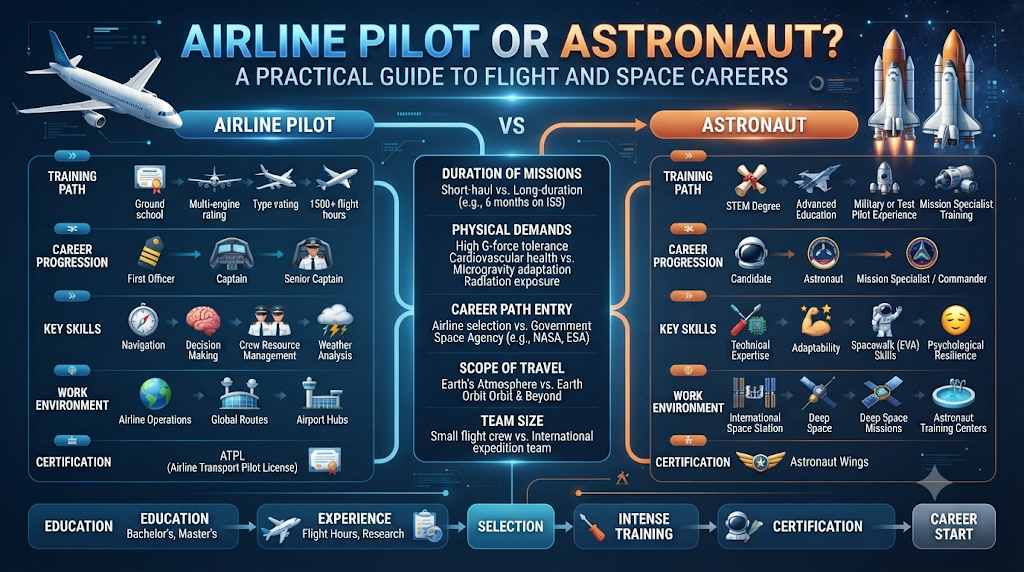
Picture two very different workdays. In the first, you sit in a bright glass cockpit at 35,000 feet, guiding two hundred passengers safely across time zones. In the second, you float inside a quiet orbital lab, checking life-support gauges while Earth curves beneath your window. Both careers reward calm thinking and technical skill, yet they follow completely separate rules. At AstroPilot, we help students and curious readers compare aviation and space paths using plain language and verified facts.
Learning how to become an airline pilot alongside how to become an astronaut gives you a clear map before you spend time or money on courses. You do not need any aviation background to follow this guide. We start with simple physics, break down pilot licenses step by step, review flight simulators, and explain how space agencies select and train crews.
Flight and Space Basics Made Simple
Before comparing career steps, it helps to see how airplanes and spacecraft move through two very different environments.
How Commercial Airplanes Fly
Aviation covers the design, flying, and upkeep of aircraft. Airliners stay aloft because their curved wings push air downward as jet engines drive the plane forward. This upward force is called aerodynamic lift.
Commercial aviation means carrying passengers or cargo for payment. Every airline flight works inside a global safety network run by air traffic control (ATC). Controllers track planes on radar and guide pilots via radio. Inside the cockpit, a Captain leads the flight while a First Officer shares flying duties, navigation, and safety checklists.
What Pilot Licenses and Ratings Do
A pilot license (called a pilot certificate in the United States) is an official permit from a national aviation authority allowing you to fly an aircraft. Think of it like a graduated driver’s license with stricter medical, written, and practical flight tests.
A rating adds a specialized skill to your license. An Instrument Rating lets you fly inside clouds using cockpit dials, while a Multi-Engine Rating qualifies you to fly planes with two or more engines.
How Astronauts Operate in Space
An astronaut is a crew member trained to fly spacecraft, run zero-gravity science experiments, repair orbital stations, and manage space missions.
Spaceflight starts where Earth’s atmosphere fades away. Because space has no air, wings cannot create lift. Rockets burn fuel to launch spacecraft upward and sideways at extreme speeds, where gravity and orbital physics take over.
How Aviation Connects to Space Exploration
Atmospheric flying and space travel share core habits. Both rely on strict checklists, clear radio talk, crew teamwork, and rapid troubleshooting. Many early astronauts started as military test pilots, and modern space agencies still use cockpit-style simulators to train crews.
Why Aviation and Aerospace Knowledge Matters
Studying how airplanes and spacecraft work offers real benefits even while you are still choosing a career:
- Smarter financial choices: Knowing exact training milestones stops you from buying unneeded courses or falling for false promises.
- Practical STEM learning: Flight and orbital concepts show how school math, physics, and computer science solve real-world problems.
- Safety-first thinking: Commercial aviation maintains high safety standards through disciplined teamwork and honest error reporting.
- Future career awareness: Hybrid-electric test planes, advanced cockpit automation, reusable rockets, and commercial space stations are actively reshaping modern transport.
Remember one key rule: passing exams or earning a degree opens opportunities, but neither guarantees an airline seat or astronaut selection. Consistent effort, good health, and timing all play major roles.
Step-by-Step Guide: How to Become an Airline Pilot
Aviation rules belong to individual countries rather than one global office. Always verify exact age, medical, and hour rules with the authority where you plan to fly—such as the FAA (United States), DGCA (India), EASA (European Union), UK CAA (United Kingdom), Transport Canada (Canada), or CASA (Australia).
Follow these ten practical steps toward an airline flight deck:
- Pick your licensing country: Confirm where you have the legal right to work and study that nation’s aviation regulations.
- Pass your aviation medical exam early: Visit an approved aviation medical examiner before paying for flight lessons to check vision, hearing, and heart health.
- Register as a student pilot: Complete your authority’s student pilot paperwork so you can legally fly solo during training.
- Meet private pilot license requirements: Learn takeoffs, landings, weather reading, radio calls, and cross-country navigation.
- Earn an Instrument Rating (IR): Train to fly safely through clouds and poor visibility using cockpit instruments alone.
- Meet commercial pilot license requirements: Master precise flight maneuvers and pass advanced exams so you can legally earn money flying.
- Add a Multi-Engine Rating (ME): Learn to control twin-engine airplanes, including safe handling if one engine stops.
- Build flight hours and cockpit judgment: Gain the total flying time airlines seek, often by teaching new students as a flight instructor.
- Complete airline transport pilot license requirements: Pass top-level airline theory exams and accumulate required multi-crew and cross-country flight experience.
- Prepare for airline hiring: Practice technical interviews, simulator checks, and group assessments, then maintain regular medical and flight renewals throughout your career.
Comparing Pilot Licenses and Ratings
Each license unlocks new flying privileges. The table below summarizes the standard progression.
| License or Rating | Target Learner | Key Privileges | Core Requirements (Varies by Authority) |
| Student Pilot | Brand-new beginners | Fly with an instructor and complete approved solo flights | Minimum age, medical clearance, and instructor sign-off |
| Private Pilot License (PPL) | Hobby flyers and career starters | Fly personal trips with passengers; no paid flying allowed | Ground exams, minimum flight hours, solo cross-country trips, and flight test |
| Instrument Rating (IR) | PPL or CPL pilots | Fly in clouds and low visibility using instruments and ATC guidance | Instrument theory, simulator/flight hours, and instrument flight test |
| Multi-Engine Rating (ME) | Pilots stepping up to twin-engine planes | Fly approved aircraft with two or more engines | Multi-engine lessons, engine-out drills, and practical flight check |
| Commercial Pilot License (CPL) | Aspiring career pilots | Fly for pay or hire in approved commercial roles | Higher flight hours than PPL, strict maneuver limits, written and flight tests |
| Flight Instructor (CFI / FI) | Qualified pilots teaching beginners | Instruct students in ground school and aircraft while logging hours | Valid commercial/instrument credentials, teaching exam, and instructor checkride |
| Airline Transport Pilot License (ATPL) | Senior airline pilots | Command large scheduled passenger and cargo airliners | High total flight hours, night/instrument/cross-country time, and ATPL exams |
Notice how private pilot license requirements focus on safe personal flying, whereas commercial pilot license requirements demand tighter control tolerances and more experience because paying passengers depend on you. Later, airline transport pilot license requirements set the highest experience bar for airline captains.
Flight Schools and Training Pathways
Student pilots generally choose between two training formats:
- Integrated programs: Full-time academy courses that guide beginners from zero hours to commercial readiness on a structured timetable.
- Modular programs: Flexible, pay-as-you-go training where you finish one license or rating at a time while keeping a job or college schedule.
Training takes place at local flight clubs, commercial flight academies, or universities that pair an aviation degree with flight lessons.
Pilot Training Programs in the USA: Part 61 vs. Part 141
Anyone researching pilot training programs in the USA will encounter two FAA rulebooks: Part 61 and Part 141.
- Part 61 lets instructors customize lesson pacing around each student’s schedule. It suits part-time learners well, though FAA minimum flight hours for certain certificates are higher.
- Part 141 requires an FAA-approved course outline, formal progress checks, and strict record-keeping, which can reduce the minimum flight hours needed for specific licenses.
Before signing any contract, confirm the school’s official government approval, ask to see maintenance logs, request a full itemized fee list, and walk away from anyone promising guaranteed airline jobs.
Using Flight Simulators for Smart Practice
A flight simulator recreates a cockpit, flight controls, instruments, and weather on a computer screen or dedicated training rig.
For beginners, simulators turn passive reading into active practice. You can rehearse engine start checklists, radio frequencies, navigation charts, instrument scans, and emergency steps without burning expensive aviation fuel.
Best Flight Simulator Software for Student Pilots
Two desktop programs lead the market when looking for the best flight simulator software for student pilots: Microsoft Flight Simulator and X-Plane.
- Microsoft Flight Simulator shines at realistic landscapes, live weather visuals, and airport layouts that help students practice visual landmarks and traffic patterns.
- X-Plane focuses heavily on flight physics and crisp instrument behavior, making it popular for practicing radio navigation and instrument approaches.
Keep simulator expectations realistic. Desktop software is a study aid and entertainment platform, not certified flight training. A home monitor cannot teach how turbulence feels in your seat, how crosswinds push a landing aircraft, or how real ATC pressure affects decision-making. Home simulator hours never replace licensed flight instruction or required aircraft hours.
How Astronaut Selection and Training Work
Unlike airlines that hire regularly, space agencies—such as NASA, ESA, and ISRO—open astronaut applications only when upcoming missions require new crew members.
Who Space Agencies Look For
A common myth claims every astronaut must be a fighter pilot. In reality, space agencies recruit engineers, physicists, biologists, medical doctors, and computer scientists alongside experienced test pilots. Most calls require a strong STEM degree (Science, Technology, Engineering, or Mathematics), several years of real-world professional or research experience, citizenship of the recruiting country or member nation, and strict medical fitness.
Inside Astronaut Candidate Training
Selected candidates complete roughly two years of basic training before receiving a mission assignment:
- Spacecraft systems: Mastering power, life support, computers, and propulsion controls.
- Full-scale simulations: Practicing launches, dockings, and sudden hardware failures inside realistic capsule mockups.
- Spacewalk practice: Training underwater in deep buoyancy pools wearing pressurized suits to simulate floating in space.
- Survival and crew skills: Completing wilderness and water survival drills while building clear communication and stress resilience.
For school and college learners exploring astronaut training for students, the best early preparation is excelling in math and science, joining robotics or aviation teams, staying fit, and practicing leadership in group projects.
Spaceflight Basics for Beginners
Understanding spaceflight basics for beginners starts with two simple ideas: gravity and forward speed.
How Orbits Work Without “Zero Gravity”
Gravity does not vanish in space. At the height where the International Space Station orbits, Earth’s gravity is still nearly 90 percent as strong as it is in your living room.
A spacecraft stays in orbit because a launch vehicle (rocket) boosts it sideways to an orbital velocity near 28,000 kilometers per hour. Gravity pulls the spacecraft downward, yet the craft moves forward so fast that Earth’s curved surface drops away beneath it at the same rate. It falls around Earth continuously without touching the ground.
Why Astronauts Float in Microgravity
Inside an orbiting space station, the station, the crew, and every floating water droplet are falling together at the exact same speed. This state of constant free fall creates microgravity, which feels like weightlessness.
Surviving Atmospheric Re-entry
To return home, a spacecraft fires braking thrusters to slow down slightly. Gravity pulls it back into Earth’s upper air, where friction creates intense heat during re-entry. Thermal heat shields protect the capsule until parachutes deploy for a safe landing.
Pilot Training vs. Astronaut Training Compared
Comparing pilot training vs astronaut training reveals how two technical careers differ in structure, cost, and daily work.
| Comparison Area | Airline Pilot Pathway | Astronaut Pathway |
| Governing Body | National civil aviation authorities and approved flight schools | Government space agencies (NASA, ESA, ISRO, etc.) |
| Entry Baseline | High school completion, aviation medical certificate, and training funds | Advanced STEM/technical degree, work experience, and agency medical clearance |
| Typical Timeline | About 18 months to 4+ years depending on full-time or modular study | Around 2 years of basic candidate training plus mission-specific prep |
| Core Subjects | Aerodynamics, meteorology, navigation, air law, and multi-crew safety | Orbital mechanics, spacecraft systems, robotics, research, and spacewalks |
| Daily Workplace | Commercial airliner cockpits on regional and international routes | Space capsules, orbital stations, simulators, labs, and mission control |
| Selection Odds | Competitive airline hiring, with steady global demand for qualified crews | Extremely small classes chosen during rare multi-year application windows |
Even with separate career tracks, both roles prize identical habits: situational awareness, calm decision-making, honest teamwork, and strict respect for safety rules.
Honest Pros, Cons, and Real-World Limits
Every aviation and space path blends exciting rewards with tough demands:
- Airline pilot realities: You gain respected technical skills, global travel, and structured career growth. However, training costs are high, medical exams repeat regularly, work hours cover nights and holidays, and airline hiring rises and falls with the economy.
- Astronaut realities: You help push human knowledge forward in space, yet selection odds are tiny, training is physically intense, and spaceflight involves real operational risk.
Seeing both the rewards and limits clearly helps you plan with confidence.
Essential Skills to Build Right Now
Students and career switchers can start building useful habits today:
- Sharpen math and physics: Practice mental math, ratios, vectors, and basic mechanics.
- Speak clearly and briefly: Pilots and astronauts avoid long, confusing sentences during critical moments.
- Strengthen English skills: English is the global standard for international air traffic control and most space missions.
- Stay calm when plans change: Practice troubleshooting small setbacks step by step instead of rushing.
- Be a reliable teammate: Join sports, coding clubs, or group science projects where mutual trust matters.
Ten Common Mistakes Beginners Should Avoid
- Delaying your medical exam: Always confirm medical fitness before paying large flight school deposits.
- Mixing rules from different countries: FAA, DGCA, and EASA licenses follow separate laws and conversion tests.
- Confusing PPL, CPL, and ATPL rights: A private license forbids paid flying, and a commercial license is only one step toward airline command.
- Picking a school without checking approval: Verify official regulator approval and speak with current students first.
- Forgetting hidden training expenses: Budget for exam fees, headsets, books, living costs, and extra flight hours beyond legal minimums.
- Relying only on desktop simulators: Treat home flight simulators as study tools, never as substitutes for real flight lessons.
- Assuming every astronaut must fly jets: Scientists, engineers, and doctors regularly win astronaut spots.
- Trusting outdated blog posts: Always double-check current rules directly on official agency websites.
- Skipping ground school focus: Weak theory knowledge makes practical flight exams much harder to pass.
- Believing licenses guarantee jobs: Airlines and space agencies select candidates for attitude, judgment, and teamwork as well as credentials.
Actionable Next Steps for Readers
Ready to turn curiosity into progress? Start with four practical actions:
- Read official rules first: Visit your national aviation authority’s website to check student pilot age and medical requirements.
- Take a discovery flight: Book a short introductory lesson at an approved local flight school to experience small-aircraft flying firsthand.
- Study real astronaut profiles: Check NASA, ESA, or ISRO pages to see the degrees and careers of recent astronaut classes.
- Practice structured habits: Combine basic aviation reading with disciplined checklist practice on a home flight simulator.
Future Trends in Flight and Spaceflight
Technology continues to reshape how pilots and astronauts train and operate:
- Modern training tools: Virtual reality cockpit trainers and flight data debriefing tools help students analyze mistakes visually.
- Cleaner aviation designs: Engineers are actively testing hybrid-electric regional aircraft, sustainable aviation fuels, and smarter cockpit safety automation.
- Growing commercial spaceflight: Reusable rockets and commercial crew capsules are expanding access to low Earth orbit while national agencies prepare new lunar missions.
How AstroPilot Supports Aviation and Space Learners
AstroPilot is an independent educational resource created to explain aviation and spaceflight clearly for beginners, students, and enthusiasts. Rather than operating as a flight school, licensing authority, or job agency, AstroPilot provides structured career guides, licensing comparisons, simulator tips, and spaceflight fundamentals so you can research pathways with clarity.
Frequently Asked Questions
1. What is the first step in learning how to become an airline pilot?
Begin by checking the student pilot age, education, and medical rules set by your country’s civil aviation authority, such as the FAA, DGCA, or EASA. Once you pass an initial aviation medical exam, you can book an introductory flight at an approved school and start Private Pilot License training.
2. How do private pilot license requirements compare to commercial pilot license requirements?
A Private Pilot License lets you fly for personal travel without pay, while a Commercial Pilot License permits you to work as a paid pilot. Commercial training demands higher total flight hours, stricter maneuver accuracy, and deeper technical exams than a private license.
3. What do airline transport pilot license requirements involve?
An Airline Transport Pilot License is the highest pilot qualification needed to command scheduled commercial airliners. Candidates must hold commercial and instrument credentials, pass comprehensive airline theory exams, and log extensive total, night, instrument, and cross-country flight hours under their authority’s rules.
4. How do pilot training programs in the USA work under Part 61 and Part 141?
In the United States, FAA Part 61 schools offer flexible scheduling tailored to individual students, making them convenient for part-time learners. Part 141 schools follow an FAA-approved structured curriculum with formal stage checks and often allow lower minimum flight hours for certain certificates.
5. Can you learn how to become an astronaut without being a pilot first?
Yes. While test pilots remain important for spacecraft flight operations, space agencies also select engineers, physicists, biologists, medical doctors, and computer scientists. Strong STEM achievements, teamwork, leadership, and strict medical fitness are essential across all astronaut backgrounds.
6. What does effective astronaut training for students look like before college graduation?
Students can prepare early by building strong grades and practical projects in math, physics, engineering, and computer science. Joining robotics clubs, sports teams, or aviation groups also builds physical stamina, teamwork, and calm problem-solving habits.
7. What is the core difference in pilot training vs astronaut training?
Pilot training follows a predictable licensing ladder through flight schools and aviation authorities toward commercial airline jobs. Astronaut training begins only after winning a competitive spot in a space agency recruitment cycle and covers spacecraft systems, orbital science, robotics, and spacewalks.
8. What are the most helpful spaceflight basics for beginners to learn?
Start by learning how gravity, orbital velocity, and microgravity interact. A spacecraft stays in orbit by traveling sideways at roughly 28,000 kilometers per hour while gravity bends its path around Earth, creating continuous free fall that produces apparent weightlessness.
9. What is the best flight simulator software for student pilots to practice with?
Microsoft Flight Simulator and X-Plane are two leading home options for student pilots. Both help beginners practice cockpit checklists, instrument scanning, navigation charts, and radio calls at home before paying for real aircraft rental hours.
10. Can home flight simulator hours replace real aircraft training hours?
No. Uncertified desktop simulator software is an educational study aid and does not count toward official flight-hour minimums. Only aviation-authority-approved simulators used under authorized instruction rules can count toward specific training credits.
11. How long does it take to finish commercial pilot training?
Full-time students in structured programs often complete commercial and instrument training in roughly 18 to 24 months, depending on weather and aircraft availability. Part-time or modular students usually take two to four years, with additional time needed to build airline-level flight hours.
12. Why should student pilots verify flight school approvals before paying fees?
Training at an unapproved school can leave you with flight hours or ground courses that your aviation authority will not recognize for licensing. Checking official approval status early protects your budget, timeline, and future career eligibility.
Conclusion
Choosing between an airline cockpit and a space mission starts with understanding how each system works. Airline pilots progress through clear licensing steps regulated by civil aviation authorities, while astronauts earn spots through competitive space agency selections backed by strong STEM or test-piloting experience. Focus on solid fundamentals, verify official rules early, build strong teamwork and math habits, and take your next step with confidence.
