Upgrade & Secure Your Future with DevOps, SRE, DevSecOps, MLOps!
We spend hours scrolling social media and waste money on things we forget, but won’t spend 30 minutes a day earning certifications that can change our lives.
Master in DevOps, SRE, DevSecOps & MLOps by DevOps School!
Learn from Guru Rajesh Kumar and double your salary in just one year.
Introduction
The CDOM – Certified DataOps Manager is a professional credential designed for those who aim to bridge the gap between data engineering and operational excellence. This guide is written for engineers and managers who recognize that data is the lifeblood of the modern enterprise and requires a structured, automated approach to remain reliable. As organizations migrate to complex cloud-native environments, the traditional methods of handling data are no longer sufficient to meet the demands of speed and accuracy.
By engaging with the programs offered at Dataopsschool, professionals can transition from reactive data troubleshooting to a proactive stance of lifecycle management. This certification focuses on applying lean manufacturing principles and DevOps agility to the data domain, ensuring that high-quality information is delivered seamlessly to stakeholders. This comprehensive guide helps professionals evaluate their current skills and make informed decisions about their long-term career growth in the data landscape.
What is the CDOM – Certified DataOps Manager?
The CDOM – Certified DataOps Manager represents a fundamental shift in how enterprises manage the velocity, volume, and variety of data across their infrastructures. It exists to address the growing complexity of data pipelines that support real-time analytics, machine learning, and business intelligence. Unlike standard certifications that focus on theoretical data science, this program emphasizes production-focused learning and the practical application of automation.
The certification aligns with modern engineering workflows by introducing Continuous Integration and Continuous Delivery (CI/CD) into the data ecosystem. It fosters a culture of shared responsibility where data producers and consumers work in a synchronized environment. For any organization looking to implement a self-service data platform, the CDOM framework provides the essential blueprints for governance, quality control, and operational stability.
Who Should Pursue CDOM – Certified DataOps Manager?
This certification is specifically designed for data engineers, site reliability engineers (SREs), and cloud professionals who manage large-scale data estates. It is also highly relevant for engineering managers and technical leaders who need to oversee the strategic implementation of data projects without becoming bogged down in individual tool maintenance. Beginners with a strong foundation in database management will find it a rigorous entry point into modern operations.
In both global and local markets, the demand for professionals who can handle data at scale is reaching an unprecedented peak. Digital transformation projects in sectors like fintech, e-commerce, and healthcare require leaders who understand the technical stack as well as the managerial overhead of governance. Whether you are an experienced engineer looking to pivot or a manager wanting to validate your strategic expertise, CDOM provides a globally recognized benchmark.
Why CDOM – Certified DataOps Manager is Valuable and Beyond
The value of the CDOM – Certified DataOps Manager lies in its ability to address the data debt that many companies accumulate during rapid scaling. As enterprise adoption of artificial intelligence increases, the underlying data pipelines must be robust, or the analytical layer will fail to provide value. This certification ensures that you remain relevant in an industry where tools change frequently but the core principles of lean management remain constant.
The return on time and career investment is significant because it positions you at the intersection of Big Data, DevOps, and strategic management. By mastering this framework, you move from being a simple implementer to a strategist who can optimize the entire data value stream. This longevity is crucial for professionals who want to future-proof their careers against the volatility of the technology sector while maintaining a high impact on business outcomes.
CDOM – Certified DataOps Manager Certification Overview
The program is delivered via the official course portal and is hosted on the primary educational website mentioned in this guide. The certification is structured to accommodate different levels of professional maturity, moving from foundational principles to advanced managerial frameworks. It utilizes a rigorous assessment approach that combines knowledge tests with scenario-based evaluations to ensure candidates can handle real-world pressure.
The ownership of the program lies with industry experts who have witnessed the evolution of data systems from on-premise silos to distributed cloud meshes. The structure is entirely practical, focusing on the “how” and “why” of DataOps rather than just the “what.” Candidates are expected to demonstrate proficiency in areas such as orchestration, data versioning, and automated quality testing, which are the hallmarks of a mature organization.
CDOM – Certified DataOps Manager Certification Tracks & Levels
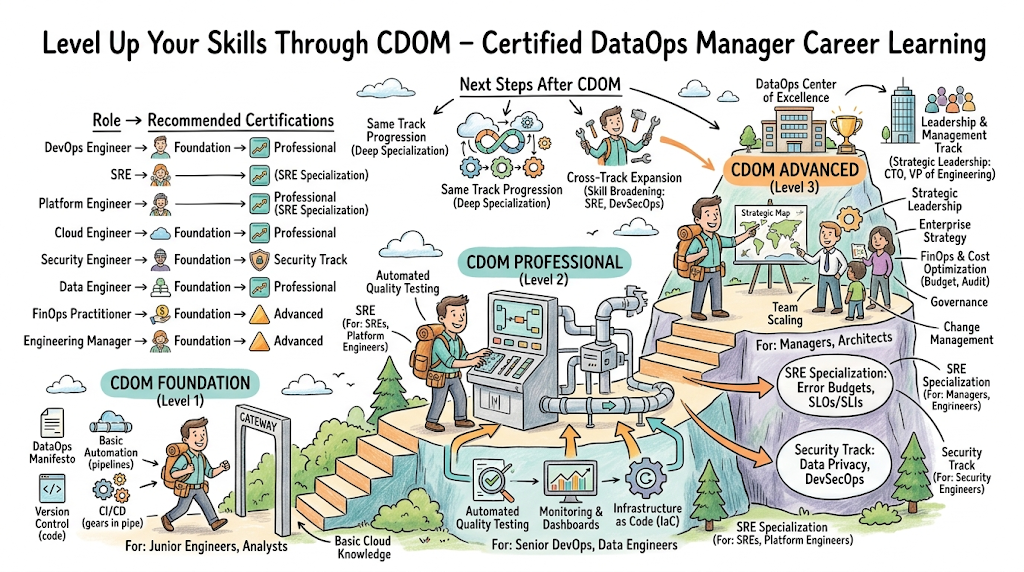
The certification tracks are divided into three distinct levels: Foundation, Professional, and Advanced. The Foundation level introduces the core vocabulary and concepts of DataOps, making it an ideal starting point for those transitioning from traditional roles. The Professional level dives deep into the technical implementation, focusing on specific tracks like reliability engineering or security-focused data pipelines.
The Advanced level, which leads to the Manager designation, focuses on the holistic management of people, processes, and technology. These levels align perfectly with typical career progression, where a professional starts by building pipelines, then optimizes them for performance, and eventually leads teams to deliver enterprise-wide strategies. This tiered approach ensures that learners can build their expertise incrementally without becoming overwhelmed by the complexity of the field.
Complete CDOM – Certified DataOps Manager Certification Table
| Track | Level | Who it’s for | Prerequisites | Skills Covered | Recommended Order |
| Core DataOps | Foundation | Junior Data Engineers | Basic SQL/Linux | CI/CD, Data Quality | 1st |
| Data Reliability | Professional | SREs / Data Engineers | Foundation Cert | Observability, SLIs | 2nd |
| Pipeline Security | Professional | DevSecOps Engineers | Foundation Cert | Encryption, Masking | 3rd |
| Data Governance | Professional | Compliance Officers | 2+ Years Exp | Auditing, Policy | 4th |
| Strategic Mgmt | Advanced | Engineering Managers | 5+ Years Exp | Team Leadership, ROI | 5th |
Detailed Guide for Each CDOM – Certified DataOps Manager Certification
CDOM – Foundation Level
What it is
This level validates the candidate’s understanding of the basic pillars of DataOps, focusing on the lifecycle of data and the application of agile principles to data management.
Who should take it
Ideal for entry-level data professionals, junior DevOps engineers, or database administrators who are looking to modernize their skills and understand automated data workflows.
Skills you’ll gain
- Understanding the core principles of the DataOps Manifesto.
- Basic version control for data schemas and transformation logic.
- Implementing automated tests for data quality and freshness.
- Knowledge of common data orchestration tools and workflow management.
Real-world projects you should be able to do
- Set up a Git-based workflow for managing SQL transformation scripts.
- Build a basic automated pipeline that triggers when new data arrives in storage.
- Create a simple dashboard showing the health of a local ingestion process.
Preparation plan
Explain 7–14 days, 30 days, and 60 days preparation strategies.
- 7-14 Days: Focus on the core glossary and attending introductory webinars focused on the DataOps lifecycle.
- 30 Days: Work through hands-on labs involving basic CI/CD tools and small datasets to understand trigger mechanisms.
- 60 Days: Deep dive into the relationship between data producers and consumers, focusing on metadata and documentation.
Common mistakes
- Treating DataOps exactly like software DevOps without accounting for data state and persistence.
- Focusing too much on specific tools rather than the underlying process improvements.
Best next certification after this
- Same-track option: CDOM Professional Level
- Cross-track option: Cloud Practitioner Certification
- Leadership option: Project Management Professional Foundations
CDOM – Professional Level
What it is
This certification validates the ability to design and implement complex, scalable, and automated data architectures that support high-velocity business requirements.
Who should take it
Experienced data engineers and site reliability engineers who are responsible for the uptime and performance of production data environments.
Skills you’ll gain
- Designing multi-stage data pipelines with automated rollback and recovery.
- Implementing advanced monitoring and observability for data volume and drift.
- Managing data infrastructure as code (IaC) using modern provisioning tools.
- Advanced troubleshooting of distributed data systems and bottleneck identification.
Real-world projects you should be able to do
- Deploy a production-grade data mesh architecture using containerization.
- Implement an automated data masking solution for sensitive information within a pipeline.
- Build a self-healing pipeline that re-runs failed jobs based on specific error logic.
Preparation plan
- 7-14 Days: Focus on the integration points between different cloud services and data storage layers.
- 30 Days: Practice complex scenario-based labs involving high-volume data streaming and batch processing.
- 60 Days: Conduct a mock audit of an existing pipeline to identify areas for performance and cost optimization.
Common mistakes
- Over-engineering pipelines for a scale that the organization does not yet require.
- Neglecting security and compliance aspects during the automation process.
Best next certification after this
- Same-track option: CDOM Advanced Manager Level
- Cross-track option: Certified DevSecOps Professional
- Leadership option: Certified Scrum Master
CDOM – Advanced Manager Level
What it is
The highest level of the program, validating a leader’s ability to drive organizational change, manage budgets, and align data operations with business goals.
Who should take it
Senior leads, engineering managers, and aspiring technical directors who need to demonstrate mastery over the cultural and strategic aspects of DataOps.
Skills you’ll gain
- Developing a long-term DataOps roadmap for an entire enterprise organization.
- Managing cross-functional teams of engineers, analysts, and business stakeholders.
- Calculating the return on investment (ROI) for major DataOps initiatives.
- Implementing organization-wide data governance and ethical AI frameworks.
Real-world projects you should be able to do
- Design a hiring and training plan for a newly formed DataOps department.
- Create a comprehensive disaster recovery and business continuity plan for data assets.
- Lead a migration project moving a legacy data stack to a modern cloud platform.
Preparation plan
- 7-14 Days: Focus on the people pillar of DataOps, studying team dynamics and change management.
- 30 Days: Analyze case studies of successful and failed DataOps implementations in large corporations.
- 60 Days: Develop a capstone project that solves a hypothetical organizational bottleneck using the CDOM framework.
Common mistakes
- Losing touch with the technical realities and challenges of the engineering teams.
- Focusing only on metrics that do not translate to actual business value or quality.
Best next certification after this
- Same-track option: Specialized Industry Data Certifications
- Cross-track option: FinOps Certified Practitioner
- Leadership option: Executive Leadership or MBA Programs
Choose Your Learning Path
DevOps Path
The DevOps path focuses on treating data as code and integrating data pipelines into existing application CI/CD workflows. Professionals on this path learn how to automate the deployment of data models alongside application code updates. The goal is to ensure that the data environment is always in sync with the application layer, reducing deployment failures. It is about bringing the agility of software development to the often-stagnant world of data management and storage.
DevSecOps Path
In this path, the primary focus is on the security of the data pipeline and the integrity of the information itself. Professionals learn how to integrate automated security scanning, data encryption, and fine-grained access control into the DataOps cycle. This path is essential for organizations operating in highly regulated industries like finance or healthcare. It ensures that the speed of data delivery does not come at the cost of compliance or vulnerability to external threats.
SRE Path
The SRE path emphasizes the reliability and availability of data systems through the use of engineering principles. Professionals focus on defining and measuring Service Level Indicators (SLIs) and Service Level Objectives (SLOs) specifically for data pipelines. This involves building robust alerting systems and automated incident response for data outages or quality drops. The goal is to apply the error budget philosophy to data operations to balance innovation with stability.
AIOps Path
The AIOps path explores the use of machine learning and artificial intelligence to enhance and automate IT operations. Professionals learn how to use algorithmic analysis to predict system failures, automate root cause analysis, and optimize resource allocation. This path is for those who want to move beyond manual script-based automation toward intelligent, self-learning infrastructure. It focuses on using the data generated by the systems themselves to improve overall operational efficiency and uptime.
MLOps Path
The MLOps path is dedicated to the operationalization of machine learning models within the enterprise. It bridges the gap between data science and production engineering, ensuring that models can be deployed, monitored, and retrained automatically. Professionals learn about feature stores, model versioning, and drift detection to maintain model accuracy over time. This path is critical for ensuring that AI initiatives provide consistent business value and are not just isolated experiments.
DataOps Path
This is the core path for those specializing purely in the optimization of the data value stream from ingestion to consumption. It covers the entire lifecycle with a heavy emphasis on lean principles and the reduction of waste in data processing. Professionals learn how to build self-service data platforms that empower analysts while maintaining central control over quality and standards. It is the definitive path for anyone looking to become a master of the modern data pipeline.
FinOps Path
The FinOps path focuses on the financial management and cost optimization of data and cloud resources. Professionals learn how to track data storage costs, optimize expensive query patterns, and align cloud spending with business outcomes. As data volumes grow, the cost of processing that data can spiral out of control if not managed properly. This path provides the tools and frameworks to ensure that the data operation remains economically sustainable for the business.
Role → Recommended CDOM – Certified DataOps Manager Certifications
| Role | Recommended Certifications |
| DevOps Engineer | CDOM Foundation, Professional Reliability |
| SRE | CDOM Professional Reliability, Advanced Manager |
| Platform Engineer | CDOM Foundation, Professional Governance |
| Cloud Engineer | CDOM Foundation, Professional Security |
| Security Engineer | CDOM Professional Security, Governance |
| Data Engineer | CDOM Foundation, Professional, Advanced |
| FinOps Practitioner | CDOM Foundation, FinOps Specialization |
| Engineering Manager | CDOM Foundation, Advanced Manager |
Next Certifications to Take After CDOM – Certified DataOps Manager
Same Track Progression
Deep specialization within the DataOps domain involves pursuing advanced certifications in specific tooling or architectural methodologies such as Data Mesh. Professionals might look into advanced cloud-specific data certifications to complement their managerial expertise. This ensures that while you have the managerial framework, you remain tethered to the cutting-edge technical capabilities of major cloud providers. Continuous learning in specialized areas like real-time streaming or graph databases can also provide a competitive edge in the market.
Cross-Track Expansion
Skill broadening is essential for a well-rounded career in modern technology management. After mastering DataOps, expanding into DevSecOps or FinOps provides a more holistic view of the enterprise ecosystem. For instance, understanding the financial implications of your data architecture through FinOps makes you a much more effective manager. Similarly, gaining a certification in SRE principles can help you apply more rigorous reliability standards to your data pipelines, ensuring that the insights you provide are always available.
Leadership & Management Track
Transitioning to broader leadership roles often requires certifications that focus on organizational strategy rather than just technical execution. Certifications like the Certified Information Systems Manager or various ITIL levels can provide the formal framework needed for high-level corporate governance. For those aiming for executive roles, combining the CDOM with advanced leadership training creates a powerful profile. This combination demonstrates that you understand both the engine room of the data factory and the boardroom of the business.
Training & Certification Support Providers for CDOM – Certified DataOps Manager
DevOpsSchool is a leading institution that has been providing technical training for over a decade. They offer comprehensive programs that cover the entire spectrum of the DevOps and DataOps lifecycle. Their approach is heavily geared toward hands-on learning, providing students with access to real-world environments and industry-standard tools. The faculty consists of working professionals who bring actual production scenarios into the classroom, ensuring that the training is practical and relevant. They provide extensive support for certification exams, including mock tests and deep-dive technical sessions.
Cotocus provides high-end consulting and training services specifically designed for enterprise-level digital transformation projects. Their focus is on helping organizations adopt lean and agile methodologies at scale, making them an excellent choice for professionals pursuing managerial certifications. They specialize in tailoring their curriculum to meet the specific needs of different industry verticals. The training programs at this institute are known for their rigor and their focus on high-level strategic thinking. They offer a blend of self-paced learning and instructor-led workshops that are highly effective for busy professionals.
Scmgalaxy is a community-driven platform that has grown into a major training provider for software configuration management and related fields. They have a massive repository of resources, including blogs, tutorials, and forums that support learners throughout their career journey. Their training programs are designed to be accessible yet thorough, covering foundational concepts before moving into advanced automation techniques. For those looking to understand the roots of DataOps in configuration management, this provider offers a unique and valuable perspective that is often missing in newer, tool-focused programs.
BestDevOps focuses on delivering high-quality, specialized training in the most in-demand skills in the cloud-native ecosystem. Their curriculum is constantly updated to reflect the latest trends and tool versions, ensuring that students are always learning the most relevant material. They offer a variety of learning paths that cater to different career goals, whether you are looking to become a technical expert or a strategist. The institute is particularly well-regarded for its career coaching and placement support, helping professionals transition into new roles with confidence and verified expertise.
Devsecopsschool is the go-to provider for those who want to integrate security into every stage of the development and data lifecycle. Their training programs are intensive and focus on the practical implementation of security as code. They cover a wide range of topics, from vulnerability management to automated compliance auditing within the pipeline. For a DataOps manager, understanding the security principles taught here is vital for building trustworthy and compliant data systems. The instructors are experts in both cybersecurity and operations, providing a rare and valuable dual perspective.
Sreschool specializes in the principles of site reliability engineering, focusing on the stability and scalability of large-scale systems. Their training programs teach professionals how to apply scientific methods to operations, including the use of metrics and automation to drive reliability. This provider is excellent for those who want to ensure their data pipelines are not just fast, but also resilient and highly available. Their courses often include complex labs that simulate production outages, giving students the chance to practice their troubleshooting skills in a safe environment.
Aiopsschool focuses on the cutting-edge field of artificial intelligence for IT operations. They provide training on how to use machine learning to automate the monitoring and management of complex infrastructure. Their programs are designed for forward-thinking professionals who want to lead the next wave of operational efficiency. The curriculum covers data science basics as well as the practical application of AI tools in an enterprise setting. For a DataOps professional, this training provides the tools to move from manual pipeline management to intelligent, self-optimizing systems.
Dataopsschool is the primary provider for the CDOM certification and offers a curriculum built from the ground up to support the DataOps Manifesto. Their training is highly specialized and focuses on the intersection of data engineering, quality, and operations. They provide a clear roadmap for professionals at all levels, from beginners to executive leaders. The platform is designed to be a one-stop-shop for everything related to DataOps, offering not just training but also a community of peers and experts who are actively shaping the future of the industry.
Finopsschool addresses the critical need for financial accountability in the cloud. Their training programs teach professionals how to manage the costs of cloud-native systems, with a specific focus on data storage and processing expenses. They provide frameworks for cloud cost optimization, budgeting, and forecasting. For anyone in a managerial role, the skills learned here are essential for proving the economic value of their technical initiatives. The training is practical and data-driven, providing immediate value for organizations looking to get their cloud spending under control.
Frequently Asked Questions (General)
- How difficult is the CDOM certification exam?
The difficulty is moderate to high, depending on your background in data engineering. The exam is designed to test practical application rather than just memorization, making it a rigorous benchmark.
- Is there a prerequisite for the Foundation level?
There are no formal prerequisites, but a basic understanding of SQL, Linux, and data movement concepts will significantly help in grasping the foundational material quickly.
- How long does it take to prepare for the Professional level?
Most candidates find that 30 to 60 days of consistent study and hands-on practice is sufficient to master the technical requirements of the professional certification.
- Is the CDOM certification recognized globally?
Yes, the certification is recognized by major technology firms and recruitment agencies worldwide as a standard for excellence in data operations and management.
- Do I need to know how to code to become a DataOps Manager?
While you do not need to be a full-stack developer, a solid understanding of scripting and the logic behind automation is essential for leading technical teams effectively.
- What is the typical salary increase after getting certified?
While results vary, professionals with specialized operations certifications often see a 15% to 25% increase in their earning potential due to the high demand for these skills.
- How often do I need to renew my certification?
The certification typically requires renewal every two to three years to ensure that your knowledge remains aligned with the latest industry standards and tool evolutions.
- Are the exams conducted online or at a center?
The exams are generally conducted online through a proctored platform, allowing candidates from all over the world to participate from their own locations.
- Does the certification focus on a specific cloud provider?
The principles taught are cloud-agnostic, meaning they can be applied to AWS, Azure, Google Cloud, or even on-premise and hybrid environments.
- Can I skip the Foundation level if I have experience?
In some cases, significant professional experience may allow you to challenge the professional level directly, but completing the foundation is recommended for consistency.
- What kind of support is available during the training?
Students typically have access to community forums, instructor-led Q&A sessions, and extensive documentation to help them through the learning process.
- Is there a focus on team management in the Advanced level?
Yes, the Advanced Manager level focuses heavily on the “People” aspect of DataOps, including team structure, culture building, and cross-functional leadership.
FAQs on CDOM – Certified DataOps Manager
- How does CDOM help in reducing data errors in production?
The framework introduces automated testing and data validation at every stage of the pipeline, ensuring that quality issues are caught before they impact the business.
- What is the role of the DataOps Manifesto in this certification?
The Manifesto serves as the philosophical foundation for the entire program, emphasizing agility, collaboration, and the elimination of waste in data workflows.
- Does the certification cover data governance and compliance?
Yes, it provides practical frameworks for implementing “Governance as Code,” allowing organizations to remain compliant with regulations like GDPR through automation.
- How does CDOM align with existing DevOps practices?
It extends DevOps principles—such as CI/CD and monitoring—into the data domain, specifically addressing the unique challenges of data state and persistence.
- Can this certification help in optimizing cloud storage costs?
By teaching efficient data lifecycle management and orchestration, CDOM helps managers identify and eliminate unnecessary processing and storage expenses.
- Is there a focus on real-time data streaming?
The professional and advanced tracks cover the operational challenges of both batch and real-time streaming data, ensuring a comprehensive understanding of modern pipelines.
- How does CDOM address the cultural gap between data scientists and engineers?
The program provides a shared vocabulary and set of practices that foster collaboration, breaking down the silos that typically exist between these two groups.
- What are the primary tools used in the hands-on labs?
While tool-agnostic, the labs often utilize industry standards such as Spark, Airflow, Jenkins, and Kubernetes to demonstrate the core principles of the framework.
Final Thoughts: Is CDOM – Certified DataOps Manager Worth It?
When you consider the current trajectory of the technology industry, it becomes clear that data is the primary differentiator for successful companies. However, the ability to manage that data reliably and at scale is a rare and highly valued skill. From a mentoring perspective, the CDOM – Certified DataOps Manager is a worthwhile investment for those who want to stop being reactive and start being strategic architects of their data environment.
If you are currently in a role where data quality is a constant battle or your pipelines feel fragile, this certification offers a path toward stability and professional growth. It is not just about adding a title to your profile; it is about changing your mental model of how data should flow through an organization. For the serious professional looking to lead in the coming years, mastering DataOps is a necessary step toward becoming a modern technical leader.
