Upgrade & Secure Your Future with DevOps, SRE, DevSecOps, MLOps!
We spend hours scrolling social media and waste money on things we forget, but won’t spend 30 minutes a day earning certifications that can change our lives.
Master in DevOps, SRE, DevSecOps & MLOps by DevOps School!
Learn from Guru Rajesh Kumar and double your salary in just one year.
Introduction
OKR & Goal Management Software helps organizations define, track, align, and measure goals across teams, departments, and business units. OKR stands for Objectives and Key Results. In simple words, it helps companies decide what they want to achieve, how success will be measured, who owns each goal, and how progress will be reviewed.
This software matters because teams often work across different tools, locations, and priorities. Without a clear goal management system, work becomes scattered, leadership loses visibility, and employees may not understand how their daily tasks connect with business outcomes. A good OKR platform creates alignment, accountability, transparency, and better execution.
Common use cases include company-wide OKR planning, department goal tracking, team check-ins, individual performance alignment, strategic execution dashboards, leadership reviews, and cross-functional project visibility.
Buyers should evaluate:
- OKR creation and alignment
- Goal progress tracking
- Check-ins and reminders
- Reporting and dashboards
- Ease of use
- Integrations with work tools
- Performance management support
- Security and access controls
- Scalability across teams
- Pricing and implementation effort
Best for: founders, executives, HR leaders, people operations teams, product teams, engineering teams, sales leaders, department heads, and organizations that need better goal alignment and execution visibility.
Not ideal for: individuals or very small teams that only need simple task tracking. In such cases, spreadsheets, notes, project boards, or basic task management tools may be enough.
Key Trends in OKR & Goal Management Software
- Goal alignment across teams: Companies want a clear connection between company objectives, department priorities, team goals, and individual work.
- AI-assisted goal writing: Some platforms are adding AI support to help users write clearer objectives, improve key results, summarize progress, and identify blocked goals.
- Continuous check-ins: Teams are moving away from static goal setting and using regular updates, confidence scores, and progress reviews to keep goals active.
- Performance and goal connection: Many organizations want OKRs connected with reviews, one-on-one meetings, feedback, compensation planning, and employee development.
- Outcome-based management: Companies are focusing less on activity tracking and more on measurable business results, ownership, and strategic impact.
- Integration with daily work tools: OKR software is expected to connect with project management tools, collaboration platforms, HR systems, analytics tools, and productivity software.
- Executive visibility: Leadership teams need dashboards that show goal progress, risks, ownership, priorities, and execution gaps.
- Flexible goal frameworks: Buyers want tools that support OKRs, KPIs, goals, initiatives, strategic plans, and hybrid frameworks.
- Better manager enablement: Goal platforms are becoming more useful for managers by offering reminders, coaching prompts, progress views, and team alignment dashboards.
- Security and governance: As goal data can include sensitive business plans, buyers expect SSO, RBAC, audit logs, privacy controls, and enterprise-grade data protection.
How We Selected These Tools
The top OKR & Goal Management Software platforms in this guide were selected using a practical evaluation model focused on business alignment, usability, scalability, and execution value. The selection considered:
- Market adoption and visibility among HR, strategy, and business teams
- Feature completeness across OKRs, goals, check-ins, dashboards, and reporting
- Fit for startups, SMBs, mid-market companies, and enterprises
- Ease of use for employees, managers, executives, and administrators
- Integration ecosystem with HRIS, project management, collaboration, and analytics tools
- Support for strategic planning, performance management, and business reviews
- Security posture signals such as SSO, access controls, privacy, and auditability
- Reporting quality and leadership visibility
- Flexibility for different goal frameworks
- Practical trade-offs such as pricing, implementation effort, and adoption complexity
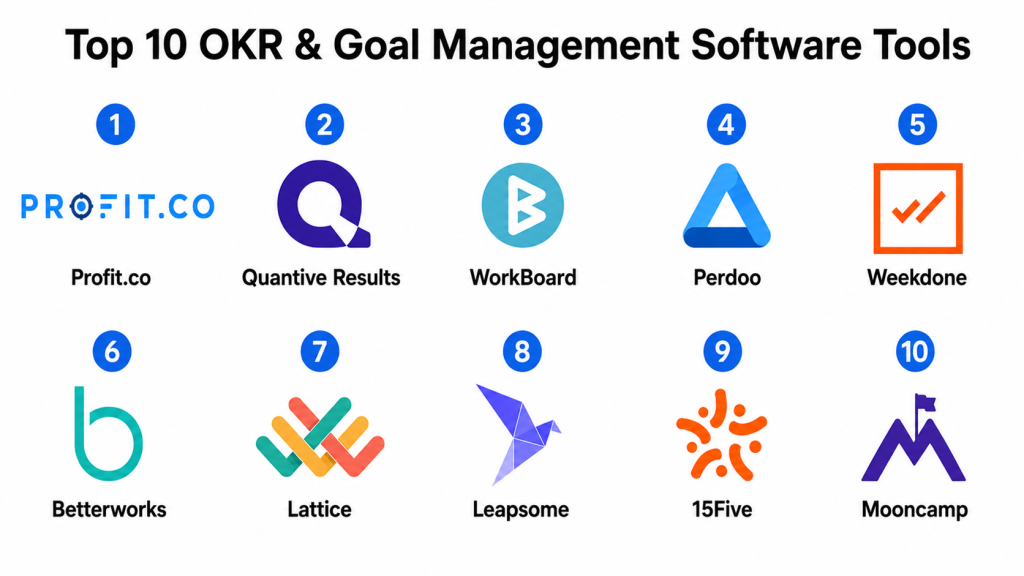
Top 10 OKR & Goal Management Software Tools
#1 — Profit.co
Short description: Profit.co is an OKR and performance management platform designed to help organizations define goals, track progress, align teams, and connect execution with performance. It is useful for companies that want a structured OKR system with dashboards, check-ins, and review workflows.
Key Features
- OKR creation and alignment
- Key result progress tracking
- Check-ins and confidence scoring
- Task and initiative linking
- Performance management support
- Dashboards and analytics
- Integrations with workplace tools
Pros
- Strong dedicated OKR functionality.
- Useful for companies that want structured goal alignment.
- Offers a balance of OKR tracking and performance workflows.
Cons
- May require training for teams new to OKRs.
- Full value depends on consistent check-ins and leadership discipline.
- Some organizations may find it more structured than they need.
Platforms / Deployment
Web / iOS / Android
Cloud
Security & Compliance
Supports common enterprise security expectations such as access controls, role-based permissions, and data protection features. Specific compliance details should be validated during procurement.
Integrations & Ecosystem
Profit.co integrates with common productivity, collaboration, HR, and project management tools. It is useful for connecting strategic goals with daily execution.
- Project management tools
- Collaboration platforms
- HR systems
- Productivity apps
- Reporting workflows
- API-based integrations
Support & Community
Profit.co provides documentation, customer support, onboarding resources, and OKR guidance. Support strength is useful for organizations that are still learning how to adopt OKRs properly.
#2 — Quantive Results
Short description: Quantive Results is a strategy execution and OKR platform built for organizations that want to connect goals, business outcomes, initiatives, and performance visibility. It is suitable for scaling companies and enterprises that need structured execution tracking.
Key Features
- OKR and goal management
- Strategic alignment dashboards
- Progress tracking and check-ins
- Initiative and project linking
- Business performance visibility
- Reporting and analytics
- Collaboration features for teams
Pros
- Strong focus on strategy execution.
- Useful for leadership teams managing complex priorities.
- Good fit for organizations that need visibility across teams and initiatives.
Cons
- May require planning and change management.
- Smaller teams may not need the full depth of features.
- Setup quality matters for successful adoption.
Platforms / Deployment
Web
Cloud
Security & Compliance
Supports common security expectations such as role-based access, data protection, and enterprise identity options. Specific compliance details should be confirmed with the vendor.
Integrations & Ecosystem
Quantive Results is designed to connect goals with execution systems and business workflows.
- Project management tools
- Collaboration platforms
- Business intelligence tools
- HR systems
- Productivity apps
- APIs and automation workflows
Support & Community
Quantive provides customer support, implementation guidance, product resources, and strategy execution content. It is suitable for teams that need both software and structured OKR adoption support.
#3 — WorkBoard
Short description: WorkBoard is an OKR and strategy execution platform focused on enterprise alignment, business reviews, outcome tracking, and leadership visibility. It is best suited for larger organizations that need structured operating rhythm and strategic execution governance.
Key Features
- OKR management
- Strategy execution dashboards
- Business review workflows
- Progress updates and check-ins
- Initiative tracking
- Executive reporting
- Alignment across departments
Pros
- Strong for enterprise strategy execution.
- Helpful for leadership teams managing complex goals.
- Supports structured business reviews and operating rhythms.
Cons
- May be too advanced for small teams.
- Requires leadership commitment for adoption.
- Implementation may need process design and training.
Platforms / Deployment
Web
Cloud
Security & Compliance
Supports enterprise security expectations such as access controls, user permissions, and data protection. Specific compliance details should be validated during vendor review.
Integrations & Ecosystem
WorkBoard connects OKRs with business execution workflows and enterprise systems.
- Collaboration tools
- Project management platforms
- Productivity systems
- HR tools
- Reporting and analytics workflows
- Enterprise integration options
Support & Community
WorkBoard provides enterprise support, onboarding resources, training, and strategy execution guidance. It is strongest for organizations that want structured OKR operating practices.
#4 — Perdoo
Short description: Perdoo is an OKR and strategy execution platform that helps companies connect goals, KPIs, initiatives, and strategy maps. It is useful for teams that want a clear visual link between strategic priorities and measurable outcomes.
Key Features
- OKR and KPI tracking
- Strategy maps
- Goal alignment views
- Initiative tracking
- Progress updates
- Reporting dashboards
- Team and company-level goal visibility
Pros
- Strong focus on connecting strategy with OKRs and KPIs.
- Helpful visual alignment features.
- Good fit for teams that want clarity between goals and execution.
Cons
- Teams new to OKRs may need guidance.
- Advanced customization needs should be validated.
- Adoption depends on regular updates from goal owners.
Platforms / Deployment
Web
Cloud
Security & Compliance
Supports common security controls such as access permissions and data protection. Specific compliance details are not publicly stated for every package and should be verified.
Integrations & Ecosystem
Perdoo integrates with common work tools to help teams connect OKRs with execution updates.
- Collaboration platforms
- Productivity tools
- HR systems
- Project management software
- Reporting tools
- Workflow integrations
Support & Community
Perdoo provides support, documentation, onboarding help, and OKR education resources. It is useful for companies that want practical guidance along with goal management software.
#5 — Weekdone
Short description: Weekdone is an OKR and weekly planning platform designed for teams that want simple goal tracking, weekly updates, progress visibility, and team status reporting. It is suitable for SMBs and growing teams adopting OKRs for the first time.
Key Features
- OKR tracking
- Weekly check-ins
- Progress reports
- Team dashboards
- Goal alignment views
- Feedback and status updates
- Simple reporting features
Pros
- Easy to understand and adopt.
- Good for teams starting with OKRs.
- Strong weekly check-in workflow.
Cons
- May not offer the same enterprise depth as larger platforms.
- Advanced analytics may be limited.
- Larger organizations may need deeper governance features.
Platforms / Deployment
Web / iOS / Android
Cloud
Security & Compliance
Supports common access and data protection features. Specific compliance details should be confirmed during procurement.
Integrations & Ecosystem
Weekdone connects with collaboration and productivity tools to support weekly goal updates and progress visibility.
- Collaboration tools
- Productivity apps
- Communication platforms
- Reporting workflows
- Team management tools
- Basic integration options
Support & Community
Weekdone provides documentation, support resources, onboarding materials, and OKR learning content. It is especially useful for teams that want a simple OKR starting point.
#6 — Betterworks
Short description: Betterworks is a performance enablement and goal management platform that helps organizations connect goals, conversations, feedback, and performance reviews. It is well suited for companies that want OKRs linked with continuous performance management.
Key Features
- Goal and OKR management
- Continuous performance conversations
- Feedback workflows
- Performance review support
- Check-ins and progress updates
- Manager dashboards
- Analytics and reporting
Pros
- Strong connection between goals and performance management.
- Useful for HR-led performance transformation.
- Good fit for mid-market and enterprise organizations.
Cons
- May be more HR-focused than pure OKR-only tools.
- Setup requires alignment between HR and business leaders.
- Some teams may need training to use it consistently.
Platforms / Deployment
Web
Cloud
Security & Compliance
Supports common enterprise security expectations such as role-based permissions, identity-related options, and data protection. Specific compliance details should be validated with the vendor.
Integrations & Ecosystem
Betterworks integrates with HR, productivity, and workplace tools to support goal and performance workflows.
- HRIS and HCM platforms
- Collaboration tools
- Productivity systems
- Performance management workflows
- Reporting dashboards
- Identity providers
Support & Community
Betterworks provides customer support, implementation services, documentation, and performance management guidance. It is strong for organizations connecting goals with employee performance conversations.
#7 — Lattice
Short description: Lattice is a people management platform that includes goals, performance reviews, engagement, feedback, and employee development. It is useful for companies that want goal management connected with broader people operations.
Key Features
- Goal and OKR tracking
- Performance reviews
- One-on-one meeting support
- Feedback and praise
- Employee engagement surveys
- Career development features
- People analytics dashboards
Pros
- Strong combination of goals, performance, and engagement.
- Good user experience for managers and employees.
- Helpful for HR teams building connected people processes.
Cons
- May not be as deep as dedicated OKR-only platforms for strategy execution.
- Best value comes when using multiple people management modules.
- Requires process discipline across managers and HR teams.
Platforms / Deployment
Web
Cloud
Security & Compliance
Supports common enterprise controls such as SSO, role-based access, and data protection features. Specific compliance details should be verified during vendor review.
Integrations & Ecosystem
Lattice connects with HRIS, collaboration, identity, productivity, and people operations tools.
- HRIS systems
- Collaboration platforms
- Identity providers
- Productivity tools
- Performance workflows
- Employee engagement systems
Support & Community
Lattice offers documentation, support resources, onboarding assistance, people strategy guidance, and a strong HR community. It is commonly used by people operations and HR teams.
#8 — Leapsome
Short description: Leapsome is a people enablement platform covering goals, OKRs, performance reviews, engagement surveys, feedback, learning, and employee development. It is suitable for organizations that want goal alignment tied to growth and performance.
Key Features
- Goals and OKRs
- Performance reviews
- Engagement surveys
- Continuous feedback
- Learning and development tools
- Competency frameworks
- People analytics
Pros
- Strong connection between goals, learning, and performance.
- Useful for companies building structured people development.
- Flexible modules for different HR maturity levels.
Cons
- May require configuration to avoid process complexity.
- Smaller teams may not need all features.
- Buyers should validate depth for pure OKR strategy execution.
Platforms / Deployment
Web
Cloud
Security & Compliance
Supports common security expectations such as access controls, role permissions, and data protection. Specific compliance details should be confirmed with the vendor.
Integrations & Ecosystem
Leapsome integrates with HR systems, collaboration platforms, identity providers, and workplace tools.
- HRIS platforms
- Collaboration tools
- Single sign-on providers
- Productivity tools
- Learning workflows
- Analytics systems
Support & Community
Leapsome provides support, documentation, onboarding guidance, and people enablement resources. It is popular with modern HR and people operations teams.
#9 — 15Five
Short description: 15Five is a performance management and employee engagement platform with goals, check-ins, feedback, recognition, and performance review features. It is useful for teams that want regular manager-employee conversations connected to goals.
Key Features
- Goal tracking
- Weekly check-ins
- Performance reviews
- Feedback and recognition
- Manager coaching workflows
- Engagement surveys
- Reporting dashboards
Pros
- Strong for continuous feedback and manager check-ins.
- Easy for employees and managers to use.
- Good fit for growing organizations with people-focused management.
Cons
- May not offer the same OKR depth as dedicated strategy execution tools.
- Requires manager participation to deliver value.
- Advanced enterprise goal governance may need validation.
Platforms / Deployment
Web / iOS / Android
Cloud
Security & Compliance
Supports common security controls such as user permissions, data protection, and identity-related options. Specific compliance details should be validated during procurement.
Integrations & Ecosystem
15Five integrates with HR, collaboration, identity, and productivity tools to support goal and performance workflows.
- HRIS platforms
- Collaboration tools
- Single sign-on providers
- Productivity systems
- Employee engagement workflows
- Reporting tools
Support & Community
15Five provides support, documentation, onboarding resources, manager enablement content, and customer success services. It has strong adoption among people teams focused on performance and engagement.
#10 — Mooncamp
Short description: Mooncamp is an OKR and strategy execution platform designed for flexible goal management, alignment, check-ins, and dashboards. It is useful for teams that want customizable OKR workflows without heavy enterprise complexity.
Key Features
- OKR and goal tracking
- Custom goal frameworks
- Check-ins and updates
- Alignment views
- Dashboards and reports
- Team and company goal visibility
- Integrations with workplace tools
Pros
- Flexible goal management experience.
- Good for companies that want customizable OKR workflows.
- Easier to adopt than some heavier enterprise platforms.
Cons
- May not have the same enterprise footprint as larger vendors.
- Buyers should validate advanced reporting and governance needs.
- Best results depend on clear internal OKR practices.
Platforms / Deployment
Web
Cloud
Security & Compliance
Supports common access controls and data protection features. Specific compliance details are not publicly stated for every package and should be verified.
Integrations & Ecosystem
Mooncamp integrates with collaboration, productivity, and workplace tools to help teams keep goals connected with daily work.
- Collaboration platforms
- Productivity tools
- Project management systems
- HR workflows
- Reporting tools
- Automation workflows
Support & Community
Mooncamp provides documentation, support resources, onboarding guidance, and OKR learning materials. It is a practical choice for teams looking for flexibility and ease of adoption.
Comparison Table
| Tool Name | Best For | Platform(s) Supported | Deployment | Standout Feature | Public Rating |
|---|---|---|---|---|---|
| Profit.co | Structured OKR and performance alignment | Web, iOS, Android | Cloud | OKR tracking with performance workflows | N/A |
| Quantive Results | Strategy execution and leadership visibility | Web | Cloud | Business goal alignment and execution dashboards | N/A |
| WorkBoard | Enterprise OKR operating rhythm | Web | Cloud | Strategy execution and business reviews | N/A |
| Perdoo | OKRs, KPIs, and strategy maps | Web | Cloud | Visual strategy-to-execution alignment | N/A |
| Weekdone | Simple OKR adoption and weekly check-ins | Web, iOS, Android | Cloud | Weekly planning and progress updates | N/A |
| Betterworks | Goals connected with performance management | Web | Cloud | Continuous performance and goal conversations | N/A |
| Lattice | People management with goals and performance | Web | Cloud | Goals, reviews, engagement, and feedback together | N/A |
| Leapsome | Goals, learning, and employee development | Web | Cloud | People enablement with OKRs and development tools | N/A |
| 15Five | Manager check-ins and goal conversations | Web, iOS, Android | Cloud | Weekly check-ins tied to performance | N/A |
| Mooncamp | Flexible OKR and goal workflows | Web | Cloud | Customizable goal management | N/A |
Evaluation & Scoring of OKR & Goal Management Software
| Tool Name | Core (25%) | Ease (15%) | Integrations (15%) | Security (10%) | Performance (10%) | Support (10%) | Value (15%) | Weighted Total (0–10) |
|---|---|---|---|---|---|---|---|---|
| Profit.co | 9.0 | 8.3 | 8.3 | 8.2 | 8.5 | 8.3 | 8.2 | 8.46 |
| Quantive Results | 9.0 | 8.0 | 8.6 | 8.5 | 8.7 | 8.4 | 7.8 | 8.45 |
| WorkBoard | 8.8 | 7.8 | 8.4 | 8.5 | 8.7 | 8.5 | 7.6 | 8.34 |
| Perdoo | 8.5 | 8.4 | 8.0 | 8.0 | 8.3 | 8.2 | 8.3 | 8.28 |
| Weekdone | 7.8 | 9.0 | 7.5 | 7.8 | 8.0 | 8.0 | 8.6 | 8.11 |
| Betterworks | 8.6 | 8.0 | 8.3 | 8.5 | 8.4 | 8.4 | 7.8 | 8.31 |
| Lattice | 8.2 | 8.6 | 8.4 | 8.3 | 8.4 | 8.4 | 8.0 | 8.32 |
| Leapsome | 8.3 | 8.4 | 8.2 | 8.2 | 8.3 | 8.2 | 8.1 | 8.25 |
| 15Five | 8.0 | 8.8 | 8.0 | 8.0 | 8.2 | 8.3 | 8.2 | 8.21 |
| Mooncamp | 8.2 | 8.7 | 7.8 | 7.8 | 8.2 | 8.0 | 8.4 | 8.17 |
These scores are comparative and should be used as a shortlisting guide. A higher score does not mean the tool is the best choice for every company. For example, WorkBoard may fit enterprise strategy execution, while Weekdone may be better for smaller teams starting with OKRs. Buyers should validate workflows, integrations, pricing, security, reporting needs, and employee adoption before making a final decision.
Which OKR & Goal Management Software Tool Is Right for You?
Solo / Freelancer
Solo professionals usually do not need a full OKR platform. A simple notes app, spreadsheet, task board, or project management tool may be enough to track personal goals and priorities.
If a freelancer manages client goals or small team objectives, Weekdone or Mooncamp can be practical starting points because they are easier to adopt than enterprise strategy platforms.
SMB
Small and medium businesses should focus on ease of use, simple OKR setup, check-ins, dashboards, and affordable pricing. Weekdone, Mooncamp, Perdoo, Profit.co, and 15Five can be good options depending on the company’s goal maturity.
If the business wants a dedicated OKR system, Profit.co or Perdoo may work well. If the company wants goal tracking with regular check-ins, 15Five or Weekdone may be more practical.
Mid-Market
Mid-market companies usually need stronger reporting, cross-team alignment, manager dashboards, HR integrations, and performance connections. Profit.co, Quantive Results, Betterworks, Lattice, Leapsome, and Perdoo are strong options.
If the company wants goals connected with performance management, Betterworks, Lattice, Leapsome, and 15Five are worth evaluating. If strategy execution is the priority, Quantive Results, Profit.co, and Perdoo may be stronger.
Enterprise
Enterprise organizations need scalability, governance, security, integrations, executive dashboards, and alignment across departments and business units. WorkBoard, Quantive Results, Betterworks, Profit.co, and Lattice are strong starting points.
WorkBoard is suitable for structured enterprise operating rhythms. Quantive Results is strong for strategy execution visibility. Betterworks is useful when goals need to connect with performance management.
Budget vs Premium
Budget-conscious teams should consider simpler goal platforms like Weekdone, Mooncamp, or selected packages from Perdoo and 15Five. These can provide enough structure without heavy implementation overhead.
Premium buyers should evaluate WorkBoard, Quantive Results, Betterworks, Profit.co, and Lattice if they need deeper reporting, enterprise controls, executive dashboards, and structured rollout support.
Feature Depth vs Ease of Use
Tools like WorkBoard, Quantive Results, Betterworks, and Profit.co provide deeper OKR and strategy execution functionality. However, they may require more training and process discipline.
Tools like Weekdone, Mooncamp, 15Five, and Perdoo may be easier for teams to adopt. The right choice depends on whether the organization needs simple goal tracking or full strategic execution management.
Integrations & Scalability
OKR software becomes more valuable when it connects with project management, HRIS, collaboration, productivity, analytics, and communication tools. This helps teams update progress without creating duplicate work.
Large companies should validate integrations before purchase. Smaller teams should focus on tools that connect with the systems they already use every day.
Security & Compliance Needs
Goal management software may include sensitive information about company strategy, team performance, business priorities, and leadership planning. Buyers should review role-based access, SSO, data protection, audit logs, privacy controls, and permission settings.
For larger organizations, HR, IT, security, and legal teams should be part of the evaluation process. Strong security is especially important when goals include confidential business plans or performance-related data.
Frequently Asked Questions
1. What is OKR & Goal Management Software?
OKR & Goal Management Software helps organizations create, align, track, and review objectives and key results. It gives teams a structured way to connect daily work with company priorities.
2. What is the difference between OKRs and KPIs?
OKRs define ambitious objectives and measurable key results. KPIs track ongoing performance metrics. Many companies use both: OKRs for strategic change and KPIs for business health monitoring.
3. Who should use OKR software?
OKR software is useful for executives, managers, HR teams, product teams, engineering teams, sales teams, and operations leaders. It is most valuable when multiple teams need alignment and visibility.
4. How much does OKR software cost?
Pricing varies by vendor, number of users, modules, support level, and company size. Some platforms offer simple per-user pricing, while enterprise tools often use custom pricing.
5. How long does OKR software implementation take?
Implementation depends on company size, goal maturity, integrations, training, and leadership involvement. Smaller teams can start quickly, while larger organizations may need a structured rollout plan.
6. What are common OKR implementation mistakes?
Common mistakes include creating too many goals, writing unclear key results, tracking tasks instead of outcomes, skipping check-ins, not training managers, and failing to connect goals with real business priorities.
7. Can OKR software integrate with project management tools?
Yes, many OKR platforms integrate with project management, collaboration, HR, and productivity tools. Integration helps teams connect strategic goals with daily execution.
8. Is OKR software useful for small businesses?
Yes, but small businesses should choose simple platforms that are easy to adopt. A lightweight OKR tool can help founders and teams stay focused without adding unnecessary process complexity.
9. Which OKR software is best for enterprises?
WorkBoard, Quantive Results, Betterworks, Profit.co, and Lattice are strong options for enterprise use cases. The best choice depends on strategy execution needs, HR integration, reporting depth, and security requirements.
10. Can OKR software improve employee performance?
It can help improve performance by clarifying priorities, creating ownership, improving feedback, and connecting work with outcomes. However, the software only works when leaders use it consistently and review progress regularly.
Conclusion
OKR & Goal Management Software helps organizations turn strategy into measurable action. The right platform can improve alignment, accountability, transparency, and execution across teams. However, the best tool depends on company size, goal maturity, budget, leadership style, integration needs, and whether the organization wants simple goal tracking or full strategy execution management.
