Upgrade & Secure Your Future with DevOps, SRE, DevSecOps, MLOps!
We spend hours scrolling social media and waste money on things we forget, but won’t spend 30 minutes a day earning certifications that can change our lives.
Master in DevOps, SRE, DevSecOps & MLOps by DevOps School!
Learn from Guru Rajesh Kumar and double your salary in just one year.
Introduction
In the current landscape of cloud-native engineering, the ability to manage costs is just as critical as the ability to manage code. The Certified FinOps Professional is a high-level credential designed for those who have moved beyond the basics of cloud spending and are looking to master the intersection of finance, engineering, and business. This guide is written for professionals navigating the complexities of DevOps, SRE, and Platform Engineering who need to bring fiscal accountability into their technical workflows. By pursuing this path at Finopsschool, engineers and managers can bridge the gap between high-scale infrastructure and bottom-line profitability. This article serves as a roadmap to help you determine if this certification aligns with your specific career trajectory and organizational needs.
What is the Certified FinOps Professional?
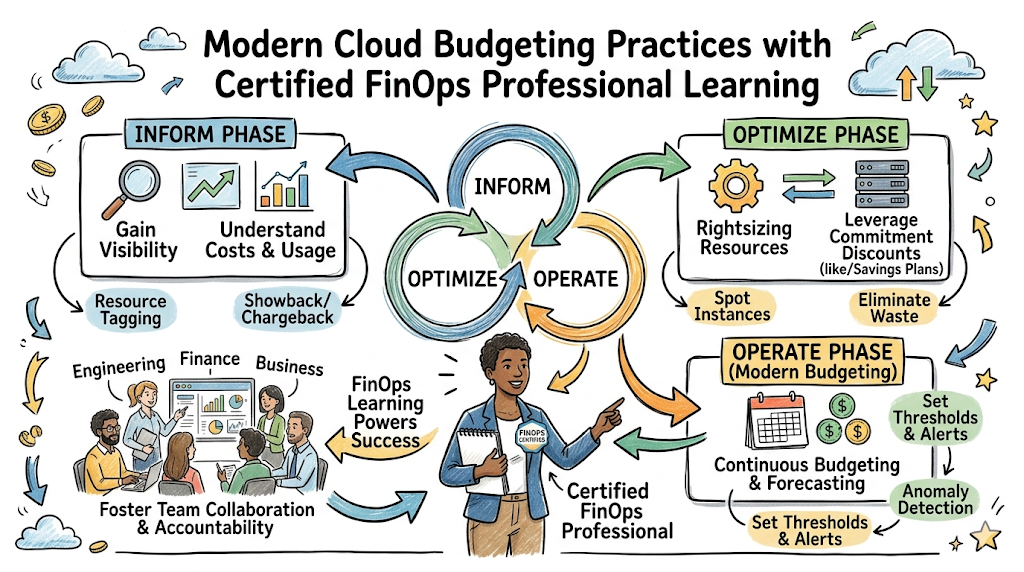
The Certified FinOps Professional represents the gold standard in cloud financial management, moving away from theoretical cost-cutting toward operational excellence. It exists because organizations have realized that lifting and shifting to the cloud often leads to unmanaged expenses that can cripple a business. This certification focuses on the Inform, Optimize, and Operate phases of the FinOps lifecycle within production-heavy environments. It aligns perfectly with modern engineering workflows by treating cost as a first-class metric, much like performance or security. For enterprises, having a certified professional means having someone who can translate complex cloud bills into actionable engineering shifts.
Who Should Pursue Certified FinOps Professional?
This certification is specifically built for cloud architects, SREs, and DevOps leads who find themselves responsible for large-scale infrastructure budgets. While beginners can learn the foundational concepts, the Professional level is geared toward those with hands-on experience in managing multi-cloud or hybrid environments. Engineering managers and technical leaders in India and globally will find it particularly useful for driving cultural change across their departments. It is also highly relevant for procurement and finance professionals who need to understand the technical nuances of auto-scaling, spot instances, and serverless pricing models. If you are tasked with proving the ROI of your cloud migration, this is the credential you need.
Why Certified FinOps Professional is Valuable and Beyond
The demand for FinOps expertise is skyrocketing as enterprises move past the initial cloud adoption phase into long-term cost sustainability. Earning this certification ensures longevity in your career because it focuses on universal principles of efficiency that remain relevant regardless of which cloud provider you use. As companies tighten their budgets, the engineers who can save millions through architectural optimization become indispensable assets. This is not just about using a tool; it is about building a culture where engineering teams take ownership of their spend. The return on time invested in this certification is realized through higher salary brackets and the ability to lead high-impact strategic initiatives.
Certified FinOps Professional Certification Overview
The program is delivered via the official certification portal and is hosted on FinOpsSchool. Unlike entry-level exams that focus on definitions, this assessment approach is practical and scenario-based, testing your ability to solve real-world financial friction. The certification levels are structured to move from foundational awareness to professional mastery and eventually specialized leadership roles. Ownership of the certification resides with the hosting site, ensuring that the curriculum is constantly updated to reflect the latest cloud pricing models and industry standards. The structure is designed to be rigorous, requiring candidates to demonstrate a deep understanding of unit economics and cloud billing data.
Certified FinOps Professional Certification Tracks & Levels
The certification path begins with the Foundation level, which establishes a common language for engineers and finance teams to communicate. The Professional level, which is our primary focus here, dives into the complexities of granular allocation, shared costs, and advanced forecasting. Advanced levels and specialization tracks allow practitioners to focus on specific domains like DevOps integration, SRE-driven automation, or executive-level FinOps governance. This progression aligns with a natural career move from an individual contributor to a strategic lead or a dedicated FinOps Principal. Each level builds upon the previous one, ensuring that the practitioner has a holistic view of the organization’s cloud financial health.
Complete Certified FinOps Professional Certification Table
| Track | Level | Who it’s for | Prerequisites | Skills Covered | Recommended Order |
| Core FinOps | Foundation | Junior Engineers | Basic Cloud Knowledge | Lifecycle, Personas | 1st |
| Professional | Advanced | Architects / Managers | FinOps Foundation | Unit Economics, Forecasting | 2nd |
| Engineering | Specialist | DevOps / SREs | Professional Level | Automation, Rightsizing | 3rd |
| Leadership | Executive | CTOs / Directors | Professional Level | Governance, Culture | 4th |
Detailed Guide for Each Certified FinOps Professional Certification
Certified FinOps Professional – Professional Level
What it is
This certification validates a professional’s ability to implement complex FinOps capabilities across a large organization. It proves you can handle advanced cost allocation, commitment-based discounts, and cultural transformation at scale.
Who should take it
It is designed for cloud architects, SREs, and senior managers with hands-on experience in cloud operations. This is for those who want to lead a FinOps practice or manage multi-million dollar cloud budgets effectively.
Skills you’ll gain
- Mastery of the FinOps Framework and its six domains.
- Ability to calculate and communicate Unit Economics for cloud services.
- Advanced techniques for Reserved Instance and Savings Plan management.
- Expertise in building automated cost-anomaly detection systems.
- Skills to negotiate with cloud vendors and drive organizational accountability.
Real-world projects you should be able to do
- Designing a tagging and labeling strategy for a multi-account organization.
- Implementing a showback/chargeback system for shared Kubernetes clusters.
- Creating a rolling 12-month cloud spend forecast with high accuracy.
- Building an automated workflow to terminate orphaned cloud resources.
Preparation plan
Explain 7–14 days, 30 days, and 60 days preparation strategies.
The 14-day plan involves a rapid review of the core framework and terminology. The 30-day plan adds deep dives into cloud billing data structures and case studies. The 60-day strategy includes hands-on dashboard building and participating in mock architectural reviews.
Common mistakes
- Focusing only on cost-cutting rather than value realization.
- Ignoring the cultural aspect of FinOps and focusing strictly on technical tools.
- Underestimating the complexity of shared cost allocation in containerized environments.
Best next certification after this
- Same-track option: Certified FinOps Expert
- Cross-track option: Certified SRE Professional
- Leadership option: Cloud Governance Leadership
Choose Your Learning Path
DevOps Path
The DevOps path focuses on integrating cost feedback loops directly into the CI/CD pipeline. Professionals in this track learn how to provide developers with real-time visibility into the cost impact of their code changes. By mastering FinOps, DevOps engineers can ensure that speed of delivery does not come at the expense of fiscal responsibility. This path emphasizes automation and the use of Infrastructure as Code to enforce cost-saving policies across all environments.
DevSecOps Path
In the DevSecOps path, the focus shifts to the Value of Security, where professionals balance the cost of security tools against the risk of breaches. FinOps knowledge helps these engineers justify the budget for security posture management and automated threat detection. It involves analyzing the spend of security-related logs and storage, ensuring that data retention policies are cost-effective. This track bridges the gap between risk management, security engineering, and financial efficiency.
SRE Path
Site Reliability Engineers use FinOps to define the Cost of Reliability. This involves understanding the financial impact of various Service Level Objectives and Error Budgets. An SRE with FinOps skills can determine when it is financially viable to increase redundancy or when the cost of high uptime exceeds the business value. This path is heavily focused on monitoring, observability, and using financial metrics as a signal for system health and stability.
AIOps Path
AIOps professionals leverage machine learning to automate the FinOps lifecycle, specifically in the areas of anomaly detection and forecasting. This path involves building models that can predict spend patterns and automatically adjust infrastructure to stay within budget. By applying AI to financial data, these engineers can move from reactive cost management to proactive, intelligent optimization. It requires a deep understanding of both data science and cloud billing APIs.
MLOps Path
The MLOps path addresses the high costs associated with training and deploying large machine learning models. FinOps-certified MLOps engineers focus on optimizing GPU utilization, managing expensive data egress fees, and rightsizing inference clusters. This path is critical for organizations scaling their AI initiatives, as model training costs can quickly spiral out of control without professional oversight. It emphasizes the Unit Cost per Prediction metric to ensure model profitability.
DataOps Path
DataOps focuses on the financial management of data pipelines, storage, and analytics platforms. FinOps professionals in this track learn how to optimize query performance to reduce costs and implement lifecycle policies for massive datasets. Given that data storage is often the fastest-growing part of a cloud bill, this path is essential for data architects and engineers. It involves balancing data accessibility with the cost of high-performance storage tiers for big data.
FinOps Path
The pure FinOps path is for those who want to specialize entirely in cloud financial management and governance. This involves leading the FinOps Center of Excellence and acting as the liaison between finance, procurement, and engineering. This path focuses on organizational change, high-level strategy, and vendor management across the enterprise. It is ideal for those moving into roles like FinOps Director or Cloud Business Manager.
Role → Recommended Certified FinOps Professional Certifications
| Role | Recommended Certifications |
| DevOps Engineer | FinOps Foundation, Professional Level |
| SRE | FinOps Professional, SRE Track |
| Platform Engineer | FinOps Professional, Core Track |
| Cloud Engineer | FinOps Foundation, Professional Level |
| Security Engineer | FinOps Foundation, DevSecOps Track |
| Data Engineer | FinOps Professional, DataOps Track |
| FinOps Practitioner | FinOps Foundation, Professional, Expert |
| Engineering Manager | FinOps Professional, Leadership Track |
Next Certifications to Take After Certified FinOps Professional
Same Track Progression
Once you have mastered the Professional level, the natural next step is to move toward the Expert or Specialist designations. These certifications often require proof of large-scale implementations and a deep dive into niche areas like multi-cloud billing integration. Specializing further allows you to become a consultant or a lead architect within the global FinOps community. This path ensures you remain at the cutting edge of cloud financial management as the industry evolves.
Cross-Track Expansion
Broadening your skills by moving into SRE or Platform Engineering certifications can make you a more versatile leader. Understanding the technical mechanics of infrastructure alongside the financial impact creates a powerful combination for any senior engineer. This expansion helps you understand the operational constraints that might prevent certain cost-saving measures from being implemented. It allows for a more holistic approach to cloud-native architecture where efficiency is built-in.
Leadership & Management Track
For those looking to move away from individual contributor roles, the Leadership track is the best option. This involves certifications in Engineering Management, Strategic Cloud Governance, or Executive Leadership. These credentials focus on the human and organizational side of FinOps—building teams, setting KPIs, and influencing C-suite decisions. It transitions your career from managing cloud resources to managing the people and processes that drive the business.
Training & Certification Support Providers for Certified FinOps Professional
DevOpsSchool
DevOpsSchool provides a comprehensive training environment that bridges the gap between traditional IT operations and modern cloud-native practices. Their curriculum is designed for working professionals who need to balance their learning with daily job responsibilities. They offer a mix of live instructor-led sessions and self-paced modules that focus heavily on the practical application of tools like Jenkins and Kubernetes. The platform is known for its extensive library of projects that simulate real-world production environments. For those looking to master the DevOps ecosystem, this provider offers a structured path toward seniority.
Cotocus
Cotocus specializes in high-end technical training for cloud architects and site reliability engineers. Their approach is centered on learning by doing, with a significant emphasis on lab-based assessments and real-world case studies. They provide tailored training programs for corporate teams looking to upskill in specific cloud domains, including FinOps and DevSecOps. The instructors are typically industry veterans who bring years of production experience to the classroom. Cotocus is a preferred partner for enterprises that require bespoke training solutions to solve specific infrastructure challenges.
Scmgalaxy
Scmgalaxy is a community-driven platform that has evolved into a major provider of technical training and resources. They focus on the entire Software Configuration Management and DevOps lifecycle, offering tutorials, certification guides, and community support. Their training modules are known for being highly detailed and technically rigorous, catering to engineers who want to understand the mechanics of their tools. The platform serves as a hub for professionals to share knowledge and stay updated on the latest industry trends. It is an excellent resource for those seeking a deep dive into automation.
BestDevOps
BestDevOps focuses on providing streamlined, efficient paths to certification for busy professionals. Their training materials are condensed to focus on the most critical concepts needed to pass professional exams and excel in the workplace. They offer a variety of bootcamps and intensive workshops designed to get engineers up to speed on new technologies in a short amount of time. The provider is particularly popular among those who are preparing for high-stakes professional certifications in the cloud and DevOps space. Their content is regularly updated to stay aligned.
Devsecopsschool.com
Devsecopsschool.com is dedicated to the integration of security into the modern DevOps workflow. They provide specialized training that teaches engineers how to automate security testing and compliance checks within their delivery pipelines. Their courses cover a wide range of topics, including container security, cloud security posture management, and secure coding practices. The goal is to empower engineers to take ownership of security without slowing down the development process. This provider is essential for any professional looking to move into a specialized DevSecOps role.
Sreschool.com
Sreschool.com offers focused training on the principles and practices of Site Reliability Engineering. Their curriculum covers essential SRE topics such as error budgets, service level objectives, and incident response management. The training is designed to help organizations transition from traditional operations to a more automated, reliability-focused approach. They emphasize the use of data and monitoring to drive engineering decisions and improve system uptime. Professionals who want to master the art of keeping high-scale systems running smoothly will find their programs invaluable.
Aiopsschool.com
Aiopsschool.com provides cutting-edge training on the application of artificial intelligence and machine learning to IT operations. Their courses teach engineers how to use AI tools for automated root cause analysis, anomaly detection, and predictive maintenance. This is a relatively new field, and this provider is at the forefront of defining the skills needed for the next generation of operations professionals. The training involves a blend of data science concepts and practical cloud operations, making it suitable for both engineers and data scientists.
Dataopsschool.com
Dataopsschool.com focuses on the operational side of data management and analytics. They provide training on how to build reliable, scalable data pipelines and how to manage the lifecycle of data within the cloud. Their curriculum includes topics such as data quality, orchestration, and the financial optimization of data storage and processing. This provider is crucial for data engineers and architects who need to ensure that their data platforms are both performant and cost-effective. They bridge the gap between traditional database management and modern operations.
Finopsschool.com is the primary destination for professionals seeking to master cloud financial management. They offer a comprehensive suite of certifications and training programs tailored to different roles and experience levels. Their curriculum is built on the FinOps Foundation framework but adds a layer of practical, real-world implementation guidance. The platform provides a wealth of resources, including case studies, templates, and community forums for practitioners to connect. It is the definitive source for anyone looking to build a career in FinOps.
Frequently Asked Questions (General)
- How difficult is the Certified FinOps Professional exam?
The exam is considered moderately difficult because it requires a mix of financial knowledge and technical cloud expertise. It is significantly more challenging than the Foundation level as it focuses on complex, multi-layered scenarios.
- What are the prerequisites for the Professional level?
You must hold a valid FinOps Foundation certification before you can attempt the Professional exam. Additionally, having a few years of hands-on cloud operations experience is highly recommended for success.
- How long is the certification valid?
The certification is typically valid for two years, after which you must recertify to show you are up to date with the latest cloud billing changes and industry standards.
- Is this certification recognized globally?
Yes, it is the industry standard for cloud financial management and is recognized by major enterprises, startups, and cloud providers worldwide.
- Can a finance professional take this certification?
Yes, but they will need to gain a solid understanding of cloud architecture and engineering workflows to pass the Professional level assessment.
- What is the ROI of getting FinOps certified?
Professionals with this certification often see significant salary increases and are eligible for high-level strategic roles that are currently in high demand.
- How much time is needed to prepare for the exam?
Most candidates spend between 30 and 60 days preparing, depending on their existing experience with cloud billing and financial management processes.
- Does the certification cover multiple cloud providers?
Yes, the principles taught are cloud-agnostic, though many practical examples use AWS, Azure, and Google Cloud billing structures and data.
- Are there hands-on labs in the training?
Most high-quality training providers include hands-on labs where you practice analyzing billing data and building functional cost dashboards.
- What is the format of the exam?
The exam usually consists of multiple-choice and scenario-based questions that test your ability to apply the FinOps framework to real-world business problems.
- Can I take the exam online?
Yes, the certification exams are typically offered through proctored online platforms, allowing you to take them from the comfort of your home or office.
- What happens if I fail the exam?
Most providers offer a retake policy, though there may be a waiting period and an additional fee involved depending on the specific track.
FAQs on Certified FinOps Professional
- What makes the Professional level different from the Foundation?
The Foundation level is about terminology and concepts, while the Professional level focuses on advanced implementation, deep analytics, and driving organizational change.
- Do I need to be a math expert to pass?
You do not need to be a mathematician, but you must be comfortable with data analysis, unit economics, and basic financial forecasting principles.
- Is it worth it for a DevOps engineer?
Absolutely, as it allows you to justify infrastructure changes with financial data, making your technical proposals much more likely to be approved.
- Does it cover Kubernetes cost management?
Yes, the Professional level dives into the complexities of container cost allocation, which is a major pain point for modern enterprises.
- Is the certification exam proctored?
Yes, to maintain high standards and integrity, the exam is proctored by an official representative or an automated monitoring system.
- Are there any hidden costs for the certification?
The main costs are the exam fee and any training courses you choose; there are typically no hidden fees for maintaining the credential during its validity.
- How does this certification help in a job interview?
It provides you with a unique set of skills that most engineers lack, allowing you to discuss business value and cost efficiency alongside technical performance.
- Can I skip the Foundation level?
No, the Foundation certification is a strict prerequisite for the Professional exam, ensuring all candidates have a baseline understanding of the framework.
Final Thoughts: Is Certified FinOps Professional Worth It?
From the perspective of a mentor who has seen the industry move from on-premise servers to serverless clusters, I can confidently say that FinOps is not a trend—it is a necessity. The days of unlimited cloud are over, and the era of efficient cloud has begun. If you are an engineer who wants to move into leadership, or a manager who wants to prove their strategic value, this certification is worth every hour of study. It provides you with a unique language that allows you to speak to the CTO and the CFO with equal authority. In an era where every dollar of cloud spend is under scrutiny, being the person who can optimize that spend is the best job security you can have. Focus on the value you create, and the career growth will follow naturally.
