Upgrade & Secure Your Future with DevOps, SRE, DevSecOps, MLOps!
We spend hours scrolling social media and waste money on things we forget, but won’t spend 30 minutes a day earning certifications that can change our lives.
Master in DevOps, SRE, DevSecOps & MLOps by DevOps School!
Learn from Guru Rajesh Kumar and double your salary in just one year.
Introduction
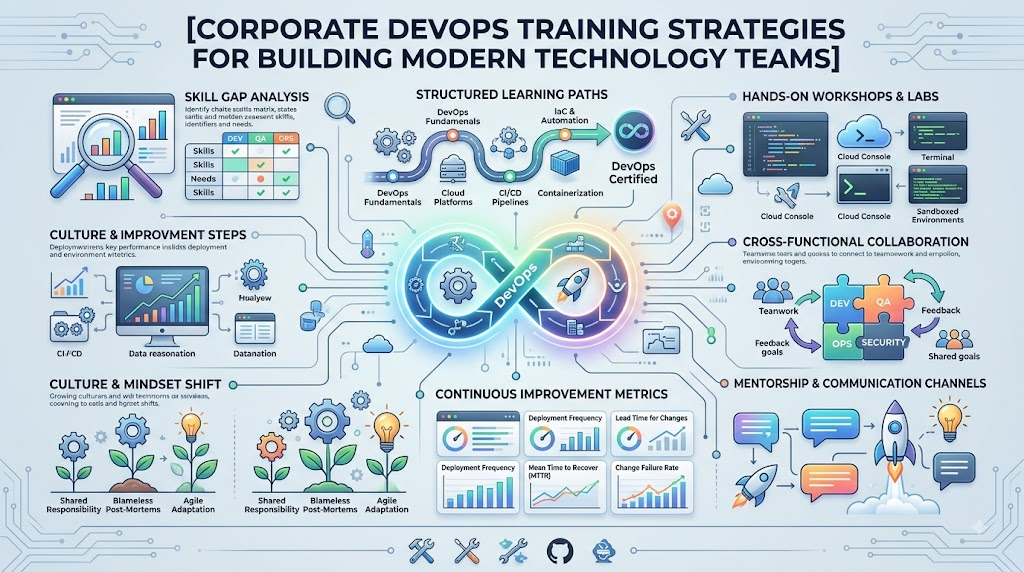
Modern software teams are expected to deliver applications faster while maintaining security, reliability, and operational efficiency. Cloud platforms, containers, Infrastructure as Code, CI/CD automation, Kubernetes, observability, and security practices have therefore become important parts of contemporary engineering environments. At the same time, technologies continue to change, creating a constant need for technical learning. For many organizations, the challenge is not simply adopting a new tool. Teams also need to understand how different technologies work together in an actual delivery process. A developer may need CI/CD knowledge, a system administrator may need cloud and automation skills, while an engineering manager may need a broader understanding of reliability and security practices. This is where structured DevOps training can be useful. A capable DevOps Trainer can combine concepts, demonstrations, exercises, troubleshooting scenarios, and practical workflows to help learners understand how DevOps practices operate beyond theory. For organizations, well-designed training can also support common learning goals across development, operations, cloud, security, and platform teams.
What Does a DevOps Trainer Do?
A DevOps Trainer teaches the principles, practices, tools, and workflows used to improve software delivery and IT operations. The role goes beyond presenting slides or explaining terminology.
Effective training may include CI/CD pipeline demonstrations, container exercises, cloud infrastructure examples, Infrastructure as Code, monitoring, automation, and deployment scenarios. Learners can also work through troubleshooting situations where a pipeline fails, a deployment behaves unexpectedly, or an application needs better observability.
The difference between theoretical and practical training is important. Theory helps learners understand concepts such as continuous integration or immutable infrastructure. Practical exercises help them understand what happens when those concepts are implemented.
A strong learning program should therefore connect explanations with activities. Depending on the audience, this may include building a pipeline, deploying an application, creating infrastructure through code, examining logs, or diagnosing a failed deployment.
Why DevOps Training Matters for Modern Engineering Teams
Technology teams often face skills gaps when they introduce new platforms or change established delivery processes. Moving workloads to the cloud, adopting containers, introducing automated deployments, or improving infrastructure management can require knowledge across several technical areas.
Structured training provides a way to organize that learning. Instead of asking every employee to independently study unrelated tools, an organization can establish a common foundation around automation, collaboration, cloud operations, security, and reliability.
Training is particularly useful when teams are adopting practices that require changes in daily engineering work. CI/CD, for example, is not simply a software product. It involves source control, testing, build processes, deployment strategies, environment management, monitoring, and rollback planning.
Training does not replace production experience. Real engineering environments contain constraints and unexpected problems that cannot all be reproduced in a classroom. However, structured learning can give professionals a stronger foundation from which to build that experience.
Corporate DevOps Training
Corporate DevOps Training is designed around the needs of a specific organization or team rather than a generic individual learner.
A development team may need more emphasis on CI/CD and application deployment, while an infrastructure group may require deeper coverage of Terraform, Kubernetes, cloud networking, and monitoring. A security team may instead focus on secure pipelines, vulnerability management, and secrets.
Customization can also consider the organization’s existing technology stack. For example, training can use scenarios involving the cloud platform, CI/CD system, container environment, or automation approach already used by the team.
Good corporate programs may combine instructor-led sessions, workshops, hands-on labs, assessments, troubleshooting exercises, and knowledge-transfer activities. This approach can make training more relevant because learners can connect concepts with situations they recognize from their own engineering environment.
A one-size-fits-all syllabus is not always appropriate for enterprise teams. Skill levels, responsibilities, technology choices, and business requirements can vary significantly even within the same organization.
Online DevOps Trainer
An Online DevOps Trainer provides instructor-led learning through virtual classrooms and remote environments. This model can be useful for distributed teams or professionals who cannot attend classroom sessions.
Online learning can include live demonstrations, screen sharing, interactive discussions, remote laboratories, assignments, recordings, and troubleshooting exercises. It also allows participants from different locations to attend the same program.
However, online training has limitations. Learners may experience connectivity problems, laboratory access issues, or reduced interaction if sessions are poorly designed. Simply converting classroom slides into an online meeting does not automatically create an effective virtual course.
The quality of the learning experience depends on instructor interaction, lab accessibility, session design, practical exercises, and learner participation. Organizations should evaluate these elements rather than choosing a program solely because it is delivered online.
How to Choose a DevOps Trainer in India
Organizations searching for a DevOps Trainer in India should evaluate both technical knowledge and teaching capability.
Real-world experience is useful because DevOps involves more than tool syntax. A trainer should ideally be comfortable discussing automation, cloud environments, CI/CD, containers, Infrastructure as Code, monitoring, troubleshooting, and production practices.
Teaching ability is equally important. A technically skilled professional may still struggle to explain complex concepts clearly. Good trainers adjust explanations according to the learner’s experience and provide examples that build understanding progressively.
A useful evaluation framework includes:
- Relevant DevOps and cloud experience
- Practical laboratory exercises
- CI/CD knowledge
- Kubernetes understanding
- Infrastructure as Code experience
- Security awareness
- SRE concepts
- Troubleshooting ability
- Clear communication
- Structured course design
- Relevant documentation and learning resources
It is also useful to review whether the trainer emphasizes problem-solving rather than simply demonstrating commands.
Kubernetes Trainer: What Should Kubernetes Training Cover?
A Kubernetes Trainer should help learners understand how containerized workloads are deployed, managed, scaled, secured, and monitored.
Training normally begins with core concepts such as pods, deployments, services, ConfigMaps, and Secrets. It can then move toward networking, storage, scaling, Helm, monitoring, security, cluster administration, and troubleshooting.
Practical exercises are particularly valuable. Learners should have opportunities to deploy workloads, inspect resources, troubleshoot failures, modify configurations, and understand how Kubernetes responds to changing workloads.
Cloud-managed Kubernetes services such as Amazon EKS, Azure AKS, and Google GKE can also be discussed where relevant. The goal should not simply be memorizing commands but understanding how Kubernetes fits into a broader application delivery and operations workflow.
Production-oriented learning should also address topics such as resource management, access control, observability, upgrades, resilience, and operational troubleshooting.
AWS DevOps Trainer
An AWS DevOps Trainer should connect cloud services with broader DevOps workflows rather than teaching individual services in isolation.
Depending on organizational requirements, training may cover EC2, EKS, ECS, Lambda, Terraform, CloudFormation, CI/CD pipelines, monitoring, and infrastructure automation.
For example, learners can explore how application code moves from source control through automated testing and deployment into an AWS environment. They can also learn how Infrastructure as Code supports repeatable infrastructure changes.
The appropriate AWS architecture depends on workload characteristics, operational requirements, team skills, security considerations, and cost constraints. Training should therefore explain trade-offs rather than presenting one service as the universal solution.
Azure DevOps Trainer
An Azure DevOps Trainer can help teams understand how development and operations practices work within Microsoft Azure environments.
Training may include Azure Pipelines, AKS, Azure infrastructure, Infrastructure as Code, release automation, CI/CD, monitoring, and deployment workflows.
Hands-on learning can demonstrate how source code, automated testing, infrastructure, deployment processes, and operational monitoring connect together. Learners can also examine common deployment problems and understand how pipeline configuration affects delivery.
As with other cloud environments, practical Azure training should focus on principles as well as platform-specific implementation. This helps learners transfer their knowledge to changing project requirements.
DevSecOps Trainer
Security should not be treated as a final checkpoint after software has already been developed. A DevSecOps Trainer helps teams understand how security activities can become part of the software delivery lifecycle.
Training may cover SAST, DAST, dependency scanning, container security, secrets management, vulnerability management, and security automation. Compliance automation can also be introduced where organizational requirements demand it.
The practical objective is to help teams identify security issues earlier and understand how automated controls can be incorporated into development and deployment workflows.
DevSecOps learning should also address operational realities. Security tools produce findings that need interpretation, prioritization, remediation, and follow-up. Simply adding scanners to a pipeline does not automatically create an effective security process.
SRE Trainer
An SRE Trainer teaches reliability as an engineering discipline. Instead of focusing only on whether an application is available, SRE learning examines measurable reliability objectives and operational practices.
Important concepts include SLI, SLO, SLA, error budgets, observability, incident management, root-cause analysis, capacity planning, and performance engineering.
Learners should understand how metrics can help teams make reliability decisions. They can also study how incident response, automation, and post-incident analysis contribute to continuous improvement.
SRE training is especially useful when teams need to move from reactive operations toward more measurable and systematic reliability practices.
MLOps Trainer
As machine-learning systems move into production, engineering teams increasingly need operational practices for models, data pipelines, infrastructure, and monitoring.
An MLOps Trainer can cover ML pipelines, model deployment, version management, model monitoring, automation, cloud infrastructure, scalability, and production operations.
The learning challenge is different from traditional application deployment because models can change as data and training processes evolve. Teams therefore need ways to manage versions, deployments, monitoring, and operational dependencies.
MLOps training can help connect machine-learning development with established DevOps and production engineering practices.
DevOps Training Technology Areas
| Training Area | Common Technologies / Practices | Learning Focus |
|---|---|---|
| CI/CD | Jenkins, GitHub Actions, GitLab CI/CD, Azure Pipelines | Automated delivery |
| Cloud | AWS, Azure, Google Cloud | Cloud operations |
| Containers | Docker, Kubernetes | Containerized workloads |
| Infrastructure as Code | Terraform, CloudFormation | Automated infrastructure |
| Security | SAST, DAST, secrets management | Secure delivery |
| Monitoring | Metrics, logs, traces | Observability |
| SRE | SLI, SLO, error budgets | Reliability |
| MLOps | ML pipelines, model monitoring | Production ML |
These technologies represent common learning areas, not an exhaustive list. The appropriate curriculum depends on the team’s environment and objectives.
Benefits of Practical DevOps Training
Hands-on training can provide several learning benefits:
- Better understanding of end-to-end DevOps workflows
- Stronger automation knowledge
- Greater familiarity with cloud environments
- Better understanding of CI/CD practices
- Improved troubleshooting skills
- Stronger Infrastructure as Code awareness
- Better security understanding
- Improved reliability knowledge
- More practical collaboration between development and operations roles
The value comes from applying concepts, not simply completing lessons. Exercises that require learners to build, test, troubleshoot, and improve systems can reveal gaps that theoretical study may not expose.
Common DevOps Training Mistakes
1. Focusing only on theory: Concepts are important, but learners need practical opportunities to apply them.
2. Teaching too many tools: A long tool list can create confusion when learners do not understand why each technology is used.
3. Ignoring hands-on labs: DevOps skills require practice with pipelines, infrastructure, containers, and operational scenarios.
4. Using outdated examples: Training should reflect current engineering practices and realistic environments.
5. Ignoring learner skill levels: Beginners and experienced engineers may require very different explanations and exercises.
6. Ignoring cloud environments: Modern DevOps workflows frequently interact with cloud infrastructure.
7. Ignoring security: Security should be considered throughout delivery and operations.
8. Skipping troubleshooting: Production work involves diagnosing failures, not only creating successful deployments.
9. Avoiding real-world scenarios: Practical situations help learners understand trade-offs and operational constraints.
10. Overloading learners: Training should prioritize relevant skills instead of attempting to cover every available technology.
How to Evaluate a DevOps Training Program
Before selecting a program, organizations can review the following areas:
- Trainer’s practical experience
- Technical depth
- Course structure
- Quality of hands-on labs
- Cloud coverage
- Kubernetes coverage
- CI/CD practices
- Infrastructure as Code
- Security concepts
- SRE principles
- MLOps awareness
- Troubleshooting scenarios
- Documentation
- Assessments
- Learning resources
- Post-training support
A useful evaluation also considers whether the course matches the team’s actual responsibilities. A platform engineering group may need deeper Kubernetes and Infrastructure as Code content, while application developers may need greater emphasis on CI/CD and deployment practices.
Training Area and Learning Need
| Training Area | Typical Learning Need |
| DevOps Training | Understand automation and delivery practices |
| Corporate DevOps Training | Build team-wide DevOps capabilities |
| Online DevOps Training | Learn remotely with flexible access |
| Kubernetes Training | Manage container orchestration environments |
| AWS DevOps Training | Learn AWS-based DevOps workflows |
| Azure DevOps Training | Understand Azure delivery and automation |
| DevSecOps Training | Integrate security into software delivery |
| SRE Training | Learn reliability engineering practices |
| MLOps Training | Operate machine-learning systems in production |
Frequently Asked Questions
1. What does a DevOps Trainer teach?
A DevOps Trainer typically teaches DevOps principles, CI/CD, automation, cloud platforms, containers, Infrastructure as Code, monitoring, troubleshooting, and production practices through a combination of theory and practical exercises.
2. What is Corporate DevOps Training?
Corporate DevOps Training is structured learning designed for an organization’s teams. It can be customized around existing technologies, employee skill levels, business requirements, and specific transformation objectives.
3. How do I choose a DevOps Trainer in India?
Evaluate practical experience, teaching ability, technical coverage, laboratory quality, communication skills, course structure, and familiarity with cloud, Kubernetes, automation, security, and reliability practices.
4. Is an Online DevOps Trainer suitable for corporate teams?
Online training can work well for distributed teams when sessions include live interaction, demonstrations, accessible labs, exercises, and opportunities for questions. The format should match the team’s learning needs.
5. What should Kubernetes training include?
A practical course can include Kubernetes architecture, pods, deployments, services, networking, storage, security, Helm, monitoring, scaling, cluster administration, and troubleshooting.
6. What does an AWS DevOps Trainer teach?
AWS-focused DevOps training may cover EC2, EKS, ECS, Lambda, CI/CD, Terraform, CloudFormation, monitoring, automation, and cloud deployment practices.
7. Why is DevSecOps training important?
DevSecOps training helps teams understand how security practices such as code scanning, dependency checks, secrets management, container security, and vulnerability management can be integrated into delivery workflows.
8. What is the difference between DevOps, SRE, and MLOps training?
DevOps training generally focuses on delivery and operational collaboration, SRE emphasizes reliability engineering and measurable service objectives, while MLOps focuses on operating machine-learning systems and their associated pipelines and models.
Conclusion
DevOps learning is no longer limited to understanding a few automation tools. Modern engineering teams may need knowledge spanning CI/CD, cloud platforms, containers, Infrastructure as Code, security, observability, reliability, and machine-learning operations. The most suitable training approach depends on learner experience, business requirements, technology choices, team maturity, and practical objectives. Individual professionals may benefit from flexible learning, while enterprise teams may require customized workshops and hands-on exercises based on their existing environments.
