Upgrade & Secure Your Future with DevOps, SRE, DevSecOps, MLOps!
We spend hours scrolling social media and waste money on things we forget, but won’t spend 30 minutes a day earning certifications that can change our lives.
Master in DevOps, SRE, DevSecOps & MLOps by DevOps School!
Learn from Guru Rajesh Kumar and double your salary in just one year.
Introduction
Every engineering team eventually faces the same uncomfortable question: is this system actually ready for production, or does it just seem ready because nothing has broken yet? The gap between perceived readiness and operational reality is where outages, incidents, and costly surprises live.
A production readiness assessment is the structured process of closing that gap. It is not a one-time checkbox exercise, nor a compliance certificate. It is an evidence-based evaluation of whether a workload, service, or entire engineering organization has the controls, practices, and operational discipline required to run reliably in production.
This guide explains what production readiness assessment means, how it connects to broader engineering maturity disciplines like DevOps, SRE, platform engineering, and DevSecOps, and how teams can use structured assessments to identify gaps and build actionable improvement roadmaps. It is written for engineers who need practical implementation guidance, for managers who need to understand organizational readiness, and for beginners who need a clear foundation.
What Is a Production Readiness Assessment?
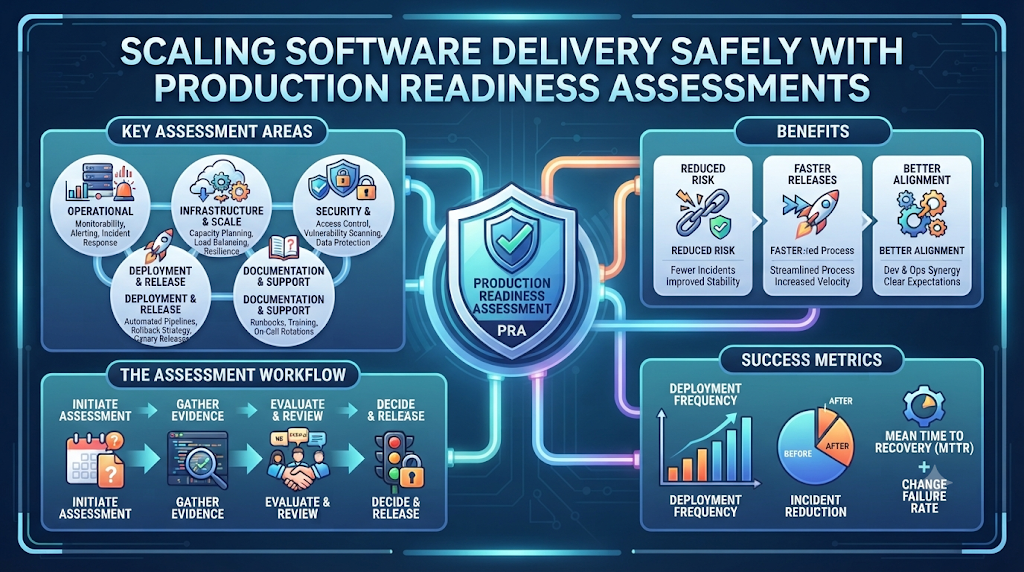
A production readiness assessment evaluates whether a system and the team behind it are prepared for the operational demands of production. It examines controls across reliability, security, deployment safety, observability, disaster recovery, data protection, operability, performance, capacity, release safety, and cost governance .
The key word is evidence. A mature assessment does not ask “do you have runbooks?” and accept a yes. It asks what the runbook contains, when it was last tested, and whether the person on call can follow it at 3 a.m. without asking for help.
Why It Matters
Production readiness matters because the cost of discovering an operational gap during an incident is orders of magnitude higher than discovering it during a review. A missing backup restoration procedure is a document gap during assessment and a data loss event during production. A liveness probe pointed at a database dependency is a configuration detail during review and a cascading restart storm during a dependency blip .
The assessment process surfaces these gaps while they are still decisions you can make deliberately rather than emergencies you must survive.
Assessment vs. Audit vs. Certification
A production readiness assessment is not an independent audit. It does not certify compliance with regulatory standards. It is a structured self-evaluation, often supported by published scoring methodologies, that helps teams understand their current state and prioritize improvements . The distinction matters: self-reported maturity reflects what a team believes about its practices, while verified operational performance reflects what actually happens in production. Assessments are a starting point for improvement, not a substitute for independent verification.
The Core Disciplines Behind Readiness
Production readiness does not exist in isolation. It draws from several interconnected engineering operations disciplines.
DevOps and DevOps Maturity Assessment
DevOps is the cultural and technical model that unifies software development and operations. A DevOps maturity assessment evaluates how well an organization has implemented practices like continuous integration, continuous delivery, infrastructure as code, and collaborative ownership . High DevOps maturity correlates with faster, safer deployments—but it does not guarantee production readiness on its own. A team can deploy rapidly and still lack backup restoration procedures or incident response discipline.
Site Reliability Engineering (SRE)
SRE applies software engineering principles to operations. Its central tools—service level indicators (SLIs), service level objectives (SLOs), and error budgets—provide the measurable contract between reliability and feature velocity . An SRE adoption roadmap typically begins with establishing honest SLOs based on current performance, not aspirational targets. Setting an SLO at 99.99% when the service currently achieves 99.5% guarantees the error budget is always burned and the policy never meaningfully engages .
Platform Engineering
Platform engineering treats the internal developer platform as a product. Its goal is to provide golden paths—templated, supported routes from “new service” to “running in production with pipelines, telemetry, and SLOs wired”—that make the right architecture the default . A platform engineering adoption roadmap should begin with evidence: measuring baseline time-to-first-deploy, interviewing the teams who will use the platform, and building only what addresses their actual friction . Internal platforms that nobody asked for die the same death as external products nobody wanted.
DevSecOps
Security cannot be a gate at the end of the pipeline. A DevSecOps implementation roadmap embeds security controls into the development workflow: secret scanning on every push, dependency scanning with build-breaking gates for critical vulnerabilities, container image minimization, and severity-based remediation SLAs agreed before a crisis forces the conversation .
Kubernetes Production Readiness Checklist Essentials
Kubernetes introduces specific, well-understood failure modes. A Kubernetes production readiness checklist addresses the controls that prevent the most common causes of production incidents .
The Required Controls
Every production workload on Kubernetes should satisfy these baseline requirements:
Resource requests and limits are set. Without requests, the scheduler places pods blindly. Without limits, one leaking container can take down an entire node .
Liveness and readiness probes test different things. Readiness removes a pod from service rotation when it cannot serve traffic. Liveness restarts it when it cannot recover. Mixing them up—pointing liveness at a database dependency, for example—turns a dependency blip into a restart cascade across every replica .
PodDisruptionBudgets protect availability during voluntary disruptions. A node drain without a PDB can take every replica offline simultaneously. The PDB ensures maintenance waits for the workload to remain available .
Multiple replicas run across different nodes. A single-replica deployment makes every node maintenance event a user-visible outage. Anti-affinity or topology spread constraints make “two replicas” actually mean two failure domains .
Secrets come from a secret manager, not base64 in Git. Base64 is encoding, not encryption, and Git history is permanent .
Stateful workloads have a tested storage, backup, and restore story. Kubernetes will reschedule your pod to another node. Whether your data follows is a decision made during assessment, not during the incident .
Beyond the Checklist
A checklist is most useful when you know which controls you are actually missing. Self-reported checklists document intended practice. A structured assessment scores controls against evidence and produces prioritized findings .
Troubleshooting Kubernetes CrashLoopBackOff
A Kubernetes CrashLoopBackOff troubleshooting process begins with preserving evidence, not restarting the pod. The lastState.terminated field holds the exit code and reason from the previous container instance. Deleting the pod destroys that evidence .
Diagnostic Sequence
First, check the exit code. Exit code 1 with an application error in previous logs points to a configuration or dependency problem. Exit code 137 with reason OOMKilled means the container exceeded its memory limit. Exit code 137 without OOMKilled often indicates a liveness probe killing a slow-starting container. Exit codes 126 or 127 suggest an entrypoint or binary problem .
Second, read the previous container’s logs. The current container usually has nothing useful because it crashed before logging anything. Use kubectl logs --previous to see what the container said before it died .
Third, check what changed. A recent rollout, a ConfigMap edit, a secret rotation, or a node migration can all trigger a crash loop that has nothing to do with the application code itself.
Remediation by Cause
For configuration errors: fix the ConfigMap or Secret and restart deliberately after capturing evidence. For OOMKilled: raise the memory limit based on observed usage, and investigate for a leak if usage continues to climb. For probe-induced restarts: add a StartupProbe or adjust the liveness failure threshold—never “fix” the problem by deleting the liveness probe entirely .
Building the Improvement Roadmap
An assessment produces findings. A roadmap converts findings into sequenced, executable work.
Prioritization Logic
Not every gap deserves immediate attention. A practical prioritization model considers impact (what happens if this control fails), likelihood (how often the conditions for failure occur), effort (how much work the fix requires), and dependencies (what must exist before this improvement can succeed) .
Critical controls—backup restoration, secret management, access control—override other priorities when missing. A team with excellent observability but no tested backup restoration has a more urgent problem than a team with basic dashboards and working backups.
Sequencing Improvements
Roadmaps should respect technical dependencies. Setting up error-budget alerts before defining SLOs produces noise. Building a platform golden path before interviewing users produces a portal nobody adopts . Establishing a monthly patch cadence before agreeing on severity-based SLAs means the cadence has no targets to hit .
The most effective roadmaps begin with measurement, establish foundational controls, and then layer sophistication. A team new to SRE should set an SLO at current reality before attempting multi-window burn-rate alerting . A team new to incident management should define the Incident Commander role and severity scale before running game days .
Connecting Assessment to Broader Maturity Models
Incident Management Maturity Model
An incident management maturity model describes the progression from improvised response to a rehearsed operational loop. Early stages feature unclear roles and ad-hoc communication. Mature stages feature a defined Incident Commander with decision authority, scheduled status updates during incidents, quarterly game days that rehearse the process, and blameless postmortems whose action items actually close .
The critical insight from mature incident practice: a policy that has never been exercised is untested code. The first real error-budget freeze should not be the first time anyone discovers who grants exceptions .
Observability Maturity Model
An observability maturity model measures whether telemetry is actually used to answer operational questions, not just collected. Early stages have metrics and logs in separate silos. Mature stages have end-to-end traces that follow a request across service boundaries, structured logs queryable by trace ID, and alerts based on user-facing symptoms rather than infrastructure thresholds .
The distinction between monitoring and observability is practical: monitoring tells you that something is wrong. Observability lets you ask why without deploying new code.
Cloud Cost Optimization Roadmap
A cloud cost optimization roadmap begins with visibility. Tagging standards, enforced at resource creation time, make spend attributable to teams and services. Monthly showback reports create feedback loops that change behavior without mandates . Daily anomaly alerts catch runaway resources within hours rather than at month-end. Scheduled sweeps remove the idle volumes, orphaned snapshots, and forgotten environments that accumulate silently .
Cost optimization is not a one-time project. It is an operational discipline with the same cadence requirements as patching or incident review.
Common Mistakes in Readiness and Maturity Work
Treating a maturity score as proof of reliability. A high DevOps maturity score does not mean the service is production-ready. It means the team has implemented certain practices. Actual reliability is measured by production behavior, not assessment answers.
Adopting tools without defining processes. A Kubernetes cluster without resource governance is not more mature than virtual machines. A observability platform without alert discipline produces dashboards nobody trusts.
Building platforms before understanding users. The platform graveyard is full of portals built from the platform team’s wishlist rather than the product teams’ friction .
Skipping the baseline. Without measuring current time-to-first-deploy, incident MTTR, or cloud spend attribution before improvement work begins, the value of that work is a vibe, and vibes do not survive budget reviews.
Assuming every organization needs the same target maturity. A small team with a single service does not need the same incident management structure as a multi-team organization with tier-1 customer-facing systems. Maturity targets should reflect business risk, team size, and operational complexity.
How OpsRoadmaps Supports Readiness Improvement
OpsRoadmaps is an engineering operations assessment and improvement platform. Its assessments score operational controls with published, versioned methodologies rather than opaque or AI-generated scores .
Relevant Assessment Resources
The Operational Health Quick Scan provides a 12-question directional assessment for founders and solo engineers who need a fast read on fundamentals . The Production Readiness Review is a 36-question STANDARD-depth assessment across reliability, security, deployment, observability, disaster recovery, data protection, operability, performance, capacity, release safety, and cost governance. It produces capability-level scores, findings, and a prioritized roadmap .
For teams that already have basics in place, the Reliability & Incident Operations Review focuses on SLO discipline, incident response, and change safety . The Production Readiness Deep Audit provides an 18-question evidence-based operating review for platform and organizational teams running quarterly reviews .
Improvement Roadmaps
OpsRoadmaps publishes executable improvement roadmaps with steps that include prerequisites, implementation guidance, validation criteria, and common failure modes. Relevant roadmaps include:
- Platform Engineering Adoption: from baseline measurement through golden path construction and self-service adoption .
- SRE Adoption: from honest SLOs through error-budget policy and burn-rate alerting .
- Incident Management Maturity: from Incident Commander role definition through game days and blameless postmortems .
- DevSecOps Rollout: from secret scanning through dependency gates and remediation SLAs .
- Observability Maturity: from trace propagation through symptom-based alerting .
- Cloud Cost Optimization: from tagging standards through showback and anomaly detection .
Technical Runbooks
For teams actively troubleshooting production issues, OpsRoadmaps provides runbooks including Kubernetes CrashLoopBackOff and Kubernetes OOMKilled with diagnostic commands, decision trees, and prevention guidance .
Frequently Asked Questions
What is a production readiness assessment?
It is a structured evaluation of whether a system and team have the operational controls—reliability, security, observability, backup restoration, incident response—required to run safely in production. It produces findings and priorities, not a certification.
How is DevOps maturity measured?
Through assessment of practices across deployment automation, testing, infrastructure as code, monitoring, and collaboration. Maturity levels reflect defined criteria, not arbitrary scores, and should be interpreted alongside actual production performance.
What should a Kubernetes production readiness checklist include?
At minimum: resource requests and limits, distinct liveness and readiness probes, PodDisruptionBudgets, multiple replicas across nodes, pinned image digests, external secret management, and a tested backup and restore procedure for stateful workloads .
How do organizations adopt platform engineering?
Start by measuring baseline time-to-first-deploy and interviewing the teams who will use the platform. Build the thinnest golden path for the worst friction point, make it self-service, and add journeys only when the first has adopters who did not have to be asked .
What is the difference between DevOps and SRE?
DevOps is a cultural and organizational model for unifying development and operations. SRE is a specific implementation of that model using software engineering practices, with SLOs and error budgets as its central reliability tools .
How does an incident management maturity model work?
It describes progression from improvised response to rehearsed process: defined roles, severity scales, communication cadences, game days, and postmortems with tracked action items. Maturity is demonstrated by practice, not documentation .
What should a DevSecOps implementation roadmap include?
Secret scanning on every push, dependency scanning with build gates for critical vulnerabilities, container image minimization, severity-based remediation SLAs with named owners, and a monthly patch cadence .
How can organizations evaluate observability maturity?
By testing whether telemetry answers operational questions: can you trace a request across service boundaries? Can you query logs by trace ID? Do alerts fire on user-facing symptoms or infrastructure thresholds?
What are the main principles of cloud cost optimization?
Visibility first (tagging enforced at creation), showback to create feedback loops, daily anomaly detection, and scheduled waste removal. Cost discipline is operational hygiene, not a one-time project .
How can engineers troubleshoot Kubernetes CrashLoopBackOff?
Preserve evidence first: check the previous container’s exit code and logs before deleting anything. Exit code 1 suggests configuration or dependency issues; 137 with OOMKilled suggests memory limits; 137 without OOMKilled suggests probe problems .
Conclusion
Production readiness is not a destination. It is an ongoing practice of measuring current state, identifying gaps before they become incidents, and improving deliberately.
The assessment itself is valuable only if it leads to action. A score without a roadmap is trivia. A checklist without evidence is wishful thinking. The most effective teams treat readiness as a continuous discipline: assess, prioritize, implement, measure, reassess.
Whether you are preparing a single workload for its first production traffic, evaluating Kubernetes controls across an estate, or building an organizational improvement roadmap across DevOps, SRE, platform engineering, and security, the starting point is the same: understand what you have, decide what matters most, and begin with the improvement that closes the most consequential gap.
OpsRoadmaps assessments and roadmaps are designed to support that process with structured, evidence-oriented guidance. The work of operational excellence belongs to the team, but the structure of where to start and what to do next can be made clearer.
