Upgrade & Secure Your Future with DevOps, SRE, DevSecOps, MLOps!
We spend hours scrolling social media and waste money on things we forget, but won’t spend 30 minutes a day earning certifications that can change our lives.
Master in DevOps, SRE, DevSecOps & MLOps by DevOps School!
Learn from Guru Rajesh Kumar and double your salary in just one year.
Introduction
The Certified FinOps Manager is a professional designation designed to bridge the gap between finance, engineering, and business leadership. This guide is written for cloud architects, finance professionals, and engineering managers who need to master the art of cloud financial management. As cloud environments become more complex, the ability to manage variable spending while maintaining high performance is no longer optional.
For professionals in the DevOps, cloud-native, and platform engineering spaces, this certification serves as a strategic career pivot. It moves the conversation from purely technical uptime to business value and unit economics. This guide provides a clear roadmap on how to navigate the FinOpsSchool curriculum to achieve mastery in this domain. By following this path, you can transition from being a technical implementer to a strategic business leader.
Understanding cloud economics is critical in the current market where organizations are scrutinizing every dollar spent on infrastructure. This certification ensures you have the skills to implement governance, drive accountability, and optimize costs without sacrificing innovation. Whether you are managing a small startup or a massive enterprise footprint, the principles covered here are universally applicable and highly valued.
What is the Certified FinOps Manager?
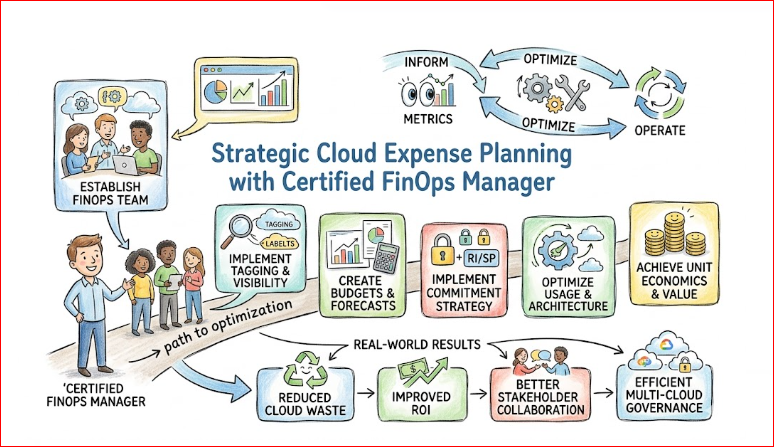
The Certified FinOps Manager represents a high-level mastery of the FinOps framework and its practical application in complex enterprise environments. It exists to provide a standardized approach to cloud financial management, ensuring that teams can speak a common language across departments. Rather than focusing solely on theoretical models, this certification emphasizes the “Inform, Optimize, and Operate” phases through a production-focused lens.
This program aligns with modern engineering workflows by integrating financial accountability into the development lifecycle. It moves away from the traditional procurement model toward a decentralized, high-velocity decision-making process where engineers take ownership of their spend. By focusing on real-world scenarios, the certification prepares managers to handle unpredictable cloud bills and misaligned incentives. It is the gold standard for those who want to lead a practice within their organization.
Who Should Pursue Certified FinOps Manager?
Engineering managers and technical leaders who are responsible for department budgets will find this certification indispensable. It provides the framework needed to justify infrastructure investments to the board and CFO using data-driven insights. Similarly, SREs and platform engineers who want to specialize in cost-optimization and efficiency will gain the technical and financial vocabulary required to excel.
For beginners in the field, this certification offers a structured path to understanding how the cloud actually works from a business perspective. Experienced professionals in security and data roles can use it to understand how their specific domains impact the overall cloud bill. In the global market, there is a massive shortage of professionals who understand both technical infrastructure and a balance sheet.
Why Certified FinOps Manager is Valuable and Beyond
The demand for FinOps professionals is growing exponentially as enterprises realize that moving to the cloud does not automatically save money. Adoption of this framework is becoming a standard requirement for large-scale digital transformation projects across all industries. This certification ensures that your skills remain relevant even as specific cloud provider tools and services evolve over time.
Investing time in this certification provides a high return on investment by positioning you at the intersection of finance and technology. It protects your career against automation by focusing on high-level strategy, cultural change, and organizational governance. Enterprises are looking for leaders who can drive a culture of cost-awareness, and this program provides the blueprint for that long-term success.
Certified FinOps Manager Certification Overview
The program is delivered via the official course page and hosted on the provider website. It is structured to provide a comprehensive learning journey that covers everything from basic cloud billing to advanced governance and policy automation. The assessment approach is designed to test practical knowledge through scenarios that mimic real-world financial challenges encountered in production environments.
Certification levels are divided into logical steps that allow a professional to grow from a foundational understanding to an advanced management role. Each level ensures that the candidate has full ownership of the concepts before moving to more complex topics. The structure is designed to be flexible enough for working professionals while maintaining a high standard of technical and financial rigor.
Certified FinOps Manager Certification Tracks & Levels
The curriculum begins with the Foundation level, which is intended to build cloud financial literacy and understanding of the core pillars. It covers the basic terminology and the general lifecycle of cloud spend, making it accessible to those outside of engineering. This level is perfect for those who are new to the intersection of finance and cloud technology.
The Professional level moves into the “how-to” of optimization and allocation, focusing on tags, accounts, and reporting structures. Finally, the Advanced or Manager level focuses on the “Operate” phase, where policy, governance, and cultural change take center stage. These levels align directly with career progression from a practitioner to a lead and finally a global manager.
Complete Certified FinOps Manager Certification Table
| Track | Level | Who it’s for | Prerequisites | Skills Covered | Recommended Order |
| Core FinOps | Foundation | Beginners, Finance, HR | Basic Cloud Literacy | Principles, Phases, Personas | 1st |
| Implementation | Professional | Engineers, Analysts | Foundation Level | Tooling, Tagging, Allocation | 2nd |
| Management | Advanced | Leads, Directors, SREs | Professional Level | Governance, Culture, Policy | 3rd |
| Specialization | Cloud Specific | Architects | Foundation Level | AWS/Azure/GCP Economics | 4th |
Detailed Guide for Each Certified FinOps Manager Certification
Certified FinOps Manager – Foundation
What it is
This certification validates a professional’s understanding of the basic principles and the core language of cloud financial management. It ensures that the candidate can explain the value of the lifecycle to various stakeholders within an organization.
Who should take it
It is suitable for finance professionals, project managers, and junior cloud engineers who need to understand why cloud bills vary. It is also an excellent starting point for non-technical stakeholders who interact with engineering teams.
Skills you’ll gain
- Understanding the six pillars of the framework.
- Ability to identify different cloud personas and their goals.
- Knowledge of the three phases: Inform, Optimize, and Operate.
- Basic understanding of cloud pricing models like on-demand and reserved instances.
Real-world projects you should be able to do
- Create a basic cloud spend report for a small department.
- Identify unallocated costs in a standard cloud billing export.
- Conduct a basic meeting between finance and engineering to align on cloud goals.
Preparation plan
- 7-14 days: Focus on reading the official framework documentation and taking practice quizzes.
- 30 days: Engage with community forums and watch case study videos of successful implementations.
- 60 days: Conduct a mock audit of a sandbox cloud account to practice identifying spend patterns.
Common mistakes
- Treating cost management as a one-time exercise rather than a continuous culture.
- Ignoring the “Operate” phase and focusing only on “Optimize.”
Best next certification after this
- Same-track option: Certified FinOps Professional
- Cross-track option: Cloud Digital Leader
- Leadership option: Project Management Professional (PMP)
Certified FinOps Manager – Professional
What it is
This certification focuses on the technical implementation of strategies and the use of data to drive decisions. It validates the ability to build sophisticated allocation models and optimization strategies in multi-cloud environments.
Who should take it
Cloud engineers, SREs, and financial analysts with at least one year of experience in cloud management should pursue this level. It is intended for those who are actively managing cloud billing and optimization tasks.
Skills you’ll gain
- Advanced tagging and labeling strategies for cost allocation.
- Managing commitment-based discounts like Savings Plans and Reserved Instances.
- Implementing automated cost-anomaly detection and alerting.
- Designing dashboards that provide actionable insights to engineering teams.
Real-world projects you should be able to do
- Automate the shutdown of non-production resources during off-hours.
- Build a cross-provider cost dashboard using third-party or native tools.
- Negotiate and manage a complex enterprise discount program with a cloud provider.
Preparation plan
- 7-14 days: Review advanced billing data exports and SQL-based querying for cost data.
- 30 days: Practice setting up organizational units and service control policies for cost governance.
- 60 days: Implement a full “showback” or “chargeback” model in a simulated environment.
Common mistakes
- Over-complicating tagging structures to the point where they become unmanageable.
- Failing to communicate the logic behind optimization requests to engineering teams.
Best next certification after this
- Same-track option: Certified FinOps Manager (Advanced)
- Cross-track option: Certified Kubernetes Administrator (CKA)
- Leadership option: ITIL 4 Strategist
Certified FinOps Manager – Advanced / Manager
What it is
The Advanced level validates the ability to lead a practice and drive organizational change at scale. It focuses on the strategic alignment of cloud spending with business value and the creation of a sustainable cost-aware culture.
Who should take it
Engineering directors, principal engineers, and senior practitioners aiming for executive roles. It is meant for those who are building the policies that the rest of the organization will follow.
Skills you’ll gain
- Creating and enforcing cloud governance policies across a global organization.
- Driving cultural change and getting executive buy-in for initiatives.
- Measuring and improving unit economics for cloud-based products.
- Strategic planning for long-term cloud investments and vendor management.
Real-world projects you should be able to do
- Develop a multi-year cloud financial roadmap for an enterprise.
- Establish a Center of Excellence (CoE) within a large organization.
- Successfully lead a massive migration project while maintaining strict cost governance.
Preparation plan
- 7-14 days: Focus on leadership principles and organizational change management frameworks.
- 30 days: Analyze high-level business case studies of framework failures and successes.
- 60 days: Draft a comprehensive policy manual for a mock 500-person engineering team.
Common mistakes
- Focusing too much on tools and not enough on the people and processes.
- Lacking empathy for engineering velocity when enforcing cost policies.
Best next certification after this
- Same-track option: Specialized Industry Tracks
- Cross-track option: Certified Information Systems Auditor (CISA)
- Leadership option: Executive Leadership Program
Choose Your Learning Path
DevOps Path
Engineers on this path should focus on integrating cost metrics into the CI/CD pipeline. The goal is to make cost a first-class citizen alongside performance and security in the deployment process. You will learn to use infrastructure as code to enforce tagging and budget limits automatically. This ensures that every deployment is financially sound before it ever hits production.
DevSecOps Path
The security-focused path emphasizes the cost of compliance and the financial impact of security tools. Professionals here learn to balance the need for rigorous security scanning with the egress and compute costs those scans generate. You will focus on optimizing the storage of security logs and the cost-efficiency of automated remediation. This path ensures that security does not become a financial bottleneck for the organization.
SRE Path
Site Reliability Engineers must balance the “error budget” with the “financial budget.” This path teaches you how to make informed decisions about redundancy and multi-region failover based on cost-benefit analysis. You will learn to architect for high availability in a way that is financially sustainable for the business. The SRE focus is on technical efficiency and the reduction of “cloud waste” through better architecture.
AIOps Path
The AIOps path focuses on using machine learning to predict and manage cloud spending. You will work on models that can identify anomalies in billing data before they become major issues. This involves using automated systems to adjust resources based on predicted demand. Professionals on this track bridge the gap between advanced data science and cloud financial management.
MLOps Path
MLOps professionals face unique challenges with high-cost GPU resources and massive data sets. This path focuses on optimizing the training and deployment of machine learning models to minimize unnecessary spend. You will learn strategies for using spot instances for model training and efficient data movement across regions. This ensures that the innovation of AI does not lead to financial ruin for the company.
DataOps Path
Data practitioners focus on the costs associated with data ingestion, storage, and egress. This path teaches you how to manage the lifecycle of data to ensure that old or unused data is moved to cheaper storage tiers. You will learn to optimize complex SQL queries and data pipelines that can otherwise drive up costs exponentially. DataOps ensures that the organization’s data lake does not turn into a financial swamp.
FinOps Path
The dedicated path is for those who want to be the primary facilitators between all other departments. This track covers the entire breadth of the framework, from technical optimization to financial reporting and cultural management. You will become an expert in the “unit economics” of the cloud, helping the business understand the cost of a single customer transaction. This is the most comprehensive path for those seeking a career as a dedicated leader.
Role → Recommended Certified FinOps Manager Certifications
| Role | Recommended Certifications |
| DevOps Engineer | Foundation + Professional |
| SRE | Professional + Advanced |
| Platform Engineer | Professional |
| Cloud Engineer | Foundation + Professional |
| Security Engineer | Foundation |
| Data Engineer | Professional |
| FinOps Practitioner | All Levels |
| Engineering Manager | Foundation + Advanced |
Next Certifications to Take After Certified FinOps Manager
Same Track Progression
Once you have mastered the management level, you should look toward industry-specific specializations. This might include focusing on specialized sectors like government, healthcare, or financial services, which have unique regulatory and cost requirements. Deepening your knowledge in specific cloud providers like AWS or Azure at an architectural level will also help you apply principles more effectively across different platforms.
Cross-Track Expansion
Broadening your skills into related areas like Site Reliability Engineering or Security is a logical next step. Understanding how these domains function allows you to be a more effective manager by anticipating their specific needs. Certifications like the CKA or various security designations provide the technical depth required to lead multi-disciplinary teams.
Leadership & Management Track
For those aiming for C-suite roles, moving into broader organizational leadership certifications is recommended. An MBA or an executive leadership program can help you translate your success into broader business strategy. This transition focuses on high-level financial planning, human resources, and corporate governance beyond just the cloud infrastructure.
Training & Certification Support Providers for Certified FinOps Manager
DevOpsSchool is a premier platform providing extensive training across the entire DevOps and technical management ecosystem. They focus on delivering hands-on labs and real-world scenarios that prepare students for the complexities of modern enterprise environments. Their instructors are seasoned professionals who bring decades of industry experience to the classroom, ensuring that learners gain practical insights rather than just theoretical knowledge. With a strong presence in India and globally, they have helped thousands of professionals upskill and achieve their career goals. Their curriculum is constantly updated to reflect the latest trends in cloud financial management and automated infrastructure. The school emphasizes a holistic approach to learning that includes mentorship and post-training support for all students.
Cotocus offers a unique blend of consulting and training services, making them a valuable partner for organizations looking to implement new operational frameworks. They understand the intricacies of cultural change and provide tailored programs that address the specific challenges faced by different engineering teams. Their approach is highly collaborative, focusing on building internal expertise so that companies can sustain their practices long-term. By bridging the gap between business objectives and technical execution, Cotocus ensures that their students are ready to drive immediate value. Their training modules are designed to be interactive and result-oriented for professionals seeking rapid career advancement. They are known for their deep expertise in complex cloud migrations and large-scale digital transformations.
Scmgalaxy is a well-known community-driven platform that provides a wealth of resources for software configuration and financial management enthusiasts. They offer a range of certification support programs that are deeply rooted in technical excellence and best practices. The platform is a hub for knowledge sharing, offering everything from detailed tutorials to community forums where professionals can solve problems together. Their focus on the automation aspect of management provides a solid foundation for understanding the mechanics of cloud spend. For those looking for a supportive environment to start their journey, Scmgalaxy is an excellent choice. They consistently produce high-quality content that helps professionals stay ahead of the curve in a fast-paced industry.
BestDevOps prides itself on offering a curated selection of high-quality training materials and certification paths. They focus on the most relevant and high-impact skills needed in the industry today, ensuring that students do not waste time on outdated concepts. Their training for the cloud financial domain is particularly strong, emphasizing the intersection of automation and financial accountability. By providing clear roadmaps and expert mentorship, they help professionals navigate the complex landscape of cloud certifications. Their goal is to empower engineers to become leaders who can balance innovation with fiscal responsibility. They offer a range of flexible learning options that cater to the needs of busy working professionals worldwide.
Devsecopsschool.com specializes in the critical intersection of development, security, and operations. Their training programs emphasize that cost management is a fundamental part of a secure and robust infrastructure. They provide deep dives into how security protocols and compliance requirements impact the cloud bill. By teaching students how to optimize security tools for both performance and cost, they fill a vital gap in the professional training market. Their courses are essential for anyone who wants to ensure that their cloud environment is both secure and financially sustainable. They maintain a high standard of technical rigor while ensuring that the content remains accessible to a wide audience of professionals.
Sreschool.com focuses on the principles of Site Reliability Engineering and how they apply to modern cloud management. They teach students how to manage the inherent trade-offs between system reliability and infrastructure cost. Their curriculum covers advanced topics like error budgets, automated remediation, and the financial implications of high availability. For SREs looking to transition into a management role, this platform provides the necessary bridge between technical metrics and business outcomes. Their hands-on approach ensures that learners can implement reliability-driven cost optimization in production environments. They are dedicated to helping engineers build systems that are as efficient as they are reliable, focusing on real-world engineering excellence.
Aiopsschool.com is at the forefront of the artificial intelligence and operations movement. They focus on how machine learning can be used to automate and enhance management practices. Their courses cover the development of predictive models for cloud spending and the use of AI for anomaly detection. By training professionals in the use of intelligent automation, they prepare them for the future of cloud financial management. This is the ideal platform for tech-forward individuals who want to lead the next generation of automated practices. They combine cutting-edge technology with practical business applications to ensure their students remain at the top of their field in the coming years.
Dataopsschool.com addresses the specific financial challenges faced by data engineers and data scientists. Their training programs focus on the massive costs associated with data pipelines, large-scale storage, and analytical processing. They provide practical strategies for managing data lifecycles and optimizing query performance to reduce cloud spend. As organizations become more data-driven, the skills taught here are becoming increasingly valuable. They ensure that data initiatives provide a positive return on investment by keeping infrastructure costs under control. The school offers a unique perspective on how data management decisions directly impact the company’s bottom line, providing essential skills for the modern data era.
Finopsschool.com is the primary host and official provider for the manager certification program. They are dedicated solely to the discipline of cloud financial management, providing the most authoritative and comprehensive training available. Their curriculum is designed by industry experts who have pioneered the framework in some of the world’s largest organizations. By focusing on the “human” element—culture, collaboration, and communication—they ensure that their graduates are well-rounded leaders. The platform provides a direct path to certification with resources that are recognized by major cloud providers. It is the definitive destination for anyone serious about mastering the art and science of FinOps at an enterprise level.
Frequently Asked Questions (General)
1. How difficult is the certification exam for a technical professional?
The difficulty is considered mid-to-high level. It requires a solid grasp of both technical cloud infrastructure and financial principles, making it a unique challenge compared to purely technical exams.
2. How much time should I set aside to complete the training?
Most professionals spend between 30 to 60 days preparing, depending on their existing experience with cloud billing and management frameworks.
3. Are there any strict prerequisites for the manager level?
While anyone can take the Foundation level, the Professional and Manager levels typically require prior certification or significant real-world experience in cloud environments.
4. What is the expected return on investment for this program?
The ROI is significant, as it qualifies you for high-paying leadership roles and helps your organization save potentially millions in cloud waste through better governance.
5. Should I take the Foundation level even if I have years of cloud experience?
Yes, the Foundation level ensures you are aligned with the specific terminology and pillars used in the official framework, which is essential for the higher-level exams.
6. Is this certification specifically valuable for Site Reliability Engineers?
Absolutely, SREs are often the ones implementing the architectural optimizations that lead to cost savings, and this certification gives them the necessary business context.
7. Is there a high demand for these skills in the Indian market?
Yes, the Indian tech sector is rapidly adopting these practices as major service providers and startups alike look to optimize their massive and growing cloud footprints.
8. Is this certification recognized by global cloud providers?
Yes, the framework is the industry standard used by Fortune 500 companies and major cloud providers worldwide to manage complex financial ecosystems.
9. Is the exam format more practical or theoretical?
The exam is designed to be highly practical, focusing on scenario-based questions that test your ability to apply the framework to real enterprise problems.
10. Will obtaining this certification help me negotiate a higher salary?
While not guaranteed, professionals with these certifications often see significant salary growth due to the specialized and high-impact nature of the role.
11. How is the final certification exam delivered to candidates?
The exam is typically delivered online through a secure, proctored environment, allowing you to take it from any location with a stable internet connection.
12. Is there a requirement to renew the certification over time?
Yes, like most professional designations, there is a renewal period to ensure you stay up to date with the latest cloud financial trends and tool updates.
FAQs on Certified FinOps Manager
1. What is the primary day-to-day goal of a FinOps Manager?
A Manager aims to ensure the organization gets the most value out of every dollar spent on the cloud through cross-functional collaboration and data-driven decisions.
2. How does this framework differ from traditional IT procurement?
Traditional procurement is centralized and often slow, whereas this framework is decentralized and fast, pushing financial accountability directly down to the engineering teams.
3. Can a finance professional without a coding background pass this program?
Yes, but they will need to spend extra time understanding cloud architecture and how resources like Kubernetes and serverless functions impact billing data.
4. What exactly is unit economics in the context of cloud management?
It is the practice of measuring the cloud cost against a specific business metric, such as the infrastructure cost required to serve one active customer transaction.
5. How do you handle shared costs across different departments?
The certification teaches various models for fair and transparent allocation of shared services like support fees, common database clusters, and networking overhead.
6. Does the curriculum focus on specific third-party tools?
It focuses on the framework and principles that can be applied to any tool, whether you are using native cloud provider tools or specialized third-party solutions.
7. What is the most challenging part of implementing the Manager role?
The most challenging part is usually the cultural shift—getting engineers to care about costs and helping finance teams understand the need for technical velocity.
8. Is this certification relevant for organizations using multiple cloud providers?
Yes, the principles are designed to be cloud-agnostic and are essential for managing the financial complexity inherent in multi-cloud and hybrid environments.
Final Thoughts
From the perspective of a veteran in the industry, this certification is one of the most strategic moves you can make. The era of unlimited and unmonitored cloud spend is over, and companies are now looking for the leaders who can manage scale responsibly. It is not just about cutting costs; it is about enabling your company to grow faster and more efficiently by making smarter financial decisions.
If you enjoy being at the intersection of different departments and solving complex organizational puzzles, this is the right path for you. The skills you learn here will remain relevant as long as businesses continue to use the cloud. It provides a level of job security and professional authority that is hard to find in purely technical tracks. Ultimately, it is an investment in your ability to lead in a cloud-first world with confidence and precision.
