Upgrade & Secure Your Future with DevOps, SRE, DevSecOps, MLOps!
We spend hours scrolling social media and waste money on things we forget, but won’t spend 30 minutes a day earning certifications that can change our lives.
Master in DevOps, SRE, DevSecOps & MLOps by DevOps School!
Learn from Guru Rajesh Kumar and double your salary in just one year.
Introduction
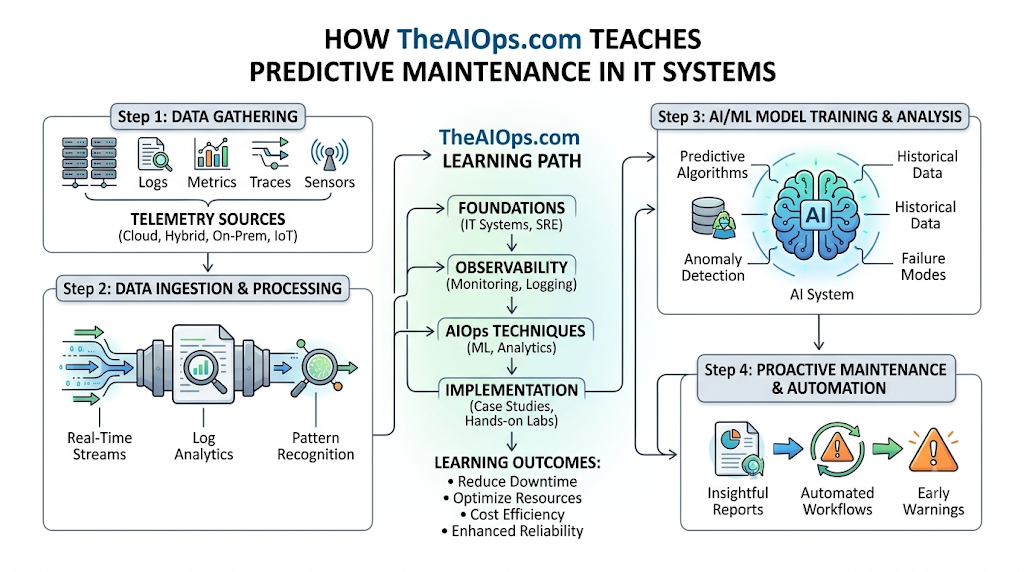
Modern enterprise digital infrastructure operates at a scale and speed that completely overwhelms traditional, reactive IT management. In complex multicloud networks, microservices architectures, and hybrid cloud environments, waiting for a system component to fail before responding guarantees costly downtime, broken Service Level Agreements (SLAs), and frustrated end-users. To eliminate unscheduled outages and transform IT operations from reactive firefighters to proactive system stewards, leading organizations are adopting Predictive Maintenance in IT. By harnessing AIOps (Artificial Intelligence for IT Operations), machine learning models analyze real-time telemetry—metrics, logs, and traces—to anticipate resource exhaustion, hardware degradation, and software performance bottlenecks long before they manifest as critical outages. As a dedicated educational platform, TheAIOps.com simplifies complex machine learning workflows into actionable engineering practices. In this comprehensive guide, we will explore how TheAIOps.com teaches predictive maintenance in IT systems, breaking down core concepts, practical workflows, real-world enterprise use cases, and career paths for engineers navigating the future of AI-driven IT operations.
What is Predictive Maintenance in IT?
In traditional physical manufacturing, predictive maintenance involves placing sensors on mechanical hardware to detect vibration or temperature spikes before a machine breaks down. In enterprise IT operations, Predictive Maintenance applies the exact same philosophy to software, virtual infrastructure, cloud services, and network hardware.
Predictive maintenance in IT refers to the continuous analysis of operational telemetry data using machine learning algorithms to forecast system failures, capacity exhaustion, and performance degradation before service disruption occurs.
┌─────────────────────────────────────────────────────────────────────────┐
│                      EVOLUTION OF IT MAINTENANCE                        │
└─────────────────────────────────────────────────────────────────────────┘

  1. REACTIVE MAINTENANCE (Fix-On-Failure)
     [ System Runs ] ──► [ System Crashes ] ──► [ Emergency Escalation ]
     • Highest downtime, unpredictable costs, manual troubleshooting.

  2. PREVENTIVE MAINTENANCE (Schedule-Based)
     [ Scheduled Maintenance Window ] ──► [ Routine System Restarts/Purges ]
     • Wastes resources, risks unnecessary changes, misses unexpected bugs.

  3. PREDICTIVE MAINTENANCE (Data-Driven AIOps)
     [ Telemetry Stream ] ──► [ ML Forecasting ] ──► [ Automated Proactive Fix ]
     • Zero unscheduled downtime, optimal capacity, root-cause precision.
Instead of relying on rigid, threshold-based alerts (e.g., “Fire an alert when CPU reaches 90%”), predictive maintenance uses time-series forecasting, baseline behavioral modeling, and anomaly detection to identify subtle trends. For example, it tracks a memory leak consuming 0.5% more RAM every hour and predicts the exact hour a database cluster will crash three weeks in advance.
Why Predictive Maintenance Matters in Modern IT Infrastructure
The rapid adoption of microservices, Kubernetes containers, serverless platforms, and multicloud setups has rendered manual system monitoring obsolete. Modern IT environments generate gigabytes of telemetry data every minute, leading to critical operational challenges:
- Alert Fatigue: Engineering teams are flooded with thousands of non-actionable notifications daily, causing critical warnings to be overlooked.
- Cascading System Failures: A single latent microservice error can rapidly cascade across distributed components, causing full-scale outages before teams pinpoint the source.
- Skyrocketing Downtime Costs: For enterprise applications in banking, e-commerce, or healthcare, a single hour of unplanned downtime can cost hundreds of thousands of dollars in lost revenue and SLA penalties.
- Complex Root Cause Analysis (RCA): Sifting through disconnected server logs, APM metrics, and network traces manually during an active incident delays resolution.
Predictive maintenance solves these challenges by converting raw telemetry noise into clear, actionable intelligence. By detecting behavioral deviations early, IT teams schedule quiet maintenance fixes or trigger automated remediation scripts during off-peak hours without interrupting end-users.
Understanding AIOps and Predictive Analytics
At the core of IT predictive maintenance lies AIOps (Artificial Intelligence for IT Operations). Coined by Gartner, AIOps combines big data engines with advanced machine learning models to automate operational processes.
Predictive analytics serves as the statistical engine within an AIOps framework. It works through three core analytical disciplines:
┌─────────────────────────────────────────────────────────────────────────────┐
│                       AIOPS PREDICTIVE ENGINE PATHWAY                       │
└─────────────────────────────────────────────────────────────────────────────┘

  [ Metric & Log Telemetry ]
              │
              ▼
  ┌────────────────────────┐
  │  Descriptive Analytics │ ──► "What is happening right now across systems?"
  └────────────────────────┘
              │
              ▼
  ┌────────────────────────┐
  │  Diagnostic Analytics  │ ──► "Why did this anomaly or degradation start?"
  └────────────────────────┘
              │
              ▼
  ┌────────────────────────┐
  │  Predictive Analytics  │ ──► "When will this component exceed capacity?"
  └────────────────────────┘
              │
              ▼
  [ Automated Remediation Execution ]
- Descriptive Analytics: Aggregates and correlates raw metrics, logs, and traces from disparate systems to establish an operational baseline.
- Diagnostic Analytics: Automatically evaluates event dependencies and topological maps to perform instant root cause analysis.
- Predictive Analytics: Applies regression analysis, time-series forecasting (e.g., ARIMA, Prophet), and deep learning (e.g., LSTM neural networks) to project future system performance and flag statistical outliers.
How TheAIOps.com Helps Professionals Learn Predictive Maintenance
Navigating the intersection of data science and enterprise infrastructure can feel overwhelming for IT engineers. Many engineers know how to manage servers or write code, but lack formal training in configuring machine learning pipelines for time-series operational data.
TheAIOps.com bridges this skill gap by delivering structured, vendor-neutral, practical education tailored specifically for IT operations professionals.
Educational Philosophy of TheAIOps.com
- Hands-on Engineering Focus: Rather than teaching abstract mathematical algorithms in isolation, TheAIOps.com focuses on real-world operational execution.
- End-to-End Pipeline Building: Learners master every layer of the predictive maintenance stack—from data ingestion and telemetry parsing to machine learning model deployment and automated remediation.
- Scenario-Based Learning: Concept modules rely on actual enterprise outages, teaching students how to diagnose memory leaks, disk fill-ups, and thread exhaustion before system crashes occur.
Core Concepts Covered by TheAIOps.com
To ensure learners build production-ready competencies, the educational framework at TheAIOps.com centers on six foundational pillars:
┌─────────────────────────────────────────────────────────────────────────────┐
│               CORE PILLARS OF PREDICTIVE MAINTENANCE LEARNING               │
└─────────────────────────────────────────────────────────────────────────────┘

  ┌────────────────────────┐      ┌────────────────────────┐
  │ 1. Telemetry Ingestion │ ───► │  2. Behavioral Baseline│
  │ (Metrics, Logs, Traces)│      │   (Dynamic Thresholds) │
  └────────────────────────┘      └────────────────────────┘
              │                               │
              ▼                               ▼
  ┌────────────────────────┐      ┌────────────────────────┐
  │  3. Anomaly Detection  │ ───► │  4. Event Correlation  │
  │  (Unsupervised Models) │      │  & Topology Mapping    │
  └────────────────────────┘      └────────────────────────┘
              │                               │
              ▼                               ▼
  ┌────────────────────────┐      ┌────────────────────────┐
  │ 5. Automated Root Cause│ ───► │ 6. Self-Healing & Auto │
  │    Analysis (RCA)      │      │    Remediation Action  │
  └────────────────────────┘      └────────────────────────┘
- Telemetry Stream Processing: Understanding how to collect high-velocity logs, metrics, and distributed traces from edge, cloud, and on-premises infrastructure.
- Dynamic Baselining: Replacing static threshold limits with continuous behavioral baselining that adapts to daily, weekly, and seasonal traffic trends.
- Machine Learning Anomaly Detection: Implementing supervised and unsupervised ML models to detect anomalous patterns in noisy datasets.
- Topology-Aware Event Correlation: Grouping thousands of related system alerts into a single actionable incident based on system dependencies.
- Algorithmic Root Cause Analysis: Automating the identification of primary failure origins across complex microservices graphs.
- Closed-Loop Automation: Connecting predictive insights to execution platforms (Ansible, Terraform, Kubernetes Controllers) to trigger self-healing actions.
AI and Machine Learning in Predictive Maintenance
Machine learning serves as the predictive engine within modern AIOps platforms. TheAIOps.com demystifies how specific AI algorithms solve targeted operational issues:
- Time-Series Forecasting (ARIMA, Prophet, Holt-Winters): Used to project metrics into the future. These models accurately forecast disk space depletion, API latency increases, and memory consumption trends based on historical usage patterns.
- Clustering Algorithms (DBSCAN, K-Means): Group log messages and unstructured text traces into coherent clusters. This helps engineers detect unprecedented error patterns without writing manual regular expressions.
- Classification Models (Random Forests, XGBoost): Classify operational risks by comparing current system metrics against known historical outage signatures.
- Neural Networks & Deep Learning (LSTM Networks): Excel at finding temporal patterns in high-dimensional telemetry streams, enabling long-range predictive analysis for enterprise IT infrastructure.
Monitoring, Log Analytics, and Observability
A common misconception among beginner IT engineers is equating basic system monitoring with full predictive maintenance. TheAIOps.com explicitly outlines the distinction across three core tiers:
┌─────────────────────────────────────────────────────────────────────────────┐
│                 MONITORING vs. OBSERVABILITY vs. AIOPS                     │
└─────────────────────────────────────────────────────────────────────────────┘

  MONITORING     ──► Tells you WHEN a service is down.
                     (Static thresholds: "CPU > 90%")

  OBSERVABILITY ──► Tells you WHY a service is failing.
                     (Exposes system internals via Metrics, Logs, Traces)

  AIOPS          ──► Tells you WHEN IT WILL FAIL in the future & FIXES IT.
                     (Machine learning, Predictive Analytics, Automation)
- Monitoring: Tracks known failure modes using static thresholds. It is inherently reactive.
- Observability: Provides the rich contextual data (the “Three Pillars”: Metrics, Logs, and Traces) required to infer the internal state of a system.
- AIOps & Predictive Maintenance: Ingests observability data, applies machine learning to infer future behavior, and automates preventative actions.
TheAIOps.com emphasizes log analytics parsing using vector embeddings and Natural Language Processing (NLP). By analyzing log syntax changes in real time, predictive models catch software bugs immediately after a new microservice deployment before end-users report performance issues.
Root Cause Analysis Using AIOps
When an enterprise application experiences a slow response time, finding the primary failure point across hundreds of container pods and databases can take hours.
TheAIOps.com teaches learners how AI-driven Root Cause Analysis (RCA) operates:
- Topological Dependency Mapping: The AIOps engine continuously auto-discovers network topology and service relationships.
- Causal Inference Engines: When multiple alerts trigger simultaneously, the platform correlates them using spatial and temporal proximity.
- Noise Suppression: Instead of sending 500 alerts to on-call engineers, the platform condenses the issue into a single ticket: “Database connection pool exhaustion on DB-Primary due to unindexed query deployed in API-Service v2.4”.
Detecting Anomalies Before System Failures
Static threshold monitoring is notorious for producing false positives and missing critical silent failures. For instance, a CPU utilization of 85% might be completely normal during a scheduled 2:00 PM batch processing job, but highly abnormal at 3:00 AM on a Sunday.
┌─────────────────────────────────────────────────────────────────────────┐
│                    STATIC vs. DYNAMIC ANOMALY BOUNDS                    │
└─────────────────────────────────────────────────────────────────────────┘

  [ Static Threshold ]  ────── Fixed Alert Line (e.g., 80% CPU) ──────
                        (Fails to detect subtle off-peak anomalies)

  [ Dynamic Baseline ]  ~~~ Upper Upper Confidence Bound ~~~
                        --- Expected Normal Seasonal Pattern ---
                        ~~~ Lower Confidence Bound ~~~
                        (Triggers alert ONLY when metric leaves band)
TheAIOps.com teaches Dynamic Anomaly Detection. Machine learning models analyze historical telemetry to construct adaptive upper and lower boundary bands around normal operating patterns. An alert triggers only when metric telemetry strays outside these dynamic confidence bands, taking into account seasonal cycles and business hour fluctuations.
Reducing Downtime Through Predictive Maintenance
Unplanned downtime disrupts operations and damages customer trust. Predictive maintenance actively protects enterprise uptime metrics through three distinct operational capabilities:
- Capacity and Resource Forecasting: Predicts exactly when storage volumes, memory limits, or cloud quotas will be exceeded.
- Automated Self-Healing: Integrates with automation platforms to execute corrective runbooks—such as auto-scaling compute pods, clearing cached temp files, or restarting failing background workers—before a crash occurs.
- Proactive Ticket Generation: Automatically generates low-priority maintenance tasks for engineering teams during business hours, preventing late-night emergency escalations.
Step-by-Step Predictive Maintenance Workflow
To help learners visualize end-to-end implementation, TheAIOps.com outlines the standard operational pipeline used across enterprise environments:
┌──────────────────────────────────────────────────────────────────────────────────┐
│                   PREDICTIVE MAINTENANCE IT WORKFLOW PIPELINE                    │
└──────────────────────────────────────────────────────────────────────────────────┘

 [ Step 1: Telemetry Collection ]
   • Agents collect Metrics, Logs, Traces across Cloud & On-Prem platforms.
               │
               ▼
 [ Step 2: Data Preprocessing & Normalization ]
   • Noise reduction, timestamp synchronization, and log parsing.
               │
               ▼
 [ Step 3: Event Correlation & Topology Mapping ]
   • Grouping related alerts using system dependency graphs.
               │
               ▼
 [ Step 4: Machine Learning Anomaly Detection ]
   • Statistical evaluation against historical dynamic baselines.
               │
               ▼
 [ Step 5: Predictive Failure Forecasting ]
   • Time-series projection identifies upcoming resource or component crashes.
               │
               ▼
 [ Step 6: Automated Alert & Incident Generation ]
   • Contextual ticket created with pinpointed root cause analysis.
               │
               ▼
 [ Step 7: Closed-Loop Automated Remediation ]
   • Orchestration tools execute self-healing runbooks (Auto-scale, Restart, Purge).
Popular AIOps Tools Used for Predictive Maintenance
Hands-on training at TheAIOps.com covers both leading commercial enterprise platforms and flexible open-source stacks:
| Tool Name | Core Strengths | Key Use Case in Predictive Maintenance | Deployment Strategy |
| Dynatrace | AI engine (Davis), auto-dependency mapping | Instant causal root-cause analysis and cloud anomaly detection | SaaS / Managed Hybrid |
| Datadog | Unified observability, Watchdog AI | Predictive metric forecasting and automated log anomaly detection | Cloud Native SaaS |
| Splunk ITSI | Event correlation, Machine Learning Toolkit (MLTK) | Enterprise log correlation and predictive service health scoring | On-Premises / Cloud |
| ScienceLogic | Hybrid cloud coverage, automated workflow runbooks | Infrastructure dependency discovery and self-healing action execution | Hybrid Enterprise |
| Elastic (ELK Stack) | Open-source search, Machine Learning anomaly jobs | Log pattern clustering and custom time-series anomaly modeling | Self-Hosted / Managed Cloud |
| Prometheus + Grafana | Cloud-native metric aggregation, open-source ecosystem | Time-series storage for custom predictive forecasting models | Kubernetes Native |
Cloud and Hybrid Infrastructure Monitoring
Modern enterprises rarely run on single-cloud architectures; they operate across complex hybrid multicloud environments combining AWS, Azure, Google Cloud Platform (GCP), and legacy on-premises datacenters.
TheAIOps.com teaches professionals how to design unified cross-cloud predictive maintenance architectures:
- Cross-Cloud Telemetry Aggregation: Breaking down monitoring silos by routing cloud metrics into a central AIOps telemetry hub.
- Hybrid Dependency Mapping: Tracking transactional dependencies as data flows from on-premises legacy databases to cloud-hosted API gateways.
- Cloud Cost and Resource Optimization: Predicting cloud infrastructure over-provisioning and idle assets to automatically scale down capacity without compromising availability.
Predictive Maintenance for Kubernetes and Containers
Containerized platforms introduce intense operational complexity. Pods spin up and down in seconds, making IP-based static monitoring obsolete.
┌─────────────────────────────────────────────────────────────────────────────┐
│                   KUBERNETES PREDICTIVE HEALTH CYCLE                        │
└─────────────────────────────────────────────────────────────────────────────┘

  [ Pod Telemetry Stream ] ──► [ AIOps Analytics Engine ]
                                        │
                                        ▼
  ┌─────────────────────────────────────────────────────────────────────────┐
  │ PREDICTIVE INSIGHT: "Node-04 memory will reach OOMKill limit in 20 min" │
  └─────────────────────────────────────────────────────────────────────────┘
                                        │
                                        ▼
  [ Automated Action ] ──► Cordon Node ──► Drain Pods ──► Scale Cluster Auto-scaler
TheAIOps.com dedicates specialized learning tracks to Kubernetes Predictive Maintenance:
- Predicting Out-Of-Memory (OOM) Kills: Machine learning models track memory usage slopes within containers, alerting engineers before the Linux kernel terminates critical worker processes.
- CrashLoopBackOff Prevention: Analyzing container log streams to detect missing dependencies or initialization errors before a deployment triggers systemic pod restarts.
- Storage Volume (PVC) Exhaustion: Forecasting persistent volume capacity growth to auto-expand storage claims dynamically before stateful databases freeze.
Real-World Enterprise Use Cases
To ground theoretical concepts in enterprise reality, TheAIOps.com utilizes real-world case studies:
1. Global E-Commerce Retailer
- Challenge: During major sales events, microservices experienced unexpected cascading database connection timeouts.
- Predictive Solution: Implemented an AIOps predictive model that monitored connection pool acquisition latency. The model detected pool degradation 15 minutes prior to lockup and dynamically adjusted thread limits.
- Outcome: Zero outages during peak shopping traffic and a 70% reduction in MTTR (Mean Time to Resolution).
2. Financial Services Institution
- Challenge: On-call engineers received over 12,000 daily alerts across legacy mainframe and cloud banking portals, causing severe alert fatigue.
- Predictive Solution: Deployed AIOps topological correlation and dynamic baselining, grouping alerts into unified incident tickets.
- Outcome: Suppressed 94% of operational alert noise, allowing engineers to focus on proactive infrastructure maintenance.
Benefits of Learning Predictive Maintenance Through TheAIOps.com
Enrolling in structured educational paths at TheAIOps.com delivers distinct career and technical advantages:
- Practical, Production-Ready Skills: Learn to build real telemetry pipelines rather than just studying theoretical data science concepts.
- Vendor-Neutral Mastery: Gain expertise across both open-source platforms (Prometheus, ELK, OpenTelemetry) and enterprise SaaS stacks.
- Industry-Aligned Curriculum: Updated continuously to reflect modern observability engineering, SRE principles, and cloud-native practices.
- Accelerated Incident Resolution: Learn techniques that dramatically lower MTTR and eliminate systemic recurring outages.
Challenges Organizations Face
Adopting predictive maintenance is not without operational hurdles. TheAIOps.com prepares engineers to navigate these organizational obstacles:
- Data Silos and Fragmentation: Telemetry isolated in disparate department monitoring tools prevents holistic AI correlation.
- Poor Data Quality: Noisy, unstructured log formats and missing metric labels degrade machine learning model accuracy.
- Cultural Resistance: Traditional IT teams used to manual troubleshooting may hesitate to trust automated self-healing actions.
- Skills Shortage: A lack of engineers who understand both IT systems administration and machine learning operations (MLOps).
Best Practices for Successful Predictive Maintenance
To overcome these adoption challenges, TheAIOps.com recommends following these industry best practices:
- Standardize Telemetry Collection: Adopt vendor-neutral collection frameworks like OpenTelemetry across all applications and infrastructure.
- Start with Targeted High-Value Use Cases: Begin by implementing predictive models for well-defined issues like storage capacity planning or database connection exhaustion before tackling full application stacks.
- Establish Clear Baselines: Allow machine learning models sufficient time (typically 2 to 4 weeks) to gather historical data and establish accurate seasonal baselines.
- Implement Human-in-the-Loop Automation: Begin with manual approvals for predictive remediation runbooks, progressing to fully automated self-healing only as model confidence grows.
- Break Down Team Silos: Foster cross-functional collaboration between DevOps, SRE, Cloud Infrastructure, and Data Science teams.
Career Opportunities in AIOps and Predictive Maintenance
As enterprise infrastructure grows in complexity, demand for engineers skilled in AI-driven operations is surging. Professionals who complete training at TheAIOps.com are well-positioned for high-impact roles:
- AIOps Engineer: Designs, deploys, and maintains enterprise AIOps platforms and predictive machine learning models.
- Site Reliability Engineer (SRE): Leverages predictive insights to enforce Error Budgets and maximize system availability.
- DevOps Architect: Integrates predictive telemetry checks into CI/CD deployment pipelines to catch performance regressions early.
- Observability Specialist: Architect end-to-end distributed tracing, log aggregation, and metric collection networks.
- IT Operations Automation Engineer: Writes automated runbooks and self-healing orchestration routines triggered by AIOps predictions.
Skills Required for Predictive Maintenance Engineers
To excel in AI-driven IT operations, engineers need a balanced blend of software, systems, and data analytics competencies:
┌─────────────────────────────────────────────────────────────────────────┐
│                      PREDICTIVE AIOPS SKILL MATRIX                      │
└─────────────────────────────────────────────────────────────────────────┘

  [ SYSTEMS & CLOUD ]        [ DATA & AI ]            [ AUTOMATION ]
  • Linux System Internals   • Time-Series Analytics  • Python / Go
  • Kubernetes & Docker      • Basic ML Concepts      • Ansible / Terraform
  • OpenTelemetry / Metrics  • Anomaly Algorithms     • CI/CD Pipelines
- Systems Fundamentals: Strong working knowledge of Linux administrative concepts, networking protocols, cloud platforms, and container orchestration.
- Observability Engineering: Hands-on expertise with metric collection, structured log parsing, and distributed tracing instrumentation.
- Basic Data Science Concepts: Understanding statistical distributions, regression models, time-series forecasting, and clustering algorithms.
- Scripting and Automation: Proficiency in Python, Shell scripting, and infrastructure-as-code tools (Terraform, Ansible) to build self-healing routines.
Learning Roadmap for Beginners
For professionals transitioning into AIOps, TheAIOps.com provides a structured, step-by-step learning pathway:
┌─────────────────────────────────────────────────────────────────────────┐
│                   AIOPS & PREDICTIVE LEARNING ROADMAP                   │
└─────────────────────────────────────────────────────────────────────────┘

  PHASE 1: Foundations
  └── Master Linux, Networking, Cloud Infrastructure, and Container Basics.

  PHASE 2: Telemetry & Observability
  └── Implement Prometheus, Grafana, OpenTelemetry, and ELK log parsing.

  PHASE 3: AIOps & Predictive Analytics
  └── Learn Dynamic Baselining, Anomaly Detection, and Event Correlation.

  PHASE 4: Closed-Loop Automation
  └── Build self-healing scripts and automated incident response workflows.
Common Mistakes to Avoid
When implementing predictive maintenance, beginner engineers and organizations frequently fall into predictable traps:
- Over-relying on Default Model Settings: Machine learning models must be tuned to match your specific application’s traffic profiles and usage cycles.
- Ignoring Data Quality: Training predictive models on dirty, unstructured, or un-synchronized log streams leads to inaccurate failure predictions.
- Automating Remediation Too Quickly: Automating destructive scripts (like node reboots) without thoroughly validating predictive alert confidence can trigger unintended outages.
- Treating AIOps as a Magic Tool: Expecting an AIOps tool to fix broken system architecture without proper observability instrumentation.
Future Trends in Predictive IT Operations
As artificial intelligence rapidly evolves, predictive maintenance in IT is moving toward several transformative advancements:
- Generative AI for Incident Remediation: Combining time-series predictive alerts with Large Language Models (LLMs) to automatically generate human-readable post-mortems and targeted code fixes.
- Causal AI Platforms: Shifting from basic correlation models to deterministic causal inference engines that mathematically prove failure origins.
- Edge Computing Predictive Analytics: Running lightweight AI anomaly detection models directly on edge devices and IoT gateways for zero-latency failure prevention.
- Fully Autonomous IT Systems (NoOps): Advancing toward infrastructure ecosystems that predict, optimize, and heal themselves continuously with minimal human intervention.
Frequently Asked Questions (FAQs)
What is the main difference between traditional monitoring and predictive maintenance?
Traditional monitoring relies on static thresholds to alert teams after a problem occurs or a limit is breached. Predictive maintenance uses machine learning models to analyze telemetry trends and forecast failures before they disrupt operations.
How does machine learning predict IT system crashes?
Machine learning algorithms analyze historical time-series data—such as memory consumption, disk growth, and error rates—to establish normal behavioral baselines. When current telemetry diverges from these trends, the model calculates the probability and timing of a future system crash.
Is coding required to learn predictive maintenance on TheAIOps.com?
Basic scripting knowledge in Python or Shell is recommended, but not strictly required to start. TheAIOps.com teaches both conceptual frameworks and practical tool configurations step-by-step.
Can predictive maintenance be implemented on legacy on-premises systems?
Yes. AIOps platforms collect metrics and log telemetry from legacy servers and mainframes just as easily as modern cloud-native applications, bringing predictive intelligence to hybrid datacenters.
How long does it take for an AIOps machine learning model to become accurate?
Most AIOps models require 2 to 4 weeks of continuous telemetry data ingestion to build reliable baseline behavior profiles and account for weekly traffic variations.
What are the most common telemetry sources used in predictive maintenance?
Predictive maintenance relies on the three core pillars of observability: Metrics (CPU, memory, latency), Logs (system, application, and audit logs), and Traces (end-to-end distributed request paths).
How does predictive maintenance help reduce alert fatigue?
By replacing static threshold alerts with dynamic anomaly detection and event correlation, AIOps platforms suppress redundant alert noise and group hundreds of related events into a single actionable incident ticket.
Does predictive maintenance completely eliminate IT outages?
While no tool can prevent unexpected hardware failures or external network cuts, predictive maintenance drastically reduces unscheduled downtime by catching resource exhaustion, software bugs, and capacity limits early.
What enterprise roles benefit most from learning AIOps on TheAIOps.com?
Site Reliability Engineers (SREs), DevOps engineers, Cloud Architects, System Administrators, IT Operations Managers, and Infrastructure Engineers benefit significantly from mastering AIOps methodologies.
How does TheAIOps.com differ from other technical learning platforms?
TheAIOps.com is dedicated exclusively to AI-driven IT operations. It provides focused, practical, vendor-neutral educational pathways that connect foundational telemetry engineering directly to production-level AIOps automation.
Conclusion
The shift from reactive IT monitoring to proactive, AI-driven predictive maintenance represents a pivotal evolution in modern enterprise infrastructure management. Organizations that master predictive maintenance eliminate catastrophic downtime, optimize cloud resources, and free engineering teams from constant alert fatigue. Mastering these technologies requires a clear learning path that combines observability fundamentals, data science principles, and automated engineering workflows. TheAIOps.com delivers the specialized knowledge, structured roadmaps, and practical insight needed to thrive in this new era of intelligent operations.
