Upgrade & Secure Your Future with DevOps, SRE, DevSecOps, MLOps!
We spend hours scrolling social media and waste money on things we forget, but won’t spend 30 minutes a day earning certifications that can change our lives.
Master in DevOps, SRE, DevSecOps & MLOps by DevOps School!
Learn from Guru Rajesh Kumar and double your salary in just one year.
Introduction
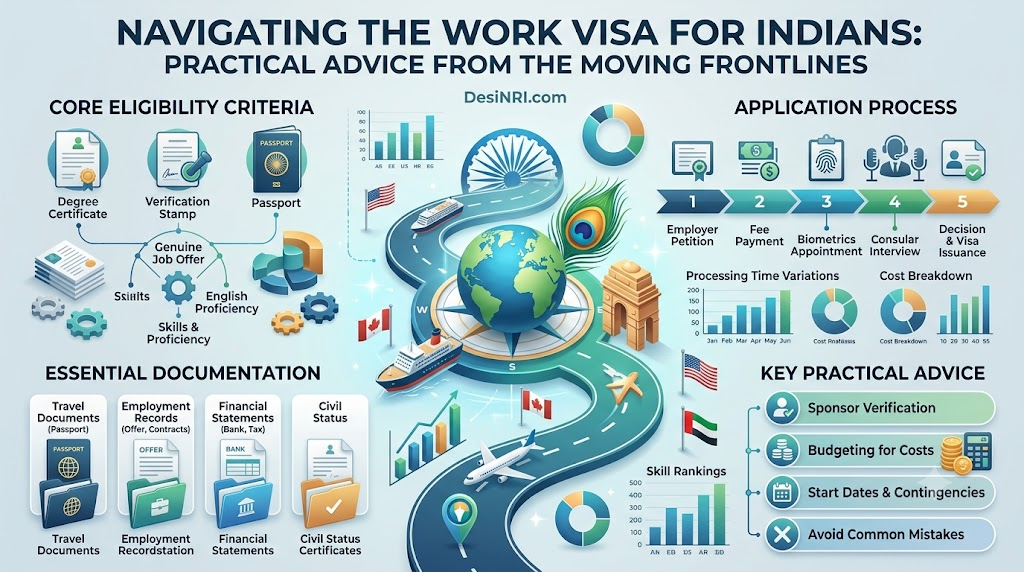
Securing an overseas job offer is a major professional milestone, but having an offer letter in hand does not grant automatic permission to relocate and start working. For Indian professionals, understanding the legal pathway between getting hired and boarding an international flight is critical. A work visa is a legally binding immigration authorization granted by a foreign government, permitting a foreign national to undertake employment under defined conditions, durations, and employers. Many applicants run into unexpected delays, rejected paperwork, or unauthorized work restrictions simply because they do not separate the employment search from statutory immigration clearance. Navigating this bridge requires clear information about visa categories, employer obligations, document verification, and regional legal compliance. This comprehensive guide breaks down the eligibility criteria, the standard documentation required from India, the application lifecycle, relocation expenses, and critical applicant safeguards. Whether you are an experienced software engineer, healthcare professional, or specialized technician, this walkthrough clarifies how to approach the process systematically, avoid costly filing mistakes, and transition smoothly into your overseas career. You can research broader pathways on DesiNRI.
Understanding the Overseas Work Visa
A work visa is a sovereign immigration document that grants a foreign citizen the legal right to enter a destination country and perform paid employment. For Indian passport holders, foreign work authorization is almost always employer-linked or tied to specific, regulated skill shortages.
It is vital to distinguish clearly between a job offer and legal work authorization:
- Job Offer: An agreement between you and an overseas employer detailing your role, compensation, and workplace responsibilities.
- Work Authorization / Visa: An official government-issued permit granting you legal status to reside and work in that specific country.
An employer can issue an offer letter, but only national immigration authorities—such as the Home Office in the United Kingdom, the Department of Home Affairs in Australia, Immigration, Refugees and Citizenship Canada (IRCC), or the US Citizenship and Immigration Services (USCIS)—can approve your legal entry.
Why Indians Pursue Overseas Work Visas
Indian skilled professionals frequently seek international roles to gain exposure to global enterprise practices, accelerate career trajectories, and earn compensation pegged to stable international currencies. Key sectors driving Indian talent abroad include information technology, cloud engineering, healthcare and nursing, civil and structural engineering, biotechnology, and specialized vocational trades.
Additionally, long-term employment permits frequently serve as the foundational step for professionals who eventually decide to explore permanent residency for Indians in destinations that reward local economic contributions.
Core Eligibility Requirements
While immigration statutes vary widely by country, most employment-based pathways for Indian passport holders share standard core pillars.
1. Valid Job Offer from an Eligible Employer
In most jurisdictions, you cannot simply apply for a work permit independently without a bona fide job offer. The hiring company must usually be registered with national labor bodies and possess an active sponsorship license or immigration clearance to recruit overseas staff.
2. Labor Market Testing and Sponsorship Clearance
Many host governments mandate that sponsoring employers prove they could not find a local citizen or permanent resident to fill the vacancy. Depending on the country, this process takes forms such as a Labour Market Impact Assessment (LMIA) in Canada, a resident labor market test in European states, or a prevailing wage and labor certification filing in the United States.
3. Professional Qualifications and Experience
Immigration officials scrutinize whether an applicant’s formal education aligns with the job profile. For Indian applicants, this requires presenting accredited degree certificates, consolidated university marksheets, and verifiable experience letters on official employer letterheads matching the designated occupation code.
4. Language Proficiency
English-speaking host countries typically mandate standardized language assessments such as IELTS (General Training), PTE Academic, or TOEFL. Specific scores vary by visa tier, occupation risk, and licensing bodies, with higher thresholds generally enforced for clinical healthcare and client-facing professional roles.
5. Financial Sustainability
Even when an overseas salary is assured, applicants are often required to demonstrate immediate liquid savings to cover initial settlement, local travel, and housing deposits until the first payroll cycle runs. Certain programs allow an authorized employer to certify maintenance directly on the sponsorship certificate.
Country Framework Comparison
Different nations employ varied administrative frameworks to assess, sponsor, and approve skilled foreign labor. The table below illustrates the procedural variations across common destinations for Indian professionals:
| Country | Primary Skilled Work Route | Sponsoring Entity Requirement | Skills / Qualification Assessment | General Minimum English Standard |
| United Kingdom | Skilled Worker Visa | Licensed UK Home Office Sponsor (Certificate of Sponsorship) | Verified against UK ENIC equivalents if required | Common European Framework (CEFR) Level B1 |
| Australia | Skills Demand / Employer Nomination (TSS subclass 482 / 186) | Approved Standard Business Sponsor (SBS) | Mandatory assessment by designated assessing body (e.g., ACS, Engineers Australia) | IELTS 5.0 to 6.0 overall (or equivalent PTE score) |
| Canada | Temporary Foreign Worker Program (LMIA-backed work permit) | Canadian employer with approved positive/neutral LMIA | Educational Credential Assessment (ECA) via WES/ICAS when required | Canadian Language Benchmark (CLB) 5 to 7 depending on NOC tier |
| Germany | EU Blue Card / Skilled Worker Visa | Registered German employer offering compliant minimum salary threshold | ZAB statement of comparability for Indian university degrees | B1/B2 German for general trades; English often accepted for IT roles |
| United States | Specialty Occupation (H-1B Visa) | US petitioner filing Labor Condition Application (LCA) | Evaluation confirming equivalent 4-year US bachelor’s degree | Demonstration of specialty competence via credentials |
Visa Document Checklist
Incomplete, inconsistent, or uncertified documentation accounts for the vast majority of processing delays. Indian applicants should systematically organize their visa document checklist across the following functional categories:
Identity and Civil Records
- Current Indian passport with at least six months of validity beyond the intended travel date and multiple blank visa pages.
- Previous passports containing historical visas and entry/exit stamps to establish travel history.
- Government-issued birth certificates with standardized English spelling of names matching the passport.
- Recent biometric passport photographs adhering strictly to destination-specific pixel, background, and head-dimension rules.
Professional and Educational Proof
- Degree certificates, provisional passing certificates, and semester-wise marksheets.
- Formal credential evaluation reports (e.g., WES, UK ENIC, or Australian assessing authority outcomes).
- Experience letters from all previous Indian employers detailing official designations, dates of tenure, and explicit job duties.
- Recent payslips (minimum 3 to 6 months) and bank statements reflecting consistent salary credits.
- Income tax returns (ITR-V forms) and Form 16 records validating formal employment in India.
Sponsorship and Employment Filings
- Official, signed contract of employment detailing job title, annual salary, hours per week, and primary work location.
- Formal sponsorship reference number, approved petition document, or statutory labor clearance certificate from the overseas immigration ministry.
Character and Medical Clearance
- Police Clearance Certificate (PCC) issued by the Regional Passport Office (RPO) via the Passport Seva Kendra system.
- Certified medical reports and chest X-rays completed exclusively at embassy-approved panel clinics to screen for active tuberculosis or specified public health conditions.
- Comprehensive travel and international health insurance covering travel dates until national health service eligibility commences.
Step-by-Step Application Process
While the administrative portals differ between consulates, the journey from interview offer to official visa endorsement follows a standardized lifecycle:
Step 1: Secure an Offer and Formal Sponsorship
Before any individual visa paperwork can be submitted, your overseas employer must complete domestic labor market clearances and assign a formal sponsorship identification or labor approval to your profile.
Step 2: Assemble and Attest Credentials
Gather all educational, employment, and civil records. Depending on your destination, documents may require formal notarization, apostille authentication by the Ministry of External Affairs (MEA) in New Delhi, or formal credential evaluations.
Step 3: Complete the National Immigration Application
Access the official government visa portal of the destination country. Fill out the application form completely, ensuring every detail matches your passport and official sponsorship records verbatim.
Step 4: Remit Official Visa Fees and Levies
Pay the mandatory statutory processing fees via secure international payment methods. Depending on the jurisdiction, this may include immigration healthcare surcharges (such as the UK’s Immigration Health Surcharge) or administrative levies.
Step 5: Schedule and Attend Biometrics Appointments
Book an appointment at an authorized visa processing center in India (such as VFS Global or TLScontact). Provide physical fingerprints, submit to digital facial photography, and submit original documents or passport booklets as instructed.
Step 6: Application Processing and Additional Inquiries
The consular division reviews your file against local immigration law. Respond immediately through authorized channels if visa officers issue formal requests for additional documentation, updated bank statements, or employer clarifications.
Step 7: Passport Collection and Decision Verification
Upon notification of a completed decision, retrieve your passport or download your digital immigration status. Carefully inspect the printed visa vignette or electronic record for correct name spellings, passport numbers, validity dates, and employment condition codes before booking international flights.
Financial Planning and Processing Expectations
Moving abroad on a professional visa entails upfront capital expenditure long before the first overseas paycheck clears. It is essential to separate non-refundable government processing fees from discretionary personal relocation costs.
Total Capital Required = Statutory Government Charges + Pre-Departure Documentation + Initial Relocation Buffer
Statutory and Administrative Costs
- Visa Application Fee: Directly collected by destination governments; non-refundable regardless of outcome.
- Immigration Health Levies: Surcharges required by some countries to grant access to national healthcare systems during your stay.
- Biometric Service Charges: Fees levied by consular partner facilities in India for identity collection and document handling.
Third-Party Documentation Outlays
- Police Clearance Certificates (PCC): Nominal administrative fee at the Passport Seva Kendra.
- Panel Physician Medical Examinations: Standardized charges paid directly to embassy-approved diagnostic hospitals.
- Language Examinations and Credential Evaluations: Fees paid to examination boards (IELTS, PTE) and educational credential evaluation bodies.
Relocation Buffer Funds
- One-way international airfare and excess baggage allocations.
- Temporary lodging, extended-stay rentals, or serviced apartments for the first 30–60 days.
- Security deposits for long-term residential leases, utility connections, and transport passes.
Processing Timelines
Processing durations are variable and subject to seasonal application surges, consular staffing levels, and the complexity of individual employment backgrounds. Straightforward applications submitted with flawless documentation typically resolve within 3 to 12 weeks. However, cases requiring employer-level audits, specialized background checks, or manual credential assessments can take several months. Never treat published processing windows as guarantees, and never terminate domestic employment or lease agreements until your visa approval is officially confirmed.
Work Rights, Restrictions, and Dependents
Securing a work permit authorizes specific professional activities, but it does not confer open-ended civil rights. Indian professionals must understand the regulatory boundaries governing their stay.
Employer and Occupation Lock-in
Most employer-sponsored visas are strictly tied to the designated sponsor and occupation code listed on the approval notice. You cannot casually switch jobs, take on secondary evening freelance work, or transition into a different corporate department without formal notification, legal amendments, or an entirely new visa petition submitted to the host government.
Primary vs. Secondary Work Rights
Some immigration systems allow secondary work up to a strict weekly limit (e.g., 20 hours in an eligible shortage occupation), provided it does not interfere with the primary sponsored role. Working outside designated conditions constitutes an immigration violation and can result in visa cancellation and deportation.
Dependent Visas and Family Rights
Spouses and dependent children are generally permitted to accompany primary work visa holders, provided financial maintenance requirements are satisfied.
- Spousal Employment: While some destinations grant accompanying spouses open work authorization, others restrict spouses from entering the local labor market or require them to secure independent employer sponsorship.
- Public Funds and Healthcare: Temporary visa holders and their dependents are typically barred from claiming welfare assistance, unemployment benefits, or public housing funds under strict “No Recourse to Public Funds” statutory conditions.
Practical Application Scenario: Indian Software Engineer
To visualize how these steps intersect in reality, consider the following practical roadmap for an Indian tech professional transitioning to an overseas post:
[Offer & Sponsorship] ──> [Skills & Language] ──> [PCC & Medicals] ──> [Biometrics & Visa] ──> [Arrival & Relocation]
- Offer Verification: The professional receives an employment agreement from an overseas enterprise. Before accepting, they confirm the employer holds active authorization with their national immigration department to issue foreign sponsorships.
- Credential Equivalence: The candidate reviews their four-year engineering degree and consolidated marksheets, submitting them to the destination country’s mandated educational evaluation agency to prove equivalence.
- Language and Legal Filings: The applicant completes the required English language exam, achieving the necessary sectional scores, while the overseas employer files the statutory labor application and issues the formal sponsorship reference.
- Local Clearances in India: The candidate books an appointment at their jurisdictional Passport Seva Kendra to obtain a valid Police Clearance Certificate and completes medical screening at a designated panel clinic.
- Consular Submission: With all references consolidated, the engineer completes the online visa application, remits government filing charges and healthcare surcharges, and attends biometrics collection at a regional processing center.
- Relocation Transition: Following formal visa issuance, the professional validates the visa vignette details, reserves initial temporary accommodation, arranges international funds via an authorized forex channel, and notifies their Indian employer to complete formal exit formalities.
Common Application Pitfalls
Even well-qualified Indian professionals can encounter refusals or costly delays due to procedural oversights:
- Inconsistent Employment Histories: Discrepancies between dates of employment listed on personal resumes, visa application forms, and official tax filings or experience letters trigger fraud investigations.
- Unregistered Sponsoring Entities: Applying on the basis of a private company offer before confirming whether the entity possesses a valid, active government sponsorship license.
- Failing to Disclose Past Immigration Refusals: Attempting to conceal historical visa rejections from any country. Consular bodies operate global information-sharing networks, and non-disclosure routinely leads to multi-year entry bans on character grounds.
- Incorrect Police Clearances: Submitting local police station certificates instead of the formally mandated Police Clearance Certificate issued directly through the Regional Passport Office/MEA network.
- Mixing Document Guidelines Across Countries: Assuming that procedural allowances permitted in one country (such as post-arrival medicals or informal credential translations) apply universally across other national systems.
Immigration Scams and Verification Safeguards
The high demand for overseas careers creates fertile ground for predatory recruitment networks and immigration fraud. Safeguard your career, finances, and identity by adhering to core protective protocols:
- No Legitimate Entity Can Guarantee Approval: Visas are granted solely at the discretion of sovereign immigration officers. Any recruitment agent or consultancy guaranteeing 100% visa approval or fast-tracked permanent residency is acting dishonestly.
- Beware of Direct-Payment Job Offers: Legitimate corporate employers do not require prospective hires to pay upfront “security deposits,” “visa processing fees,” or “equipment reservation charges” into personal bank accounts or via untraceable digital wallets.
- Verify Employer Licenses on Official Portals: Before committing funds or handing over identity documents, check whether the prospective employer appears on the destination government’s official public register of licensed sponsors.
- Protect Sensitive Identity Credentials: Never surrender original passports, identity documents, or digital authentication passwords to private agents. Consulates and accredited processing centers return physical passports directly to applicants via verified couriers.
Relocation, Settlement, and Community Integration
Securing your visa vignette completes the immigration challenge, but successfully transitioning your life abroad presents new logistical hurdles.
Initial Settlement Essentials
Upon landing, your initial focus must center on foundational administrative setups: registering with local municipal or police authorities where legally required, collecting physical residence permits or biometric identity cards, and opening a local bank account using your residential lease and visa approval documents.
Navigating Healthcare and Local Services
Ensure you understand how to register with local medical practices or national health insurance schemes immediately upon arrival. Arrange a local mobile SIM card to manage two-factor authentication for regional banking, government digital logins, and workplace communications.
Connecting with the Diaspora
Building a local support network mitigates early isolation and eases professional adaptation. The wider NRI community provides invaluable, real-world perspective on practical matters: identifying neighborhood rental markets, sourcing familiar grocery essentials, navigating public transport systems, and understanding neighborhood school enrollments. Engaging with established community networks allows newly arrived professionals to exchange practical settlement experiences while respecting that community insights complement, but never replace, formal regulatory compliance.
Frequently Asked Questions (FAQs)
What are the primary eligibility criteria for a work visa for Indians?
Applicants must generally possess a confirmed job offer from an authorized overseas sponsor, hold relevant academic credentials, demonstrate required professional experience, meet designated English language testing scores, pass panel medical examinations, and present a clean police clearance record.
Can an Indian citizen apply for an overseas work visa without a job offer?
Most standard temporary employment routes strictly require a qualifying job offer and official employer sponsorship. Certain countries offer independent talent or points-tested routes for elite researchers or high-earning innovators, but standard corporate relocations require an established sponsoring company.
How does an employer’s sponsorship status impact my application?
If a hiring company does not hold an active, valid sponsorship license with its domestic immigration ministry, any work permit application based on their offer will be summarily refused. Verification of an employer’s legal eligibility to hire overseas staff must precede document preparation.
What is the standard validity period for an initial work visa?
Initial validity typically spans between one and three years, contingent upon the underlying employment contract, occupation classification, and national immigration rules. Most jurisdictions permit in-country renewals or extensions provided ongoing employment and sponsorship conditions remain fully compliant.
Can my family members accompany me on a skilled work visa?
Spouses and unmarried dependent children under 18 years old can generally apply as accompanying dependents. You must establish financial maintenance capacity and submit certified relationship evidence, including formal marriage and birth certificates.
Are accompanying spouses legally permitted to work in the destination country?
Spousal work authorization varies significantly by jurisdiction and visa subcategory. Some destinations confer unrestricted open work permits to spouses of skilled professionals, while other regions require spouses to independently secure their own employer sponsorship before entering the workforce.
What is the difference between a work visa and permanent residency?
A work visa is a temporary, conditional immigration permit that remains active only as long as you maintain qualifying employment. Permanent residency grants indefinite permission to reside, work for any employer, and access wider public services without ongoing corporate sponsorship.
How long does consular work visa processing typically take for Indian applicants?
Standard processing durations generally range from 3 to 12 weeks following biometrics enrollment. Timelines fluctuate based on seasonal filing volumes, background verification demands, employer labor clearances, and whether the consulate requests supplementary evidence.
Can an overseas work visa transition into permanent residency?
In many destinations, continuous years spent legally working and paying taxes on a qualifying skilled work visa create an established pathway toward permanent residency, provided you meet regional residency, income, and language requirements.
Where should Indian applicants verify official visa requirements?
Always verify statutory immigration procedures, authorized forms, and fee schedules directly through official government immigration portals, high commission websites, or accredited consular processing partners rather than relying on unverified third-party advice.
Conclusion
Transitioning to an overseas career is a rewarding milestone that demands equal parts professional competence and procedural discipline. Understanding that an immigration permit is distinct from a private corporate job offer ensures you approach each filing milestone with the precision it requires. By securing authorized sponsorship, compiling an unassailable document trail, budgeting transparently for mandatory levies, and adhering strictly to conditions attached to your entry permit, you safeguard your professional standing and legal status abroad. Maintain focus on official statutory directives, stay vigilant against recruitment irregularities, and draw on verified resources like DesiNRI as you take deliberate, confident steps toward building your global career.
