Upgrade & Secure Your Future with DevOps, SRE, DevSecOps, MLOps!
We spend hours scrolling social media and waste money on things we forget, but won’t spend 30 minutes a day earning certifications that can change our lives.
Master in DevOps, SRE, DevSecOps & MLOps by DevOps School!
Learn from Guru Rajesh Kumar and double your salary in just one year.
Introduction
Software development teams often face significant friction when transitioning code from local workstations to production servers. Developers encounter unexpected runtime errors, system administrators struggle with manual server updates, and releases get delayed for weeks due to integration bottlenecks. Whether you are a system administrator moving away from manual configurations, a software developer adopting container workflows, or an enterprise technology manager leading an automation initiative, mastering practical delivery principles is essential. In competitive technology ecosystems, teams need structured skill building to implement container orchestration, automated testing, and secure infrastructure. This guide covers the essential technical foundations, core deployment pipelines, operational challenges, and practical skill paths associated with comprehensive DevOps training China, helping you understand how modern software delivery works from code commit to production monitoring.
Understanding Modern DevOps: Principles and Core Architecture
DevOps is not simply a job title or a collection of standalone utilities. It represents an engineering discipline that combines software development practices with IT operations to shorten the delivery lifecycle while maintaining system reliability. At its foundation, DevOps shifts operational responsibility leftward in the development process and introduces automated feedback loops at every stage.
Traditional IT delivery separated teams into distinct organizational silos. Developers wrote application code and handed artifacts over a wall to operational teams. The operations team then manually provisioned physical or virtual servers, configured runtime dependencies, and handled customer-facing outages without direct insight into how the application was authored. This separation resulted in finger-pointing, slow incident recovery, and high deployment failure rates.
Modern engineering replaces this fragmented approach with shared accountability, version-controlled infrastructure, and continuous feedback. Instead of deploying software changes once a quarter during painful weekend maintenance windows, teams release smaller, decoupled updates multiple times a week or even multiple times a day.
This model reduces release risk because small code changes are significantly easier to test, trace, and revert if an anomaly arises.
Key principles of modern delivery include:
- Continuous Integration (CI): Regularly merging developer code branches into a shared mainline repository, followed by automated builds and comprehensive test suites.
- Continuous Delivery and Deployment (CD): Ensuring every validated build is automatically packaged, configured, and made ready for immediate production deployment.
- Infrastructure as Code (IaC): Treating computing environments, networking topologies, and access policies as version-controlled software definitions.
- Proactive Observability: Measuring real-time telemetry—including metrics, logs, and distributed traces—to understand system behavior rather than waiting for user bug reports.
- Shared Operational Responsibility: Fostering collaboration where developers understand operational runtime constraints and operations teams understand application architecture.
How Automated Delivery Works: The End-to-End Workflow
A production-grade delivery process relies on an automated progression of verifiable gates. Each phase must validate specific aspects of application health, security compliance, and runtime readiness before allowing code to advance toward end users.
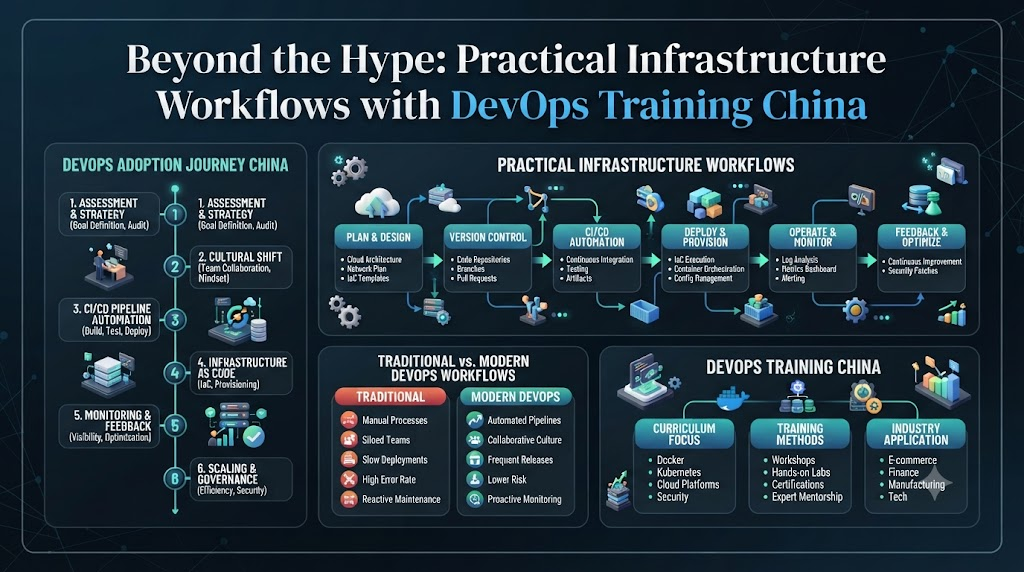
Source Code → Build → Test → Security Scan → Package → Deploy → Monitor → Improve
The delivery lifecycle operates across distinct, synchronized stages:
- Source Code Management: Developers write features or bug fixes in local branches and submit merge requests to platforms like Git. Code reviews and automated linting occur before any branch can be merged into the primary branch.
- Automated Build Execution: When code merges, an automated runner retrieves the repository, compiles the application source code, and resolves external runtime dependencies.
- Automated Quality Testing: The pipeline runs unit tests, integration tests, and regression suites. If any test fails, the pipeline halts immediately, preventing defective logic from progressing.
- Security Analysis: Static application security testing (SAST) and software composition analysis (SCA) scan the codebase and third-party libraries for known vulnerabilities, configuration flaws, and license non-compliance.
- Container Packaging: Validated binaries and runtime dependencies are packaged into immutable container images and tagged with unique identifiers matching the Git commit hash.
- Artifact Storage: Images are pushed to an authenticated container registry where vulnerability scanners perform binary inspection.
- Orchestrated Deployment: Deployment agents or GitOps operators apply updated configurations to targeted staging or production clusters, verifying health probes before routing user traffic.
- Real-Time Observability and Feedback: Systems capture latency, error rates, and resource utilization. Operational insights inform developers of performance bottlenecks, initiating the next improvement cycle.
Core Tooling Across the Delivery Ecosystem
Tools should serve specific operational goals rather than being adopted merely for industry novelty. An effective engineering toolchain supports automation, consistency, and traceability across the infrastructure lifecycle.
| Operational Domain | Primary Tooling | Core Engineering Purpose |
| Version Control | Git, GitHub, GitLab | Provides centralized version history, peer code review workflows, and integration hooks for automation engines. |
| CI/CD Automation | Jenkins, GitLab CI, Argo CD | Executes automated build pipelines, runs validation suites, and synchronizes declarative cluster states. |
| Containerization | Docker, containerd | Bundles applications with their dependencies into isolated, reproducible execution units across environments. |
| Container Orchestration | Kubernetes, Helm | Manages container scheduling, service discovery, automated scaling, ingress routing, and workload self-healing. |
| Infrastructure as Code | Terraform, OpenTofu, Ansible | Automates infrastructure provisioning, state tracking, and repeatable OS-level system configuration. |
| Observability | Prometheus, Grafana, OpenTelemetry | Collects operational time-series metrics, aggregates service logs, and visualizes application performance dashboards. |
| Defensive Security | SonarQube, Trivy, Vault | Enforces automated static analysis, scans container image layers, and manages application secrets securely. |
Exploring Specializations: Kubernetes, SRE, and DevSecOps
As organizations mature, general delivery practices evolve into specialized engineering disciplines designed to solve distinct architectural challenges.
Kubernetes and Cloud-Native Platforms
Container orchestration provides the backbone for microservices architectures. Rather than managing independent virtual machines, platform teams utilize container orchestrators to manage compute capacity dynamically. Kubernetes handles container placement based on resource requests, performs automated rollouts with zero downtime, and handles node failures transparently.
Engineers mastering container orchestration learn how Declarative APIs, Pod lifecycles, Ingress controllers, and persistent storage volumes interact to host production services.
Site Reliability Engineering (SRE)
Site Reliability Engineering applies software engineering methodologies to system operations. Rather than attempting to maintain unattainable 100% uptime, SRE teams use mathematical frameworks to balance rapid software delivery with system stability:
- Service Level Indicators (SLIs): Direct measurements of service performance, such as request latency or error percentages.
- Service Level Objectives (SLOs): Specific target reliability metrics agreed upon by product and engineering stakeholders (for example, 99.9% of requests returning success over a 30-day window).
- Error Budgets: The allowable room for downtime or degraded performance (such as 0.1% over a month), which development teams can spend to release features rapidly. When the error budget is exhausted, releases pause, and engineering focus shifts entirely to stability improvements.
- Toil Elimination: Identifying repetitive, manual operational tasks and replacing them with robust software automation.
DevSecOps: Shifting Security Left
Traditional security reviews occurred at the end of the development lifecycle, frequently delaying production releases when critical flaws were discovered days before launch. DevSecOps embeds automated security checks directly into the continuous integration workflow.
By running static code analysis, scanning open-source package registries for vulnerabilities, and validating Infrastructure as Code templates against security policies before deployment, security becomes a continuous engineering quality gate rather than an operational roadblock.
Real-World Engineering Example: Zero-Downtime Microservice Deployment
Consider a payment gateway microservice deployed to an enterprise Kubernetes cluster. A software engineer updates the payment processing logic to support an optimized settlement protocol. The following scenario illustrates how modern automated delivery handles this change safely:
1. Code Commit and Continuous Integration:
The developer pushes code to a feature branch. The CI engine triggers automatically:
- Runs unit tests across payment processing modules.
- Executes a static security analysis tool to confirm no raw secrets or hardcoded credentials exist.
- Compiles the binary, builds a lightweight container image, and tags it with
payment-service:v2.4.1. - Runs a container vulnerability scanner; finding zero critical vulnerabilities, the pipeline pushes the image to an internal container registry.
2. Declarative Infrastructure Configuration:
The engineer updates the target image tag in the version-controlled GitOps repository. An automated deployment operator detects the change between the Git specification and the running cluster state:
- The orchestrator schedules new Pods running
payment-service:v2.4.1on worker nodes with sufficient CPU and memory capacity. - The orchestrator initiates startup and readiness probes, querying an internal
/healthzendpoint. - While the new version initializes database connection pools, existing traffic continues flowing uninterrupted to the older
payment-service:v2.4.0instances.
3. Traffic Cutover and Rollout Verification:
- Once readiness probes return HTTP 200 OK, the internal service router adds the new Pods to the active load-balancing pool.
- The orchestrator begins systematically terminating old Pod instances using a rolling update strategy, maintaining target capacity throughout the transition.
- If the new application version begins throwing unexpected HTTP 500 errors, telemetry scrapers capture the elevated error rate immediately.
- The system triggers an automated rollback, reverting the deployment specification to the previous stable revision within seconds without requiring manual emergency SSH interventions.
Common Implementation Challenges and Mitigations
Adopting modern engineering workflows introduces practical hurdles that require deliberate technical and cultural strategies.
Manual Scripting & Drift   ──► Replace with Declarative IaC & Versioning
Tool Sprawl & Fragmentation ──► Establish Curated Golden Paths
Overlooking Security Gates ──► Automate Dependency & Image Scanning in CI
Alert Fatigue & Blind Spots ──► Implement SLO-Based Alerting & Dashboards
Challenge 1: Configuration Drift Across Environments
When staging and production environments are modified manually via command lines, system configurations diverge over time. Code that functions correctly in testing fails unexpectedly when released to production.
Mitigation: Implement strict Infrastructure as Code practices using tools like Terraform or Ansible. Remove interactive write permissions to production servers, requiring all environmental changes to pass through version-controlled pull requests.
Challenge 2: Tool Sprawl and Operational Fragmentation
Teams often adopt dozens of isolated point solutions across different departments, leading to disjointed workflows, unmaintained scripts, and high cognitive load for incoming engineers.
Mitigation: Standardize on cohesive platforms and establish internal “golden paths”—curated, self-service pipeline templates that provide developers with out-of-the-box build, testing, and deployment workflows without reinventing infrastructure primitives.
Challenge 3: Inadequate Observability and Alert Fatigue
Generating millions of unstructured log lines without standardized metadata makes finding root causes during production outages difficult. Furthermore, setting arbitrary thresholds on CPU utilization leads to constant alerts that engineers eventually ignore.
Mitigation: Implement structured JSON logging, distributed tracing using open standards like OpenTelemetry, and shift alerting strategies away from infrastructure utilization toward customer-impacting symptoms captured by SLOs.
Structuring a Learning Roadmap: From Fundamentals to Platform Engineering
Developing competence in modern systems engineering requires an iterative, layered learning approach. Attempting to master complex orchestrators without understanding underlying system primitives leads to fragile implementations.
Phase 1: Foundations (Linux Systems, Networking, Shell Scripting, Git)
   │
   ▼
Phase 2: Automation & Containers (Docker, Jenkins/GitLab CI, Unit Testing)
   │
   ▼
Phase 3: Infrastructure as Code & Orchestration (Terraform, Kubernetes, Ingress)
   │
   ▼
Phase 4: Advanced Operations & Architecture (SRE Metrics, DevSecOps, Platform APIs)
Phase 1: Core System and Networking Foundations
Before touching complex orchestration platforms, engineers must possess a firm understanding of system fundamentals:
- Linux Administration: File permissions, systemd service management, process scheduling, and resource limits.
- Networking Primitives: TCP/IP, DNS resolution, HTTP/S request lifecycles, subnets, load balancers, and reverse proxies.
- Scripting and Automation: Bash scripting and Python automation for parsing data formats like JSON and YAML.
- Version Control: Branching strategies, rebasing, merge conflict resolution, and commit hygiene in Git.
Phase 2: Build Automation and Container Packaging
With fundamentals established, focus shifts to automating code movement:
- Creating deterministic, multi-stage Dockerfiles that yield lightweight runtime images.
- Configuring continuous integration servers to trigger automated test suites upon every commit.
- Setting up artifact repositories and managing build dependencies cleanly.
Phase 3: Cluster Orchestration and Infrastructure Automation
At this intermediate stage, engineers learn to manage distributed systems reproducibly:
- Provisioning cloud virtual networks, storage buckets, and compute clusters using declarative Terraform code.
- Deploying and managing Kubernetes workloads, including Deployments, Services, ConfigMaps, and Secrets.
- Configuring automated rolling updates, resource quotas, and ingress routing rules.
Phase 4: Production SRE, DevSecOps, and Platform Engineering
Advanced practitioners focus on enterprise resilience, compliance, and developer enablement:
- Designing distributed monitoring systems that calculate error budgets and fire actionable alerts.
- Integrating automated vulnerability scanning and policy-as-code enforcement into deployment pipelines.
- Building Internal Developer Platforms (IDPs) that offer self-service application scaffolding, abstracting complex infrastructure details away from product engineering teams.
Certification vs. Practical Production Experience
Many engineers preparing for career transitions pursue professional certifications such as the Certified Kubernetes Administrator (CKA), AWS Certified DevOps Engineer, or HashiCorp Certified Terraform Associate. While these certifications provide substantial educational value, their role should be understood within a balanced context.
| Dimension | Technical Certifications | Practical Production Experience |
| Primary Value | Provides structured learning roadmaps, validates foundational tool knowledge, and demonstrates commitment to professional development. | Develops deep intuition for edge-case failures, cascading outages, and complex system trade-offs. |
| Assessment Focus | Tests command syntax, architectural conventions, and standardized configuration patterns. | Evaluates troubleshooting under pressure, legacy system migrations, and architectural compromises. |
| Limitations | Cannot fully simulate the chaos of multi-team dependencies, production outages, or undocumented legacy systems. | Often hyper-focused on an organization’s specific tech stack, leaving potential gaps in industry-standard practices. |
Certifications are highly effective for establishing baseline competencies and mastering tool syntax in hands-on terminal environments. However, top-tier engineering performance relies equally on troubleshooting unexpected production behaviors, performing root-cause analyses, and communicating technical trade-offs across cross-functional teams.
Choosing the Right Training Approach
Selecting an educational path depends heavily on organizational objectives, current team skill levels, and immediate infrastructure goals.
- Self-Paced Individual Learning: Best suited for independent engineers seeking to explore new open-source tools through self-guided documentation, sandboxes, and personal lab environments.
- Instructor-Led Hands-On Programs: Recommended for engineers and career switchers who require structured guidance, immediate feedback on architectural errors, and deep-dive technical mentorship.
- Corporate Engineering Workshops: Critical for enterprise organizations undertaking modern cloud migrations. Effective corporate programs focus on the enterprise’s exact technology stack, addressing real architecture bottlenecks, security requirements, and internal workflow modernizations.
When evaluating learning resources, organizations and individuals often seek comprehensive technical frameworks that combine theory with realistic, hands-on lab environments. Dedicated platforms like DevOpsSchool.cn offer structured roadmaps covering core DevOps implementations, Kubernetes cluster administration, Site Reliability Engineering, and cloud automation workflows tailored to practical industry demands.
Frequently Asked Questions (FAQs)
What is covered in modern DevOps training China?
Comprehensive training covers core Linux systems, Git version control, CI/CD automation pipelines, Docker containerization, Kubernetes orchestration, Infrastructure as Code using Terraform, continuous monitoring, and defensive DevSecOps security practices.
How does DevOps training differ from traditional system administration courses?
Traditional administration focuses on manually managing, updating, and troubleshooting individual servers. Modern DevOps training teaches engineers to write software that automatically provisions, configures, tests, scales, and heals entire distributed environments programmatically.
Do beginners need programming experience before starting DevOps training?
While advanced software development experience is not strictly required, having a working understanding of basic programming logic, shell scripting (Bash), and data serialization formats like JSON and YAML is essential for automating workflows effectively.
Why is Kubernetes a central component of DevOps training curricula?
Kubernetes has become the industry standard for container orchestration. Learning Kubernetes teaches engineers how to manage container lifecycles, service discovery, rolling updates, storage persistence, and automated workload scaling across distributed clusters.
What is the role of Site Reliability Engineering (SRE) in DevOps?
SRE provides actionable, metrics-driven frameworks for managing reliability. It introduces Service Level Objectives, error budgets, incident post-mortems, and systematic automation to eliminate repetitive operational toil while maintaining required system availability.
How does DevSecOps integrate into continuous delivery pipelines?
DevSecOps introduces automated security checks into the CI/CD pipeline. This includes static application code analysis, dependency vulnerability scanning, secrets detection, and container image inspection, ensuring security issues are caught before deployment.
What should enterprises evaluate before choosing corporate DevOps training?
Enterprises should assess their current infrastructure maturity, existing technical debt, target cloud platforms, and internal team skill gaps. Effective corporate training must align directly with the company’s real-world tech stack and operational challenges.
Are professional certifications enough to secure a senior DevOps role?
Certifications validate foundational knowledge and command-line familiarity, but senior roles require practical experience. Employers evaluate troubleshooting capabilities, architecture design skills, incident management experience, and a deep understanding of production trade-offs.
What is Platform Engineering, and how does it relate to DevOps?
Platform Engineering is the practice of designing and building internal developer platforms (IDPs) that offer self-service capabilities. It provides product teams with curated golden paths, reducing operational friction while maintaining organizational security and compliance policies.
How do Infrastructure as Code tools like Terraform prevent configuration drift?
Terraform uses declarative configuration files to define desired infrastructure states. By comparing configuration files against the real-world environment, it identifies and remediates manual changes, ensuring environments remain identical, version-controlled, and completely reproducible.
Conclusion
Modern software delivery demands speed, stability, and security in equal measure. Relying on manual deployments, undocumented server configurations, and reactive firefighting is no longer viable for organizations operating distributed systems. Mastering the fundamentals of continuous integration, container orchestration, infrastructure automation, and reliability engineering transforms how teams build and operate software. Developing these skills requires dedication to hands-on practice, deep curiosity about system internals, and a commitment to continuous learning. As technology stacks continue to evolve toward containerized microservices and automated platforms, engineers who combine strong architectural understanding with disciplined automation practices will continue to drive modern software delivery forward.
