Upgrade & Secure Your Future with DevOps, SRE, DevSecOps, MLOps!
We spend hours scrolling social media and waste money on things we forget, but won’t spend 30 minutes a day earning certifications that can change our lives.
Master in DevOps, SRE, DevSecOps & MLOps by DevOps School!
Learn from Guru Rajesh Kumar and double your salary in just one year.
Introduction
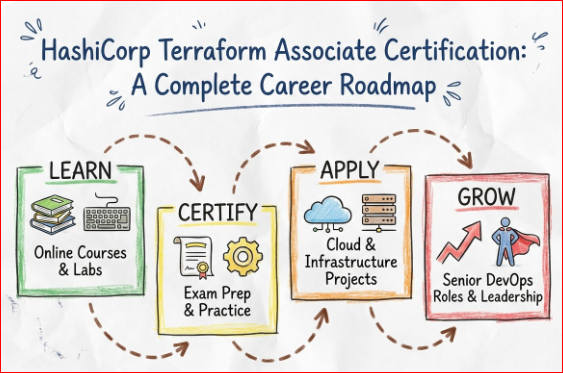
The world of cloud computing has fundamentally changed. Today, we no longer click through web consoles to build servers, networks, or databases. Instead, we write code. Infrastructure as Code (IaC) is the industry standard for deploying and managing technology environments, and HashiCorp Terraform is the undisputed king of this domain. If you are a working engineer, a software developer, or an engineering manager looking to validate your cloud automation skills, the HashiCorp Certified Terraform Associate certification is your gateway. This credential proves that you understand the core concepts of IaC, state management, and multi-cloud provisioning. This master guide will break down everything you need to know about this certification, how to prepare for it, and how it fits into your long-term career roadmap.
Certification Overview
| Track | Level | Who it is for | Prerequisites | Skills Covered | Recommended Order |
|---|---|---|---|---|---|
| Infrastructure as Code (IaC) | Associate (Foundational/Intermediate) | Software Engineers, Cloud Engineers, DevOps, Managers | Basic terminal skills, fundamental cloud knowledge (AWS/Azure/GCP) | IaC principles, Terraform CLI, modules, state management, Terraform Cloud | 1st certification in the IaC and Automation track |
What it is
The HashiCorp Certified Terraform Associate is an industry-recognized credential that validates your foundational knowledge of open-source Terraform and its enterprise features. It proves your ability to reliably provision, manage, and destroy multi-cloud infrastructure using code.
Who should take it
This certification is highly recommended for working engineers, system administrators, and software engineers transitioning into cloud automation roles. It is also incredibly valuable for engineering managers who oversee cloud teams and need to understand the mechanics of modern infrastructure delivery.
Skills you will gain
- Deep understanding of Infrastructure as Code (IaC) principles and advantages.
- Mastery of the Terraform CLI workflow (init, plan, apply, destroy).
- Ability to read, write, and modify declarative Terraform configuration files.
- Safe handling of Terraform state, including remote state storage and state locking.
- Knowledge of creating, using, and versioning reusable Terraform modules.
- Familiarity with Terraform Cloud and Terraform Enterprise capabilities.
Real-world projects you should be able to do after it
- Deploying a highly available, multi-tier web application architecture on AWS, Azure, or GCP entirely through code.
- Creating standardized, reusable networking modules (like VPCs and subnets) for your company’s enterprise landing zones.
- Automating the provisioning of disaster recovery infrastructure in secondary cloud regions.
- Integrating your Terraform code into CI/CD pipelines (like GitHub Actions or GitLab CI) for automated infrastructure delivery.
Preparation plan
- 7–14 days (Fast Track): For experienced cloud engineers who already use Terraform daily. Focus strictly on reviewing the exam objectives, mastering state management nuances, and taking mock exams to understand the question format.
- 30 days (Standard Path): For engineers with basic cloud knowledge but new to IaC. Spend week 1 on IaC theory, week 2 writing basic configurations, week 3 exploring modules and remote state, and week 4 doing hands-on labs and practice tests.
- 60 days (Beginner Path): For absolute beginners or managers. Take time to learn fundamental cloud concepts first. Build small, single-file deployments, slowly progressing to complex multi-module architectures before tackling exam prep.
Common mistakes
- Memorizing the documentation without actually writing and executing Terraform code in a real cloud environment.
- Ignoring the complexities of Terraform state, especially how state locking works in team environments.
- Failing to understand the functional differences between Terraform Open Source, Terraform Cloud, and Terraform Enterprise.
- Skipping the debugging and troubleshooting commands, such as
terraform taint(or the modernapply -replace) andterraform state rm.
Best next certification after this
Once you have mastered Terraform, the best next step is usually the Certified Kubernetes Administrator (CKA). Terraform is perfect for provisioning the underlying infrastructure (like an EKS or AKS cluster), while Kubernetes is the standard for running the containerized applications on top of that infrastructure.
Choose Your Path
Terraform is not just for DevOps engineers. It is a foundational tool that powers multiple specialized tech domains. Here is how Terraform fits into various modern career paths:
DevOps
In DevOps, Terraform is the bedrock of your toolchain. You will use it to provision servers, databases, and networks, pairing it with CI/CD tools to deliver infrastructure at the exact same speed you deliver software code.
DevSecOps
Security starts at the infrastructure level. In DevSecOps, you will use Terraform to define secure baselines. You will integrate security scanning tools (like tfsec or Checkov) directly into your Terraform pipelines to block insecure infrastructure before it is ever built.
SRE (Site Reliability Engineering)
For an SRE, manual changes are the enemy of reliability. Terraform allows you to maintain strict infrastructure consistency, enabling rapid disaster recovery and eliminating “configuration drift” across massive production environments.
AIOps/MLOps
Machine learning requires massive, expensive compute resources like GPU clusters. In AIOps and MLOps, you will use Terraform to dynamically spin up these expensive environments only when training models, and automatically destroy them afterward to save money.
DataOps
Modern data platforms are complex. DataOps engineers use Terraform to automate the deployment of data warehouses, ETL pipelines, and streaming infrastructure, ensuring data engineering teams always have scalable, repeatable environments.
FinOps
Cloud costs can spiral out of control without governance. FinOps practitioners use Terraform to enforce mandatory tagging policies on all cloud resources, making it easy to track spending back to specific teams, and automating the deletion of idle resources.
Role → Recommended Certifications Mapping
| Job Role | Foundational | Advanced / Specialized |
|---|---|---|
| DevOps Engineer | Hashicorp Terraform Associate | CKA, AWS Certified DevOps Engineer Pro |
| SRE | Hashicorp Terraform Associate | CKA, Datadog/New Relic Observability Certs |
| Platform Engineer | Hashicorp Terraform Associate | CKS, Hashicorp Vault Associate |
| Cloud Engineer | Hashicorp Terraform Associate | AWS Solutions Architect Pro, Azure Administrator |
| Security Engineer | Hashicorp Terraform Associate | Microsoft AZ-500, Certified Kubernetes Security (CKS) |
| Data Engineer | Hashicorp Terraform Associate | AWS Certified Data Analytics, Snowflake SnowPro |
| FinOps Practitioner | Hashicorp Terraform Associate | FinOps Certified Practitioner, AWS Cloud Practitioner |
| Engineering Manager | Hashicorp Terraform Associate | PMP, ITIL 4 Foundation |
Next Certifications to Take
After passing your Terraform Associate exam, you should strategically plan your next move based on your career goals:
- Same Track (HashiCorp Stack): HashiCorp Certified: Vault Associate. If you want to dive deeper into the HashiCorp ecosystem, Vault is the industry standard for secrets management and perfectly complements Terraform.
- Cross-Track (Containers/Cloud): Certified Kubernetes Administrator (CKA). If you want to master the complete modern cloud stack, learning to manage container orchestration on top of the infrastructure you just built with Terraform is the ultimate combination.
- Leadership (Management): FinOps Certified Practitioner. If you are moving toward management or architecture, understanding how to align cloud infrastructure provisioning (Terraform) with financial accountability (FinOps) makes you highly valuable to business leaders.
Top Institutions for Training & Certification
DevOpsSchool
DevOpsSchool is a premier, globally recognized training institution that offers the official Hashicorp Certified Terraform Associate program. They provide expert-led sessions, rigorous hands-on labs, and real-world project scenarios that ensure you are fully prepared for the exam and enterprise challenges.
Cotocus
Cotocus excels in providing corporate training and IT consulting, making their Terraform courses highly practical. Their instructors focus heavily on enterprise use cases, ensuring that working engineers learn how to apply IaC principles directly to their daily jobs.
Scmgalaxy
Scmgalaxy is a massive community-driven platform dedicated to software configuration management and automation. Their Terraform training resources are deeply rooted in real-world community knowledge, offering excellent peer support and practical troubleshooting guides.
BestDevOps
BestDevOps focuses on curating and delivering the most high-impact automation practices in the industry. Their Terraform courses are designed to help engineers implement robust, scalable infrastructure pipelines rapidly.
devsecopsschool.com
If your goal is to integrate security into your infrastructure provisioning, devsecopsschool.com is the ideal platform. They teach you not just how to use Terraform, but how to write secure code and implement infrastructure compliance checks from day one.
sreschool.com
For engineers focused on system reliability, sreschool.com offers Terraform training through the lens of Site Reliability Engineering. You will learn how to use IaC to reduce downtime, manage configuration drift, and build highly resilient cloud architectures.
aiopsschool.com
Operating at the cutting edge of tech, aiopsschool.com teaches engineers how to automate complex environments using Terraform. Their training is perfect for those looking to deploy scalable infrastructure that supports AI and machine learning workloads.
dataopsschool.com
Specializing in data engineering automation, dataopsschool.com provides Terraform training tailored for deploying data platforms. You will learn how to write code that reliably spins up databases, data lakes, and streaming services.
finopsschool.com
Cost management is a critical cloud skill, and finopsschool.com blends Terraform training with financial operations. They teach you how to write IaC that enforces budget constraints, tags resources correctly, and prevents cloud waste.
Frequently Asked Questions (FAQs)
1. How difficult is the Terraform Associate exam?
The exam is considered moderately difficult. It is not overly technical to the point of requiring complex programming logic, but it deeply tests your understanding of the Terraform CLI, state behavior, and IaC concepts. Practical experience makes it much easier.
2. How much time do I need to prepare?
If you use Terraform at work, you can prepare in 1 to 2 weeks by simply reviewing the syllabus. If you are a beginner, expect to spend about 30 to 45 days studying for a few hours each week and doing hands-on labs.
3. Are there any prerequisites for this certification?
There are no official prerequisites. However, having a basic understanding of terminal/command-line operations and fundamental knowledge of at least one public cloud (AWS, Azure, or GCP) is highly recommended.
4. Does the exam focus on a specific cloud provider like AWS?
No. Terraform is cloud-agnostic, and the exam focuses on Terraform’s core functionality, not cloud-specific resources. You might see example code using AWS or Azure, but the questions test Terraform concepts, not cloud provider concepts.
5. What is the format of the exam?
The exam consists of multiple-choice, multiple-answer, and true/false questions. It is a proctored online exam, typically lasting about one hour.
6. Does the certification hold value for Engineering Managers?
Absolutely. Managers need to understand how their teams are deploying infrastructure to manage risks, timelines, and costs. This certification gives managers the technical vocabulary and conceptual understanding to lead cloud teams effectively.
7. How does this certification impact my career outcomes?
Holding this certification instantly flags your resume for modern cloud, DevOps, and SRE roles. It proves you understand modern automation, which is a required skill for almost all senior engineering positions today.
8. Should I learn Terraform before or after Kubernetes?
You should learn Terraform first. Terraform is used to build the servers, networks, and clusters. Kubernetes runs on top of those clusters. Understanding how to provision the base infrastructure first makes learning Kubernetes much more intuitive.
9. What is the difference between Terraform and Ansible?
Terraform is a declarative provisioning tool designed to build and destroy immutable infrastructure (servers, networks). Ansible is an imperative configuration management tool designed to configure the software running inside those servers. They are often used together.
10. Do I need to know how to code in Go or Python to pass?
No. Terraform uses its own declarative language called HashiCorp Configuration Language (HCL). HCL is very readable, resembles JSON, and does not require traditional programming skills like loops and functions (though it has some lightweight programmatic features).
11. Does the exam cover Terraform Cloud and Enterprise?
Yes. While the bulk of the exam is about open-source Terraform, you are expected to understand the basic value propositions and features of Terraform Cloud and Enterprise, such as Sentinel policies and remote state backends.
12. Can I use the command line during the exam?
No. The exam is purely knowledge-based (multiple choice). There are no practical, command-line sandbox environments during the test, which is why hands-on practice beforehand is crucial for memorizing CLI commands.
13. How long is the certification valid?
The HashiCorp Certified Terraform Associate certification is valid for two years from the date you pass the exam. After two years, you must recertify.
14. Will this certification help me get a job in DevSecOps?
Yes. DevSecOps relies heavily on automated, secure infrastructure pipelines. Knowing Terraform allows you to understand where to inject security controls and how to read the infrastructure code you are trying to secure.
15. Is it worth getting certified if I already use AWS CloudFormation?
Yes. While CloudFormation is powerful, it is locked strictly to AWS. Most modern enterprises operate in multi-cloud environments or use third-party SaaS tools. Terraform can manage AWS, Azure, GCP, GitHub, DataDog, and hundreds of other platforms with a single workflow.
16. What happens if I fail the exam?
If you fail, you can retake the exam, but you will need to pay the exam fee again. There is usually a short waiting period before you can attempt it a second time.
17. How is Terraform state tested on the exam?
State is heavily tested. You must understand what the terraform.tfstate file is, why it contains sensitive data, how to store it remotely (like in an S3 bucket), and how state locking prevents multiple team members from corrupting the infrastructure.
18. Do I need to memorize all Terraform providers?
No. There are thousands of providers. You only need to understand what a provider is, how to declare it in your code, and how Terraform downloads it during the terraform init phase.
19. Can a Data Engineer benefit from this certification?
Highly. Data environments require massive databases, streaming clusters (like Kafka), and data warehouses (like Snowflake). Automating the creation of these resources with Terraform makes data engineering pipelines much more reliable.
20. What is the best way to practice for the exam?
The best method is to open a free tier account on AWS or Azure, install the Terraform CLI, and start building. Write code to create a VPC, add some servers, output their IP addresses, and then destroy them. Combine this with official practice tests.
Testimonials
“Transitioning from a traditional sysadmin role to a Cloud Engineer felt overwhelming until I learned Terraform. Earning the Terraform Associate certification gave me the structured knowledge I needed to automate our entire AWS environment. It completely changed the trajectory of my career.”
— Rahul M., Senior Cloud Engineer
“As an Engineering Manager, I was constantly a bottleneck for my team because I didn’t fully grasp our infrastructure deployment process. Going through the Terraform Associate training at DevOpsSchool helped me understand IaC principles deeply. Now, I can effectively review infrastructure PRs and lead my SRE teams with confidence.”
— Sarah K., VP of Engineering
“I wanted to move into DevSecOps, but lacked infrastructure skills. Mastering Terraform was the missing link. Once I understood how infrastructure was coded, I easily learned how to secure it using automated scanning tools. This certification was the highest-ROI credential I have earned.”
— Amit P., DevSecOps Architect
Conclusion
The HashiCorp Certified Terraform Associate is far more than just a badge on your resume; it is a fundamental shift in how you view and manage technology environments. In an era where speed, consistency, and multi-cloud architectures are non-negotiable, knowing how to code your infrastructure is a mandatory skill for modern IT professionals. Whether you are a developer looking to deploy your own applications, a system administrator automating away manual toil, or a manager aiming to modernize your team’s workflow, this certification lays the perfect foundation. By following the learning paths outlined in this guide and leveraging top-tier training platforms, you can master Infrastructure as Code and future-proof your career in the cloud computing industry. Start your IaC journey today, and stop clicking—start coding.
