Upgrade & Secure Your Future with DevOps, SRE, DevSecOps, MLOps!
We spend hours scrolling social media and waste money on things we forget, but won’t spend 30 minutes a day earning certifications that can change our lives.
Master in DevOps, SRE, DevSecOps & MLOps by DevOps School!
Learn from Guru Rajesh Kumar and double your salary in just one year.
It is 11 p.m., and a system admin is restarting the same service for the fourth time this week. Every night brings the same tired checks. He wonders what work would feel like if the servers fixed themselves.
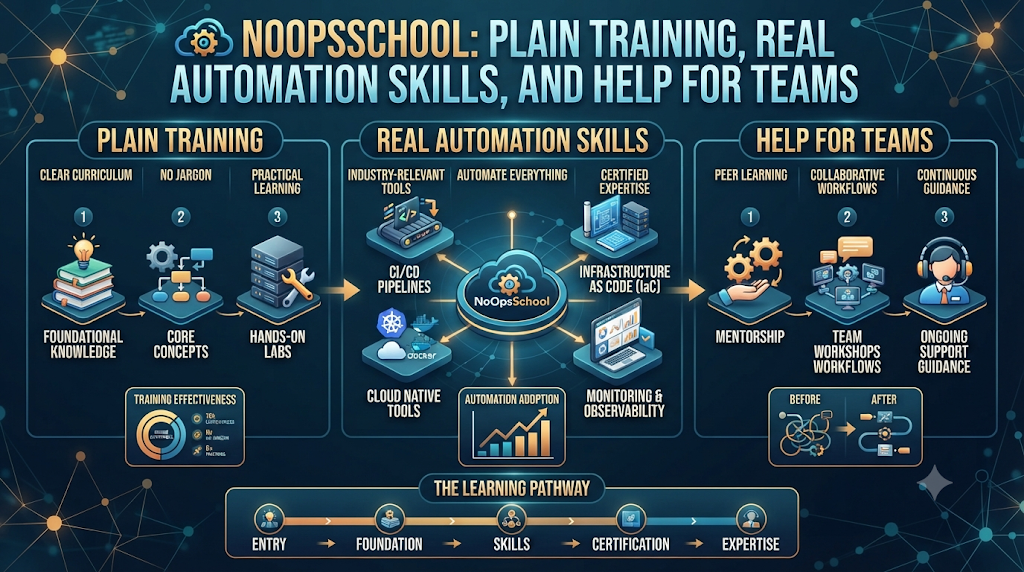
That thought sits at the heart of a big idea called NoOps, short for “No Operations.” NoOpsSchool is an online school that teaches this idea. It offers training courses, cert programs, learning resources, and direct help for companies that want less manual IT work. This article explains both sides of the site in plain words.
What NoOpsSchool Is and Who It Serves
NoOpsSchool is an IT education, certification, and consulting platform. Its focus areas are NoOps, cloud infrastructure automation, and modern software delivery. In short, it teaches people how to build systems that largely run and repair themselves.
The school serves a wide set of IT roles. DevOps engineers, cloud architects, platform engineers, developers, system admins, and IT managers all fit here. Teams that want to cut manual work through automation can also use the site.
The offer has two halves. For learners, the site lists NoOps training courses, certification programs, learning resources, and guidance on hands-off IT ops. For companies, the site advertises consulting services and access to skilled freelance experts.
The platform is based in India. It serves an international English-speaking technical audience through online training and professional services. So a learner in Ohio and a team in Berlin can both use it in the same language.
One point comes first, before all the tools. NoOps reduces manual workload. It does not remove the duty to stay accountable. People still watch, decide, and own the results, and the school builds its teaching around that fact.
At a Glance: Learners vs. Organizations
The site speaks to two very different readers. This chart shows how its offer splits between them.
| Area | For Learners and Professionals | For Organizations |
|---|---|---|
| Main purpose | Build and prove automation skills | Cut manual op work |
| What the site offers | Courses, certs, resources, guidance | Consulting services, freelancer access |
| Skills and topics | Cloud, Kubernetes, Terraform, GitOps, CI/CD | Matched to each project |
| Practical focus | Hands-on labs, real-world scenarios | Op reviews, strategy, implementation |
| Next step | Pick a role track and enroll | Confirm details with the site |
Read the chart as two doors into one building. Learners come to grow their careers. Teams come to get work done. Often one door leads to the other, since a trained engineer later drives the team’s own plan.
Part One: Learning NoOps, From First Steps to Certification
What is NoOps? A Plain Answer
Start with the question many engineers type into search bars: what is NoOps? The short answer is simple. NoOps is a goal where almost all op work, such as patching, scaling, and fixing, runs through automation. Teams then spend their time on design and review, not on hands-on tasks.
A related question follows fast: what happens to the people? The answer is calm. Automation removes repeated chores, not people. Someone must still write the rules the machines follow and check the results.
One useful tip comes before you study anything. Watch for the word “aim.” NoOps is a direction a team moves in, not a switch it flips. Any tool that promises zero human effort is overreaching.
NoOps vs DevOps: One Way to Look at It
Another common search is NoOps vs DevOps, so set both ideas side by side. DevOps is a set of practices that brings development and operations teams closer together. The goal is to ship software faster through shared ownership.
NoOps pushes the same spirit further. It aims to automate op work so teams spend less time on manual tasks. The two ideas are related, not opposed. They sit on one path, at different points.
For example, a team may fully automate its backups but still review deploys by hand. Real teams often use parts of both approaches, and that mix is fine. One way to look at it: DevOps is a shared way of working, and NoOps is where that way of working gets deeply automated. Human oversight stays in both cases.
Who the School Is For
The school names its learners clearly. DevOps engineers who want less manual toil. Cloud architects who shape large systems. Platform engineers who build internal tools. Developers who want to own more of their deploy. System admins buried in repetitive work. IT managers who plan budgets and skills.
Each role needs a slightly different thing, which is why the programs split by role. An engineer wants build skill. A manager wants plan skill. A developer wants deploy skill.
Here is a tip for choosing well. Match the program to the work you do most days, not to a title you wish you had. That match keeps you engaged, since you can apply each lesson at work the same week.
NoOps Training Courses and What They Cover
The core of the site is its coursework. A NoOps training course covers a broad set of modern topics, and each topic gets a plain explanation as you meet it. The list below follows the school’s own topics.
Infrastructure as code means writing server setup as text files that software can run. Cloud-native computing means building apps to live on cloud systems from day one. Kubernetes is a tool that runs and manages many small app containers across machines. Docker is a tool that packs an app and its needs into one portable container.
Terraform is a tool that builds cloud setups from written code. GitOps means storing the desired state of systems in version control and syncing to it. CI/CD automation means pipelines that test and release code with little manual work. Serverless design means running code on demand with no servers to manage.
Observability means collecting logs, metrics, and traces so you can see inside a system. AI-powered ops, sometimes called AIOps, uses machine models to spot and react to system problems. Each topic builds on the last, and the school teaches them as one connected skill set.
A tip about these topics goes far. Do not chase them all at once. Pick one, and stay with it until you can explain it to a coworker in a minute.
Hands-On Labs, Real Drills, and Self-Healing Systems
Reading about automation is easy. Doing it is hard, and the training materials stress practice. The courses push hands-on labs, which are guided sandbox drills where you set up and fix real systems yourself. They also use real-world pockets of work drawn from what teams face.
Two themes run through that practice. Self-healing systems means setups that detect failure and repair themselves without a person typing commands. Automated response means software that takes the first steps when something breaks. The on-call engineer then starts from a calm place.
These two themes define the NoOps goal. The system does the midnight restarts. The people design the rules that let it do so safely.
One tip for lab work helps a lot. Break things on purpose. In a sandbox, an outage you caused teaches more than one you only read about.
Tools and Technologies on the List
Learners also ask about NoOps automation tools. The school names a specific set: Kubernetes, Docker, Terraform, GitOps, and CI/CD. These five appear across its courses.
It helps to see how they fit in one flow. Docker packs an app into a container. Kubernetes runs containers at scale. Terraform builds the cloud setup they run on. GitOps stores the desired state in version control. CI/CD pipelines then test and ship every change.
A tip on learning order serves many learners well. Learn packaging and shipping first, since containers and pipelines touch everything else. Then add code-built server setup, and finally the deeper platform topics.
NoOps Cert Tracks
Alongside its courses, the school offers certification. Many learners arrive after searching for a NoOps certification, so this part matters. NoOpsSchool offers cert tracks that match its learning programs, so each role track pairs with a matching certificate track.
The site does not advertise exam formats, pass rates, or industry recognition for these certificates. It presents them inside its training programs. If such details matter to you, ask the school directly before you enroll.
One tip about certs keeps your outlook fair. Treat the certificate as a record of study, not a promise of a job. The real proof of skill comes from what you can build, and the labs grow that proof.
The NoOps Engineer Track
The engineer track is the builder’s path. It pairs a learning program with a NoOps engineer certification from the school. It suits people who write automation code and keep pipelines alive.
The training aims to give experts the skills to build, run, and improve cloud setups that mostly run themselves. The school does not spell out every tool per role on the site, so confirm the exact syllabus of each track there.
One tip for engineers on this path works well. Save your lab setups in a notes file. Rebuilding them from memory weeks later is the fastest way to make the knowledge stick.
The NoOps Architect Track
The architect track is the designer’s path. It pairs a program with NoOps architect training and a matching cert track. The school aims this material at people who plan the big picture of self-running environments.
Where an engineer writes the pipeline, an architect decides how many pipelines exist and how they link. That planning view of automation is what this track serves.
One tip for learners on this path. As you study each topic, sketch how it would look at your own company’s scale. Design choices get much easier once the tools sit on a real map.
The NoOps Manager Track
The manager track is the planner’s path. It pairs a program with a NoOps manager certification. The school builds it for people who guide rather than type commands, so team leads and IT managers fit well.
The focus sits on sound calls about automation. What should a team automate first? How much oversight must remain? Where do the skill gaps sit? Those choices decide whether a NoOps push succeeds.
One tip for managers on this track works well. Write down your team’s most repeated manual task before you start. Each topic will then read as an answer to that real problem.
The NoOps Professional Track
The professional track is the wide path. The school offers a learning program and cert track for NoOps Professionals. It aims at people whose work spans a few of the roles above, such as a platform engineer who builds, codes, and plans.
This track suits learners who want wide coverage rather than one deep focus. It accepts that many real jobs do not fit in one box.
One tip for choosers of this track. Be honest about your goal. If your work spans many areas, breadth wins. If you live in one tool all week, a role track may fit tighter.
Resources and Guidance Beyond Courses
Courses and certs are not the whole site. Its learning content also covers NoOps concepts, NoOps vs DevOps, NoOps architecture, tools, and self-running system management. That last phrase means systems that manage themselves with light human touch.
The school also offers practical guidance for teams moving to hands-off IT ops. This guidance sits between study and action. It helps a learner turn fresh ideas into a plan their own team can follow.
One tip about using these resources. Read the concept pages before the tool pages. Terms such as self-running systems make more sense after the basics are set.
Which Offering Fits You? A Quick Map
Five kinds of help sit on this site, and they overlap less than you might think. Use this chart to find your entry point.
| Offering | What It Covers | Who It Helps |
|---|---|---|
| Training courses | NoOps, cloud automation, modern delivery topics | Engineers, admins, developers, architects |
| Cert tracks | Matched to each learning program | Learners who want proof of study |
| Learning resources | NoOps concepts, architecture, tool explainers | Anyone building background |
| Consulting services | Op reviews, strategy, modernization, automation | Companies cutting manual work |
| Freelance experts | Terraform, Kubernetes, cloud, monitoring skills | Teams needing outside skill |
Be clear about how to read it. The first three rows are paths you walk as a learner. The last two are services the site advertises to companies. Terms and scope should be confirmed directly with the site before you decide anything.
Part Two: For Companies, From Review to Build
NoOps Consulting Services: What the Site Advertises
Teams that want outside help have a second door. The site advertises NoOps consulting services, a portfolio aimed at cutting manual op work through automation. The word “advertised” matters. This article describes what the site lists, and every real commitment should be confirmed with the school itself.
The portfolio covers a clear set of areas: op reviews, automation strategy, cloud-native modernization, server provisioning, CI/CD implementation, AIOps integration, and security automation. Each area maps to a stage of a journey, from first look to full build.
A tip for teams before that first call. Walk in knowing your pain points. A list of your most repetitive manual tasks will make the talk far more useful.
Reviews and Automation Strategy
Two portfolio areas sit at the start. An op review is a check of how a team works today. It finds which tasks stay manual and where the friction sits. An automation strategy then turns that picture into an ordered plan.
These suit companies that know they must change but not where to start. Order matters greatly in this work. A team that automates the wrong task first spends real money learning that.
One tip shines here. Insist that the plan names what stays manual. Teams that keep humans in clear control of key choices automate with far more confidence.
Cloud-Native Modernization and Server Provisioning
The next two areas are about the base. Cloud-native modernization means reshaping older systems so they follow cloud design ideas, such as small services and containers. Server provisioning means setting up servers and networks through code, not manual clicks.
These areas suit companies running older systems on hand-built setups. Once a system is cloud-native and built by code, the rest of the NoOps toolkit sits on a stable floor.
A tip before this work begins. Start with one system, not the whole estate. One service moved and built by code teaches the pattern at low risk.
CI/CD, AIOps, and Security Automation
Three portfolio areas continue the build. CI/CD implementation means setting up pipelines that test and release code automatically. AIOps integration means adding machine models that watch system signals and flag or act on problems. Security automation means running checks such as scans and policy tests inside the pipeline, not after the fact.
These areas suit companies whose teams ship code but still release and review by hand. Together, they move human effort from execution to review.
One tip ties all three together. Add monitoring before you automate any response. Automation acting on weak signals does the wrong things very fast. Seeing clearly should come first.
Access to Freelance Experts
Sometimes a team wants a person, not a firm. The site advertises access to freelance experts that focus on Terraform, Kubernetes, cloud platforms, automated monitoring, and self-healing systems. A team can hire NoOps freelancers through this route when a task needs deep skill for a short time.
A pipeline that must be built once, or a cluster setup that needs review, fits that shape. The school lists those skill areas, and this article adds nothing to them.
The careful advice here matters. Rates, terms, and working styles are not described in the facts this article uses. Companies should confirm all such details with the site before they commit to anyone.
Realistic Expectations: What NoOps Does and Does Not Do
Set fair expectations before any promise is made. NoOps reduces manual op work. That claim sits at the center of the idea and the school’s material. Less repetitive toil is a real and reachable goal.
But NoOps does not remove accountability or human oversight. Machines can run tasks and react to alerts. People still own the design, the review, and the results. A team that forgets this will automate its own blind spots, and that path ends badly.
Fair goals sound like this. Spend fewer hours on repeated tasks. Keep every key choice with a person. Grow the team’s skill step by step. Be wary of anyone promising fully autonomous ops or instant results. Good automation is built in layers over time, by people who know what the machines are doing.
Tips for Learners and Organizations
For learners and professionals:
- Start with the basics before the tools. The concept pages give you the “why,” and each tool lesson then makes more sense.
- Pick the role track that matches your job. Each track aims at real work you already do.
- Give the hands-on labs real time. Reading a topic takes minutes, but doing it once in a lab makes it yours.
- Learn one topic at a time. Finish infrastructure as code before you start Kubernetes, and you will never drown.
For companies:
- Review your manual work first. Write down the repeated tasks, so any first talk starts from facts.
- Set realistic goals for the push. Aim for less manual toil, not a mythic zero-ops team.
- Keep humans in the loop at key points. Decide before you automate which choices stay with people.
- Confirm current details with the site before you decide. Course scope and service terms both deserve a direct check.
A Hypothetical Scenario
Note that this scenario is hypothetical. Say a mid-size company runs a small platform team of three. Each month they lose days to manual releases, hand-built server setups, and late-night alerts. The lead engineer wants change but has no map.
First, the team learns. They read the school’s pages on NoOps and its architecture, and everyone now shares one vocabulary. The lead also confirms that no plan here removes the operations knowledge. Only the chores go.
Next, each person picks a track. The lead joins the manager level to plan the push. One engineer takes the engineer track for the pipeline work. A second engineer looks at the professional track, since her work spans many areas.
Then they practice. In the labs, the team builds a small container setup and tries self-healing examples in a sandbox. The drills mirror real team problems, not toy examples alone.
Finally, the company checks outside help. It reads the consulting list, from op reviews to security automation, and the list of freelance skill areas, from Terraform to self-healing systems. The team confirms scope and terms directly with the site, then picks a starting point. No results were promised. But the team now has one shared plan, trained people, and a clear next step.
Frequently Asked Questions About NoOpsSchool
What exactly is NoOpsSchool, and who uses it?
It is an online IT education, certification, and consulting platform. It serves engineers, architects, admins, developers, IT managers, and companies that want automation. It is based in India and teaches in English worldwide.
Can you explain NoOps in one plain line?
It is a goal where nearly all op work runs through automation. Teams spend less time on manual tasks. People still watch, review, and own the results.
How do NoOps and DevOps relate to each other?
One way to look at it: DevOps is a set of practices that joins development and operations teams. NoOps pushes that same spirit further through deep automation. Real teams often use parts of both.
If systems run themselves, are people still needed?
Yes. NoOps reduces manual work but never removes accountability or oversight. Someone must design the automation and check what it does. The school’s material says this clearly.
Do all four role programs lead to a certificate?
The school lists separate programs for NoOps Engineers, Archists, Managers, and Professionals. Each has a matching cert track. Ask the site for exam or certificate details.
What will I actually study in the courses?
The content covers infrastructure as code, cloud-native computing, Kubernetes, Docker, Terraform, GitOps, CI/CD, serverless design, observability, and AI-powered ops. Each term comes with a plain explanation. Labs run beside the reading.
Are the labs like real work situations?
The training stresses hands-on labs and real-world pockets of work. You practice on self-healing systems and automated response. Those drills mirror problems working teams face.
Which tools does the material teach, by name?
The site lists Kubernetes, Docker, Terraform, GitOps, and CI/CD across its courses. The facts this article uses do not tie any tool to a specific role. Check the course pages for the current split.
Where is the platform based, and who can join?
NoOpsSchool is based in India. It serves an international English-speaking technical audience online. Anyone in the listed IT roles can learn through its programs.
What services does the site advertise for companies?
It advertises consulting services covering op reviews, automation strategy, cloud-native modernization, server provisioning, CI/CD implementation, AIOps integration, and security automation. It also advertises freelance access. Confirm all terms with the site.
What skills do the listed freelancers bring?
The freelancer section focuses on Terraform, Kubernetes, cloud platforms, automated monitoring, and self-healing systems. The site presents these skill areas as its focus for matching experts. Engagement details should be confirmed with the site.
Who should think about the manager-level track?
The school builds that program for people who guide work rather than type commands. Team leads and IT managers fit well. It pairs a learning program with a matching cert track.
Final Thoughts
NoOps is a big word on a simple promise. Let software handle the repeated toil so skilled people can design, review, and lead. NoOpsSchool turns that promise into a path. Learners get role-based tracks, plain teaching, and labs that demand practice. Companies get a menu of advertised consulting help and a list of freelance skill areas. Nothing here runs itself by magic, and no one should want that. People stay in charge, and the machines take the heavy lifting. If your nights fill up with the same old fixes, start with a shared map and take the steps one at a time.
