Upgrade & Secure Your Future with DevOps, SRE, DevSecOps, MLOps!
We spend hours scrolling social media and waste money on things we forget, but won’t spend 30 minutes a day earning certifications that can change our lives.
Master in DevOps, SRE, DevSecOps & MLOps by DevOps School!
Learn from Guru Rajesh Kumar and double your salary in just one year.
Introduction
Influencer Marketing Platforms help brands discover creators, manage collaborations, run campaigns, track performance, approve content, handle payments, and measure results from influencer partnerships. In simple words, these tools make it easier to find the right influencers and manage the full campaign workflow from outreach to reporting.
Influencer marketing matters because buyers often trust creator recommendations, niche communities, expert voices, and authentic product stories more than traditional ads. A good platform helps teams avoid random influencer selection, fake engagement, poor campaign tracking, missed deadlines, and weak ROI visibility.
Common use cases include creator discovery, influencer outreach, campaign management, product seeding, affiliate tracking, content approval, performance reporting, and creator relationship management.
Buyers should evaluate influencer database quality, audience insights, fraud detection, campaign workflows, creator communication, payment support, ecommerce integrations, reporting, team approvals, and security.
Best for: ecommerce brands, DTC companies, agencies, consumer brands, SaaS marketers, PR teams, social media managers, performance marketers, and enterprises running creator campaigns at scale.
Not ideal for: businesses with no social strategy, teams running only one small creator collaboration, or companies that need only basic manual outreach through spreadsheets and email.
Key Trends in Influencer Marketing Platforms
- AI-assisted creator discovery is becoming more useful for matching brands with creators based on audience fit, niche, content style, engagement quality, and campaign goals.
- Micro and niche creators are gaining more attention because smaller creators often have highly engaged communities and stronger trust within focused audiences.
- Performance-based influencer campaigns are growing as brands want trackable clicks, sales, affiliate revenue, promo code usage, and customer acquisition data.
- Creator relationship management is becoming important because brands now treat influencers as long-term partners, not one-time media placements.
- Fraud detection and audience quality checks are essential due to fake followers, inflated engagement, bot activity, and mismatched audience demographics.
- Content usage rights are now a major workflow need as brands reuse influencer content across ads, landing pages, emails, and product pages.
- Ecommerce integrations are improving with product gifting, affiliate links, discount codes, storefronts, and revenue attribution.
- Approval workflows are becoming stronger as legal, brand, product, and compliance teams need to review sponsored content before it goes live.
- Social commerce is increasing campaign complexity because creators influence discovery, consideration, purchase, and post-purchase advocacy.
- Better reporting is expected with metrics like reach, engagement, clicks, conversions, cost per acquisition, content value, and creator-level ROI.
How We Selected These Tools
- Market recognition across influencer discovery, campaign management, creator relationship management, and influencer analytics.
- Feature completeness for discovery, outreach, campaign briefs, approvals, tracking, reporting, and payments.
- Fit across SMBs, agencies, ecommerce brands, mid-market teams, and enterprise marketing organizations.
- Strength of creator database, audience insights, fraud detection, and brand-fit analysis.
- Integration depth with ecommerce platforms, affiliate systems, CRM tools, social platforms, and analytics workflows.
- Security posture signals such as account permissions, user roles, access controls, and workflow governance.
- Ease of use for marketers, agencies, social teams, and campaign managers.
- Scalability for managing many creators, campaigns, regions, products, and brands.
- Reporting quality for both brand awareness and performance-driven campaigns.
- Overall value compared with pricing, complexity, onboarding needs, and campaign volume.
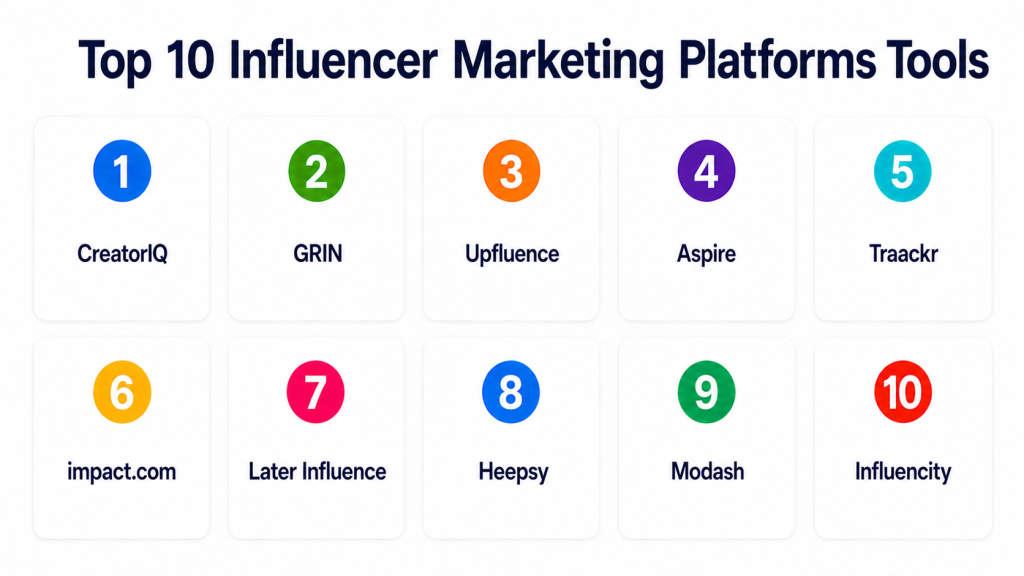
Top 10 Influencer Marketing Platforms Tools
#1 — CreatorIQ
Short description: CreatorIQ is an enterprise influencer marketing platform for creator discovery, campaign management, measurement, and relationship management. It is best for large brands and agencies managing structured influencer programs at scale.
Key Features
- Creator discovery and audience analysis.
- Campaign management workflows.
- Influencer relationship management.
- Creator content tracking.
- Brand safety and fraud detection signals.
- Reporting and performance measurement.
- Enterprise collaboration and governance features.
Pros
- Strong fit for enterprise influencer programs.
- Good for managing large creator networks.
- Useful for campaign measurement and creator relationship tracking.
Cons
- May be too advanced for small teams.
- Pricing and implementation can be enterprise-focused.
- Requires process maturity to get full value.
Platforms / Deployment
Web
Cloud
Security & Compliance
Supports user permissions, access controls, workflow governance, and secure campaign management. Specific certifications should be validated directly.
Integrations & Ecosystem
CreatorIQ works well for larger marketing teams that need influencer data connected with campaign and business workflows.
- Social platforms
- Ecommerce workflows
- Affiliate tracking tools
- Reporting systems
- CRM-style creator workflows
- Marketing analytics tools
Support & Community
CreatorIQ provides enterprise onboarding, customer success support, documentation, and strategic guidance for mature influencer programs.
#2 — GRIN
Short description: GRIN is an influencer marketing platform focused on ecommerce creator management, product seeding, affiliate tracking, and campaign reporting. It is best for DTC and ecommerce brands building creator-led growth programs.
Key Features
- Influencer relationship management.
- Creator discovery and recruitment.
- Product gifting and seeding workflows.
- Affiliate links and discount code tracking.
- Campaign briefs and content approvals.
- Ecommerce performance reporting.
- Creator communication workflows.
Pros
- Strong ecommerce and DTC focus.
- Good for product gifting and creator relationships.
- Useful for tracking creator-driven revenue.
Cons
- Best value depends on ecommerce campaign volume.
- May be more than early-stage brands need.
- Setup requires organized creator and product workflows.
Platforms / Deployment
Web
Cloud
Security & Compliance
Supports user permissions, secure account access, campaign controls, and creator data management. Specific certifications should be validated directly.
Integrations & Ecosystem
GRIN fits brands that connect influencer campaigns with ecommerce growth.
- Ecommerce platforms
- Affiliate workflows
- Product gifting tools
- Email communication
- Social platforms
- Analytics tools
Support & Community
GRIN provides onboarding, customer support, campaign resources, documentation, and ecommerce influencer marketing guidance.
#3 — Upfluence
Short description: Upfluence helps brands discover influencers, manage campaigns, track outreach, and connect influencer activity with ecommerce performance. It is best for ecommerce brands, agencies, and marketing teams that need creator discovery plus campaign management.
Key Features
- Influencer search and discovery.
- Audience and engagement analysis.
- Campaign management.
- Outreach and creator communication.
- Ecommerce integrations.
- Affiliate and promo code tracking.
- Reporting dashboards.
Pros
- Strong creator discovery database.
- Good ecommerce integration options.
- Useful for outreach and campaign tracking.
Cons
- May require training for advanced workflows.
- Data quality should be reviewed during evaluation.
- Pricing may not fit very small teams.
Platforms / Deployment
Web
Cloud
Security & Compliance
Supports account controls, user permissions, and secure campaign workflows. Specific certifications should be validated directly.
Integrations & Ecosystem
Upfluence connects influencer discovery with ecommerce and campaign operations.
- Ecommerce platforms
- Social media platforms
- Affiliate tracking
- CRM-style workflows
- Email outreach
- Campaign analytics
Support & Community
Upfluence provides documentation, onboarding support, customer success resources, and campaign guidance.
#4 — Aspire
Short description: Aspire is an influencer marketing platform for creator discovery, campaign workflows, content collaboration, product seeding, and reporting. It is best for ecommerce, lifestyle, beauty, fashion, wellness, and consumer brands.
Key Features
- Creator discovery and recruitment.
- Campaign brief management.
- Product gifting and seeding.
- Creator communication.
- Content approval workflows.
- Performance reporting.
- Relationship management tools.
Pros
- Good fit for consumer and ecommerce brands.
- Useful for managing creator collaborations.
- Supports both discovery and campaign execution.
Cons
- May not be ideal for very small one-off campaigns.
- Advanced needs may require onboarding support.
- Pricing and capabilities vary by plan.
Platforms / Deployment
Web
Cloud
Security & Compliance
Supports access controls, team permissions, and secure creator campaign management. Specific certifications should be validated directly.
Integrations & Ecosystem
Aspire fits brands running structured creator programs and product-led campaigns.
- Ecommerce platforms
- Social platforms
- Creator outreach workflows
- Product seeding systems
- Reporting workflows
- Content approval tools
Support & Community
Aspire provides onboarding resources, customer support, documentation, and creator campaign strategy guidance.
#5 — Traackr
Short description: Traackr is an influencer marketing and creator intelligence platform focused on discovery, relationship management, competitive insights, and performance measurement. It is best for larger brands that need data-driven influencer strategy.
Key Features
- Influencer discovery and vetting.
- Audience and engagement insights.
- Creator relationship management.
- Competitive benchmarking.
- Campaign performance measurement.
- Brand safety and authenticity signals.
- Reporting and analytics dashboards.
Pros
- Strong analytics and influencer intelligence.
- Good for global brand and enterprise teams.
- Useful for long-term creator relationship strategy.
Cons
- May be too advanced for small brands.
- Best suited for teams with mature influencer programs.
- Campaign execution workflows may need process planning.
Platforms / Deployment
Web
Cloud
Security & Compliance
Supports user permissions, account controls, and secure influencer data workflows. Specific certifications should be validated directly.
Integrations & Ecosystem
Traackr works well for brands that treat influencer marketing as a strategic channel.
- Social platforms
- Analytics workflows
- Creator databases
- Reporting tools
- Campaign planning systems
- Brand measurement workflows
Support & Community
Traackr provides customer success support, onboarding resources, documentation, and strategic influencer marketing guidance.
#6 — impact.com
Short description: impact.com supports partnerships, affiliate marketing, influencer campaigns, creator tracking, contracting, payments, and performance measurement. It is best for brands that want influencer marketing connected with partnership and affiliate revenue.
Key Features
- Partnership and influencer management.
- Affiliate and creator tracking.
- Contracting workflows.
- Performance reporting.
- Payment workflows.
- Promo code and link tracking.
- Partner lifecycle management.
Pros
- Strong for performance-driven influencer programs.
- Good fit for affiliate and partnership teams.
- Useful for tracking revenue and partner contribution.
Cons
- May be broader than influencer-only teams need.
- Setup can require partnership operations planning.
- Smaller brands may find it complex.
Platforms / Deployment
Web
Cloud
Security & Compliance
Supports account permissions, partner controls, payment workflow controls, and secure platform access. Specific certifications should be validated directly.
Integrations & Ecosystem
impact.com connects influencer campaigns with broader partnership and affiliate ecosystems.
- Affiliate networks
- Ecommerce platforms
- CRM systems
- Payment workflows
- Campaign tracking
- Analytics tools
Support & Community
impact.com provides documentation, support, onboarding, partner program guidance, and enterprise customer success resources.
#7 — Later Influence
Short description: Later Influence supports influencer discovery, creator campaign management, and branded content workflows. It is best for social-first brands that want influencer marketing connected with visual content and social planning.
Key Features
- Creator discovery.
- Influencer campaign management.
- Content collaboration.
- Campaign tracking.
- Social content workflows.
- Creator communication.
- Reporting and performance insights.
Pros
- Good fit for visual and social-first campaigns.
- Useful for creator content workflows.
- Practical for brands already focused on social planning.
Cons
- May not match enterprise-level influencer intelligence depth.
- Advanced ecommerce attribution may require other tools.
- Best suited for content and campaign workflows.
Platforms / Deployment
Web
Cloud
Security & Compliance
Supports team access controls and secure campaign workflows. Specific certifications are not publicly stated here.
Integrations & Ecosystem
Later Influence fits brands connecting influencer content with social media planning.
- Social platforms
- Content calendars
- Creator workflows
- Campaign reporting
- Visual content workflows
- Social media management tools
Support & Community
Later provides documentation, support resources, creator marketing guidance, and social media education.
#8 — Heepsy
Short description: Heepsy is an influencer discovery platform that helps brands search for creators by niche, location, audience, and engagement signals. It is best for small businesses and agencies that mainly need influencer discovery.
Key Features
- Influencer search and filtering.
- Audience demographic insights.
- Engagement analysis.
- Location and niche filters.
- Creator list building.
- Contact discovery workflows.
- Basic campaign planning support.
Pros
- Simple influencer discovery experience.
- Good for smaller teams and agencies.
- Useful for finding niche creators quickly.
Cons
- Not a full enterprise campaign management suite.
- Limited advanced workflow and payment features.
- Data quality should be checked before outreach.
Platforms / Deployment
Web
Cloud
Security & Compliance
Supports account access controls and secure platform use. Specific certifications are not publicly stated here.
Integrations & Ecosystem
Heepsy is mainly focused on influencer discovery and list building.
- Social creator discovery
- Outreach workflows
- Creator lists
- Campaign research
- Agency prospecting
- Manual CRM workflows
Support & Community
Heepsy provides help resources, documentation, and support for creator search and influencer discovery workflows.
#9 — Modash
Short description: Modash is an influencer discovery and analytics platform focused on finding creators, checking audience quality, and managing influencer lists. It is useful for brands and agencies that need creator discovery and vetting.
Key Features
- Influencer discovery.
- Audience demographics.
- Fake follower and quality checks.
- Creator list management.
- Contact and outreach support.
- Campaign monitoring features.
- Creator analytics.
Pros
- Strong creator discovery and vetting.
- Useful for checking audience quality.
- Good fit for agencies and ecommerce teams.
Cons
- Campaign execution features may be lighter than full suites.
- Payment and contracting workflows may require other tools.
- Best for discovery-heavy workflows.
Platforms / Deployment
Web
Cloud
Security & Compliance
Supports secure account access and user controls. Specific certifications are not publicly stated here.
Integrations & Ecosystem
Modash fits teams that need influencer research and creator quality checks.
- Social creator discovery
- Influencer databases
- Outreach workflows
- Campaign monitoring
- Creator lists
- Ecommerce creator research
Support & Community
Modash provides documentation, support resources, onboarding guidance, and creator discovery education.
#10 — Influencity
Short description: Influencity is an influencer marketing platform for creator discovery, campaign management, analytics, and reporting. It is best for agencies and brands that want a structured tool for influencer research and campaign operations.
Key Features
- Influencer discovery.
- Audience and profile analysis.
- Campaign management.
- Influencer relationship tracking.
- Performance reporting.
- Creator list organization.
- Collaboration workflows.
Pros
- Good balance of discovery and campaign management.
- Useful for agencies managing multiple campaigns.
- Practical analytics for creator selection.
Cons
- May not have the same enterprise depth as larger platforms.
- Advanced ecommerce attribution may require integrations.
- Teams should test reporting fit before committing.
Platforms / Deployment
Web
Cloud
Security & Compliance
Supports user permissions, account controls, and secure campaign workflows. Specific certifications are not publicly stated here.
Integrations & Ecosystem
Influencity fits influencer research, campaign planning, and agency workflows.
- Social platforms
- Creator databases
- Campaign reports
- Agency workflows
- Outreach planning
- Analytics workflows
Support & Community
Influencity provides documentation, support resources, onboarding help, and influencer marketing guidance.
Comparison Table
| Tool Name | Best For | Platform(s) Supported | Deployment | Standout Feature | Public Rating |
|---|---|---|---|---|---|
| CreatorIQ | Enterprise influencer programs | Web | Cloud | Creator intelligence and large-scale campaign management | N/A |
| GRIN | Ecommerce creator relationships | Web | Cloud | Product seeding and creator revenue tracking | N/A |
| Upfluence | Discovery and ecommerce campaigns | Web | Cloud | Influencer discovery with ecommerce integrations | N/A |
| Aspire | Consumer brand creator campaigns | Web | Cloud | Creator collaboration and product gifting workflows | N/A |
| Traackr | Influencer intelligence and benchmarking | Web | Cloud | Data-driven creator relationship strategy | N/A |
| impact.com | Partnerships and influencer revenue | Web | Cloud | Affiliate and influencer performance tracking | N/A |
| Later Influence | Social-first influencer content | Web | Cloud | Influencer workflows connected with social content | N/A |
| Heepsy | Simple influencer discovery | Web | Cloud | Creator search and niche filtering | N/A |
| Modash | Creator vetting and audience quality | Web | Cloud | Influencer discovery with audience quality checks | N/A |
| Influencity | Agency influencer campaign workflows | Web | Cloud | Discovery, campaign management, and reporting | N/A |
Evaluation & Scoring of Influencer Marketing Platforms
| Tool Name | Core (25%) | Ease (15%) | Integrations (15%) | Security (10%) | Performance (10%) | Support (10%) | Value (15%) | Weighted Total (0–10) |
|---|---|---|---|---|---|---|---|---|
| CreatorIQ | 9 | 6 | 8 | 8 | 8 | 9 | 6 | 7.75 |
| GRIN | 9 | 7 | 9 | 8 | 8 | 8 | 7 | 8.05 |
| Upfluence | 8 | 7 | 8 | 8 | 8 | 8 | 7 | 7.70 |
| Aspire | 8 | 8 | 8 | 8 | 8 | 8 | 7 | 7.85 |
| Traackr | 8 | 7 | 7 | 8 | 8 | 8 | 7 | 7.55 |
| impact.com | 9 | 6 | 9 | 9 | 8 | 8 | 7 | 8.00 |
| Later Influence | 7 | 8 | 7 | 7 | 8 | 7 | 8 | 7.40 |
| Heepsy | 7 | 9 | 6 | 7 | 7 | 7 | 8 | 7.35 |
| Modash | 8 | 8 | 7 | 7 | 8 | 7 | 8 | 7.65 |
| Influencity | 8 | 8 | 7 | 7 | 8 | 7 | 8 | 7.65 |
These scores are comparative and should be used as a practical selection guide, not as a fixed ranking. GRIN and Aspire are strong for ecommerce and creator collaboration. CreatorIQ and Traackr fit enterprise influencer programs. impact.com is useful when influencer marketing connects with affiliate and partnership revenue. Heepsy, Modash, and Influencity are practical for discovery, vetting, and agency workflows.
Which Influencer Marketing Platforms Tool Is Right for You?
Solo / Freelancer
Solo marketers and freelancers usually need simple creator discovery, list building, and basic outreach. They may not need a full campaign management suite.
Good options:
- Heepsy for simple influencer search.
- Modash for creator vetting and audience checks.
- Influencity for campaign planning and reporting.
- Later Influence for social-first creator content workflows.
SMB
SMBs need practical discovery, outreach, campaign tracking, and creator collaboration without heavy enterprise complexity.
Good options:
- Upfluence for discovery and ecommerce campaigns.
- Aspire for product gifting and creator collaboration.
- GRIN for ecommerce creator relationship management.
- Modash for audience quality and creator research.
- Influencity for structured campaign workflows.
Mid-Market
Mid-market teams often need better reporting, content approvals, product seeding, creator communication, and ecommerce or affiliate tracking.
Good options:
- GRIN for ecommerce creator management.
- Aspire for campaign workflows and gifting.
- Upfluence for creator discovery and activation.
- impact.com for affiliate-connected influencer programs.
- Traackr for influencer strategy and measurement.
Enterprise
Enterprises need governance, scale, creator intelligence, reporting, approvals, brand safety, regional workflows, and multi-team collaboration.
Good options:
- CreatorIQ for enterprise influencer operations.
- Traackr for influencer intelligence and benchmarking.
- impact.com for partnership and performance-based creator programs.
- GRIN for large ecommerce creator programs.
- Aspire for structured brand collaborations.
Budget vs Premium
Budget-focused teams should start with discovery and manual outreach tools. Premium platforms are better when influencer marketing becomes a repeatable growth channel with many creators, campaigns, approvals, and performance goals.
Budget-friendly scenarios:
- Small creator discovery.
- Manual outreach.
- One-off campaigns.
- Local influencer programs.
- Simple gifting campaigns.
Premium scenarios:
- Large creator communities.
- Ecommerce revenue tracking.
- Affiliate and influencer partnerships.
- Brand safety review.
- Multi-market campaigns.
- Enterprise reporting and approvals.
Feature Depth vs Ease of Use
Ease of use matters when teams are just starting influencer marketing. Feature depth matters when teams manage many creators, track ROI, handle payments, and reuse creator content.
Choose ease of use when:
- You run small campaigns.
- You mainly need creator search.
- Your team is small.
- You do manual outreach.
- You do not need complex reporting.
Choose feature depth when:
- You manage many influencers.
- You need product gifting.
- You need revenue attribution.
- You need approval workflows.
- You need fraud detection.
- You need creator relationship management.
Integrations & Scalability
Influencer platforms are most useful when connected with ecommerce, affiliate tracking, customer data, content workflows, and reporting systems.
Important integrations include:
- Ecommerce platforms
- Affiliate tracking tools
- CRM systems
- Email tools
- Social media platforms
- Product gifting workflows
- Payment tools
- Analytics platforms
- Content approval tools
- Reporting dashboards
Security & Compliance Needs
Influencer marketing platforms manage creator data, contracts, campaign briefs, content rights, payments, and sometimes customer or ecommerce data. Security and governance should be reviewed carefully.
Important checks include:
- Role-based access control.
- User permissions.
- Approval workflows.
- Creator data handling.
- Contract and payment controls.
- Content usage rights.
- Audit logs.
- SSO/SAML.
- MFA.
- Vendor security documentation.
Frequently Asked Questions
What is an Influencer Marketing Platform?
An Influencer Marketing Platform helps brands find influencers, manage campaigns, communicate with creators, approve content, track performance, and measure campaign results.
Why do brands use influencer marketing platforms?
Brands use these platforms to avoid manual spreadsheet work, improve creator discovery, check audience quality, manage campaigns, and track influencer performance more clearly.
What types of influencers can brands find?
Brands can find nano, micro, mid-tier, macro, and celebrity-level creators depending on the platform, filters, location, category, and campaign goals.
What pricing models are common?
Pricing may be based on users, creator database access, campaign volume, features, managed services, creator contacts, or enterprise plans. Pricing varies, so buyers should confirm directly.
What is the biggest mistake in influencer marketing?
The biggest mistake is choosing creators only by follower count. Audience quality, engagement, niche fit, content style, trust, and conversion potential matter more.
Can influencer platforms detect fake followers?
Many platforms provide audience quality signals, engagement checks, and authenticity indicators. These tools are helpful, but brands should still review creators manually.
Can these platforms track sales?
Some platforms support affiliate links, promo codes, ecommerce integrations, and revenue reporting. Sales tracking depends on setup, campaign type, and integrations.
Are influencer platforms useful for agencies?
Yes. Agencies use them for creator discovery, client campaign management, approvals, reporting, influencer lists, outreach, and multi-brand collaboration.
What is product seeding?
Product seeding means sending products to creators so they can try, review, or create content around the product. Some platforms help manage shipping, gifting, and follow-up.
Do influencer platforms support content approvals?
Many platforms include content approval workflows where brands review creator posts, captions, images, videos, and usage rights before content goes live.
What are alternatives to influencer marketing platforms?
Alternatives include manual social search, spreadsheets, email outreach, affiliate platforms, social listening tools, creator marketplaces, PR agencies, and manual CRM workflows.
How should a brand start with influencer marketing?
Start with a clear campaign goal, define the audience, shortlist relevant creators, check engagement quality, create a brief, track links or codes, and measure results after launch.
Conclusion
Influencer Marketing Platforms help brands move from manual creator outreach to structured, measurable, and scalable creator partnerships. The best platform depends on your campaign size, industry, budget, ecommerce needs, reporting depth, and team maturity. CreatorIQ and Traackr are strong for enterprise influencer intelligence. GRIN, Aspire, and Upfluence are practical for ecommerce and creator collaboration. impact.com fits brands connecting influencer work with affiliate and partner revenue. Later Influence, Heepsy, Modash, and Influencity are useful for discovery, vetting, planning, and agency workflows.
