Upgrade & Secure Your Future with DevOps, SRE, DevSecOps, MLOps!
We spend hours scrolling social media and waste money on things we forget, but won’t spend 30 minutes a day earning certifications that can change our lives.
Master in DevOps, SRE, DevSecOps & MLOps by DevOps School!
Learn from Guru Rajesh Kumar and double your salary in just one year.
Introduction
Imagine data moving through a company like clean water traveling through a giant network of pipes into every home. If the pipes get clogged or dirty, nobody gets what they need to cook or drink. In the business world, teams need fresh, accurate data to make everyday decisions, run smart applications, and build useful reports.
When data breaks or arrives late, entire projects come to a sudden halt. Modern data practices fix these issues by treating data delivery like an organized, automated assembly line. Educational platforms like TheDataOps.org show beginners and engineering teams how to master these modern methods so data always flows smoothly, quickly, and securely.
What Is DataOps And Why Does It Matter
DataOps is a collaborative way of working that combines Agile software development, DevOps automation, and quality control principles to improve data delivery. In traditional environments, data engineers, analysts, and operations teams often work in separate silos. This separation creates slow communication, repetitive manual work, and unexpected bugs in reports.
By bringing these roles together, organizations establish automated testing and repeatable workflows across their entire infrastructure. Instead of waiting weeks to clean or verify new data inputs, teams catch errors before bad information reaches important decision-makers.
Core Goals Of Data Delivery
The primary mission is simple: deliver high-quality data to the right people as fast as possible without sacrificing safety.
- Faster Cycle Times: Teams can release updates and new metrics in hours rather than months.
- Higher Reliability: Automated tests catch schema errors, missing rows, and incorrect formatting early.
- Seamless Collaboration: Analysts and platform engineers share unified tools and clear visibility.
A Simple Factory Example
Think of a toy factory. If workers paint the toy parts by hand one by one, production is slow and mistakes happen often.
If the factory installs a conveyor belt with automatic paint sprayers and digital sensors that check every toy, production speeds up. If a toy misses a wheel, the sensor stops the belt before the toy is boxed up. DataOps acts as that automated sensor system for business data.
How Data Pipeline Automation Keeps Systems Running
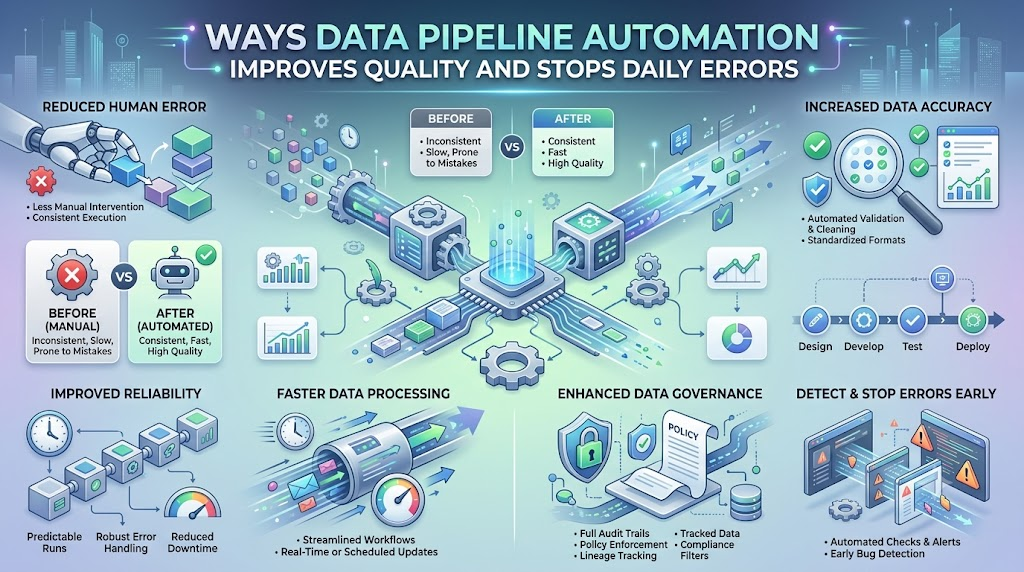
Data pipeline automation is the practice of moving and transforming information from source systems to storage targets without manual intervention. In an automated system, software handles data ingestion, cleans up messy entries, and drops verified records into analytical databases.
Engineers use orchestrators like Apache Airflow to schedule tasks, manage dependencies, and retry failed jobs automatically. Instead of an engineer waking up in the middle of the night to rerun a broken script, the orchestration engine manages the recovery process independently.
Practical Workflow Stages
A healthy, automated data flow typically follows three clear stages:
- Ingestion and Staging: Raw records arrive from websites, mobile applications, or transactional databases and land in cloud storage.
- Transformation and Testing: Engines like Apache Spark or SQL transformation tools clean, format, and test the dataset against predefined rules.
- Publishing and Monitoring: Clean records load into warehouses, while monitoring dashboards display pipeline health.
Understanding Data Observability And Quality Management
Building automated pipelines is only half the battle; teams must also monitor the health of the data running inside those pipes. This practice is known as data observability. While traditional infrastructure monitoring tracks server health and CPU usage, observability tracks the health of the actual numbers and text records.
Data quality management ensures that incoming information matches exact business expectations. If a table suddenly receives negative prices or missing customer names, alerting tools alert the team immediately.
| Operational Focus | Data Quality Management | Data Observability |
| Primary Question | Is the data correct and valid right now? | Where and why did the data break across the system? |
| Core Components | Schema checks, null checks, format validation | Lineage tracing, volume anomaly detection, freshness metrics |
| Common Tools | Great Expectations, custom unit tests | Open-source monitors, lineage graphs, metadata trackers |
| Target Outcome | Clean, compliant, and accurate datasets | Complete visibility and fast incident resolution |
Exploring Essential DataOps Tools And Platforms
A modern data stack relies on specialized tools working together seamlessly. No single product handles every part of the lifecycle, so teams choose components that fit their unique scale and cloud infrastructure.
Workhorse Technologies In Modern Architectures
- Apache Airflow: Schedules and tracks complex workflows using Python scripts as directed graphs.
- Apache Kafka: Streams events in real time, allowing systems to react instantly to user actions.
- Apache Spark: Processes massive datasets in parallel across distributed computer clusters.
- Kubernetes: Manages containers to ensure data processing applications have enough compute power.
- Jenkins: Runs automated tests and code checks whenever a developer submits updates to pipeline scripts.
- Grafana: Visualizes operational metrics and pipeline run times on clear, centralized dashboards.
Selecting the right DataOps platform depends on company size, existing cloud setups, and technical comfort. Learning how these tools communicate is a foundational step for any aspiring practitioner.
Real World Applications And Common Challenges
Organizations in healthcare, retail, and finance rely on dependable data operations to serve customers every day. For example, a hospital network can automatically combine patient admission logs with laboratory results to optimize bed availability.
However, teams often face hurdles when modernizing legacy systems:
- Cultural Resistance: Moving from manual spreadsheet checks to automated code pipelines requires time and training.
- Tool Sprawl: Adopting too many disconnected platforms creates confusion and maintenance burdens.
- Data Volume Growth: Expanding data sizes can overwhelm unoptimized transformation jobs, leading to costly cloud bills.
- Inconsistent Standards: Different departments may define basic terms differently, causing reporting mismatches.
Addressing these challenges requires a clear educational roadmap and shared engineering standards across all departments.
Career Pathways For The DataOps Engineer
As businesses build more complex data systems, the demand for a dedicated DataOps Engineer continues to expand. This professional bridges the gap between data engineering and infrastructure operations, ensuring pipelines remain healthy and scalable.
Essential Skills To Develop
- Scripting and Programming: Writing clean, modular code using Python and advanced SQL.
- Version Control and CI/CD: Using Git to track pipeline logic and setting up automated testing environments.
- Infrastructure as Code: Provisioning cloud compute and storage using modern automation templates.
- Monitoring and Alerting: Setting up proactive alerts that notify engineers before reports break.
Learners looking to enter this field often explore a specialized DataOps Course or structured DataOps Training to build hands-on skills. Pursuing a recognized DataOps Certification helps practitioners validate their knowledge of orchestration, testing frameworks, and cloud architecture.
For organizations seeking external guidance on strategy, professional DataOps Consulting provides customized blueprints to modernize legacy pipelines safely. Anyone curious about developing these engineering skills can find structured tutorials and technology overviews on TheDataOps.org.
Frequently Asked Questions
What is the main difference between DataOps and traditional DevOps?
DevOps focuses on building, testing, and deploying software applications smoothly.
DataOps borrows these same automation ideas but applies them specifically to data pipelines, datasets, and analytical models, ensuring the data itself is accurate, fresh, and properly governed.
How does pipeline automation improve overall data quality?
Automated pipelines run predefined verification tests on every batch of information before loading it into production tables.
This automated gatekeeping stops corrupted or missing fields immediately, preventing bad records from ever reaching dashboards or machine learning models.
What tools should a beginner start learning first?
Beginners should build a strong foundation in Python and SQL, as both languages are used across nearly all pipeline tasks.
After mastering the basics, learning an orchestration tool like Apache Airflow and version control with Git will provide the most practical starting point.
Can small companies benefit from modern data operations?
Yes, small teams benefit greatly from adopting basic automation early in their development.
Setting up simple automated tests and reliable schedule tracking saves small teams dozens of hours of manual troubleshooting each week, freeing them to focus on core product features.
Final Thoughts
Modern organizations succeed when they can trust the numbers running through their digital pipelines. Adopting automated testing, clear observability, and continuous integration transforms messy data workflows into predictable, high-speed delivery engines.
Whether you are an experienced data engineer optimizing distributed clusters or a curious beginner exploring your first orchestration script, learning these practices creates exciting career opportunities. Exploring educational articles and community tutorials through platforms such as TheDataOps.org provides the practical knowledge needed to build resilient, production-ready data operations.
