Upgrade & Secure Your Future with DevOps, SRE, DevSecOps, MLOps!
We spend hours scrolling social media and waste money on things we forget, but won’t spend 30 minutes a day earning certifications that can change our lives.
Master in DevOps, SRE, DevSecOps & MLOps by DevOps School!
Learn from Guru Rajesh Kumar and double your salary in just one year.
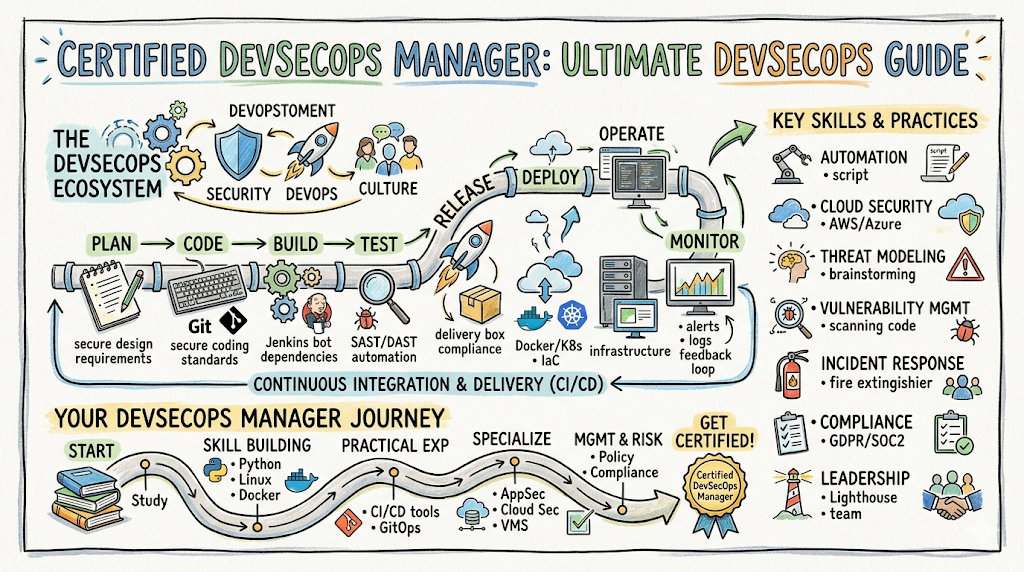
DevSecOps is now a critical part of how modern software teams design, build, and run applications. Security can no longer be a separate phase at the end of the lifecycle; it must be integrated from planning to production. The Certified DevSecOps Manager program helps you become the person who can lead this change, connect development, operations, and security, and build secure delivery pipelines end to end. This guide explains what the Certified DevSecOps Manager certification is, who it is for, what skills you gain, how to prepare, and how to use it as a strategic step in your DevOps, Security, or Platform career. It is written for working engineers, leads, and managers in India and across the globe who want a practical, career‑oriented view, not just marketing language.
Certifications overview table
| Track | Level | Who it’s for | Prerequisites | Skills covered | Recommended order |
|---|---|---|---|---|---|
| DevSecOps | Manager | DevOps/SRE/Security leads, managers | 2–3 years in DevOps/SRE/Security basics | DevSecOps culture, secure CI/CD, security tooling, policy‑as‑code, governance | Take after core DevOps/Cloud or Security fundamentals |
| DevOps | Associate | Junior–mid DevOps/Cloud engineers | Basic Linux, Git, scripting | CI/CD, automation, basic cloud, containers | First DevOps‑oriented certification |
| DevOps | Professional | Senior DevOps/Platform engineers | DevOps associate‑level knowledge | Advanced CI/CD, scaling pipelines, multi‑cloud, observability | After 1–2 foundational certifications |
| Security | Associate | Software/Security engineers starting in AppSec | Basic programming and web app knowledge | Secure coding, common vulnerabilities, testing basics | Before or alongside DevSecOps Manager |
| SRE | Associate | DevOps/Infra engineers moving to reliability | Linux, networking, monitoring basics | SLOs, error budgets, incident response, reliability patterns | Before or after DevSecOps Manager depending on interest |
| Cloud | Architect | Cloud/Platform engineers and architects | 1–2 years cloud + infra experience | Cloud architecture, security, networking, cost design | Alongside or after DevSecOps Manager |
Deep dive: Certified DevSecOps Manager
What it is
Certified DevSecOps Manager is a structured program that teaches you how to manage, implement, and scale DevSecOps practices in real organizations. It focuses on people, process, and tooling together, not just isolated tools. You learn to design secure software delivery workflows that fit modern cloud‑native environments.
Who should take it
- DevOps Engineers and SREs who want to move into security‑focused roles
- Security Engineers who want to work closer to CI/CD and cloud‑native delivery
- Platform and Cloud Engineers who build shared platforms for many teams
- Tech Leads and Engineering Managers who own security outcomes for products
- Architects who design delivery platforms, governance, and guardrails for multiple teams
Skills you’ll gain
- Understanding of DevSecOps culture, principles, and maturity models
- Designing secure CI/CD pipelines with integrated security controls
- Implementing SAST, DAST, SCA, container scanning, and secrets scanning in pipelines
- Defining security policies as code and using policy engines
- Implementing role‑based access control (RBAC) and least‑privilege practices
- Designing secure patterns for containers, Kubernetes, and cloud‑native platforms
- Managing vulnerabilities, exceptions, and risk‑based prioritization
- Monitoring, logging, and incident response from a DevSecOps perspective
- Leading DevSecOps adoption across multiple teams and stakeholders
Real‑world projects you should be able to do after it
After completing this certification, you should be able to:
- Design and implement a CI/CD pipeline with automated security checks at every stage
- Introduce static and dynamic application security testing into existing pipelines
- Implement software composition analysis (SCA) and container image scanning at build time
- Set up secrets management, key rotation, and secure configuration patterns
- Define and roll out security guardrails and policy‑as‑code for multiple teams
- Create a DevSecOps rollout plan for your organization, including training and governance
- Build dashboards and reports that show security posture and risk to leaders
Preparation plan
You can prepare for Certified DevSecOps Manager with different timelines depending on your experience and available time.
7–14 days (fast track)
Best for: experienced DevOps/SRE/Security professionals already familiar with CI/CD and cloud.
- Day 1–2:
- Review DevSecOps fundamentals, principles, and key practices.
- Map your current experience with security in pipelines and platforms.
- Day 3–5:
- Focus on security testing: SAST, DAST, SCA, secrets scanning, container scanning.
- Study how these fit into build, test, and deploy stages.
- Day 6–8:
- Deep dive into policy‑as‑code, RBAC, and secure configuration management.
- Study patterns for secure Kubernetes and cloud deployments.
- Day 9–11:
- Work through 1–2 hands‑on projects, building or improving a secure pipeline.
- Capture notes, patterns, and lessons you can reuse in the exam and in interviews.
- Day 12–14:
- Revise key concepts, practice exam‑style questions (if available), and review real case studies.
30 days (balanced plan)
Best for: working professionals who can spend 1–2 hours per day.
- Week 1: DevSecOps culture, principles, and lifecycle integration
- Week 2: Security testing tools and automation in CI/CD
- Week 3: Cloud‑native security, container/Kubernetes security, and platform guardrails
- Week 4: Governance, reporting, rollout strategies, and revision + mock tests
60 days (foundations + advanced)
Best for: professionals newer to DevOps or security.
- Weeks 1–2: Strengthen DevOps basics (CI/CD, version control, infrastructure as code)
- Weeks 3–4: Security fundamentals (vulnerabilities, OWASP top 10, identity, access control)
- Weeks 5–6: DevSecOps tooling and patterns in real pipelines
- Weeks 7–8: Hands‑on projects and revision focused on practical scenarios
Common mistakes to avoid
- Treating DevSecOps as only a tool or scanner instead of a culture and process change
- Adding security checks that slow pipelines without clear value or tuning
- Ignoring developers’ workflow and pushing security as extra work instead of integrating it
- Focusing only on one layer (for example, app or container) and ignoring cloud/platform security
- Not defining clear metrics and reports for leadership to see progress
- Skipping hands‑on practice and relying only on theory before the exam
Best next certification after this
Depending on your career direction, you can choose:
- Same track (DevSecOps): another advanced DevSecOps or Cloud Security certification focusing deeper on tooling, architecture, or cloud provider security.
- Cross‑track:
- DevOps/Platform certifications (for example, Kubernetes, cloud architect, or CI/CD tooling).
- Application security certifications focusing on secure coding and threat modeling.
- Leadership: agile leadership, product ownership, or security leadership programs that help you lead multiple teams and large transformations.
Choose your path: 6 learning paths
1. DevOps path
Focus: delivery speed, reliability, and automation.
- Foundations: Git, CI/CD fundamentals, Linux, scripting
- Intermediate: containerization (Docker), Kubernetes, infrastructure as code
- Milestone: Certified DevSecOps Manager for integrating security into your pipelines
- Next: advanced cloud and platform certifications, SRE practices, reliability engineering
2. DevSecOps path
Focus: integrating security into every part of the delivery lifecycle.
- Foundations: basic security concepts, OWASP, Linux, CI/CD
- Intermediate: security testing tools, vulnerability management, secrets management
- Milestone: Certified DevSecOps Manager as your core DevSecOps management credential
- Next: cloud security, security architecture, zero‑trust, policy‑as‑code
3. SRE path
Focus: reliability, observability, and incident response.
- Foundations: SRE concepts, SLIs/SLOs, incident management, monitoring and logging
- Intermediate: infrastructure as code, Kubernetes, service reliability patterns
- Milestone: Certified DevSecOps Manager to bring strong security into SRE practice
- Next: site reliability leadership, resilience engineering, chaos engineering
4. AIOps/MLOps path
Focus: automated operations and machine‑learning lifecycle.
- Foundations: DevOps basics, observability, logging, metrics, ML workflow basics
- Intermediate: MLOps tooling, model deployment, monitoring of data and models
- Milestone: Certified DevSecOps Manager to ensure secure pipelines and data handling
- Next: specialized AIOps/MLOps certifications focused on automation and intelligent operations
5. DataOps path
Focus: secure and reliable data pipelines.
- Foundations: data engineering basics, ETL/ELT processes, data platforms
- Intermediate: data quality, observability, governance, and cataloging
- Milestone: Certified DevSecOps Manager to apply security practices to data pipelines
- Next: advanced data engineering or cloud data platform certifications
6. FinOps path
Focus: cost optimization and financial accountability in the cloud.
- Foundations: cloud billing concepts, cost management tools, tagging and budgets
- Intermediate: cost optimization patterns, shared responsibility models
- Milestone: Certified DevSecOps Manager to ensure that cost‑optimized architectures remain secure
- Next: FinOps practitioner/advanced programs and cloud cost management specializations
Role → recommended certifications table
| Role | Primary certifications (suggested) | How Certified DevSecOps Manager fits |
|---|---|---|
| DevOps Engineer | Core DevOps certification, Kubernetes, cloud associate | Adds strong security to your CI/CD and platform work |
| SRE | SRE/observability certification, cloud associate/professional | Ensures your reliability work includes robust security controls |
| Platform Engineer | Cloud architect, Kubernetes admin, infrastructure as code certifications | Helps you design secure platform guardrails for all teams |
| Cloud Engineer | Cloud associate/professional, networking and security basics | Adds pipeline and application‑level security to your skillset |
| Security Engineer | Application security, cloud security, incident response certifications | Connects your security expertise directly with DevOps practices |
| Data Engineer | Data engineering, cloud data platform, analytics certifications | Helps secure data pipelines and platforms end‑to‑end |
| FinOps Practitioner | FinOps practitioner/advanced, cloud cost management | Ensures cost‑optimized designs remain secure and compliant |
| Engineering Manager | Leadership, agile/project management, optional cloud/DevOps foundations | Equips you to sponsor and lead DevSecOps transformations |
Next certifications to take after Certified DevSecOps Manager
1. Same track: Advanced DevSecOps / Security
If you want to specialize further in security and DevSecOps, choose an advanced security or cloud‑security certification that deepens your expertise in cloud‑native security, compliance, and threat modeling.
Good next‑step themes include:
- Cloud provider security (for example, AWS/Azure/GCP security‑focused credentials)
- Advanced DevSecOps or security engineering programs focused on policy‑as‑code, zero‑trust, and compliance‑as‑code
- Platform or Kubernetes security certifications that strengthen container, cluster, and supply‑chain protection skills
This path is ideal if you want to become the go‑to person for secure architecture, security automation, and governance.
2. Cross‑track: SRE, AIOps/MLOps, DataOps
If you want broader technical influence, move into a cross‑track certification that connects DevSecOps with reliability, data, or intelligent operations.
- SRE certifications: focus on SLIs/SLOs, error budgets, and incident management, helping you tie security work to reliability and uptime.
- AIOps/MLOps certifications: focus on using automation and ML for operations, anomaly detection, and model pipelines, where secure data and pipelines are crucial.
- DataOps certifications: focus on secure, governed data pipelines, where your DevSecOps skills extend to data platforms and analytics systems.
This path fits engineers aiming for broad platform roles that combine security, reliability, and data‑driven operations.
3. Leadership: DevOps / DevSecOps / Cloud leadership
If you want to lead teams and transformations, your next step should be a leadership‑oriented certification that focuses on culture, strategy, and governance.
- DevOps or DevSecOps leadership programs: focus on leading DevSecOps adoption, managing change, and aligning security with business goals.
- Cloud or platform leadership certifications: focus on architecting secure, cost‑effective, and reliable platforms at organization scale.
- SRE or observability “master”‑level programs: focus on high‑level visibility, decision‑making, and executive reporting across large systems.
This path suits Engineering Managers, Architects, and senior ICs who want to drive strategy, not just implement tools.
Top institutions for training and certification support
DevOpsSchool
DevOpsSchool focuses on end‑to‑end DevOps, Cloud, and CI/CD training with strong hands‑on labs. Their programs are designed for working professionals who want practical exposure along with theory. They also offer structured learning paths that include DevSecOps, SRE, and modern cloud practices.
Cotocus
Cotocus is known for specialized training and consulting around DevOps and related transformations. They often work on real projects and bring that experience into their training programs. Their approach helps you connect certification topics with actual enterprise use cases.
ScmGalaxy
ScmGalaxy focuses on software configuration management, build and release engineering, and DevOps practices across tools and platforms. Their training covers both foundational and advanced topics and is suitable for teams who manage complex delivery workflows.
BestDevOps
BestDevOps curates training and content focused on DevOps, cloud, automation, and modern engineering practices. It is a good place for professionals who want a mix of conceptual learning, tools exposure, and guided practice aligned with industry needs.
devsecopsschool.com
DevSecOpsSchool (devsecopsschool.com) specializes in DevSecOps‑focused learning. They provide programs like Certified DevSecOps Manager and other security‑integrated DevOps courses. Their curriculum is built around real‑world cases where security, DevOps, and cloud platforms come together.
sreschool.com
SRESchool (sreschool.com) focuses on Site Reliability Engineering, observability, and operations for modern distributed systems. Their programs teach you how to work with SLOs, error budgets, incident response, and resilient architectures, which pairs well with security‑aware delivery.
aiopsschool.com
AIOpsSchool (aiopsschool.com) is centered on AIOps and MLOps, where automation, machine learning, and operations meet. Their training helps you understand how to apply ML to operations data and how to manage ML pipelines securely and reliably.
dataopsschool.com
DataOpsSchool (dataopsschool.com) focuses on DataOps, data engineering, and the processes around reliable and secure data pipelines. It is a good choice if you work with data platforms and want to integrate DevSecOps principles into data workflows.
finopsschool.com
FinOpsSchool (finopsschool.com) specializes in cloud cost optimization and FinOps practices. Their training helps you understand how to design, operate, and govern cloud systems in a way that balances cost, performance, and security.
FAQs
1. What is the main focus of Certified DevSecOps Manager?
The main focus is to teach you how to integrate security into DevOps practices across teams, pipelines, and platforms. You learn to design secure delivery workflows, manage security tools, and lead DevSecOps culture.
2. How difficult is this certification?
The difficulty is moderate to high for someone new to DevOps or security, and moderate for professionals already comfortable with CI/CD and cloud. The exam tests both concepts and practical scenarios, so hands‑on experience helps a lot.
3. How long does it take to prepare?
Most working professionals can prepare in 30–60 days with 1–2 hours per day, depending on prior experience. If you already work with DevOps and security tools, a focused 2‑week plan can also work.
4. Do I need prior security experience?
Formal security experience is not mandatory, but basic knowledge of vulnerabilities, OWASP concepts, and common security issues is very helpful. At minimum, you should understand web applications, APIs, and basic cloud concepts.
5. Do I need prior DevOps or CI/CD experience?
Yes, you should have basic familiarity with Git, CI/CD pipelines, containers, or cloud platforms. The certification assumes you understand software delivery workflows and focuses on how to embed security into them.
6. Is this certification useful for managers and leads?
Yes, it is very useful for team leads, engineering managers, and architects who are responsible for security outcomes. It gives you a common language to work with security teams and a framework to drive DevSecOps adoption.
7. What kind of jobs can this certification help me get?
It can support roles like DevSecOps Engineer, DevSecOps Manager, Platform Security Engineer, Security‑focused DevOps Engineer, and Security‑aware SRE or Platform Engineer. It also strengthens your profile for senior technical leadership roles.
8. How does this certification compare to pure security certifications?
Traditional security certifications focus more on concepts, compliance, or specific security domains. Certified DevSecOps Manager focuses on how to apply security in CI/CD, cloud, and modern development workflows, making it highly relevant for engineering teams.
9. Is hands‑on practice required, or is theory enough?
Hands‑on practice is strongly recommended. You should spend time implementing at least one secure pipeline, using security testing tools, and experimenting with policy‑as‑code and secure configuration before taking the exam.
10. Can software engineers and developers take this certification?
Yes, developers who build backend, frontend, or microservices can benefit from this certification. It helps them understand how their code flows through pipelines, how security is enforced, and how to design more secure features.
11. Is this certification useful if I work in a small company or startup?
It is useful in any environment where you ship software. In smaller companies, one person often wears multiple hats; understanding DevSecOps helps you make better design, tooling, and process decisions early in the lifecycle.
12. How does this certification help in the long term?
In the long term, it positions you as someone who can balance speed and security, which is a critical differentiator. As more organizations adopt DevSecOps, professionals who can lead these transformations will be in high demand.
FAQs specific to the Certified DevSecOps Manager
1. What is covered in the Certified DevSecOps Manager syllabus?
The syllabus typically covers DevSecOps principles, secure CI/CD patterns, security testing tools, cloud‑native security, policy‑as‑code, governance, and rollout strategies. It focuses on both technical and managerial aspects of DevSecOps.
2. What format is the exam?
The exam is usually scenario‑based, with multiple‑choice or multi‑select questions focused on real‑world DevSecOps challenges. The exact format can vary, so it is important to review the latest details on the official certification page.
3. Do I need to attend training, or can I self‑study?
You can often self‑study if you have strong DevOps and security experience, but structured training helps you cover the entire syllabus faster. Training also exposes you to sample questions and practical labs aligned with the exam.
4. How much hands‑on work should I do before the exam?
Try to complete at least 1–2 hands‑on projects where you integrate security tools into a CI/CD pipeline, implement container and image scanning, and set up basic policy‑as‑code. This makes the exam scenarios much easier to understand.
5. Is there a fixed sequence of topics I must follow?
There is a logical sequence: start with DevSecOps fundamentals, then move to security testing, then cloud‑native security and governance. Within that structure, you can adjust based on your strengths and weaknesses.
6. Can I retake the exam if I do not pass?
Most certification providers allow retakes after a certain period or for an additional fee. Check the latest retake policy on the official certification URL before booking your exam.
7. Will this certification expire?
Many modern certifications are valid for a fixed period (for example, two or three years) and may require renewal. Confirm the current validity period and renewal process on the official page before planning your long‑term roadmap.
8. Is this certification recognized globally?
DevSecOps skills are in demand worldwide, and a focused DevSecOps Manager credential is relevant in many markets. Its recognition is strongest where DevOps and cloud‑native practices are widely adopted, across India and global engineering hubs.
Conclusion
Certified DevSecOps Manager is a powerful certification for engineers, leads, and managers who want to combine DevOps speed with strong security. It helps you move beyond isolated security tools and build full delivery workflows where security is part of design, coding, testing, deployment, and operations. If you are already on a DevOps, SRE, Cloud, or Security path, this certification can be your bridge into higher‑impact roles where you influence architecture, process, and culture. With a focused 30–60 day preparation plan, solid hands‑on practice, and the right training partner, you can use Certified DevSecOps Manager as a key milestone in your long‑term engineering career.
