Upgrade & Secure Your Future with DevOps, SRE, DevSecOps, MLOps!
We spend hours scrolling social media and waste money on things we forget, but won’t spend 30 minutes a day earning certifications that can change our lives.
Master in DevOps, SRE, DevSecOps & MLOps by DevOps School!
Learn from Guru Rajesh Kumar and double your salary in just one year.
Introduction
Interview Intelligence Tools help hiring teams capture, analyze, summarize, and improve interview conversations. In simple English, these platforms turn interviews into structured hiring data by recording or transcribing conversations, generating notes, highlighting key moments, supporting scorecards, and helping recruiters and hiring managers make better decisions.
These tools matter now because hiring teams are under pressure to move faster while improving fairness, consistency, candidate experience, and hiring quality. Interview conversations often contain valuable signals, but without a proper system, those signals can get lost in rushed notes, memory bias, incomplete feedback, or inconsistent interviewer styles. Modern interview intelligence platforms use AI, automation, structured workflows, and analytics to make interviews easier to manage and easier to review.
Real-world use cases include AI interview notes, recruiter coaching, structured scorecards, interview summaries, candidate comparison, compliance-friendly documentation, interview quality review, and hiring manager collaboration. Some platforms also support video interviews, technical interviews, AI screening, and candidate assessment workflows. Industry guides now commonly describe interview intelligence as a category focused on capturing interview conversations and turning them into structured hiring insight.
Buyers should evaluate:
- AI note-taking and transcription quality
- Interview recording and consent workflows
- Structured scorecards and feedback tools
- ATS and calendar integrations
- Candidate privacy and data retention controls
- Recruiter and interviewer usability
- Coaching and interview quality insights
- Reporting and analytics
- Scalability across teams and regions
- Security, permissions, and compliance readiness
Best for: recruiting teams, talent acquisition leaders, hiring managers, interviewers, HR operations teams, staffing teams, and companies that run frequent interviews. These tools are especially useful for mid-market companies, enterprises, high-growth startups, and hiring teams that want more consistent interview feedback.
Not ideal for: very small teams that conduct only a few interviews each year may not need a dedicated interview intelligence tool. A basic ATS, calendar tool, or manual scorecard process may be enough until interview volume increases.
Key Trends in Interview Intelligence Tools
AI-generated interview notes: Interview intelligence tools increasingly summarize interviews, capture important moments, and reduce the manual note-taking burden for recruiters and hiring managers. BrightHire and Metaview both position AI note-taking and interview summaries as central capabilities.
- Human-led, AI-assisted hiring: More companies are exploring how AI can support interview workflows without fully replacing human judgment. Recent hiring process discussions show that AI use in interviews is becoming a real operational topic, especially in technical hiring.
- Interviewer coaching: The category is moving beyond simple recording. Some platforms now focus on improving interviewer behavior, feedback quality, and consistency across hiring teams.
- Structured interviews and scorecards: Companies are using interview intelligence tools to standardize questions, evaluation criteria, and post-interview feedback so candidates are assessed more consistently.
- Compliance-aware summaries: Because interview recordings and transcripts can contain sensitive candidate information, buyers are paying more attention to consent, privacy, data retention, and what information is included in summaries.
- ATS-first workflows: The best tools connect interview notes, feedback, and hiring decisions back into recruiting platforms such as applicant tracking systems, calendars, and HR systems.
- Video and async interviews: Some platforms combine interview intelligence with live video interviews, one-way interviews, structured video screening, and candidate assessments.
- Technical interview intelligence: Technical hiring teams increasingly need tools that support coding interviews, engineering assessments, skill validation, and interviewer feedback in a structured way.
- Bias and fairness concerns: AI-assisted interviewing is useful, but buyers must carefully review how tools generate summaries, recommendations, and scores to avoid overreliance on automated judgment.
- Workflow automation: Scheduling, reminders, interview prep, note syncing, feedback collection, and debrief summaries are becoming more automated.
How We Selected These Tools
The following interview intelligence tools were selected using practical buyer-focused evaluation logic:
- Market adoption and visibility: Tools commonly discussed in interview intelligence, AI interviewing, video interviewing, and recruiting operations were prioritized.
- Feature completeness: Platforms with interview notes, summaries, recordings, scorecards, analytics, coaching, and integrations were considered stronger.
- Recruiting workflow fit: Tools that support recruiters, hiring managers, interviewers, and talent operations teams received priority.
- AI capability: Platforms with AI-assisted note-taking, candidate summaries, interview insights, or automated screening were included where relevant.
- Security posture signals: Tools that appear suitable for sensitive hiring data, access control, and enterprise evaluation were considered more suitable for serious buyers.
- Integrations and ecosystem: ATS, calendar, email, video, HRIS, assessment, and collaboration integrations were important selection factors.
- Customer segment balance: The list includes enterprise-focused tools, mid-market tools, SMB-friendly tools, video interviewing platforms, and AI-first screening tools.
- Interview quality improvement: Platforms that help improve interviewer consistency, feedback quality, and hiring decisions were valued.
- Candidate experience: Tools that support smoother interviews, clearer workflows, and faster decisions were favored.
- Practical buying fit: The list is designed to help real buyers compare tools by use case, not only by feature count.
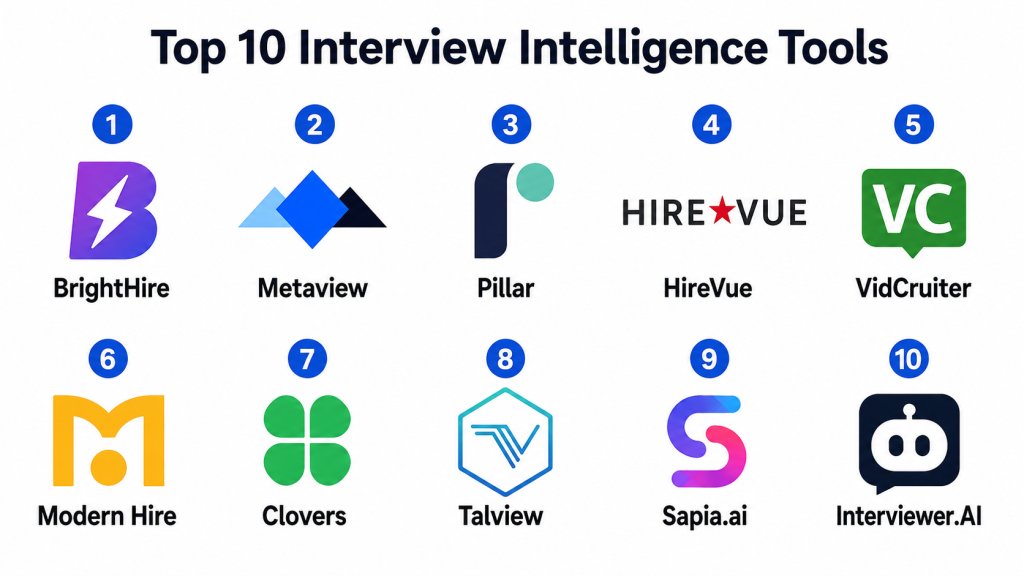
Top 10 Interview Intelligence Tools
#1 — BrightHire
Short description: BrightHire is an interview intelligence platform built to help recruiting teams capture interview notes, generate summaries, highlight key moments, and improve hiring decisions. It is a strong fit for mid-market and enterprise teams that want structured interview documentation and better interviewer collaboration.
Key Features
- AI-powered interview notes and summaries
- Interview recording and key moment capture
- Hiring plan and interview workflow support
- Candidate feedback and collaboration tools
- Talent insights and interview analytics
- ATS workflow support
- Interviewer productivity features
Pros
- Reduces manual note-taking during interviews.
- Helps hiring teams review conversations more consistently.
- Useful for recruiters who need faster, cleaner post-interview feedback.
Cons
- Requires thoughtful candidate consent and privacy handling.
- May be more useful for teams with regular interview volume.
- Value depends on interviewer adoption and ATS workflow fit.
Platforms / Deployment
Web
Cloud
Security & Compliance
BrightHire supports interview data workflows and is used in business recruiting environments. Specific details such as SOC 2, ISO 27001, GDPR, HIPAA, SSO/SAML, MFA, encryption, audit logs, and RBAC should be validated directly during vendor review.
SOC 2 / ISO 27001 / GDPR / HIPAA: Not publicly stated.
Integrations & Ecosystem
BrightHire is designed to fit into recruiting workflows and connect interview insights with broader hiring systems. It is commonly evaluated by teams that already use ATS and calendar-based interview processes.
- Applicant tracking systems
- Calendar tools
- Video interview workflows
- Recruiting analytics
- Candidate feedback tools
- Hiring team collaboration systems
Support & Community
BrightHire provides product support, onboarding resources, and customer guidance. Community strength and support depth may vary by contract, customer size, and implementation scope.
#2 — Metaview
Short description: Metaview is an AI recruiting platform focused on interview note-taking, recruiting reports, job posts, and hiring workflow assistance. It is built for recruiters and hiring teams that want AI to reduce busywork across the recruiting process.
Key Features
- AI interview note-taking
- Interview summaries and structured insights
- Recruiting reports and analytics
- Job post assistance
- Recruiter workflow automation
- ATS and calendar workflow support
- Hiring manager collaboration
Pros
- Purpose-built for recruiting workflows rather than generic meeting notes.
- Helps recruiters reduce administrative work after interviews.
- Strong fit for teams that want AI support across hiring tasks.
Cons
- Teams must review AI outputs carefully before relying on them.
- May require workflow alignment with existing ATS processes.
- Smaller teams may not need the full AI recruiting layer.
Platforms / Deployment
Web
Cloud
Security & Compliance
Metaview handles recruiting conversation data and should be evaluated carefully for privacy, access controls, retention, and compliance requirements. Specific certifications and controls should be verified during procurement.
SOC 2 / ISO 27001 / GDPR / HIPAA: Not publicly stated.
Integrations & Ecosystem
Metaview is built around recruiting workflows and commonly fits into ATS, calendar, interview, and reporting environments.
- ATS platforms
- Calendar tools
- Recruiting reports
- Job posting workflows
- Interview notes workflows
- Hiring team collaboration tools
Support & Community
Metaview provides customer support and product documentation. Community strength is growing among modern recruiting operations and talent acquisition teams.
#3 — Pillar
Short description: Pillar is an interview intelligence platform focused on structured interviews, AI notes, interviewer coaching, and hiring decision support. It is useful for organizations that want to improve interview consistency and reduce scattered feedback.
Key Features
- AI interview notes
- Structured interview guides
- Interviewer coaching insights
- Candidate evaluation support
- Hiring team collaboration
- Interview analytics
- ATS workflow alignment
Pros
- Strong focus on improving interview quality.
- Useful for teams that want structured and consistent candidate evaluation.
- Helps reduce incomplete or vague interview feedback.
Cons
- Requires adoption from both recruiters and interviewers.
- Best value comes when teams standardize interview processes.
- Buyers should validate integrations for their exact ATS stack.
Platforms / Deployment
Web
Cloud
Security & Compliance
Pillar should be reviewed for candidate consent, recording controls, data access, retention, and privacy handling. Specific certifications and compliance details are not confirmed here.
SOC 2 / ISO 27001 / GDPR / HIPAA: Not publicly stated.
Integrations & Ecosystem
Pillar is typically considered alongside ATS, interview scheduling, calendar, and recruiting workflow tools.
- Applicant tracking systems
- Calendar platforms
- Video meeting tools
- Interview scorecards
- Recruiting analytics
- Hiring manager workflows
Support & Community
Pillar provides customer support and onboarding resources. Support levels, documentation depth, and customer success options should be confirmed during evaluation.
#4 — HireVue
Short description: HireVue is a well-known hiring platform focused on video interviewing, assessments, and AI-assisted hiring workflows. It is commonly evaluated by enterprise recruiting teams that need scalable interview and assessment processes.
Key Features
- Video interviewing
- One-way and live interview workflows
- Structured candidate assessments
- Interview scheduling support
- Candidate evaluation tools
- Enterprise recruiting workflow support
- Analytics and hiring insights
Pros
- Strong fit for enterprise and high-volume hiring.
- Supports structured video interview workflows.
- Useful for teams managing many candidates across roles and locations.
Cons
- May feel heavy for smaller hiring teams.
- Candidate experience must be designed carefully.
- AI-assisted assessment use should be reviewed for fairness and compliance.
Platforms / Deployment
Web / iOS / Android
Cloud
Security & Compliance
HireVue is used in enterprise hiring environments, but buyers should validate exact security documentation, privacy controls, AI governance, consent workflows, and compliance claims directly.
SOC 2 / ISO 27001 / GDPR / HIPAA: Not publicly stated.
Integrations & Ecosystem
HireVue is commonly integrated into enterprise recruiting workflows and can connect with ATS, assessment, scheduling, and HR systems.
- Applicant tracking systems
- Video interview workflows
- Assessment platforms
- Scheduling tools
- HR systems
- Recruiting analytics
Support & Community
HireVue offers enterprise support, onboarding, documentation, and customer success resources. Support experience may vary by package and implementation scope.
#5 — VidCruiter
Short description: VidCruiter is an interview management and video interviewing platform that supports structured interviews, scheduling, assessment workflows, and hiring team collaboration. It is often used by organizations with formal hiring processes and complex interview workflows.
Key Features
- Live video interviews
- Pre-recorded video interviews
- Structured interview workflows
- Interview scheduling
- Candidate evaluation tools
- Assessment and scoring support
- Recruiting process automation
Pros
- Strong for structured and repeatable interview workflows.
- Useful for organizations with formal hiring stages.
- Supports both live and async interview formats.
Cons
- May require planning to configure complex workflows.
- Smaller teams may not need all interview management features.
- Candidate communication and consent should be handled carefully.
Platforms / Deployment
Web
Cloud
Security & Compliance
VidCruiter should be reviewed for interview recording security, candidate data handling, access permissions, and retention controls. Specific certifications and compliance coverage should be confirmed with the vendor.
SOC 2 / ISO 27001 / GDPR / HIPAA: Not publicly stated.
Integrations & Ecosystem
VidCruiter can support recruiting workflows that need video interviews, scheduling, assessments, and structured evaluation.
- ATS platforms
- Calendar systems
- Video interview workflows
- Assessment tools
- HR systems
- Reporting tools
Support & Community
VidCruiter provides implementation support, customer resources, and documentation. Support depth can vary based on organization size and workflow complexity.
#6 — Modern Hire
Short description: Modern Hire is a hiring platform focused on interview technology, assessments, and science-based hiring workflows. It is often used by larger organizations that need structured evaluation at scale.
Key Features
- On-demand interview workflows
- Live interview support
- Candidate assessments
- Structured evaluation tools
- Scheduling support
- Hiring analytics
- Enterprise recruiting workflow support
Pros
- Useful for structured and high-volume hiring programs.
- Combines interview workflows with assessment capabilities.
- Good fit for organizations that want more standardized candidate evaluation.
Cons
- May be too advanced for low-volume hiring teams.
- Implementation and workflow design may take time.
- Buyers should carefully review AI and assessment governance.
Platforms / Deployment
Web
Cloud
Security & Compliance
Modern Hire handles candidate assessment and interview data, so buyers should verify security controls, data retention, consent management, and compliance documentation directly.
SOC 2 / ISO 27001 / GDPR / HIPAA: Not publicly stated.
Integrations & Ecosystem
Modern Hire is generally evaluated as part of enterprise recruiting, ATS, assessment, and interview workflow environments.
- Applicant tracking systems
- Candidate assessment tools
- Scheduling workflows
- HR systems
- Reporting dashboards
- Interview management systems
Support & Community
Modern Hire provides implementation support and customer resources. Support structure and onboarding depth should be checked during vendor evaluation.
#7 — Clovers
Short description: Clovers is an interview intelligence platform focused on interview recording, transcription, structured feedback, collaboration, and inclusive hiring workflows. It is useful for teams that want better interview visibility and more consistent evaluation.
Key Features
- Interview recording and transcription
- AI-generated interview notes
- Candidate feedback workflows
- Structured interview support
- Collaboration tools for hiring teams
- Interview analytics
- Candidate experience support
Pros
- Helps teams reduce manual interview documentation.
- Supports better post-interview collaboration.
- Useful for improving consistency across interviewers.
Cons
- Requires clear privacy and consent communication.
- Value depends on recruiter and interviewer adoption.
- Buyers should validate depth of ATS integrations.
Platforms / Deployment
Web
Cloud
Security & Compliance
Clovers should be evaluated for candidate data privacy, recording consent, access controls, retention settings, and compliance requirements. Specific certifications are not confirmed here.
SOC 2 / ISO 27001 / GDPR / HIPAA: Not publicly stated.
Integrations & Ecosystem
Clovers fits into recruiting workflows that need interview capture, feedback, and collaboration.
- ATS platforms
- Video meeting tools
- Calendar tools
- Interview scorecards
- Candidate feedback systems
- Recruiting analytics
Support & Community
Clovers provides customer support and onboarding resources. Documentation and support tier details should be confirmed during buying evaluation.
#8 — Talview
Short description: Talview is an AI-enabled hiring and assessment platform that supports video interviews, assessments, remote proctoring, and candidate evaluation workflows. It is commonly used where remote hiring and structured candidate assessment are important.
Key Features
- Video interviewing
- Online assessments
- Remote proctoring support
- Candidate screening workflows
- Interview scheduling
- AI-assisted hiring features
- Hiring analytics
Pros
- Strong fit for remote assessment and interview workflows.
- Useful for high-volume screening and structured evaluation.
- Supports multiple stages of candidate assessment.
Cons
- May require careful candidate communication around assessment and proctoring.
- Not every team needs remote proctoring features.
- AI-related evaluation should be reviewed for fairness and compliance.
Platforms / Deployment
Web
Cloud
Security & Compliance
Talview should be reviewed for assessment data security, candidate consent, privacy controls, access management, and compliance requirements. Specific certifications are not confirmed here.
SOC 2 / ISO 27001 / GDPR / HIPAA: Not publicly stated.
Integrations & Ecosystem
Talview can connect with recruiting workflows that include ATS platforms, assessments, video interviews, and remote hiring processes.
- ATS platforms
- Assessment systems
- Video interview tools
- Remote proctoring workflows
- HR systems
- Reporting dashboards
Support & Community
Talview provides customer support, onboarding, and implementation guidance. Support quality may depend on customer segment and contract level.
#9 — Sapia.ai
Short description: Sapia.ai is an AI interview platform focused on structured chat-based interviews, candidate insights, and scalable screening. It is useful for organizations that need consistent early-stage candidate evaluation at volume.
Key Features
- Chat-based structured AI interviews
- Candidate screening insights
- AI-supported scoring explanations
- Scalable high-volume interview workflows
- Candidate experience-focused design
- Reporting and hiring insights
- Structured evaluation support
Pros
- Useful for high-volume early-stage screening.
- Chat-based format can be easier to scale than live interviews.
- Provides structured candidate insights for recruiters.
Cons
- Not a full replacement for human interviews.
- AI scoring and recommendations need careful governance.
- May be less suitable for final-stage or relationship-heavy hiring.
Platforms / Deployment
Web
Cloud
Security & Compliance
Sapia.ai handles candidate interview and evaluation data, so buyers should validate data privacy, AI governance, consent workflows, retention controls, and security documentation directly.
SOC 2 / ISO 27001 / GDPR / HIPAA: Not publicly stated.
Integrations & Ecosystem
Sapia.ai is typically used alongside ATS, recruiting automation, and candidate screening workflows.
- Applicant tracking systems
- Recruiting automation tools
- Candidate screening workflows
- HR systems
- Reporting platforms
- High-volume hiring processes
Support & Community
Sapia.ai provides customer support and implementation resources. Support depth and onboarding model should be reviewed during vendor selection.
#10 — Interviewer.AI
Short description: Interviewer.AI is an AI video interview platform designed for hiring, admissions screening, conversational AI interviews, and mock interview workflows. It is useful for organizations and institutions that need scalable interview screening.
Key Features
- AI video interview workflows
- Conversational AI interview support
- Candidate screening and evaluation
- Mock interview capabilities
- Hiring and admissions use cases
- Interview analytics
- Scalable candidate review workflows
Pros
- Useful for high-volume candidate screening.
- Supports multiple interview experience formats.
- Can help standardize early-stage evaluation.
Cons
- AI evaluation should be reviewed carefully for fairness.
- May not replace human-led interviews for senior or complex roles.
- Buyers should validate integrations and compliance fit.
Platforms / Deployment
Web
Cloud
Security & Compliance
Interviewer.AI should be reviewed for candidate privacy, AI evaluation governance, consent handling, access controls, and data retention. Specific certifications are not confirmed here.
SOC 2 / ISO 27001 / GDPR / HIPAA: Not publicly stated.
Integrations & Ecosystem
Interviewer.AI supports hiring and screening workflows that may connect with ATS, admissions systems, candidate databases, and review processes.
- ATS platforms
- Candidate screening workflows
- Video interview systems
- Admissions systems
- Reporting tools
- Hiring team review workflows
Support & Community
Interviewer.AI provides customer support and product resources. Support tier, onboarding help, and implementation depth should be confirmed directly.
Comparison Table
| Tool Name | Best For | Platform(s) Supported | Deployment | Standout Feature | Public Rating |
|---|---|---|---|---|---|
| BrightHire | Recruiters needing AI notes and interview insights | Web | Cloud | AI interview notes and highlights | N/A |
| Metaview | AI-powered recruiting workflow support | Web | Cloud | Purpose-built recruiting AI notetaker | N/A |
| Pillar | Structured interviews and interviewer coaching | Web | Cloud | Interview quality and coaching insights | N/A |
| HireVue | Enterprise video interviewing and assessment | Web, iOS, Android | Cloud | Scalable video interview workflows | N/A |
| VidCruiter | Structured interview management | Web | Cloud | Live and pre-recorded interview workflows | N/A |
| Modern Hire | Enterprise assessments and interview workflows | Web | Cloud | Science-based hiring evaluation | N/A |
| Clovers | Interview recording, transcription, and collaboration | Web | Cloud | Inclusive interview intelligence workflows | N/A |
| Talview | Remote interviews, assessments, and proctoring | Web | Cloud | Remote assessment and interview management | N/A |
| Sapia.ai | High-volume chat-based AI screening | Web | Cloud | Structured AI chat interviews | N/A |
| Interviewer.AI | AI video interviews and scalable screening | Web | Cloud | AI video and conversational interview workflows | N/A |
Evaluation & Scoring of Interview Intelligence Tools
The scoring below is comparative and based on practical buyer evaluation criteria. A higher score does not mean the tool is best for every company. It means the platform performs strongly against this specific model for interview intelligence, recruiting workflow fit, usability, security expectations, and value.
| Tool Name | Core (25%) | Ease (15%) | Integrations (15%) | Security (10%) | Performance (10%) | Support (10%) | Value (15%) | Weighted Total (0–10) |
|---|---|---|---|---|---|---|---|---|
| BrightHire | 9.2 | 8.4 | 8.6 | 8.2 | 8.6 | 8.2 | 7.8 | 8.50 |
| Metaview | 9.0 | 8.6 | 8.5 | 8.1 | 8.5 | 8.0 | 8.0 | 8.48 |
| Pillar | 8.7 | 8.2 | 8.2 | 8.0 | 8.3 | 7.9 | 7.8 | 8.25 |
| HireVue | 8.8 | 7.6 | 8.4 | 8.5 | 8.7 | 8.2 | 7.4 | 8.27 |
| VidCruiter | 8.5 | 7.8 | 8.1 | 8.3 | 8.5 | 8.1 | 7.7 | 8.16 |
| Modern Hire | 8.4 | 7.5 | 8.0 | 8.3 | 8.4 | 8.0 | 7.5 | 8.02 |
| Clovers | 8.2 | 8.2 | 7.8 | 8.0 | 8.2 | 7.8 | 7.9 | 8.04 |
| Talview | 8.2 | 7.8 | 7.9 | 8.1 | 8.2 | 7.8 | 7.8 | 8.00 |
| Sapia.ai | 8.0 | 8.4 | 7.6 | 7.9 | 8.1 | 7.7 | 8.0 | 7.99 |
| Interviewer.AI | 7.8 | 8.2 | 7.5 | 7.8 | 8.0 | 7.6 | 8.0 | 7.85 |
These scores should be used as a starting point, not a final decision. BrightHire, Metaview, and Pillar are strong choices for interview intelligence and note-taking workflows. HireVue, VidCruiter, Modern Hire, and Talview are stronger when video interviewing and assessment workflows are central. Sapia.ai and Interviewer.AI may be better for scalable AI screening. Always test consent workflows, ATS integration, transcript quality, AI summaries, data retention controls, and interviewer adoption before purchase.
Which Interview Intelligence Tools Tool Is Right for You?
Solo / Freelancer
Solo recruiters or freelance hiring consultants may not need a full enterprise interview intelligence platform. If the hiring volume is low, a lightweight AI note-taking workflow, basic ATS, or simple scorecard process may be enough.
However, independent recruiters handling multiple clients may benefit from tools that capture interview notes, summarize candidate discussions, and improve follow-up quality. Metaview, Manatal-style recruiting tools, or lightweight AI interview platforms may be practical depending on budget and workflow.
SMB
Small and growing companies should focus on ease of use, affordability, interview notes, simple scorecards, candidate communication, and ATS integration. SMBs usually do not need heavy enterprise assessment infrastructure unless they hire at high volume.
BrightHire, Metaview, Clovers, Sapia.ai, or Interviewer.AI can be useful depending on whether the team needs live interview notes, AI screening, or structured video workflows. The priority should be reducing manual work without making the hiring process feel complicated.
Mid-Market
Mid-market companies usually need stronger workflows, better interview consistency, team collaboration, reporting, and integrations with ATS and HR systems. At this stage, interview intelligence can help standardize hiring quality across teams.
BrightHire, Metaview, Pillar, VidCruiter, and HireVue can be strong options depending on the hiring model. If the company has many hiring managers, choose a tool that supports coaching, feedback quality, and structured scorecards.
Enterprise
Enterprises need scalable workflows, advanced permissions, auditability, privacy controls, regional compliance support, candidate consent management, integrations, analytics, and structured hiring governance.
HireVue, VidCruiter, Modern Hire, BrightHire, Metaview, and Pillar are better fits for large organizations depending on whether the main need is video interviewing, assessment, note-taking, coaching, or interview analytics. Enterprise buyers should involve HR, legal, security, IT, and recruiting operations before rollout.
Budget vs Premium
Budget-focused teams should avoid buying a large platform before they understand their interview process. Start with the must-have needs: notes, summaries, scorecards, ATS sync, and candidate consent.
Premium tools make sense when hiring volume is high, interview quality varies across teams, compliance matters, and recruiting leaders need analytics across interviewers, roles, departments, and candidate pipelines.
Feature Depth vs Ease of Use
Feature-rich tools can provide recordings, transcripts, summaries, coaching, analytics, assessments, video interviews, and integrations. But more features also mean more setup and governance.
Choose feature depth if you have complex hiring workflows, many interviewers, or enterprise governance needs. Choose ease of use if adoption by recruiters and hiring managers is the biggest success factor.
Integrations & Scalability
Interview intelligence tools should connect with your ATS, calendars, video tools, HRIS, assessment systems, and reporting stack. Without integration, recruiters may need to copy notes manually, which reduces adoption.
Scalable teams should choose tools that support multiple roles, departments, locations, interview types, permission levels, and reporting views.
Security & Compliance Needs
Interview intelligence tools handle sensitive candidate conversations. They may store recordings, transcripts, resume details, interview feedback, compensation discussions, and evaluation notes.
Buyers should review SSO, MFA, RBAC, audit logs, encryption, data retention, deletion workflows, candidate consent, privacy notices, and AI governance. For regulated industries or global hiring, legal and security review should happen before rollout.
Frequently Asked Questions
1. What is an interview intelligence tool?
An interview intelligence tool helps hiring teams record, transcribe, summarize, analyze, and improve interview conversations. It turns interviews into structured hiring data that recruiters and hiring managers can review more easily.
2. How is interview intelligence different from video interviewing?
Video interviewing focuses on conducting interviews through video, either live or recorded. Interview intelligence focuses on capturing insights from interviews, such as notes, summaries, scorecards, highlights, coaching signals, and analytics.
3. Do interview intelligence tools use AI?
Yes, many interview intelligence tools use AI for transcription, summaries, note-taking, candidate highlights, feedback organization, and recruiter workflow automation. AI outputs should still be reviewed by humans before making decisions.
4. Are interview intelligence tools expensive?
Pricing varies by vendor, number of users, interview volume, features, integrations, and enterprise requirements. Some tools are priced per user, while others use custom pricing for larger teams.
5. How long does implementation take?
Implementation depends on ATS integration, calendar setup, consent workflows, interviewer training, data policies, and hiring process complexity. Smaller teams may roll out faster, while enterprises need a structured change plan.
6. What is the biggest mistake when buying interview intelligence software?
The biggest mistake is buying a tool before standardizing the interview process. Teams should define interview stages, scorecards, consent language, feedback rules, and data ownership before rollout.
7. Are interview recordings legal?
Rules vary by region and situation. Many organizations require clear consent before recording interviews. Buyers should work with legal teams to create proper consent, privacy, retention, and deletion workflows.
8. Can interview intelligence tools reduce hiring bias?
They can help by improving structure, consistency, and feedback quality. However, they do not automatically remove bias. Hiring teams still need good training, clear evaluation criteria, and careful review of AI-generated outputs.
9. Do these tools integrate with ATS platforms?
Many interview intelligence tools integrate with applicant tracking systems, calendars, video meeting tools, and recruiting workflows. Integration depth varies, so buyers should test the exact ATS connection before purchase.
10. Are interview intelligence tools useful for technical hiring?
Yes, they can help capture technical discussions, interviewer feedback, and decision rationale. For coding-heavy workflows, teams may also need technical assessment platforms or coding interview tools.
Conclusion
Interview Intelligence Tools are becoming important for hiring teams that want better interview quality, faster feedback, stronger collaboration, and more consistent hiring decisions. These platforms can reduce manual note-taking, improve interviewer accountability, create cleaner candidate records, and help recruiting leaders understand where interview processes are working or failing. However, the best tool depends on context. A small team may need simple AI notes, while an enterprise may need advanced video interviews, privacy controls, analytics, ATS integration, and structured governanceThere is no single universal winner. BrightHire, Metaview, and Pillar are strong for interview intelligence and live interview insights. HireVue, VidCruiter, Modern Hire, and Talview are stronger when video interviewing and assessment workflows are central. Sapia.ai and Interviewer.AI are useful for AI-assisted screening at scale.
