Upgrade & Secure Your Future with DevOps, SRE, DevSecOps, MLOps!
We spend hours scrolling social media and waste money on things we forget, but won’t spend 30 minutes a day earning certifications that can change our lives.
Master in DevOps, SRE, DevSecOps & MLOps by DevOps School!
Learn from Guru Rajesh Kumar and double your salary in just one year.
Introduction
Modern enterprise environments run on staggering volumes of data, intricate multi-cloud architectures, and relentless user demands. Traditional manual operations—such as handling routine ticket requests, manually provisioning servers, or hunting down root causes across sprawling log files—are no longer sustainable. Organizations are shifting toward intelligent operations, yet many stumble because they lack a clear blueprint. An IT automation roadmap acts as the strategic compass, guiding teams from chaotic firefighting to proactive, AI-driven efficiency. Designing and executing this roadmap requires structured learning, proven frameworks, and deep technical alignment. This is where TheAIOps.com empowers IT professionals, DevOps engineers, SREs, and enterprise leaders by bridging the gap between theoretical automation concepts and hands-on, real-world execution.
What is IT Automation?
IT automation is the use of software scripts, orchestration tools, and artificial intelligence to execute recurring, predictable operational tasks without human intervention. Instead of engineers manually restarting services, deploying application patches, or scaling cloud instances, automated systems handle these workflows instantly, accurately, and at scale.
Beyond simple scripts, modern IT automation encompasses automated provisioning, configuration management, continuous integration and continuous deployment (CI/CD) pipelines, and intelligent remediation. By removing repetitive human toil, engineering teams free up mental bandwidth to focus on innovation, architecture design, and strategic business growth.
Why Organizations Need an IT Automation Roadmap
Jumping straight into tool selection without a strategy often leads to siloed scripts, tool fatigue, and failed projects. An IT automation roadmap provides a phased, structured master plan that aligns technology initiatives with business objectives.
An effective roadmap helps organizations:
- Establish clear priorities for what to automate first based on impact and complexity.
- Prevent technical debt by standardizing automation frameworks across departments.
- Ensure seamless collaboration between development, security, and operations teams.
- Optimize operational costs by reducing manual labor hours and minimizing costly downtime.
Understanding Digital Transformation and Automation
Digital transformation is the holistic integration of digital technology into all areas of a business, fundamentally changing how organizations operate and deliver value to customers. Automation sits at the absolute core of this evolution.
When companies move from legacy data centers to cloud-native ecosystems, the velocity of change skyrockets. Manual processes cannot keep pace with dynamic container deployments, microservices architectures, and rapid feature releases. Automation bridges this velocity gap, transforming rigid infrastructure into flexible, self-healing digital engines that adapt to market shifts in real time.
Assessing Current IT Operations
Before building an automation strategy, teams must conduct an honest, thorough assessment of their current operational maturity. This discovery phase identifies bottlenecks, security vulnerabilities, and areas plagued by human error.
Key Assessment Steps
- Catalog Existing Workflows: Document routine tasks, incident response times, and deployment frequencies.
- Identify Pain Points: Pinpoint recurring operational bottlenecks, such as slow provisioning times or high alert fatigue.
- Evaluate Skill Sets: Assess team familiarity with automation languages (Python, Bash, Go) and orchestration platforms.
- Measure Tool Sprawl: Audit existing monitoring, logging, and ITSM tools to identify integration gaps.
Building an IT Automation Strategy
A sustainable automation strategy bridges business goals with technical execution. It requires cross-functional buy-in, clear governance, and measurable performance indicators.
[Business Objectives] ---> [Automation Strategy] ---> [Tooling & Frameworks] ---> [Continuous Optimization]
Core Strategy Pillars
- Executive Sponsorship: Secure leadership backing to ensure funding and cross-departmental cooperation.
- Standardization First: Establish coding standards, version control policies, and naming conventions before writing automation scripts.
- Security Integration: Bake security checks into the automation pipeline from day one (often called DevSecOps).
- Culture Shift: Foster a learning culture where engineers are encouraged to automate repetitive toil continuously.
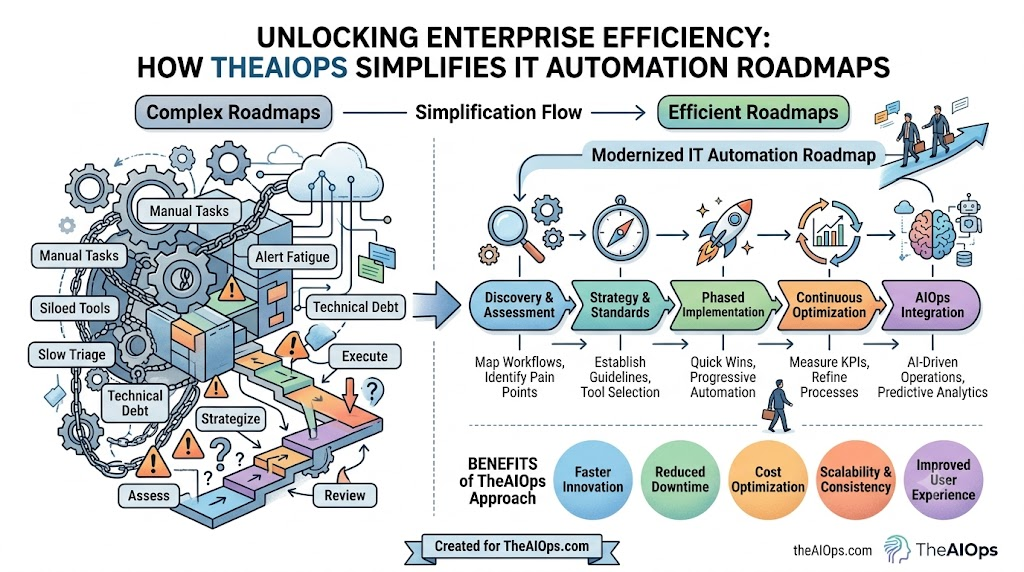
Phases of an IT Automation Roadmap
Implementing automation is a journey, not a single project. A mature roadmap is typically broken down into four progressive phases.
| Phase | Focus Area | Key Objectives |
| Phase 1: Standardization & Visibility | Foundation | Establish infrastructure monitoring, centralize logs, and document manual runbooks. |
| Phase 2: Tactical Automation | Quick Wins | Automate repetitive, low-risk tasks like server provisioning, password resets, and backup verification. |
| Phase 3: Advanced Orchestration | Integration | Connect CI/CD pipelines, ITSM ticketing, and automated incident response workflows. |
| Phase 4: Autonomous Operations (AIOps) | Intelligence | Deploy AI and machine learning for predictive analytics, anomaly detection, and automated remediation. |
Role of AIOps in IT Automation
Artificial Intelligence for IT Operations (AIOps) takes traditional automation to the next level by combining big data analytics and machine learning. While traditional automation follows strict, pre-written “if-this-then-that” rules, AIOps dynamically analyzes streaming operational data to spot hidden patterns, predict outages before they happen, and recommend or execute corrective actions autonomously.
Infrastructure Monitoring and Observability
Visibility is the prerequisite for automation. You cannot automate what you cannot see.
- Infrastructure Monitoring: Collects predefined metrics, CPU utilization, memory thresholds, and disk space usage to tell you when something is broken.
- Observability: Goes deeper by providing insights into the internal state of systems through metrics, logs, and distributed traces (often called the three pillars of observability).
Modern automation tools rely on robust observability data streams to trigger automated scaling and healing mechanisms precisely when anomalies arise.
Event Correlation and Intelligent Alerting
Enterprise environments generate thousands of alerts every hour, leading to severe alert fatigue and missed critical incidents.
Event correlation algorithms group related alerts from disparate monitoring tools into a single, cohesive incident ticket. Intelligent alerting filters out background noise, suppresses duplicate warnings, and escalates true anomalies to the right on-call engineers instantly, reducing mean time to acknowledge (MTTA).
Workflow Automation and Orchestration
While automation executes a single task (such as restarting a web service), orchestration coordinates multiple automated tasks across complex, multi-system workflows.
For example, when a new employee joins an organization, an orchestration workflow automatically provisions their corporate email, configures cloud access permissions, assigns security training modules, and updates the IT service management database without human touches.
Incident Management and Automated Remediation
When production incidents occur, every minute of downtime costs money. Incident management automation standardizes the triage process.
Automated remediation takes response a step further by allowing systems to fix known issues autonomously. If a database connection pool exhausts its limit, an automated script or AIOps platform can safely recycle the connection pool or scale up resources instantly, resolving the alert before human engineers even open their laptops.
Integration with DevOps, SRE, Cloud Platforms, and ITSM
Automation cannot exist in a vacuum. A successful roadmap requires tight integration across core enterprise disciplines:
- DevOps: Bridges software development and IT operations to accelerate release cycles.
- Site Reliability Engineering (SRE): Applies software engineering principles to infrastructure and operations management, focusing on error budgets and reliability targets.
- Cloud Platforms: Leverages native APIs from AWS, Azure, and Google Cloud to provision resources dynamically.
- ITSM: Syncs automated workflows with platforms like ServiceNow or Jira Service Management for seamless audit trails and ticket tracking.
Choosing the Right Automation Tools
Selecting appropriate tooling is a critical milestone. The table below compares leading automation and observability tools across key operational dimensions.
| Tool Category | Primary Features | Integrations | Scalability | Ideal Use Cases |
| Ansible Automation Platform | Agentless configuration management, playbook automation | Extensive (Cloud, Network, Security APIs) | High | Enterprise configuration management and OS provisioning |
| Terraform (HashiCorp) | Infrastructure as Code (IaC), state management | Multi-cloud, Kubernetes, SaaS tools | Very High | Multi-cloud resource provisioning and infrastructure state management |
| Datadog | Full-stack observability, APM, log management, AIOps | 600+ out-of-the-box integrations | Enterprise-grade | Unified monitoring, metric tracking, and anomaly detection |
| PagerDuty | Incident response, event orchestration, automated remediation | ITSM, CI/CD, and monitoring tools | High | On-call management, alert routing, and automated incident triage |
| ServiceNow ITSM | Workflow orchestration, IT service desk, change management | Enterprise software ecosystem | Massive Enterprise | IT service management and enterprise workflow automation |
Measuring Automation Success Without Vanity Metrics
To prove return on investment (ROI), organizations must track meaningful metrics rather than vanity figures like “number of scripts written.”
Core Success Metrics
- Mean Time to Resolution (MTTR): How quickly incidents are successfully resolved.
- Deployment Frequency & Lead Time: How often code reaches production and how fast it gets there.
- Change Failure Rate: The percentage of automated deployments that result in degradation or outages.
- Toil Reduction Hours: Total engineering hours reclaimed from manual operational tasks.
Common Challenges During Automation Adoption
Roadmaps often encounter friction during execution. Anticipating these hurdles ensures smoother delivery.
- Siloed Teams: Resistance between developers and operations staff (solved by fostering a shared DevOps culture).
- Automating Broken Processes: Codifying a flawed manual process only creates automated chaos faster. Always streamline workflows before scripting them.
- Skill Gaps: Lack of internal expertise in modern automation languages and cloud-native frameworks.
Best Practices for Successful IT Automation
- Start Small and Scale: Begin with repetitive, low-risk administrative tasks before tackling core production pipelines.
- Embrace Infrastructure as Code (IaC): Treat infrastructure definitions just like application code with version control, pull requests, and automated testing.
- Maintain Comprehensive Documentation: Ensure runbooks and automated workflows are well-documented so teams understand system dependencies.
- Invest in Continuous Training: Upskill engineers regularly through structured platforms like TheAIOps.com.
Common Mistakes Organizations Should Avoid
- Automating Everything at Once: Boiling the ocean leads to burnout, errors, and project abandonment.
- Neglecting Security: Hardcoding credentials or API keys inside automation scripts introduces severe enterprise security risks.
- Ignoring Feedback Loops: Failing to monitor the performance and accuracy of automated workflows over time.
How TheAIOps.com Helps IT Professionals Learn Automation
Navigating the vast ecosystem of IT automation, AIOps, and SRE can feel overwhelming. TheAIOps.com serves as an indispensable educational partner for individuals and enterprise teams alike.
The platform provides:
- In-Depth Tutorials: Clear, beginner-friendly guides breaking down complex automation concepts into digestible lessons.
- Implementation Frameworks: Proven, battle-tested blueprints for designing enterprise automation roadmaps.
- Certification Resources: Curated learning paths designed to help engineers master modern cloud infrastructure, DevOps practices, and AIOps toolchains.
- Hands-On Learning Materials: Practical examples and architectural patterns that bridge theory with real-world execution.
Future Trends in AI-Driven IT Automation
The landscape of IT automation is evolving rapidly. Key trends shaping the future include:
- Hyperautomation: Combining AI, machine learning, and robotic process automation (RPA) to automate nearly all routine enterprise tasks.
- Self-Healing Systems: Infrastructure that autonomously diagnoses root causes, applies patches, and optimizes performance without human intervention.
- Generative AI for Operations: Natural language interfaces that allow engineers to execute complex infrastructure commands and query logs using conversational prompts.
Frequently Asked Questions
What is an IT automation roadmap?
An IT automation roadmap is a strategic, phased master plan that outlines how an organization will transition from manual, reactive IT operations to standardized, automated, and AI-driven workflows over time.
Why is AIOps important for modern IT operations?
AIOps leverages big data and machine learning to analyze streaming telemetry, correlate alerts, predict potential outages, and automate incident remediation far beyond the capability of static rules-based scripts.
How does TheAIOps.com help beginners learn automation?
TheAIOps.com offers structured tutorials, practical implementation guides, and easy-to-understand frameworks tailored specifically for students, system administrators, and professionals starting their automation journey.
What is the difference between IT automation and orchestration?
IT automation executes a single, repetitive task automatically, whereas orchestration coordinates and manages multiple automated tasks across complex, multi-system workflows.
How do I choose the right tools for my automation roadmap?
Assess your organization’s current operational maturity, technical skill sets, existing tech stack, and scalability requirements, then select tools that integrate seamlessly with your current workflows.
What role does SRE play in IT automation?
Site Reliability Engineering (SRE) applies software engineering principles to operations, utilizing automation to eliminate toil, manage error budgets, and ensure high system reliability.
How can organizations measure the ROI of automation?
ROI is measured by tracking key performance indicators such as reduced Mean Time to Resolution (MTTR), faster deployment frequencies, lower change failure rates, and hours of engineering toil saved.
What are the first processes an organization should automate?
Organizations should start with low-risk, high-frequency operational tasks such as user provisioning, server backups, password resets, and standard log aggregation.
How does observability support infrastructure automation?
Observability provides deep, real-time insights into system health through metrics, logs, and traces, giving automation engines the accurate data required to trigger automated scaling and healing actions.
Where can I find reliable certification and training resources for AIOps?
You can explore comprehensive guides, tutorials, and structured learning pathways directly on TheAIOps to accelerate your expertise in modern IT operations.
Conclusion
Designing and implementing an effective IT automation roadmap is no longer optional for organizations striving to remain competitive in a digital-first world. By moving systematically from manual operations to intelligent, AI-driven workflows, enterprises can eliminate operational toil, minimize downtime, and accelerate innovation. Success requires the right blend of strategy, tooling, and continuous education. Equip your team with the knowledge and frameworks needed to excel by exploring TheAIOps for expert tutorials, automation guides, and hands-on learning resources.
