Upgrade & Secure Your Future with DevOps, SRE, DevSecOps, MLOps!
We spend hours scrolling social media and waste money on things we forget, but won’t spend 30 minutes a day earning certifications that can change our lives.
Master in DevOps, SRE, DevSecOps & MLOps by DevOps School!
Learn from Guru Rajesh Kumar and double your salary in just one year.
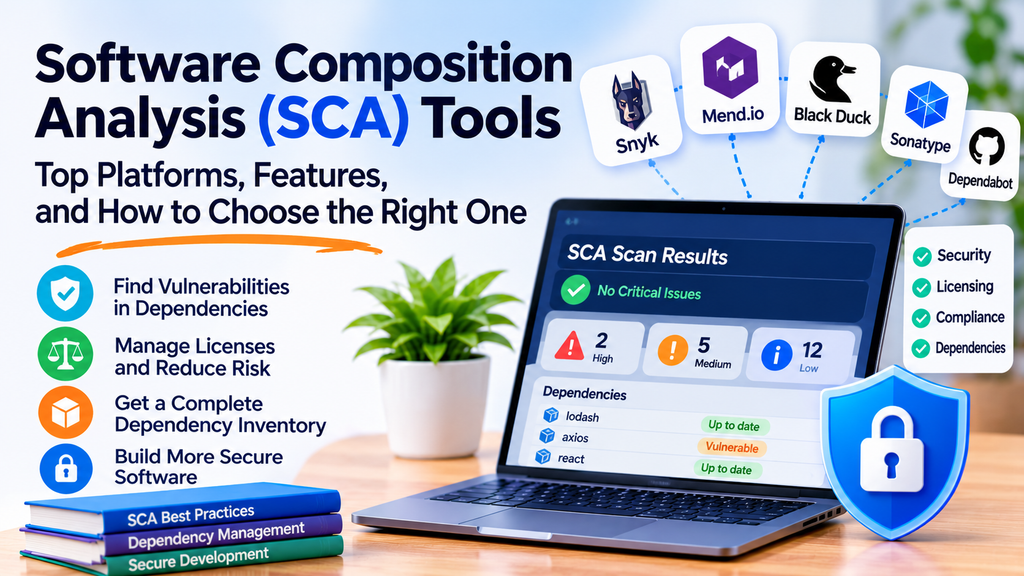
Software Composition Analysis (SCA) Tools: Top Platforms, Features, and How to Choose the Right One
Software Composition Analysis (SCA) tools help organizations identify, track, and manage open-source and third-party components used in software applications. Modern applications rely on external libraries, frameworks, and packages to accelerate development, but these dependencies can introduce security vulnerabilities, outdated versions, and licensing obligations. SCA tools help development and security teams understand these risks and make informed decisions about software dependencies.
By integrating SCA into development workflows and CI/CD pipelines, organizations can detect vulnerable components earlier, monitor dependency changes, and improve software supply chain security.
What Is Software Composition Analysis?
Software Composition Analysis is the process of identifying and evaluating third-party and open-source components in an application. SCA tools analyze dependency manifests, lockfiles, source repositories, container images, and other supported artifacts to discover components and assess their associated risks.
Typical SCA capabilities include:
- Open-source dependency discovery.
- Known vulnerability identification using security advisories and vulnerability databases.
- Software license detection and policy enforcement.
- Dependency version and upgrade recommendations.
- Transitive dependency analysis.
- Software Bill of Materials (SBOM) generation and consumption.
- Integration with developer tools and CI/CD pipelines.
The exact features vary by product, language ecosystem, and licensing tier.
Why Are SCA Tools Important?
SCA tools help organizations:
- Identify known vulnerabilities in third-party packages.
- Understand direct and transitive dependencies.
- Reduce the risk of using outdated or unsupported libraries.
- Identify open-source license obligations.
- Prioritize remediation based on severity and application context.
- Support software supply chain security practices.
- Maintain visibility into components used across projects.
- Automate dependency checks before software is released.
Top Software Composition Analysis Tools
1. Snyk Open Source
Snyk Open Source helps developers identify vulnerabilities in open-source dependencies and provides remediation guidance for supported ecosystems.
Key features:
- Dependency vulnerability scanning.
- Fix advice and upgrade recommendations.
- Integration with repositories and developer workflows.
- CI/CD security checks.
- Support for multiple package ecosystems.
Best for: Development teams that want dependency security checks integrated into everyday coding and delivery workflows.
2. Mend.io
Mend.io provides application security capabilities that include open-source dependency and license analysis. It helps organizations discover vulnerable components and apply policies to dependency usage.
Key features:
- Open-source dependency identification.
- Vulnerability and license risk reporting.
- Policy-based dependency management.
- Repository and CI/CD integrations.
- Support for enterprise application security workflows.
Best for: Organizations that need centralized open-source risk management and governance.
3. Black Duck SCA
Black Duck, from Synopsys’ software integrity business now associated with the broader SCA portfolio, is an established solution for open-source risk management. Verify current product ownership, packaging, and licensing when evaluating it.
Key features:
- Open-source component identification.
- Vulnerability and license analysis.
- Policy and compliance reporting.
- Component inventory management.
- Support for enterprise application security processes.
Best for: Enterprises managing open-source risk across complex software portfolios.
4. Sonatype Lifecycle
Sonatype Lifecycle helps teams govern open-source components throughout the software development lifecycle, with policy controls and integrations for supported development environments.
Key features:
- Component risk assessment.
- Vulnerability and license policy enforcement.
- Guidance for selecting safer component versions.
- Integration with repository managers and CI/CD systems.
- Governance reporting.
Best for: Teams seeking dependency governance integrated with software development and artifact management workflows.
5. GitHub Dependabot
Dependabot helps GitHub users identify dependency vulnerabilities and keep supported dependencies updated. It can create alerts and pull requests for eligible dependency updates.
Key features:
- Dependency vulnerability alerts.
- Automated dependency update pull requests.
- Integration with GitHub repositories.
- Support for supported package ecosystems.
- Connection with GitHub security workflows.
Best for: Teams using GitHub that want straightforward dependency monitoring and update automation.
6. GitLab Dependency Scanning
GitLab provides dependency scanning and related software supply chain security capabilities, with availability and features depending on the product tier and configuration.
Key features:
- Dependency vulnerability detection for supported projects.
- Security findings within GitLab workflows.
- CI/CD pipeline integration.
- Dependency-related reporting.
- Integration with broader application security capabilities.
Best for: Teams already using GitLab for source control, pipelines, and security workflows.
7. OWASP Dependency-Check
OWASP Dependency-Check is an open-source tool that attempts to identify publicly disclosed vulnerabilities associated with project dependencies. It supports several development ecosystems and build integrations.
Key features:
- Dependency identification and vulnerability matching.
- Reports for discovered findings.
- Integration with supported build systems.
- Command-line and automation support.
- Open-source availability.
Best for: Developers and organizations looking for an open-source dependency vulnerability scanning option. Findings should be reviewed because identification and matching can produce false positives or miss components.
8. FOSSA
FOSSA focuses on open-source license compliance and software supply chain risk management, including dependency visibility and vulnerability-related capabilities depending on the offering.
Key features:
- Open-source license identification.
- Dependency inventory and policy controls.
- License compliance reporting.
- Developer and CI/CD integrations.
- Support for software supply chain workflows.
Best for: Organizations that need to manage open-source licensing alongside dependency risk.
9. Trivy
Trivy is an open-source security scanner that can detect vulnerabilities in supported software dependencies, container images, and other artifacts. Its capabilities extend beyond SCA alone.
Key features:
- Dependency and package vulnerability scanning.
- Container image analysis.
- Integration into CI/CD pipelines.
- SBOM-related capabilities.
- Support for automated security checks.
Best for: DevOps and security teams that want a flexible scanner for dependencies, containers, and related artifacts.
10. OSV-Scanner
OSV-Scanner is an open-source vulnerability scanner built around the Open Source Vulnerabilities (OSV) ecosystem. It helps identify known vulnerabilities in supported dependencies and lockfiles.
Key features:
- Dependency scanning against OSV data.
- Lockfile-based analysis for supported ecosystems.
- Command-line usage and automation support.
- Integration options for development workflows.
- Open-source tooling.
Best for: Developers seeking an open-source tool for identifying known vulnerabilities in supported open-source dependencies.
Comparison of Popular SCA Tools
| Tool | Primary strength | Best suited for |
|---|---|---|
| Snyk Open Source | Developer-focused dependency security | Development teams |
| Mend.io | Open-source risk governance | Enterprise application security |
| Black Duck SCA | Enterprise component and license analysis | Large software portfolios |
| Sonatype Lifecycle | Dependency policy management | Governed development workflows |
| GitHub Dependabot | Vulnerability alerts and dependency updates | GitHub repositories |
| GitLab Dependency Scanning | Integrated pipeline security | GitLab users |
| OWASP Dependency-Check | Open-source vulnerability scanning | Build and CI automation |
| FOSSA | License compliance and dependency visibility | Open-source governance |
| Trivy | Dependency and artifact scanning | DevOps and cloud-native teams |
| OSV-Scanner | Open-source vulnerability matching | Developers and automation workflows |
SCA vs. SAST vs. DAST
Software Composition Analysis focuses on third-party and open-source dependencies. Static Application Security Testing (SAST) examines an application’s code for potentially insecure patterns without executing it. Dynamic Application Security Testing (DAST) tests a running application for security weaknesses observable through its behavior.
These methods address different risk areas. Organizations often combine SCA, SAST, DAST, code review, and infrastructure security checks for broader application security coverage.
How to Choose the Right SCA Tool
- Identify your programming languages, package managers, and build systems.
- Decide whether vulnerability detection, license compliance, or both are priorities.
- Check coverage of direct and transitive dependencies.
- Evaluate vulnerability data quality, remediation guidance, and prioritization features.
- Confirm integration with repositories, IDEs, artifact registries, and CI/CD pipelines.
- Review SBOM generation and import/export requirements.
- Consider policy controls, reporting, access management, and audit requirements.
- Compare pricing, hosting options, and administrative effort.
- Test the tool on representative projects before organization-wide adoption.
Best Practices for SCA Implementation
- Scan dependencies during development and CI/CD execution.
- Keep dependency manifests and lockfiles accurate and version-controlled.
- Prioritize fixes using severity, exploitability, exposure, and application context.
- Establish clear policies for vulnerable and restricted components.
- Review license obligations before distributing software.
- Automate safe dependency updates where practical.
- Investigate false positives and document approved exceptions.
- Generate and maintain SBOMs when required by customers, contracts, or policy.
- Re-scan applications regularly as vulnerability intelligence changes.
- Assign responsibility for remediation and track issues to closure.
SCA in the Software Development Lifecycle
SCA can run during pull request checks, scheduled repository scans, build pipelines, and release preparation. Early feedback helps developers address dependency risks before changes are merged. Continuous monitoring also matters because a component that has no known vulnerability today may be affected by a security advisory later.
Effective programs combine automated detection with clear ownership, practical remediation deadlines, and a process for evaluating exceptions. A scanner alone does not eliminate supply chain risk; teams must act on the findings and maintain visibility into their dependencies.
Conclusion
Software Composition Analysis tools help organizations understand the open-source components in their applications, detect known vulnerabilities, manage license obligations, and improve software supply chain security. Snyk, Mend.io, Black Duck, Sonatype Lifecycle, Dependabot, GitLab, OWASP Dependency-Check, FOSSA, Trivy, and OSV-Scanner offer different approaches to dependency analysis and governance.
The right solution depends on your technology stack, security goals, compliance requirements, and existing development platform. Integrating SCA into the development lifecycle and consistently remediating important findings helps teams build and deliver more secure software.
