Upgrade & Secure Your Future with DevOps, SRE, DevSecOps, MLOps!
We spend hours scrolling social media and waste money on things we forget, but won’t spend 30 minutes a day earning certifications that can change our lives.
Master in DevOps, SRE, DevSecOps & MLOps by DevOps School!
Learn from Guru Rajesh Kumar and double your salary in just one year.
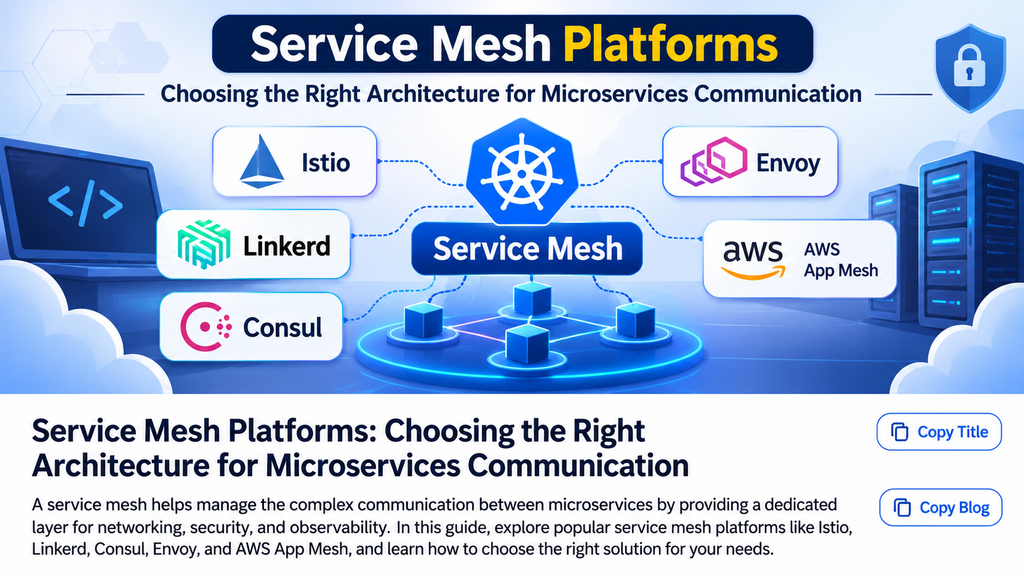
Microservices give engineering teams the flexibility to deploy, scale, and update individual services independently. However, that flexibility introduces a difficult operational problem: every service must communicate reliably with other services while handling authentication, encryption, traffic routing, retries, failures, and observability.
A service mesh addresses these challenges by providing a dedicated infrastructure layer for service-to-service communication. Instead of implementing networking policies separately in every application, teams can manage many communication behaviors through shared infrastructure and configuration.
The important decision is not simply which service mesh offers the most features. It is whether the platform fits your Kubernetes environment, operational expertise, security requirements, traffic patterns, and tolerance for additional infrastructure complexity.
What Is a Service Mesh?
A service mesh separates application business logic from many of the concerns involved in network communication. Depending on the implementation, it can provide encrypted connections between services, identity-based access controls, traffic management, telemetry, and failure-handling policies.
A typical deployment has two major components:
- Data plane: Handles actual service traffic, often through proxies deployed alongside application workloads or through newer proxyless and node-level approaches.
- Control plane: Distributes configuration, manages service identities and certificates, and coordinates traffic policies or proxy behavior.
Consider an online shopping application with separate services for payments, inventory, customer accounts, and order processing. A service mesh can help enforce encrypted communication, control which workloads may access the payment service, and expose latency or error metrics without requiring each team to build those capabilities independently.
A mesh does not automatically make applications resilient. Poor retry policies can amplify an outage, telemetry can increase infrastructure costs, and overly permissive security policies can undermine access controls.
Leading Service Mesh Platforms
1. Istio
Istio is an open-source service mesh offering traffic routing, workload identity, security policies, and telemetry. Kubernetes is a central deployment environment, and its architecture supports both traditional sidecar proxies and the sidecarless ambient mode.
Istio is worth evaluating when an organization needs fine-grained traffic management, centralized security policies, and control over complex microservices communication.
Consider the configuration complexity, infrastructure resources, compatibility with existing networking components, and the expertise needed to troubleshoot distributed traffic behavior.
Official documentation: https://istio.io/latest/docs/
2. Linkerd
Linkerd focuses on a Kubernetes-oriented service mesh experience, using lightweight proxies to provide encrypted service communication, telemetry, and traffic-handling capabilities.
It can suit teams that want core mesh functionality without adopting more networking complexity than their requirements justify.
Before choosing it, verify the required policy features, compatibility with your cluster configuration, management experience, and the differences between available distributions or enterprise offerings.
Official documentation: https://linkerd.io/
3. Consul Service Mesh
Consul combines service discovery with service-mesh capabilities. Depending on the architecture, it can help organizations coordinate service connectivity across Kubernetes, virtual machines, and hybrid environments.
It is particularly relevant when service registration and connectivity across distributed infrastructure are important requirements.
Evaluate the deployment topology, integration with existing service discovery, identity and certificate management, licensing, and the operational responsibility of maintaining supporting infrastructure.
Official documentation: https://developer.hashicorp.com/consul/docs
4. Envoy Proxy
Envoy is a high-performance proxy widely used as a data-plane component in service-mesh architectures. It supports traffic management, protocol handling, observability, and extensible networking behavior.
However, Envoy alone is not a complete service mesh. Teams adopting it directly may need to build or integrate configuration distribution, workload identity, policy management, and service discovery.
It is suitable for platform engineering teams that need customized networking infrastructure or want to use a proxy within a larger control-plane architecture.
Official documentation: https://www.envoyproxy.io/docs
5. AWS App Mesh
AWS App Mesh was designed to help manage communication between services running on AWS infrastructure. The service has been discontinued, so it should not be considered for new deployments.
Organizations with existing App Mesh workloads should prioritize migration planning and assess supported alternatives against their current traffic policies, observability integrations, and application architecture.
This illustrates why product lifecycle status matters as much as technical features when evaluating infrastructure software.
Service Mesh Platform Comparison
| Platform | Primary purpose | Main consideration |
|---|---|---|
| Istio | Full-featured service mesh | Broad policy and traffic-management capabilities require careful operation |
| Linkerd | Kubernetes-focused service mesh | Verify required features and supported configurations |
| Consul Service Mesh | Service discovery and connectivity | Useful for distributed and hybrid environments |
| Envoy Proxy | Networking proxy and data-plane building block | Requires additional control and management capabilities for a complete mesh |
| AWS App Mesh | Discontinued service-mesh offering | Existing deployments need a migration strategy |
These are architectural distinctions, not a performance ranking. The right choice depends on workload behavior, infrastructure, security requirements, and the capabilities your team can operate reliably.
How to Choose the Right Platform
Start With a Specific Networking Problem
A service mesh adds another infrastructure layer. Before introducing one, identify the issue you are trying to solve.
Examples include inconsistent mutual TLS configuration, limited visibility into service-to-service latency, the need for centralized workload access policies, or difficulty performing controlled traffic shifts.
If basic service discovery or a small number of network rules are sufficient, existing platform features may already meet your requirements.
Choose the Data-Plane Architecture
Sidecar-based architectures deploy a proxy alongside each participating workload. They provide an established way to intercept and manage application traffic, but can add resource consumption and lifecycle complexity.
Sidecarless approaches can reduce the need for per-workload proxy deployment in some configurations. Their capabilities and traffic-processing paths differ, so verify which features require Layer 7 processing and how traffic is intercepted.
Test the actual architecture you plan to run in production instead of comparing architecture labels alone.
Establish Security Policies
Mutual TLS can encrypt connections and authenticate workloads, but encryption alone does not establish authorization. Access policies must also specify which identities can communicate with which services.
A sensible rollout includes:
- Establishing workload identities and certificate-management procedures.
- Enabling encrypted communication in a controlled environment.
- Applying restrictive authorization policies to representative services.
- Testing legitimate application flows and expected denials.
- Monitoring policy failures before expanding enforcement.
A mesh should complement broader security controls such as workload hardening, secret management, and application-level authorization.
Measure Operational Costs
The cost of a mesh includes more than software licensing. Teams should account for proxy CPU and memory, control-plane resources, telemetry ingestion, storage, support, and engineering time.
During a pilot, measure application latency and throughput before and after introducing the mesh. Also track resource consumption, policy failures, recovery behavior, and the time required to diagnose networking problems.
Results will vary according to the workload and configuration. General claims that a mesh is faster or cheaper are not substitutes for representative measurements.
A Practical Evaluation Checklist
Before adopting a platform, assess the following requirements:
- Compatibility: Does it work with your cluster networking configuration, protocols, and deployment processes?
- Security: Can workload identity and authorization policies enforce the required access boundaries?
- Observability: Are latency, errors, and traffic behavior visible without overwhelming the telemetry pipeline?
- Resilience: Do timeouts, retries, and traffic policies behave predictably during partial failures?
- Operations: Can engineers safely update policies, rotate certificates, upgrade components, and troubleshoot incidents?
- Cost: What additional compute, storage, support, and maintenance effort will the deployment require?
Choose a small group of representative services for a pilot. Include realistic traffic patterns, service-to-service authentication, and failure scenarios. Define acceptance criteria before testing, then expand only when the technical benefits justify the operational overhead.
Common Mistakes to Avoid
Deploying a mesh without a clear requirement: Additional infrastructure does not automatically improve reliability or security. Define the problem and determine how success will be measured.
Enabling retries indiscriminately: Retrying every failed request can overload an already struggling service. Configure retry limits, timeouts, and idempotency behavior according to application semantics.
Confusing encryption with authorization: Mutual TLS protects and authenticates connections, but access policies still determine which workloads may communicate.
Ignoring telemetry costs: Excessive metrics, tracing, and logging can create substantial storage and processing demands. Set sensible retention, sampling, and cardinality controls.
Underestimating migration complexity: Moving between meshes may involve service discovery, identity, policy syntax, telemetry integrations, deployment configuration, and operational processes. Inventory these dependencies before committing to a migration.
Making the Final Choice
Istio is worth evaluating when fine-grained traffic management and centralized policy control are important. Linkerd is a candidate for teams prioritizing a Kubernetes-focused mesh experience. Consul Service Mesh deserves consideration when service discovery and connectivity across distributed environments are central requirements. Envoy is relevant when building or customizing the networking layer rather than selecting a complete mesh platform.
The most defensible decision comes from matching platform capabilities to documented requirements and validating the result in a representative environment. Start with a limited pilot, measure technical outcomes and operational overhead, and expand only when the benefits justify the added complexity.
