Upgrade & Secure Your Future with DevOps, SRE, DevSecOps, MLOps!
We spend hours scrolling social media and waste money on things we forget, but won’t spend 30 minutes a day earning certifications that can change our lives.
Master in DevOps, SRE, DevSecOps & MLOps by DevOps School!
Learn from Guru Rajesh Kumar and double your salary in just one year.
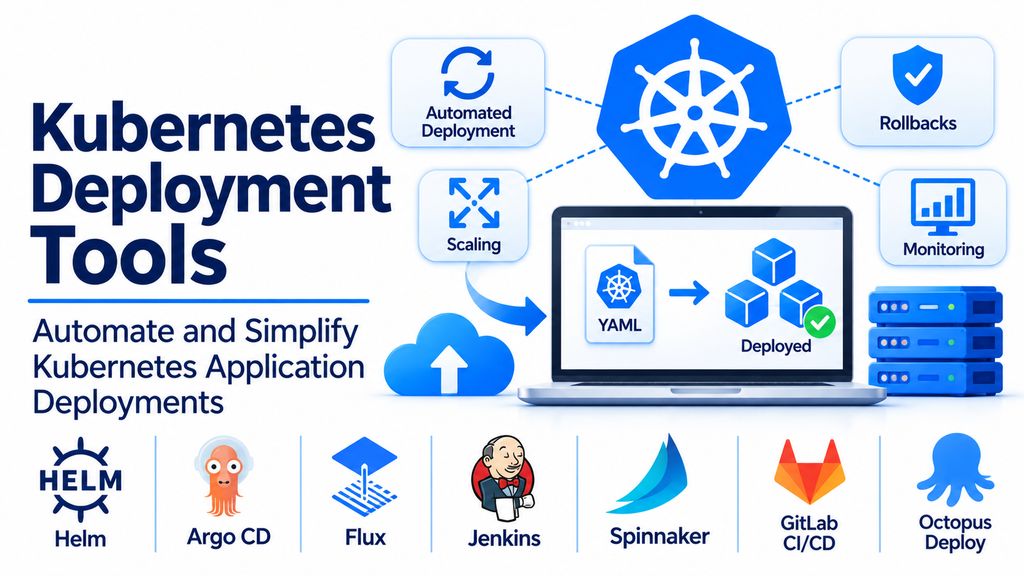
Kubernetes makes it possible to deploy and operate containerized applications across distributed infrastructure. However, managing application releases, updating workloads, maintaining configurations, and coordinating deployments can become challenging as environments grow.
Kubernetes deployment tools help development and operations teams automate these tasks. They support application packaging, release management, configuration control, continuous delivery, and deployment monitoring. By reducing manual work and standardizing release processes, these tools help organizations deliver application updates more consistently.
From command-line deployment utilities to GitOps platforms and continuous delivery systems, Kubernetes deployment tools support different stages of the application delivery lifecycle.
What Are Kubernetes Deployment Tools?
Kubernetes deployment tools are software applications and utilities that help teams install, configure, update, and manage applications running on Kubernetes clusters.
They simplify the process of turning application code and configuration into running workloads. Depending on the tool, this may include building container images, managing Kubernetes manifests, packaging applications, automating releases, and tracking deployment status.
Common capabilities include:
- Application deployment: Create and manage Kubernetes workloads and services.
- Release automation: Automate application updates and delivery workflows.
- Configuration management: Maintain deployment settings across environments.
- Version control: Track application releases and configuration changes.
- Rollback support: Restore earlier versions when deployments fail.
- GitOps workflows: Use version-controlled repositories as the source of deployment configuration.
- Environment management: Coordinate deployments across development, testing, and production.
- Deployment monitoring: Track rollout progress and identify failed updates.
Popular Kubernetes Deployment Tools
1. Helm
Helm is a widely used package manager for Kubernetes. It helps teams package applications and their Kubernetes resources into reusable collections called charts.
Helm makes it easier to install, configure, upgrade, and manage applications across different Kubernetes environments.
Key capabilities:
- Kubernetes application packaging through charts.
- Reusable deployment templates.
- Configuration through values files.
- Application installation and upgrades.
- Release history and rollback support.
Best suited for: Teams deploying complex applications or managing reusable Kubernetes configurations across multiple environments.
2. Argo CD
Argo CD is a declarative GitOps continuous delivery tool for Kubernetes. It synchronizes application configurations stored in Git repositories with the desired state of Kubernetes clusters.
It helps teams automate deployments and maintain consistency between version-controlled configuration and running workloads.
Key capabilities:
- GitOps-based application delivery.
- Automated and manual synchronization.
- Deployment status visualization.
- Configuration drift detection.
- Application health monitoring.
- Rollback through version-controlled configurations.
Best suited for: Kubernetes teams adopting GitOps practices and managing deployments through Git repositories.
3. Flux CD
Flux CD is an open-source GitOps toolkit for keeping Kubernetes clusters synchronized with configuration stored in version control and other supported sources.
It uses controllers to automate application and infrastructure updates.
Key capabilities:
- Continuous configuration synchronization.
- Git-based deployment workflows.
- Helm release management.
- Image automation capabilities.
- Configuration reconciliation.
- Support for multi-cluster workflows.
Best suited for: Platform engineering and DevOps teams that want automated GitOps-based Kubernetes delivery.
4. Jenkins X
Jenkins X is an open-source project designed to support automated CI/CD workflows for Kubernetes-based applications. It brings together development automation, pipeline execution, and GitOps-oriented delivery practices.
Key capabilities:
- Kubernetes-focused CI/CD workflows.
- Automated build and deployment pipelines.
- GitOps-based promotion workflows.
- Preview environments for application changes.
- Integration with development tools.
Best suited for: Teams exploring automated cloud-native software delivery workflows. Organizations should evaluate the project’s current maintenance and ecosystem status before adopting it for new deployments.
5. Spinnaker
Spinnaker is an open-source continuous delivery platform designed to automate application releases across cloud environments. It supports Kubernetes deployment workflows and provides pipeline-based release management.
Key capabilities:
- Automated deployment pipelines.
- Kubernetes deployment support.
- Multi-cloud delivery workflows.
- Release strategies and deployment controls.
- Rollback and deployment management.
Best suited for: Organizations that need advanced release automation across Kubernetes and multiple cloud platforms.
6. Skaffold
Skaffold is a command-line tool that supports continuous development workflows for Kubernetes applications. It automates tasks such as building container images, pushing them to registries, and deploying applications to Kubernetes.
Key capabilities:
- Automated build and deployment workflows.
- Kubernetes manifest support.
- Development and testing workflows.
- Integration with build tools and image registries.
- Continuous application iteration.
Best suited for: Developers who want to streamline local Kubernetes development and application testing.
7. Kustomize
Kustomize is a configuration management tool built into the Kubernetes ecosystem through kubectl. It allows teams to customize Kubernetes YAML configurations without modifying the original base files.
It is useful for maintaining consistent application configurations across different environments.
Key capabilities:
- Declarative configuration customization.
- Base and overlay management.
- Environment-specific configuration.
- Resource patching and transformations.
- Integration with kubectl.
Best suited for: Teams managing Kubernetes manifests across development, staging, and production environments.
8. Octopus Deploy
Octopus Deploy is a deployment automation platform that supports application delivery across infrastructure environments, including Kubernetes.
It helps teams coordinate releases, manage deployment variables, and control application delivery processes.
Key capabilities:
- Kubernetes deployment automation.
- Release and environment management.
- Deployment orchestration.
- Configuration and variable management.
- Approval and release controls.
Best suited for: Organizations that need structured release management across Kubernetes and other application environments.
Kubernetes Deployment Tools Comparison
| Tool | Main strength | Best suited for |
|---|---|---|
| Helm | Application packaging and release management | Kubernetes application teams |
| Argo CD | GitOps continuous delivery | Platform engineering teams |
| Flux CD | Automated configuration reconciliation | GitOps-focused teams |
| Jenkins X | Kubernetes-oriented CI/CD workflows | Cloud-native development teams |
| Spinnaker | Advanced release automation | Enterprise delivery teams |
| Skaffold | Developer build and deployment workflows | Application developers |
| Kustomize | Kubernetes configuration customization | DevOps and platform teams |
| Octopus Deploy | Release and deployment orchestration | Enterprise IT teams |
These tools serve different purposes. Helm and Kustomize focus on application packaging and configuration, while Argo CD and Flux CD specialize in GitOps delivery. Other platforms provide broader deployment pipeline and release automation capabilities.
Important Features to Look For
Choosing a Kubernetes deployment tool requires evaluating how well it supports application delivery and operational requirements.
1. Deployment Automation
The tool should reduce manual deployment tasks and support repeatable release workflows. Automation helps teams deliver updates consistently across environments.
2. Configuration Management
Look for support for Kubernetes manifests, Helm charts, environment-specific settings, and configuration versioning.
3. Rollback Capabilities
Failed releases can affect application availability. Deployment tools should provide suitable mechanisms for restoring previous application versions or configurations.
4. GitOps Support
GitOps capabilities allow teams to manage deployment configurations through version control. Automated reconciliation can help keep clusters aligned with the desired configuration.
5. CI/CD Integration
Compatibility with build pipelines, source control systems, container registries, and testing tools helps create a connected software delivery process.
6. Environment Management
The platform should support controlled deployments across development, testing, staging, and production environments.
7. Deployment Visibility
Dashboards, deployment histories, status information, and health checks help teams understand release progress and identify failures.
8. Security and Access Controls
Authentication, role-based permissions, approval workflows, and secure handling of deployment credentials are important for production environments.
Business Applications of Kubernetes Deployment Tools
Kubernetes deployment tools support application delivery across many industries and technical environments.
- SaaS development: Automate releases for applications that receive frequent updates.
- E-commerce: Coordinate application deployments while maintaining service availability.
- Financial technology: Apply controlled release processes to business-critical applications.
- Enterprise IT: Standardize deployments across teams and infrastructure environments.
- Microservices architecture: Manage independent application releases across multiple services.
- DevOps operations: Connect development, testing, and production delivery workflows.
- Hybrid cloud infrastructure: Coordinate deployments across different Kubernetes environments.
Kubernetes Deployment vs. Continuous Delivery
Kubernetes deployment refers to installing, updating, and managing applications on Kubernetes clusters.
Continuous delivery is a broader software engineering practice that prepares application changes for reliable release through automated build, testing, and delivery workflows.
A Kubernetes deployment tool may handle the final release process, while a continuous delivery platform can coordinate the larger workflow leading up to that release.
For example, a CI pipeline may build and test a container image, publish it to a registry, and then trigger Argo CD to synchronize the updated application configuration with a Kubernetes cluster.
Common Kubernetes Deployment Challenges
Organizations may face several challenges when managing Kubernetes releases.
- Configuration inconsistencies: Different environments may use conflicting deployment settings.
- Failed releases: Application updates may introduce errors or unexpected behavior.
- Deployment complexity: Large microservices environments can involve many interdependent workloads.
- Configuration drift: Running clusters may become inconsistent with version-controlled configurations.
- Secret management: Deployment credentials and sensitive configuration values require secure handling.
- Limited visibility: Teams may struggle to track release status across multiple clusters.
- Rollback difficulties: Restoring a previous application state can be complicated when database or infrastructure changes are involved.
Standardized deployment templates, automated testing, version control, health checks, and carefully designed rollback procedures can help reduce these risks.
How to Choose the Right Kubernetes Deployment Tool
Before selecting a solution, consider the following factors:
- Understand your deployment workflow: Identify how applications are currently built, tested, packaged, and released.
- Choose the right approach: Decide whether you need packaging, configuration management, GitOps, or complete release automation.
- Evaluate integrations: Check compatibility with source control, CI/CD pipelines, container registries, and Kubernetes platforms.
- Review rollback options: Confirm that the tool supports safe recovery from unsuccessful deployments.
- Assess environment management: Ensure it can support your development, staging, and production workflows.
- Check security controls: Evaluate authentication, permissions, approvals, and secret handling.
- Consider scalability: Select a solution that can support your number of applications, clusters, and teams.
- Test with real applications: Run a pilot deployment and evaluate reliability, usability, and operational overhead.
Conclusion
Kubernetes deployment tools help organizations automate application releases, manage configurations, and maintain consistent workloads across Kubernetes environments.
Helm and Kustomize simplify application packaging and configuration, while Argo CD and Flux CD support GitOps-based delivery. Skaffold helps developers streamline local workflows, and platforms such as Spinnaker and Octopus Deploy provide broader release automation capabilities.
The right choice depends on application architecture, deployment frequency, team expertise, infrastructure complexity, and security requirements. By adopting suitable deployment tools and establishing consistent release practices, organizations can improve delivery efficiency and maintain more reliable Kubernetes applications.
