Upgrade & Secure Your Future with DevOps, SRE, DevSecOps, MLOps!
We spend hours scrolling social media and waste money on things we forget, but won’t spend 30 minutes a day earning certifications that can change our lives.
Master in DevOps, SRE, DevSecOps & MLOps by DevOps School!
Learn from Guru Rajesh Kumar and double your salary in just one year.
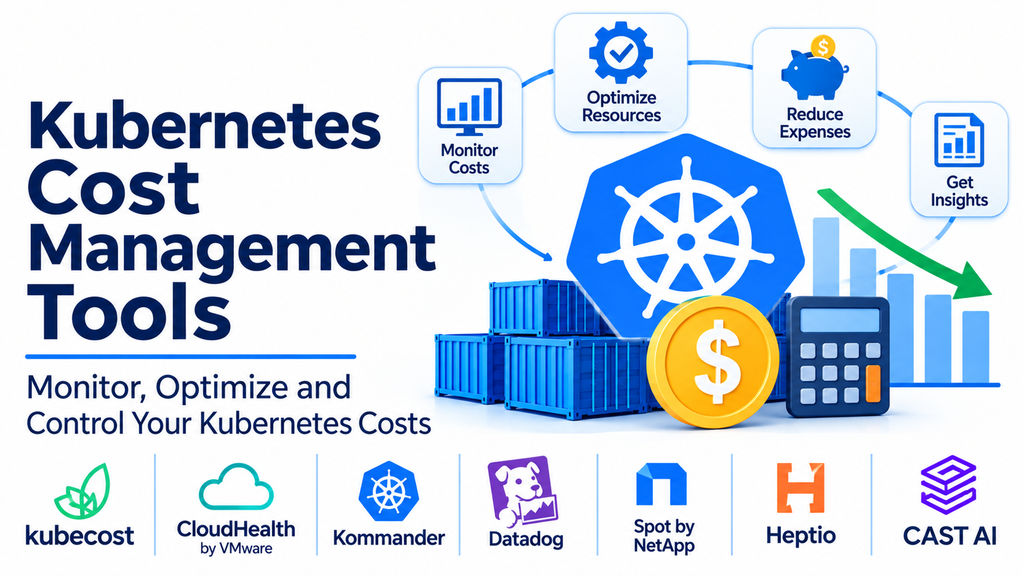
Kubernetes provides powerful capabilities for deploying and scaling containerized applications, but managing its infrastructure costs can be challenging. As organizations expand their clusters, workloads, and cloud environments, infrastructure expenses can increase quickly when resources are not monitored and allocated efficiently.
Kubernetes cost management tools help organizations understand where their infrastructure spending goes, identify wasted resources, optimize workload configurations, and improve budget visibility. They provide insights into CPU and memory usage, cluster utilization, cloud service expenses, and the costs associated with individual teams or applications.
By combining cost visibility with resource optimization, businesses can make better infrastructure decisions while maintaining application performance and reliability.
What Are Kubernetes Cost Management Tools?
Kubernetes cost management tools are software platforms that measure, analyze, allocate, and optimize the costs associated with Kubernetes infrastructure and workloads.
They help organizations understand how much they spend on clusters, nodes, namespaces, workloads, and applications. Many solutions also provide recommendations for reducing unnecessary resource consumption.
Common capabilities include:
- Cost allocation: Attribute infrastructure expenses to teams, applications, namespaces, or projects.
- Resource utilization analysis: Compare requested CPU and memory with actual usage.
- Waste identification: Detect idle resources, oversized workloads, and underutilized nodes.
- Budget monitoring: Track spending against organizational budgets.
- Cost forecasting: Estimate future infrastructure expenses based on usage patterns.
- Optimization recommendations: Suggest resource adjustments and infrastructure improvements.
- Cloud cost visibility: Connect Kubernetes spending with underlying cloud infrastructure costs.
- Reporting: Generate cost reports for engineering, finance, and management teams.
Popular Kubernetes Cost Management Tools
1. Kubecost
Kubecost is a Kubernetes cost monitoring and optimization platform that helps organizations understand spending across clusters, namespaces, workloads, and other Kubernetes resources.
It provides visibility into resource consumption and helps teams identify opportunities to improve infrastructure efficiency.
Key capabilities:
- Kubernetes cost allocation.
- Cluster and namespace cost reporting.
- Resource efficiency analysis.
- Budget monitoring and alerts.
- Cost optimization recommendations.
Best suited for: Organizations that want detailed visibility into Kubernetes spending and workload-level cost allocation.
2. CAST AI
CAST AI provides Kubernetes automation and optimization capabilities focused on improving infrastructure efficiency and managing cloud costs.
Its platform helps organizations optimize compute resources and automate certain infrastructure operations.
Key capabilities:
- Automated infrastructure optimization.
- Kubernetes workload resource analysis.
- Node provisioning and scaling automation.
- Cloud cost reduction recommendations.
- Cluster efficiency monitoring.
Best suited for: Organizations seeking automated Kubernetes infrastructure optimization and cloud cost control.
3. Harness Cloud Cost Management
Harness Cloud Cost Management provides cloud financial management capabilities that help organizations understand and optimize infrastructure spending, including costs associated with Kubernetes environments.
It supports visibility into cloud consumption and helps teams identify opportunities for cost savings.
Key capabilities:
- Cloud cost visibility and allocation.
- Kubernetes cost reporting.
- Spending analysis and dashboards.
- Budget tracking and alerts.
- Cost optimization recommendations.
Best suited for: Engineering and finance teams that need cloud and Kubernetes cost visibility within a broader software delivery platform.
4. OpenCost
OpenCost is an open-source project that provides cost monitoring and allocation for Kubernetes environments. It helps organizations understand the cost of running workloads across clusters and infrastructure.
It is designed to provide transparent Kubernetes cost information through a standardized approach.
Key capabilities:
- Kubernetes cost allocation.
- Namespace and workload cost analysis.
- Resource usage reporting.
- Prometheus integration.
- Cost data export and visualization integrations.
Best suited for: Teams looking for an open-source foundation for Kubernetes cost monitoring.
5. CloudZero
CloudZero is a cloud cost intelligence platform that helps organizations connect infrastructure spending with engineering activities, products, and business outcomes.
It can provide insights into Kubernetes-related cloud expenses as part of broader cloud cost management.
Key capabilities:
- Cloud cost allocation.
- Engineering and product cost visibility.
- Cost anomaly detection.
- Spending analysis and reporting.
- Unit economics and cost efficiency insights.
Best suited for: Cloud-native businesses that want to understand infrastructure spending in relation to products and business performance.
6. Spot by NetApp
Spot by NetApp provides cloud infrastructure optimization capabilities, including tools for managing Kubernetes infrastructure and improving cloud resource efficiency.
Its solutions help organizations automate infrastructure management and optimize compute spending.
Key capabilities:
- Cloud infrastructure optimization.
- Kubernetes node management.
- Automated scaling and provisioning.
- Workload infrastructure optimization.
- Cloud spending visibility.
Best suited for: Organizations running Kubernetes on cloud infrastructure that want to automate resource optimization.
7. Datadog Cloud Cost Management
Datadog Cloud Cost Management provides visibility into cloud infrastructure expenses and connects cost information with infrastructure monitoring.
It can help teams analyze Kubernetes-related spending alongside performance and resource utilization data.
Key capabilities:
- Cloud cost monitoring.
- Infrastructure spending analysis.
- Cost allocation and reporting.
- Resource utilization insights.
- Cost and performance correlation.
Best suited for: Organizations that already use Datadog for observability and want to connect infrastructure performance with cloud spending.
Kubernetes Cost Management Tools Comparison
| Tool | Main strength | Best suited for |
|---|---|---|
| Kubecost | Kubernetes cost allocation | Kubernetes platform teams |
| CAST AI | Automated infrastructure optimization | Cloud-native organizations |
| Harness Cloud Cost Management | Cloud spending visibility | Engineering and finance teams |
| OpenCost | Open-source cost monitoring | DevOps and platform teams |
| CloudZero | Business-oriented cost intelligence | Cloud-native businesses |
| Spot by NetApp | Automated cloud infrastructure optimization | Enterprise cloud teams |
| Datadog Cloud Cost Management | Cost and performance visibility | Datadog users |
These platforms differ in their focus. Some specialize in Kubernetes workload cost allocation, while others provide broader cloud financial management and infrastructure optimization capabilities.
Important Features to Look For
Selecting a Kubernetes cost management tool requires evaluating how effectively it explains spending and helps reduce unnecessary expenses.
1. Detailed Cost Allocation
The platform should show how infrastructure expenses are distributed across clusters, namespaces, workloads, teams, and applications. This makes it easier to identify which services contribute most to spending.
2. Resource Utilization Monitoring
Comparing requested resources with actual CPU and memory usage helps teams identify oversized workloads and improve resource efficiency.
3. Cost Optimization Recommendations
Useful tools should identify idle resources, inefficient node configurations, and opportunities to adjust workload requests and limits.
4. Budget Tracking and Alerts
Budget monitoring helps organizations detect unexpected spending increases and take corrective action before costs become difficult to control.
5. Cloud Provider Integration
For organizations using managed Kubernetes services, integration with cloud billing data can provide a more complete picture of infrastructure expenses.
6. Cost Forecasting
Forecasting capabilities help teams estimate future infrastructure spending based on historical usage and expected workload growth.
7. Reporting and Dashboards
Customizable dashboards make cost information accessible to engineers, finance departments, and business managers.
8. Automation
Some platforms support automated resource optimization and infrastructure changes. Organizations should evaluate the available controls and safeguards before enabling automation.
