Upgrade & Secure Your Future with DevOps, SRE, DevSecOps, MLOps!
We spend hours scrolling social media and waste money on things we forget, but won’t spend 30 minutes a day earning certifications that can change our lives.
Master in DevOps, SRE, DevSecOps & MLOps by DevOps School!
Learn from Guru Rajesh Kumar and double your salary in just one year.
Introduction
Managing business cash flow requires precise financial execution. However, traditional accounts receivable operations continue to drain resources. Finance teams spend hours manually generating billing documents, following up on unpaid balances, and cross-referencing bank statements against payment gateway records. Automating these processes resolves operational friction. Adopting enterprise invoice and payment management software allows organizations to unify billing, digital collections, and bank settlements within a single interface. This guide explores modern billing operations, accounts receivable automation, Indian GST compliance, multi-gateway management, and end-to-end invoice-to-cash workflows. You will discover how automated payment reconciliation software accelerates cash flow while streamlining accounting operations.
What is Invoice and Payment Management Software?
Invoice and payment management software is a dedicated digital platform designed to automate billing, collection tracking, and financial reconciliation. It connects billing systems directly with digital payment rails, creating a real-time data flow between sales orders, customer payments, and general ledger accounts.
Core Workflow
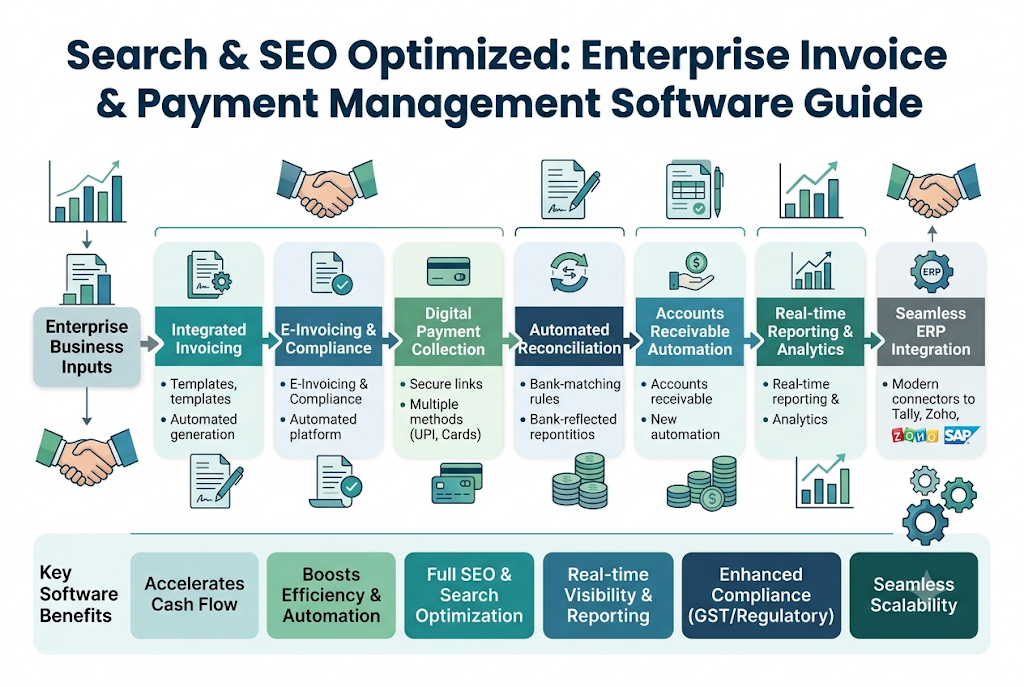
The workflow moves through six distinct phases:
- Generation: Automated creation of GST-compliant tax invoices.
- Distribution: Direct delivery via email, SMS, or WhatsApp with embedded payment links.
- Collection: Secure collection through multi-gateway options, including UPI, cards, and net banking.
- Tracking: Real-time visibility into payment statuses (Pending, Partial, Paid, Expired).
- Reconciliation: Matching collected funds with pending invoices and bank deposits.
- Ledger Update: Automatic posting of cleared transactions to core financial systems.
+------------------+     +------------------+     +------------------+
| Invoice Creation | --> | Payment Delivery | --> | Multi-Gateway    |
| (GST Compliant)  |     | (Links/WhatsApp) |     | Collection       |
+------------------+     +------------------+     +------------------+
                                                           |
                                                           v
+------------------+     +------------------+     +------------------+
| Financial Ledger | <-- | Automated        | <-- | Settlement &     |
| Accounting       |     | Reconciliation   |     | Tracking         |
+------------------+     +------------------+     +------------------+
Essential Components
An enterprise invoice and payment management platform brings together essential financial components:
- Customizable Invoicing Engine: Supports GST taxation rules, customizable fields, and line-item details.
- Payment Link Infrastructure: Generates unique, secure payment URLs tied to specific invoice balances.
- Multi-Gateway Aggregator: Unifies multiple payment gateways into a single operational interface.
- Reconciliation Engine: Matches bank settlements with ledger entries using automated rules.
- Audit & Reporting Suite: Tracks ledger activities, user permissions, and aging accounts receivable.
Why Modern Businesses Need Automated Payment Management
Relying on legacy spreadsheets and manual payment matching creates operational bottlenecks. As transaction volume grows, manual financial processes struggle to scale efficiently.
- Predictable Cash Flow: Automated reminders and embedded payment links reduce Days Sales Outstanding (DSO), getting payments processed faster.
- Real-Time Financial Visibility: Real-time dashboards eliminate missing payment entries and provide immediate insight into working capital.
- Elimination of Manual Tasks: Automation reduces manual data entry, allowing finance teams to focus on strategic analysis instead of tracking down receipts.
- Scalable Operations: Automated platforms handle high transaction volumes without requiring a linear increase in finance staff.
- Frictionless Customer Experience: Providing modern payment methods and dynamic payment links helps customers view and settle invoices quickly.
Key Features of PayManagerPro
PayManagerPro provides an enterprise-grade toolkit built to simplify complex financial workflows.
- GST-Compliant Invoicing: Automatically calculates tax rates and applies sequential e-invoice numbering rules.
- Dynamic Payment Link Management: Generates secure links supporting full or partial payments, with customizable expiration dates.
- Unified Collection Dashboard: Displays incoming payments across all gateways in one centralized interface.
- Multi-Gateway Integration: Connects with leading payment processors to ensure high transaction success rates.
- Automated Payment Reconciliation: Matches ledger entries with processor settlement files automatically.
- RESTful APIs: Integrates seamlessly with custom enterprise ERPs, CRMs, and legacy accounting tools.
- Maker-Checker Workflows: Enforces multi-tier permissions for invoice approvals and payout authorizations.
- Immutable Audit Logs: Tracks every system action, user update, and payment status change for compliance.
GST Invoice Software India
Navigating tax compliance in India requires adherence to guidelines established by the GST Council and the Ministry of Corporate Affairs. Modern enterprise billing platforms handle these complex regulations automatically.
                        +----------------------------+
                        |  Invoice Transaction Type  |
                        +----------------------------+
                                      |
                   +------------------+------------------+
                   |                                     |
                   v                                     v
        [ Intra-State Sale ]                  [ Inter-State Sale ]
                   |                                     |
          +--------+--------+                            |
          |                 |                            |
          v                 v                            v
    +-----------+     +-----------+                +-----------+
    | CGST Tax  |     | SGST Tax  |                | IGST Tax  |
    | Component |     | Component |                | Component |
    +-----------+     +-----------+                +-----------+
Tax Structure Integration
The system automatically applies the correct tax structures based on place-of-supply rules:
- Intra-State Transactions: Splits liability into Central GST (CGST) and State GST (SGST).
- Inter-State Transactions: Applies Integrated GST (IGST) correctly.
Compliance Features
The platform supports e-invoicing formats, including HSN/SAC code lookups, QR code rendering, and mandatory invoice fields. It also categorizes tax data automatically, simplifying quarterly and annual filings for finance teams.
Payment Link Management
Traditional PDF invoices often sit unattended in email inboxes. A modern payment link management platform turns static billing documents into interactive payment channels.
- Instant Link Generation: Create payment links instantly from generated invoices or bulk CSV uploads.
- Multi-Channel Delivery: Send links automatically through email, SMS, or WhatsApp messaging APIs.
- Flexible Payment Options: Allow full payments or structured partial payments based on agreed commercial terms.
- Expiration Control: Set dynamic link expiration windows to manage time-sensitive discount terms.
- Real-Time Status Tracking: Track link interactions—from initial delivery to final payment—in real time.
Automated Payment Collection
Relying on a single payment method often leads to friction and abandoned transactions. Enterprise payment collection management software unifies diverse payment methods into a smooth customer experience.
- Unified Payment Interface (UPI): Supports instant collections via UPI QR codes, intent links, and collect requests backed by the National Payments Corporation of India (NPCI) infrastructure.
- Credit & Debit Cards: Supports tokenized processing across major domestic and international card networks.
- Net Banking & E-Wallets: Direct API access to major banking institutions and digital wallets ensures high payment success rates.
Unifying these payment rails onto one platform lowers transaction drop-offs and consolidates incoming funds into a single, organized stream.
Invoice Payment Tracking
Clear visibility into outstanding receivables is essential for sound financial planning. Specialized invoice payment tracking software provides deep insight into uncollected balances.
- Aging Analysis: Categorizes receivables into aging buckets (0–30, 31–60, 61–90, 90+ days) for quick credit assessment.
- Automated Dunning Workflows: Automatically sends friendly payment reminders before due dates, followed by structured follow-up notices for past-due accounts.
- Single-View Customer Ledgers: Maintains an accurate record of payments, credit notes, and outstanding balances for every account.
Automated Payment Reconciliation
Matching payments manually across multiple gateways, bank accounts, and invoice ledgers is time-consuming and prone to human error. Automated payment reconciliation software replaces tedious spreadsheets with intelligent matching rules.
+--------------------------+        +--------------------------+
|  Pending Invoice System  |        | Gateway Settlement File  |
+--------------------------+        +--------------------------+
             |                                   |
             +-----------------+-----------------+
                               |
                               v
               +-------------------------------+
               |  Matching Engine Rules:       |
               |  1. Invoice ID Check          |
               |  2. Transaction Amount Match  |
               |  3. UTR Reference Verify      |
               +-------------------------------+
                               |
                   +-----------+-----------+
                   |                       |
                   v                       v
         [ Verified Match ]        [ Discrepancy Flag ]
                   |                       |
                   v                       v
          Automatic Ledger         Exception Management
               Posting                   Workflow
The system automatically extracts settlement files from connected gateways and cross-references unique transaction reference (UTR) numbers, invoice IDs, and final settlement amounts. Matching transactions clear instantly. Any discrepancies—such as partial payments, fee deductions, or chargebacks—are flagged for quick manual review, keeping audit logs accurate and up to date.
Accounts Receivable Automation
Accounts receivable automation software unifies invoicing, payment follow-ups, collection management, and ledger updates into a single end-to-end workflow.
+-------------------------------------------------------------------+
|                  ACCOUNTS RECEIVABLE AUTOMATION                   |
+-------------------------------------------------------------------+
|  1. Automated Billing  -->  2. Omnichannel Link Delivery          |
|  3. Smart Dunning      -->  4. Multi-Gateway Collection           |
|  5. Instant Matching   -->  6. Real-Time Ledger Reconciliation      |
+-------------------------------------------------------------------+
By eliminating manual steps, companies can reduce payment delays and improve working capital. Finance teams gain clearer visibility into cash flows, lower collection expenses, and maintain predictable balance sheets.
Invoice-to-Cash Automation
The invoice-to-cash lifecycle covers every step between billing a customer and recognizing settled funds in your bank account.
  [1. Invoice Generation]
             |
             v
  [2. Payment Link Creation]
             |
             v
  [3. Multi-Channel Distribution]
             |
             v
  [4. Gateway Collection]
             |
             v
  [5. Bank Settlement]
             |
             v
  [6. Automated Reconciliation]
             |
             v
  [7. General Ledger Posting]
Automating this process removes friction at every stage: invoices issue instantly, payment links deliver across multiple channels, collections process through optimized payment gateways, and settlements reconcile automatically into core financial systems.
Enterprise Payment Management
Large enterprises with complex operational structures need solutions designed to handle scale, security, and governance.
- Multi-Branch Management: Supports distinct sub-accounts, business units, and legal entities under a central governance model.
- Granular Permission Controls: Implements Role-Based Access Control (RBAC) to ensure employees only view data relevant to their role.
- Maker-Checker Approvals: Requires dual authorization for payouts, credit notes, and manual balance adjustments.
- High-Volume Enterprise APIs: Built on robust API infrastructure capable of handling high transaction volumes without performance degradation.
Security & Compliance
Protecting sensitive business transaction data requires enterprise-grade security practices.
- Data Protection: Keeps financial data safe with standard encryption both in transit and at rest.
- Complete Audit Logs: Keeps a clear, immutable record of every transaction change, balance update, and user access.
- Regulatory Compliance: Aligns with Reserve Bank of India (RBI) payment guidelines and Indian tax standards.
- Access Management: Features multi-factor authentication (MFA) and single sign-on (SSO) integration to secure user logins.
Integration Capabilities
Isolated financial tools create operational data silos. An enterprise payment management platform integrates directly with your existing software stack.
+-------------------------------------------------------------------+
|                         PAYMANAGERPRO                             |
+-------------------------------------------------------------------+
         |                          |                          |
         v                          v                          v
+------------------+       +------------------+       +------------------+
| Payment Gateways |       | Enterprise ERPs  |       | Accounting Tools |
| - Razorpay       |       | - SAP            |       | - Tally          |
| - Cashfree       |       | - Oracle         |       | - Zoho Books     |
| - Paytm          |       | - Salesforce CRM |       | - QuickBooks     |
+------------------+       +------------------+       +------------------+
- Payment Gateways: Connects directly with providers like Razorpay, Cashfree, and Paytm.
- ERP & CRM Platforms: Syncs sales orders, customer profiles, and invoice updates with SAP, Oracle, and Salesforce.
- Accounting Platforms: Keeps ledgers matched across Tally, Zoho Books, and QuickBooks without double entry.
Industries That Can Use PayManagerPro
- Manufacturing: Automates complex billing cycles, milestone payments, and trade credit terms for supply chain operations.
- Healthcare: Simplifies patient billing, insurance claim payouts, and supplier balances across multi-facility operations.
- Education: Streamlines recurring tuition collection, fee breakdowns, and automated late-fee notices.
- Logistics: Accelerates payment collection upon proof of delivery, helping logistics networks manage fuel and fleet costs efficiently.
- Retail & E-Commerce: Manages high-volume B2B wholesale orders alongside automated payment reconciliation.
- SaaS & Tech Subscriptions: Automates recurring subscription billing, plan changes, and usage-based invoices.
- Agencies & Services: Tracks project milestones, retainer invoices, and billable service hours with automated reminders.
- Financial Services: Simplifies loan repayment schedules, fee collections, and regulatory reporting updates.
- Professional Services: Facilitates clear time-and-materials billing with built-in payment link options.
Manual Process vs. PayManagerPro
| Operational Metric | Legacy Manual Process | PayManagerPro Platform |
| Invoice Creation | Manual data entry across spreadsheets and Word documents. | Automated generation matching current GST tax guidelines. |
| Payment Collection | Manual bank transfers requiring manual verification. | Smart multi-gateway links sent via WhatsApp and Email. |
| Reconciliation | Manual cross-referencing of bank statements and gateway files. | Automated matching of deposits, fees, and unpaid invoices. |
| Financial Reporting | Static reports built manually end-of-month. | Real-time analytics dashboards updating transactions instantly. |
| Error Rate | High risk of duplicate entries and calculation mistakes. | Automated validation checks that reduce input errors. |
| Time Required | Hours spent weekly on manual accounts receivable work. | Fast, automated workflows running smoothly in the background. |
Business Benefits
Upgrading to a modern invoicing and reconciliation platform delivers clear operational gains:
- Faster Cash Collections: Omnichannel payment links shorten invoice lifecycle times significantly.
- Stronger Working Capital: Accelerated collections build healthier liquid cash reserves to fund growth.
- Lower Operational Overhead: Eliminating repetitive manual processes helps manage administrative costs.
- Fewer Accounting Errors: Automated data synchronization keeps ledgers clean and minimizes manual entry errors.
- Clearer Financial Insights: Comprehensive real-time reporting provides finance leaders with actionable metrics.
- Smoother Customer Interactions: Flexible payment options help customers resolve outstanding balances easily.
Best Practices for Invoicing & Payment Management
To maximize the return on investment from automation, consider implementing these foundational strategies:
- Standardize Billing Schedules: Issue invoices immediately upon order fulfillment or milestone completion to avoid billing lag.
- Offer Flexible Payment Methods: Support popular regional payment options like UPI, net banking, and cards to streamline collections.
- Automate Dunning Workflows: Set up systematic, polite payment reminders before due dates to maintain steady cash flow.
- Reconcile Daily: Run automated daily reconciliations to catch payment exceptions and discrepancies early.
- Monitor Receivables Aging Closely: Review your accounts receivable aging reports weekly to resolve overdue accounts early.
Common Mistakes in Billing & Reconciliation Operations
Even established finance teams can run into operational pitfalls without the right tools in place:
- Relying on Manual Spreadsheets: Using manual files to track collections leads to untracked invoices and version control issues.
- Inconsistent Follow-Ups: Inconsistent payment reminders lengthen collection cycles and increase bad debt risks.
- Duplicate Invoice Generation: Creating manual invoices without system validation causes buyer confusion and processing delays.
- Incorrect Tax Formatting: Missing dynamic fields or wrong tax rates can create GST non-compliance issues.
- Delayed Reconciliation Routines: Waiting until month-end to reconcile ledger entries leads to delayed balance sheet updates.
Future Trends in Digital Payment Management
- AI-Driven Reconciliation: Machine learning models will automatically handle complex payment matches and clear unusual transaction exceptions.
- Predictive Cash Flow Analytics: Smart algorithms will analyze historic payment habits to accurately forecast upcoming cash reserves.
- Embedded Finance Workflows: Accounts receivable software will integrate working capital solutions and trade credit directly into billing screens.
- API-First Ecosystems: Modular financial tech stacks will communicate seamlessly across cloud ERPs, payment rails, and tax portals.
- Real-Time Digital Ledger Auditing: Automated financial recordkeeping will streamline preparation for regulatory checks and year-end audits.
Frequently Asked Questions
1. What is enterprise invoice and payment management software?
Enterprise invoice and payment management software is a central system that automates billing, payment processing, tracking, and financial reconciliation. It connects billing engines with payment gateways and bank systems, giving companies full visibility into cash flow while eliminating manual data entry.
2. How does automated payment reconciliation software work?
Automated payment reconciliation software fetches settlement files from bank feeds and payment processors, matching them against open invoices using UTR references, transaction values, and customer IDs. Validated matches settle automatically, while any unmatched line items are flagged for quick operational review.
3. Does PayManagerPro support Indian GST compliance regulations?
Yes. The platform supports Indian tax rules by applying correct CGST, SGST, and IGST rates automatically based on state locations. It formats tax totals clearly, handles sequential e-invoice numbering, and creates compliant ledger files for simple tax filing.
4. How do dynamic payment links speed up customer payments?
Dynamic payment links let customers pay immediately using their preferred payment channel, such as UPI, cards, or net banking. Delivered through email, SMS, or WhatsApp, these links eliminate manual transfer setup and simplify the payment process for clients.
5. Can PayManagerPro integrate with existing enterprise ERP and accounting software?
Yes. PayManagerPro features RESTful APIs and pre-built connectors that sync with major systems like Tally, Zoho Books, SAP, Oracle, and leading CRMs. This keeps your accounting ledgers up to date without manual data transfer.
6. How does accounts receivable automation help improve business cash flow?
Accounts receivable automation speeds up invoicing, sends automated payment reminders, offers flexible payment channels, and matches incoming funds instantly. This lowers overall Days Sales Outstanding (DSO), reduces bad debt risks, and maintains steady, predictable cash reserves.
7. What security features protect payment collections and transaction data?
The platform protects operations with end-to-end data encryption, Role-Based Access Control (RBAC), multi-factor authentication, and immutable audit trails. It also adheres to RBI framework updates to ensure enterprise-grade security for your transaction records.
8. Can PayManagerPro handle partial payments against open invoices?
Yes. You can configure payment link settings to allow partial collections based on your commercial terms. The system tracks partial payments against the original invoice balance, updates receivables automatically, and adjusts remaining due amounts in real time.
9. What industries benefit most from using enterprise payment platforms?
Industries handling regular billing—including manufacturing, logistics, SaaS, healthcare, education, retail wholesale, and professional services—see major gains from automation. The system scales easily to manage high transaction volumes and complex multi-entity structures.
9. How does unified multi-gateway tracking help finance teams?
A unified dashboard consolidates transaction feeds from multiple payment processors into one view. This saves finance teams from logging into separate portals, simplifying balance checks and streamlining cross-gateway reporting.
Conclusion
Modernizing accounts receivable processes is essential for maintaining strong, predictable working capital. Relying on manual invoicing, disconnected payment links, and spread-out spreadsheet matching creates administrative friction and delays cash availability. Moving to automated billing operations transforms your financial processes into a scalable growth engine. Implementing specialized enterprise invoice and payment management software streamlines every phase of your billing lifecycle—from compliant GST invoice generation to omnichannel payment link delivery, real-time collection tracking, and automated bank reconciliations. Adopting these modern tools eliminates manual data errors, reduces administrative costs, and gives finance leaders clear visibility into working capital.
