Upgrade & Secure Your Future with DevOps, SRE, DevSecOps, MLOps!
We spend hours scrolling social media and waste money on things we forget, but won’t spend 30 minutes a day earning certifications that can change our lives.
Master in DevOps, SRE, DevSecOps & MLOps by DevOps School!
Learn from Guru Rajesh Kumar and double your salary in just one year.
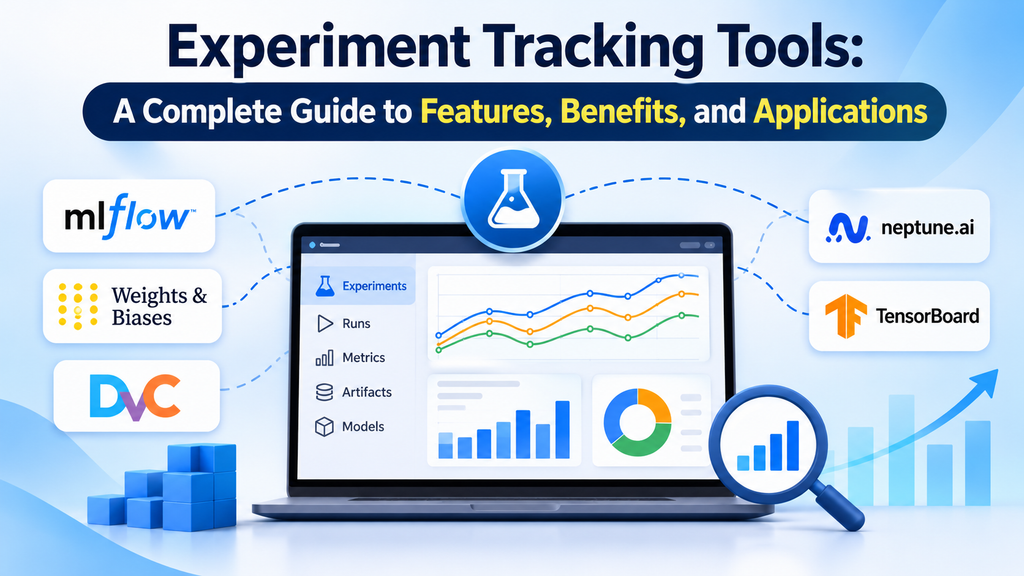
Experiment Tracking Tools: A Complete Guide to Features, Benefits, and Applications
Experiment tracking tools help machine learning teams record, organize, compare, and reproduce the experiments they run while developing models. They capture important details such as parameters, datasets, code versions, metrics, model artifacts, and execution history.
What Are Experiment Tracking Tools?
Experiment tracking tools are software platforms that create a structured record of machine learning experiments. Instead of relying on scattered notebooks, spreadsheets, or manual notes, teams can use a centralized system to understand what was tested, how it performed, and which configuration produced a particular result.
A typical experiment record may include hyperparameters, training and validation metrics, dataset references, source-code versions, environment information, logs, visualizations, and saved model files.
Why Experiment Tracking Matters
Machine learning development is iterative. Teams often train dozens or hundreds of model variations before finding a reliable solution. Without tracking, it becomes difficult to identify the best run, reproduce results, understand performance changes, or collaborate effectively.
Experiment tracking provides consistency and visibility. It helps teams compare runs, diagnose problems, preserve evidence of model development, and make informed decisions based on recorded results.
Key Features
1. Parameter and metric logging: Record hyperparameters such as learning rate, batch size, model depth, and training metrics such as accuracy, precision, recall, and loss.
2. Run comparison: Compare multiple experiments side by side to understand which configurations perform better.
3. Artifact management: Store or reference model files, charts, evaluation reports, datasets, and other outputs associated with each run.
4. Version tracking: Connect experiments with code, data, and environment versions to make results easier to reproduce.
5. Visual dashboards: View learning curves, metric trends, parameter relationships, and experiment histories.
6. Collaboration: Share experiment results with colleagues and maintain a common record of development work.
7. Integration and automation: Connect tracking systems with machine learning frameworks, notebooks, pipelines, and deployment workflows.
Popular Experiment Tracking Tools
MLflow: An open-source platform with experiment tracking capabilities for logging parameters, metrics, and artifacts. It is useful for teams that want an extensible tracking workflow and integration with broader ML lifecycle processes.
Weights & Biases (W&B): Provides experiment dashboards, metric visualization, run comparisons, and collaboration features. It is often used by teams that want a polished interface for monitoring training progress and sharing results.
DVC: Supports data and model versioning alongside experiment management. Its experiment features are especially useful for teams that want reproducible workflows connected to Git-based projects.
Neptune.ai: Known for experiment metadata management and tracking workflows. Before adopting it, teams should verify current product availability, support, and service terms.
TensorBoard: A visualization toolkit commonly used with TensorFlow and other machine learning workflows. It helps developers inspect training metrics, model graphs, and other experiment information.
These tools differ in hosting options, integrations, collaboration features, and workflow design. The best choice depends on the team’s infrastructure and requirements.
Benefits of Experiment Tracking
- Reproducibility: Preserve the settings and context needed to repeat experiments.
- Faster iteration: Find promising configurations without manually searching through old logs.
- Better collaboration: Give team members a shared view of model development.
- Improved debugging: Identify when performance changes and investigate the associated experiment details.
- Clearer decisions: Compare results using consistent metrics and recorded evidence.
- Stronger governance: Maintain a useful history of how models were developed and evaluated.
Common Applications
Experiment tracking is useful in supervised learning, deep learning, natural language processing, computer vision, recommendation systems, forecasting, and reinforcement learning. It also supports research teams comparing model architectures and businesses optimizing models for production use.
For example, a team developing a customer churn model might test different algorithms, feature sets, and hyperparameters. A tracking platform records each run and its evaluation metrics, allowing the team to identify the most effective configuration and reproduce its results later.
How to Choose the Right Tool
Start by identifying the team’s workflow. Consider which machine learning frameworks are used, whether the platform must run on-premises or in the cloud, and how experiment data should be stored. Evaluate ease of integration, access controls, artifact management, visualization, scalability, and total cost.
Also consider the level of reproducibility required. A team working on regulated or business-critical models may need detailed records of code, data, dependencies, and experiment decisions. A small research project may need only lightweight metric logging and run comparison.
Best Practices
Use consistent experiment names and record meaningful descriptions. Log important parameters and metrics for every run. Track code and dataset versions, preserve relevant artifacts, and establish a shared metric naming convention. Avoid storing secrets or sensitive data in experiment logs. Periodically review old experiments and define retention policies so tracking systems remain manageable.
Conclusion
Experiment tracking tools bring structure, transparency, and reproducibility to machine learning development. Platforms such as MLflow, Weights & Biases, DVC, Neptune.ai, and TensorBoard help teams capture experiment details, compare results, and understand how models evolve. By selecting a tool that fits their workflow and adopting consistent tracking practices, machine learning teams can improve collaboration, reduce repeated work, and make better model-development decisions.
