Upgrade & Secure Your Future with DevOps, SRE, DevSecOps, MLOps!
We spend hours scrolling social media and waste money on things we forget, but won’t spend 30 minutes a day earning certifications that can change our lives.
Master in DevOps, SRE, DevSecOps & MLOps by DevOps School!
Learn from Guru Rajesh Kumar and double your salary in just one year.
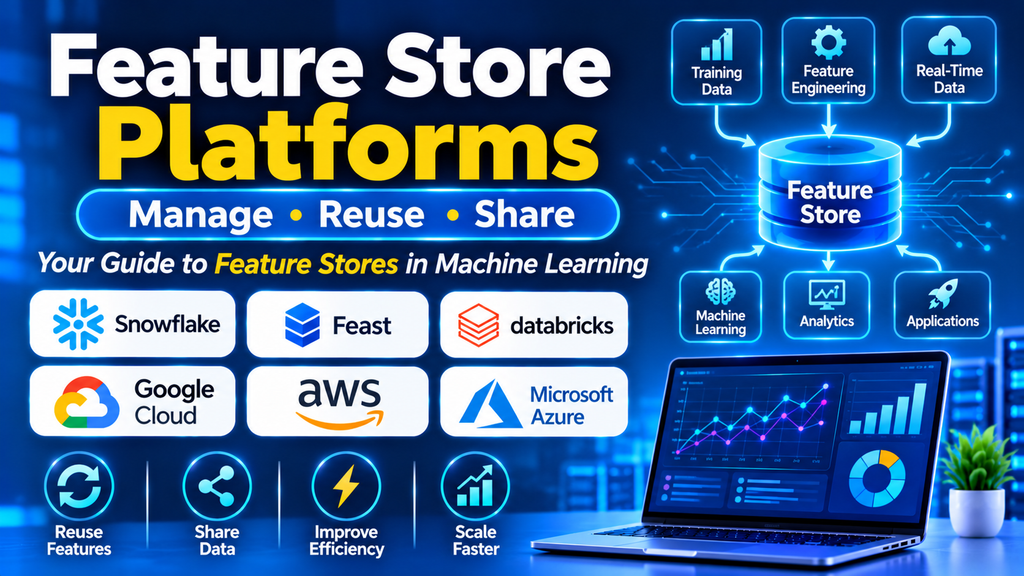
Feature Store Platforms: A Complete Guide to Tools, Features, Benefits, and Applications
Introduction
Machine learning models depend on high-quality data to generate accurate predictions. One of the most important parts of machine learning development is feature engineering, which involves transforming raw data into meaningful inputs for models.
Managing these features across multiple projects can become complicated. Feature store platforms solve this problem by providing centralized environments for storing, managing, sharing, and serving machine learning features.
What Are Feature Store Platforms?
Feature store platforms are specialized systems that manage machine learning features throughout the model development lifecycle.
They store reusable feature definitions and values, provide consistent access to historical and real-time features, and help ensure consistency between model training and production inference.
Popular Feature Store Platforms
1. Feast
Feast is an open-source feature store that helps teams manage and serve machine learning features.
It supports offline and online feature retrieval and integrates with different data infrastructure systems.
2. Tecton
Tecton is an enterprise feature platform designed to manage feature engineering, feature pipelines, and online and offline feature serving for production machine learning applications.
It helps organizations operationalize feature engineering workflows.
3. Hopsworks
Hopsworks is a feature store and AI platform that supports feature engineering, feature management, and serving features for machine learning applications.
It helps data science teams organize and reuse features across projects.
4. Databricks Feature Store
Databricks Feature Store provides feature management capabilities within the Databricks ecosystem.
It helps teams create, discover, share, and manage features for machine learning workflows.
5. Amazon SageMaker Feature Store
Amazon SageMaker Feature Store is an AWS service for storing, sharing, and serving machine learning features.
It supports both training and inference workflows and helps maintain consistent feature access across applications.
6. Google Vertex AI Feature Store
Google Cloud provides feature management and serving capabilities within the Vertex AI ecosystem.
These capabilities help machine learning teams manage features and integrate them into model development and prediction workflows.
7. Snowflake Feature Store
Snowflake Feature Store provides feature engineering and management capabilities integrated with Snowflake’s data platform.
It supports machine learning workflows that use enterprise data stored in Snowflake.
Key Features of Feature Store Platforms
- Centralized feature management: Stores and organizes machine learning features.
- Feature discovery: Helps teams find existing features for new projects.
- Feature reuse: Reduces duplicated feature engineering work.
- Offline storage: Maintains historical features for model training.
- Online serving: Provides low-latency feature access for real-time predictions.
- Historical retrieval: Supports retrieving features as they existed at specific points in time.
- Point-in-time correctness: Helps prevent data leakage during model training.
- Feature documentation: Maintains descriptions and metadata.
- Data quality monitoring: Helps identify missing or unexpected feature values.
- Integration: Connects feature management with machine learning pipelines.
Benefits of Feature Store Platforms
Feature store platforms provide several important advantages:
- Feature Reusability: Teams can reuse existing features across multiple machine learning projects.
- Improved Consistency: They help maintain consistency between training and production inference.
- Faster Development: Data scientists spend less time recreating existing features.
- Better Collaboration: Teams can share and discover features more efficiently.
- Scalability: They support growing machine learning workloads.
- Real-Time Predictions: Online feature serving enables low-latency applications.
- Improved Governance: Centralized management supports better documentation and access control.
- Reduced Maintenance: Standardized feature workflows simplify ongoing management.
Common Applications of Feature Store Platforms
1. Fraud Detection: Provide transaction features for identifying suspicious financial activities.
2. Recommendation Systems: Manage user preferences, browsing behavior, and product interaction features.
3. Customer Analytics: Organize customer behavior and engagement information.
4. Credit Risk Assessment: Manage financial and historical features used in credit scoring models.
5. Real-Time Advertising: Support personalized advertising based on user activity and preferences.
6. Predictive Maintenance: Manage sensor measurements and equipment performance features.
7. Demand Forecasting: Organize historical sales and market information for forecasting models.
8. Customer Churn Prediction: Maintain customer activity and engagement features for retention models.
How Feature Stores Work
A typical feature store workflow includes several stages:
- Data Collection: Collect raw data from databases, applications, and streaming systems.
- Feature Engineering: Transform raw data into meaningful machine learning features.
- Feature Registration: Define and document features for reuse.
- Feature Storage: Store features in offline and online storage systems.
- Feature Retrieval: Make historical or real-time features available to machine learning models.
- Model Training: Use historical features to train machine learning models.
- Model Inference: Retrieve current features when generating production predictions.
- Monitoring: Track feature quality and identify potential issues.
Offline stores support historical training and analysis, while online stores provide low-latency feature retrieval for real-time predictions.
How to Choose the Right Feature Store Platform
Selecting the right platform requires evaluating several factors:
- Compatibility with existing data infrastructure.
- Online and offline feature serving requirements.
- Prediction latency requirements.
- Data volume and scalability.
- Feature discovery and reuse capabilities.
- Security and governance.
- Integration with machine learning tools.
- Pricing and infrastructure costs.
Feast is a flexible open-source option. Tecton and Hopsworks support dedicated feature management workflows. Databricks, Amazon SageMaker, Google Vertex AI, and Snowflake provide feature store capabilities integrated with their respective data and cloud ecosystems.
Conclusion
Feature store platforms are important components of modern machine learning infrastructure.
They simplify feature management, encourage reuse, improve training-serving consistency, and support scalable AI applications.
Choosing the right feature store helps organizations build more reliable machine learning workflows and accelerate the development of data-driven products.
