Upgrade & Secure Your Future with DevOps, SRE, DevSecOps, MLOps!
We spend hours scrolling social media and waste money on things we forget, but won’t spend 30 minutes a day earning certifications that can change our lives.
Master in DevOps, SRE, DevSecOps & MLOps by DevOps School!
Learn from Guru Rajesh Kumar and double your salary in just one year.
Introduction
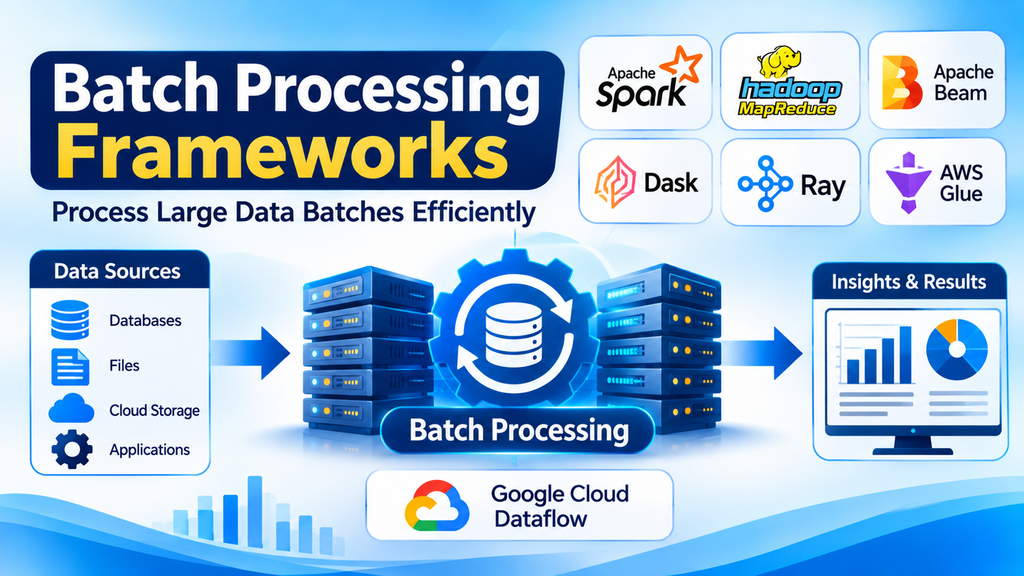
Organizations process large amounts of data from business applications, databases, transactions, logs, and connected systems. Not every workload needs instant results. Many analytical and operational tasks are better handled by collecting data over a period of time and processing it together.
Batch processing frameworks make this possible. They help organizations process large datasets in scheduled or defined groups, making them useful for data transformation, reporting, data warehousing, machine learning preparation, and large-scale computation.
What Are Batch Processing Frameworks?
Batch processing frameworks are software technologies designed to process accumulated data in groups rather than handling every record immediately as it arrives. Data is collected, organized into a batch, and processed according to a schedule or a defined trigger.
These frameworks can perform tasks such as data cleaning, transformation, aggregation, sorting, and large-scale calculations. They are commonly used in data engineering, enterprise reporting, financial processing, and data warehouse pipelines.
Why Are Batch Processing Frameworks Important?
Batch processing remains valuable for workloads where high-volume processing, efficiency, and repeatability are more important than immediate results.
Key benefits include:
- Large-scale data processing: Handle extensive datasets through distributed computing.
- Efficient resource utilization: Schedule workloads to make better use of available infrastructure.
- Reliable workflows: Run repeatable processing jobs with defined steps and dependencies.
- Data transformation: Clean, combine, and prepare information for analytics.
- Cost management: Process workloads in planned execution windows.
- Historical analysis: Process accumulated records for reporting and trend analysis.
- Automation: Schedule recurring data-processing tasks with minimal manual intervention.
Key Features of Batch Processing Frameworks
- Batch Job Execution: Process large groups of records as individual jobs or workflows.
- Distributed Computing: Divide workloads across multiple machines to improve processing capacity.
- Data Transformation: Support filtering, sorting, joining, aggregation, and other operations.
- Scheduling and Automation: Run jobs at specific times or in response to defined triggers.
- Fault Tolerance: Provide mechanisms for handling failures and recovering interrupted jobs.
- Workflow Management: Organize jobs into dependent tasks and processing pipelines.
- Scalability: Support growing datasets and more demanding workloads.
- Data Source Integration: Connect with databases, file systems, cloud storage, and data warehouses.
- Monitoring and Logging: Track job execution, processing duration, failures, and resource usage.
- Output Management: Deliver processed data to storage systems, analytical platforms, or downstream applications.
Popular Batch Processing Frameworks
- Apache Hadoop MapReduce
Apache Hadoop MapReduce is a distributed processing model designed to process large datasets across clusters of computers. It divides processing tasks into map and reduce stages, making it suitable for large-scale batch computation.
- Apache Spark
Apache Spark is a distributed data processing engine that supports batch processing, SQL analytics, streaming, and machine learning workloads. It is widely used for data transformation, large-scale analytics, and data engineering pipelines.
- Apache Flink
Apache Flink supports both stream and batch processing. Its batch execution capabilities allow organizations to process bounded datasets using distributed computation and advanced data-processing operations.
- Apache Beam
Apache Beam provides a unified programming model for building data-processing pipelines. Developers can define batch and streaming workflows and execute them using compatible processing engines.
- Dask
Dask is a flexible parallel computing library for Python. It helps developers scale familiar Python workflows across multiple cores or distributed clusters, making it useful for data analysis and larger-than-memory processing.
- Ray
Ray is a distributed computing framework for scaling Python applications. It supports parallel and distributed workloads, including data processing, machine learning, and computational tasks.
- Celery
Celery is a distributed task queue used to execute asynchronous and scheduled tasks. It is useful for applications that need to distribute background jobs across workers, although it is not a large-scale data processing engine like Spark or Hadoop.
- AWS Glue
AWS Glue is a managed data integration service that supports batch data processing and ETL workflows. It helps organizations discover, prepare, transform, and move data across supported sources and destinations.
- Google Cloud Dataflow
Google Cloud Dataflow is a managed service for executing data-processing pipelines built with Apache Beam. It supports both batch and streaming workloads and manages much of the underlying infrastructure.
- Azure Data Factory
Azure Data Factory is a cloud data integration service that helps organizations create, schedule, and manage data movement and transformation workflows. It is commonly used to coordinate batch-oriented data pipelines.
How Batch Processing Frameworks Work
- Data Collection: Gather records from databases, applications, files, and other sources.
- Batch Creation: Group accumulated records into a defined processing unit.
- Job Scheduling: Start the processing workflow manually, automatically, or according to a schedule.
- Data Processing: Apply transformations, calculations, filtering, sorting, or aggregation.
- Validation: Check processed records for quality, completeness, and consistency.
- Output Delivery: Store the results in databases, data warehouses, data lakes, or reporting systems.
- Monitoring: Review execution logs, processing time, errors, and job status.
Common Use Cases Across Industries
- Banking and Finance: Process account statements, transaction histories, financial reports, and reconciliation records.
- Retail and E-commerce: Analyze daily sales, update inventory records, and prepare customer reports.
- Healthcare: Process administrative records, historical datasets, and operational reports.
- Manufacturing: Consolidate production records, calculate performance metrics, and analyze quality data.
- Telecommunications: Process usage records, billing information, and network performance reports.
- Education: Generate student performance reports and process enrollment records.
- Logistics: Consolidate shipment records, delivery information, and operational data.
- Marketing: Process campaign results, customer records, and historical engagement data.
Challenges of Batch Processing
- Processing Delays: Results are not available until the scheduled or triggered job completes.
- Large Resource Requirements: Processing extensive datasets can require substantial computing and storage resources.
- Job Failures: Failed tasks may interrupt downstream workflows and require recovery procedures.
- Data Quality Problems: Incomplete or inconsistent source records can affect the final output.
- Dependency Management: Complex pipelines require careful coordination of job order and dependencies.
- Performance Optimization: Poorly designed jobs can increase processing time and infrastructure costs.
- Monitoring Complexity: Large workflows need effective logging, alerting, and troubleshooting processes.
Best Practices for Implementing Batch Processing
- Define clear processing objectives and expected completion times.
- Break complex workflows into manageable tasks.
- Use appropriate data partitioning and parallel processing.
- Validate source data before running major transformations.
- Design jobs to support safe retries and recovery.
- Monitor job duration, resource consumption, and failure rates.
- Avoid unnecessary processing of unchanged data where possible.
- Secure data access and protect sensitive information.
- Document job dependencies and transformation logic.
- Test workloads using realistic data volumes before deployment.
How to Choose the Right Batch Processing Framework
- Data Volume: Determine the amount of information the framework must process.
- Performance: Assess expected job completion times and processing throughput.
- Scalability: Check whether the solution can support future workload growth.
- Programming Support: Review available languages, APIs, and development tools.
- Integration: Confirm compatibility with existing databases, storage platforms, and cloud services.
- Workflow Scheduling: Evaluate how jobs and dependencies can be automated.
- Fault Tolerance: Review recovery, retry, and job-monitoring capabilities.
- Deployment Options: Compare cloud-based, on-premises, and hybrid environments.
- Security: Consider authentication, access controls, encryption, and governance.
- Total Cost: Compare infrastructure, licensing, maintenance, and operational expenses.
The Future of Batch Processing Frameworks
Batch processing continues to evolve as organizations adopt cloud computing, distributed architectures, and modern data platforms.
Cloud-native processing services are making it easier to scale workloads without managing all the underlying infrastructure. Improvements in distributed computing and data pipeline orchestration are also helping teams coordinate complex workflows more efficiently.
Batch processing is increasingly used alongside stream processing, allowing organizations to combine historical analysis with continuously updated information. This hybrid approach supports a wide range of modern data engineering requirements.
Conclusion
Batch processing frameworks help organizations process large volumes of accumulated data through scheduled, repeatable, and scalable workflows. They support data transformation, reporting, analytics, financial processing, and enterprise data integration.
Choosing the right framework requires evaluating data volume, performance, scalability, integration, scheduling, reliability, and cost. With well-designed workflows and effective monitoring, batch processing remains an important foundation for modern data infrastructure.
