Upgrade & Secure Your Future with DevOps, SRE, DevSecOps, MLOps!
We spend hours scrolling social media and waste money on things we forget, but won’t spend 30 minutes a day earning certifications that can change our lives.
Master in DevOps, SRE, DevSecOps & MLOps by DevOps School!
Learn from Guru Rajesh Kumar and double your salary in just one year.
Master Data Management (MDM) Tools: Build a Single Source of Truth for Enterprise Data
Modern organizations manage enormous volumes of information across customer relationship management systems, enterprise resource planning applications, financial platforms, marketing tools, databases, and cloud environments.
However, the same business entity can appear differently across these systems. A customer may have multiple records, a supplier may be registered under different names, and product information may contain inconsistent descriptions or identifiers.
These inconsistencies create significant challenges for organizations. Duplicate records affect reporting accuracy, incorrect customer information disrupts business operations, and inconsistent product details make it difficult to maintain reliable enterprise data.
Master Data Management (MDM) tools address these challenges by creating a consistent, governed view of critical business information across different systems.
They help organizations identify duplicate records, standardize information, establish trusted data sources, and synchronize approved master records across applications.
For enterprises focused on data quality, governance, operational efficiency, and digital transformation, MDM platforms play an important role in building a reliable data foundation.
What Are Master Data Management Tools?
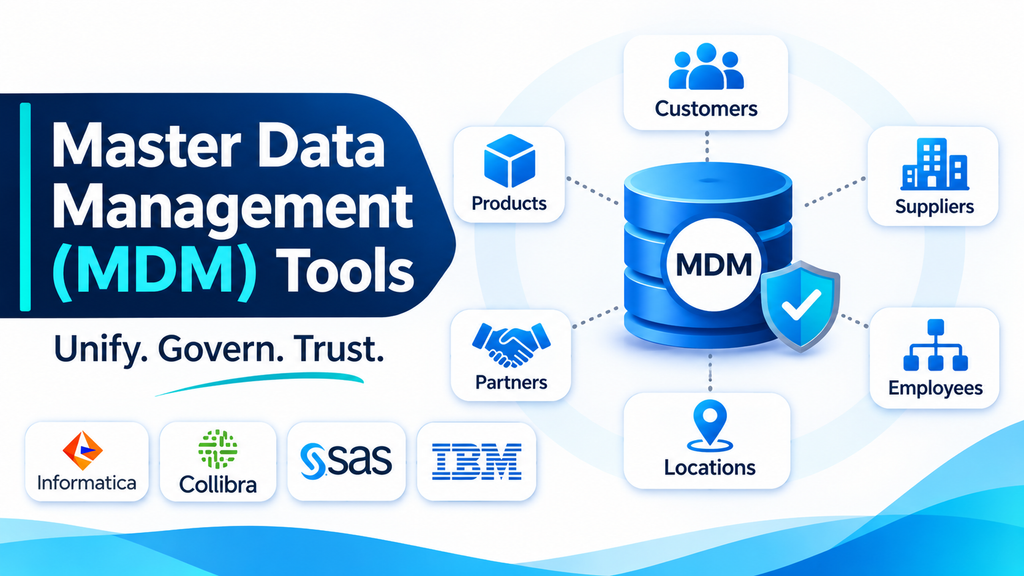
Master Data Management tools are software platforms designed to manage an organization’s most important shared business entities.
These entities are commonly called master data and typically include:
- Customer data: Customer names, addresses, contact information, and account details.
- Product data: Product identifiers, descriptions, categories, specifications, and pricing attributes.
- Supplier data: Vendor names, registration details, contact information, and purchasing relationships.
- Employee data: Employee identifiers, organizational structures, and employment information.
- Location data: Office addresses, business locations, distribution centers, and geographical identifiers.
- Financial data: Account structures, cost centers, and other shared financial reference information.
MDM platforms help ensure that these records are accurate, consistent, and appropriately governed across the organization.
For example, if a customer is registered in three different business applications, an MDM platform can identify the duplicate records, compare their attributes, apply matching rules, and establish a trusted master record.
This trusted record can then be shared with connected systems according to the organization’s data management policies.
How Master Data Management Works
A typical MDM implementation involves several interconnected processes.
- Data collection from multiple operational systems.
- Data standardization to establish consistent formats.
- Matching and deduplication to identify duplicate records.
- Record consolidation to establish trusted master information.
- Data validation and governance to maintain accuracy.
- Distribution and synchronization across connected applications.
The result is a more consistent representation of important business entities.
Different Master Data Management Approaches
Registry-style MDM: Maintains a central index of records while leaving the original data in its source systems.
Consolidation-style MDM: Collects master records from different sources into a central repository for reporting and analytical purposes.
Coexistence-style MDM: Maintains a central master record while allowing connected operational systems to continue managing their own information.
Centralized MDM: Establishes a central repository as the primary source of approved master records.
Hybrid MDM: Combines multiple approaches depending on business requirements, data domains, and system architecture.
Leading Master Data Management Tools
1. Informatica Intelligent Data Management Cloud
Informatica provides enterprise MDM capabilities through its Intelligent Data Management Cloud ecosystem.
Its MDM capabilities help organizations manage customer, product, supplier, and other critical business records. The platform supports matching, merging, survivorship rules, data quality, and governance workflows.
Its broader data management environment also connects MDM with integration, cataloging, and data quality capabilities.
It is particularly relevant for large enterprises managing multiple master data domains and complex integration requirements.
2. SAP Master Data Governance
SAP Master Data Governance (SAP MDG) provides centralized governance and management of important business information.
It supports master data domains such as business partners, customers, suppliers, materials, and financial information.
Its strengths include structured workflows, validation, approvals, and integration with SAP enterprise applications.
It is particularly relevant for enterprises operating SAP-based business environments.
3. Reltio Connected Data Platform
Reltio provides a cloud-native approach to managing connected enterprise data.
Its platform focuses on creating unified views of important business entities by combining information from multiple applications and sources.
It supports identity resolution, data matching, relationship management, and data quality capabilities.
It is particularly relevant to organizations seeking cloud-native MDM and connected views of business entities.
4. Profisee Master Data Management
Profisee provides master data management capabilities designed to help organizations create consistent, trusted business records.
The platform supports data modeling, matching, survivorship, stewardship, workflows, and data quality management.
It is particularly relevant to organizations implementing customer and product MDM and businesses seeking centralized data stewardship.
5. Semarchy xDM
Semarchy xDM provides an enterprise data management environment for building and managing master data applications.
It supports data modeling, matching, data quality, workflow management, and governance processes.
Its configurable approach allows organizations to build master data solutions around specific business domains.
6. Ataccama ONE
Ataccama ONE combines data quality, governance, cataloging, and master data management capabilities.
Its approach helps organizations identify, standardize, validate, and manage critical business information.
It is particularly relevant to enterprises prioritizing data quality and governance.
7. IBM InfoSphere Master Data Management
IBM’s master data management technology provides capabilities for consolidating and managing critical business information.
Its MDM approach supports the creation of trusted master records, identity resolution, data matching, and governance across enterprise systems.
It is relevant to organizations with complex enterprise data environments and established IBM technology investments.
Confirm product lifecycle, deployment options, current support arrangements, and the specific IBM MDM edition under consideration.
8. TIBCO EBX
TIBCO EBX is a multidomain master data management and reference data management platform.
It supports the management of shared business information, data models, hierarchies, workflows, and governance processes.
It is particularly relevant to enterprises managing multiple data domains and complex reference data.
Comparing the Leading MDM Platforms
| Platform | Main strength | Best suited for |
|---|---|---|
| Informatica | Enterprise MDM and integration | Large enterprises |
| SAP MDG | Structured master data governance | SAP environments |
| Reltio | Cloud-native connected data | Customer and organization data |
| Profisee | Multidomain MDM | Enterprise data stewardship |
| Semarchy xDM | Configurable data management | Custom MDM applications |
| Ataccama ONE | Data quality and governance | Data quality-focused organizations |
| IBM InfoSphere MDM | Enterprise master data management | Complex enterprise environments |
| TIBCO EBX | Multidomain and reference data | Complex business data structures |
Essential Features to Look for in MDM Software
1. Data Matching and Deduplication
Matching capabilities identify records that refer to the same real-world entity.
For example, a customer might appear as John Smith, J. Smith, or John A. Smith. An MDM solution should identify potential duplicates using configurable matching rules, similarity scoring, and identity resolution.
2. Golden Record Management
A golden record is the trusted representation of a business entity created by consolidating information from multiple sources.
The platform should support survivorship rules that determine which source provides the authoritative value for each attribute.
3. Data Quality Management
MDM platforms should help identify missing, invalid, inconsistent, and outdated information.
Useful capabilities include data validation, standardization, completeness checks, duplicate detection, business rule enforcement, and data quality monitoring.
4. Data Stewardship and Workflows
Data stewards need tools to review records, resolve conflicts, approve changes, and maintain business definitions.
Look for configurable approval workflows, exception management, audit trails, and role-based responsibilities.
5. Integration and Synchronization
Master records must be accessible to the applications that depend on them.
Evaluate APIs, connectors, batch processing, event-driven integration, and synchronization capabilities.
6. Security and Governance
Master data frequently contains confidential business and customer information.
Check access controls, audit logging, encryption, data classification, and compliance-related capabilities.
How to Choose the Right MDM Platform
Selecting an MDM solution should begin with identifying the business problem.
For SAP-centric organizations: SAP Master Data Governance is a natural candidate because of its integration with SAP business applications.
For complex enterprise data ecosystems: Informatica and broader enterprise governance capabilities are worth evaluating alongside dedicated MDM platforms.
For cloud-native customer data management: Reltio is worth considering.
For flexible multidomain implementations: Profisee, Semarchy xDM, and TIBCO EBX are relevant options.
For integrated data quality and governance: Ataccama ONE offers a broader data management approach.
For organizations with established IBM environments: Evaluate IBM’s current MDM offerings and product support roadmap.
These are evaluation starting points rather than universal recommendations. The final choice should depend on domain complexity, integration requirements, deployment preferences, and total ownership costs.
Common MDM Implementation Challenges
Poor source data quality: Inconsistent information from source applications can affect matching and consolidation accuracy.
Unclear data ownership: Without clearly assigned owners, master records may become outdated or disputed.
Complex integration: Connecting legacy applications, cloud systems, and business platforms requires careful planning.
Incorrect matching rules: Aggressive matching can combine unrelated records, while restrictive rules can leave duplicates unresolved.
Low user adoption: Employees must understand how to create, review, and maintain trusted master records.
Insufficient governance: Data quality and accuracy need continuous monitoring rather than one-time cleanup.
Frequently Asked Questions
What is the main purpose of Master Data Management?
MDM helps organizations establish consistent, accurate, and trusted records for important business entities such as customers, products, suppliers, and employees.
What is a golden record in MDM?
A golden record is a consolidated and trusted representation of a business entity, created by combining information from multiple source systems using defined matching and survivorship rules.
What is the difference between MDM and data governance?
MDM focuses on managing and maintaining trusted master records. Data governance establishes the policies, ownership, responsibilities, and controls that guide how organizational data is managed.
Is MDM suitable for small businesses?
Yes. Small businesses can benefit from MDM when customer, supplier, or product information is distributed across multiple applications. The implementation should be proportionate to the organization’s complexity and budget.
What is the difference between MDM and CRM?
CRM systems manage customer relationships and interactions. MDM manages trusted master information across multiple applications, potentially including CRM, ERP, finance, and marketing systems.
Can MDM improve business intelligence?
Yes. Consistent master records can improve customer segmentation, product reporting, supplier analysis, financial reporting, and cross-departmental analytics.
Building a Trusted Foundation for Enterprise Data
Master Data Management is an important part of modern enterprise data architecture. As organizations adopt more applications, cloud services, analytics platforms, and AI technologies, maintaining consistent business information becomes increasingly important.
Platforms such as Informatica, SAP Master Data Governance, Reltio, Profisee, Semarchy xDM, Ataccama ONE, IBM MDM, and TIBCO EBX provide different approaches to solving this challenge.
The right solution should match the organization’s business domains, integration architecture, governance requirements, and long-term data strategy.
Ultimately, successful MDM is not simply about removing duplicate records. It is about establishing reliable business information that employees, applications, analytics systems, and AI solutions can consistently use.
