Upgrade & Secure Your Future with DevOps, SRE, DevSecOps, MLOps!
We spend hours scrolling social media and waste money on things we forget, but won’t spend 30 minutes a day earning certifications that can change our lives.
Master in DevOps, SRE, DevSecOps & MLOps by DevOps School!
Learn from Guru Rajesh Kumar and double your salary in just one year.
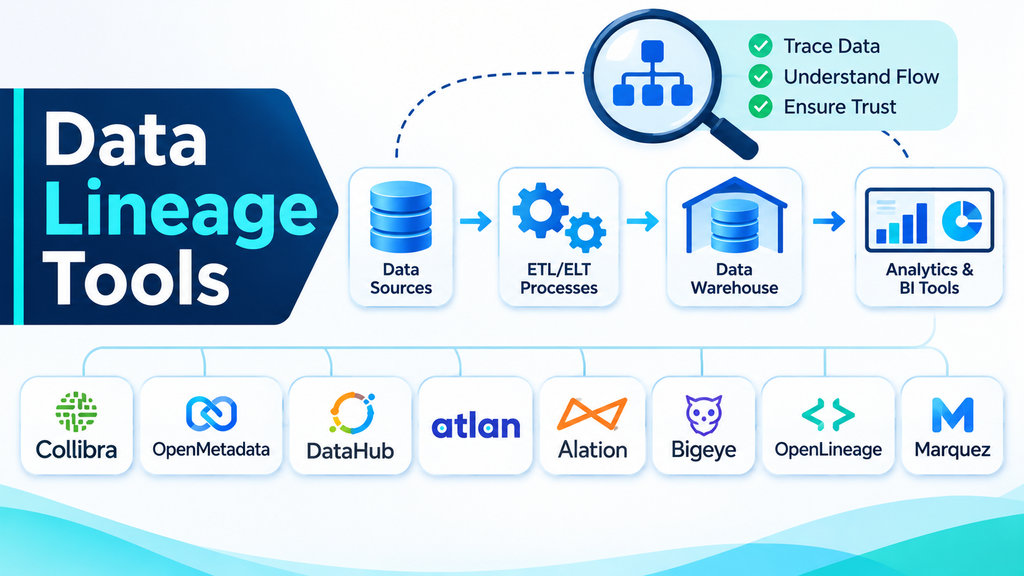
Data Lineage Tools: Trace Every Transformation From Source Data to Business Decisions
A dashboard reports an unexpected revenue figure. The data team needs to investigate, but the number may have passed through several databases, transformation jobs, intermediate tables, and reporting systems before reaching the dashboard.
Finding the original source is only part of the problem. The team must also understand which transformations occurred, which columns contributed to the result, and which other reports might be affected by a change.
This is the problem data lineage tools are designed to solve.
Data lineage provides visibility into how information moves through an organization’s data environment. It connects source systems, processing jobs, transformations, analytical datasets, and downstream reports to create a traceable view of the data lifecycle.
For data engineers, governance professionals, analytics teams, and enterprise architects, this visibility is essential for investigating errors, assessing change impact, maintaining regulatory traceability, and building confidence in business reporting.
What Data Lineage Tools Track
Data lineage describes the origin, movement, transformation, and destination of data throughout its lifecycle.
A typical lineage chain includes source databases, ETL/ELT processing, data warehouses, and BI dashboards.
This relationship helps teams answer important questions:
- Where did a particular dataset originate?
- Which transformation jobs modified it?
- Which columns contributed to a calculated value?
- Which dashboards depend on a specific table?
- What could break if a source schema changes?
- Where did an incorrect or unexpected value enter the pipeline?
Different levels of data lineage
Table-level lineage: Shows relationships between tables, databases, and other data assets.
Column-level lineage: Tracks how individual columns move and transform between datasets.
Job-level lineage: Connects processing jobs, workflows, and pipeline executions with datasets.
Business lineage: Connects technical data flows to business concepts, metrics, reports, and organizational processes.
End-to-end lineage: Combines relationships to provide visibility from original sources through processing to downstream consumption.
Data Lineage Tools Worth Evaluating
1. Collibra Data Lineage
Collibra Data Lineage focuses on tracing information across enterprise data environments and connecting technical data flows with business context.
Its lineage capabilities cover relationships between source systems, transformation processes, and downstream destinations. It also distinguishes technical lineage from business lineage.
It is particularly relevant to enterprises with complex governance requirements and organizations needing technical and business lineage together.
Its trade-off is that a full enterprise governance implementation may be more extensive than necessary for teams seeking only lightweight pipeline visualization.
2. OpenMetadata
OpenMetadata provides lineage as part of its broader metadata management platform.
It supports table-level and column-level lineage, pipeline relationships, database assets, and dashboard connections.
It is particularly relevant to engineering teams preferring open-source infrastructure and organizations building centralized metadata repositories.
Self-hosted deployments require infrastructure management, connector configuration, upgrades, and ongoing maintenance.
3. DataHub
DataHub provides an extensible metadata architecture for understanding relationships between datasets, pipelines, dashboards, and other data assets.
Its lineage model is useful for organizations that want to connect metadata collection with data engineering processes. Developers can use APIs and integrations to create and maintain relationships between assets.
DataHub also works with OpenLineage-based workflows.
It is particularly relevant to engineering teams and organizations building customized metadata workflows.
Its value depends on integration coverage and metadata ingestion quality.
4. Atlan
Atlan connects data assets and their relationships through its Enterprise Data Graph.
Its lineage capabilities help users explore how datasets are connected to transformation processes, analytical systems, and downstream assets.
It is particularly relevant to modern cloud data environments and teams using multiple transformation and BI tools.
Evaluate source coverage and lineage extraction depth for the technologies in use.
5. Alation Data Lineage
Alation combines data discovery and governance with lineage capabilities that help users understand upstream sources and downstream consumption.
Its catalog-oriented approach is valuable when organizations want lineage to be part of a wider data discovery experience.
It is particularly relevant to organizations with established data catalog programs and analytics teams investigating report dependencies.
Confirm the required lineage depth for specific sources, especially when detailed column-level transformations are essential.
6. Bigeye Lineage Plus
Bigeye takes an observability-oriented approach to lineage.
Its Lineage Plus capabilities provide automated table-level and column-level lineage across supported data sources. Users can explore lineage graphs with overlays for observability status and data classifications.
It is particularly relevant to teams combining data observability with lineage and organizations investigating data quality incidents.
Connector coverage and transformation parsing determine how complete the lineage graph will be.
7. OpenLineage
OpenLineage is fundamentally different from a conventional lineage visualization product.
It is an open standard for collecting and exchanging lineage metadata through structured events. Pipeline systems can emit information about jobs, runs, and datasets so that compatible metadata platforms can consume it.
It is particularly relevant to engineering teams seeking standardized lineage collection.
OpenLineage is not itself a complete enterprise data catalog or standalone lineage visualization application. It typically works with a compatible backend or metadata platform.
8. Marquez
Marquez is an open-source metadata service associated with the OpenLineage ecosystem.
It provides a backend for receiving and managing lineage metadata generated by compatible data processing systems.
It is particularly relevant to engineering teams implementing OpenLineage and organizations experimenting with event-driven lineage collection.
Marquez is more specialized than a complete enterprise catalog, so organizations requiring business glossaries and extensive governance workflows may need complementary software.
Other Lineage Capabilities Built Into Data Platforms
Microsoft Purview: Provides lineage capabilities within its data governance environment.
Databricks Unity Catalog: Provides data governance and lineage visibility within the Databricks ecosystem.
Snowflake Horizon: Provides governance and lineage-related capabilities around Snowflake data assets.
dbt: Provides model dependency visualization through its project graph and documentation.
Embedded lineage can be useful, but visibility may stop at platform boundaries.
Comparing Data Lineage Solutions
| Tool | Main approach | Notable capability |
|---|---|---|
| Collibra | Enterprise governance | Technical and business lineage |
| OpenMetadata | Open-source metadata platform | Table and column lineage |
| DataHub | Extensible metadata platform | Programmatic lineage |
| Atlan | Connected metadata platform | Enterprise Data Graph |
| Alation | Enterprise data catalog | Discovery with lineage context |
| Bigeye | Data observability | Automated column-level lineage |
| OpenLineage | Open lineage standard | Structured lineage events |
| Marquez | Open-source metadata backend | Job and dataset lineage |
How to Evaluate Data Lineage Tools Before Buying
The biggest mistake when comparing lineage platforms is treating every visual lineage graph as equally useful.
1. Column-Level Lineage Accuracy
Determine whether the platform can explain how individual columns are derived.
For example, a customer lifetime value metric might depend on transaction amounts, refunds, purchase frequency, and customer identifiers.
Evaluate direct column dependencies, SQL transformation parsing, calculated-field relationships, joins, aggregations, and handling of nested queries.
2. Automated Lineage Collection
Evaluate whether a tool can collect lineage through:
- SQL query parsing.
- Database query history.
- Pipeline metadata.
- ETL and ELT integrations.
- OpenLineage events.
- BI platform integrations.
- APIs and SDKs.
The best collection approach depends on the architecture.
3. Impact Analysis
Impact analysis helps teams understand what might be affected before changing a data asset.
A useful lineage platform should help identify dependent tables, transformation jobs, dashboards, and reports.
4. Integration Coverage
| Environment | Integration requirement |
|---|---|
| Databases | Source and destination relationships |
| Cloud warehouses | SQL and table dependencies |
| ETL/ELT tools | Transformation and job lineage |
| Workflow orchestrators | Execution and dependency information |
| BI applications | Dashboard and report dependencies |
| Data quality systems | Connection between issues and affected assets |
| AI and ML platforms | Dataset and model relationships |
Do not assume that a vendor’s general integration count guarantees the exact lineage depth required for each connector.
5. Governance and Sensitive Data Traceability
Evaluate whether lineage can connect with classification metadata, access policies, audit processes, and governance workflows.
Also distinguish between tracing the movement of a sensitive field and enforcing controls over its access.
Common Data Lineage Implementation Challenges
Incomplete source coverage: Unconnected databases and applications create gaps in lineage.
Undocumented SQL transformations: Custom scripts and complex queries can make automated parsing difficult.
Inconsistent metadata: Different systems may use different names for the same business concept.
Excessively complicated graphs: Large environments require filtering, grouping, and domain-based views.
Ignoring operational maintenance: Connectors, permissions, pipeline configurations, and schema changes need ongoing attention.
Frequently Asked Questions
What is the primary purpose of data lineage tools?
They help organizations track where data originates, how it moves through systems, what transformations it undergoes, and which downstream datasets or reports depend on it.
What is the difference between data lineage and data mapping?
Data mapping describes how fields or structures correspond between systems. Data lineage provides a broader view of the origin, movement, transformation, and dependencies of data throughout its lifecycle.
What is column-level data lineage?
Column-level lineage tracks relationships between individual fields across datasets and transformations. It helps teams understand how a particular value is calculated and which upstream fields influence it.
Is OpenLineage a data lineage platform?
OpenLineage is an open standard for collecting and exchanging lineage events. It generally requires compatible systems or a metadata backend to store, explore, and visualize the collected information.
Can data lineage tools help with compliance?
Yes. Lineage can support traceability by showing where information originated, how it was processed, and which systems use it. However, lineage alone does not establish regulatory compliance.
Are open-source data lineage tools suitable for enterprise environments?
Platforms such as DataHub, OpenMetadata, and the OpenLineage ecosystem can support substantial engineering environments. Suitability depends on connector coverage, operational expertise, security requirements, scalability, and support arrangements.
Choosing a Lineage Strategy That Works Across the Data Lifecycle
The most appropriate data lineage solution depends on where information is processed and how much visibility an organization requires.
Collibra is worth evaluating when technical traceability must connect with enterprise governance. OpenMetadata and DataHub are relevant for engineering teams seeking extensible metadata infrastructure. Atlan and Alation provide lineage within broader data discovery experiences, while Bigeye connects lineage with observability and incident investigation.
OpenLineage and Marquez offer a different approach for organizations that want standardized, engineering-driven lineage collection. Meanwhile, Microsoft Purview, Databricks Unity Catalog, Snowflake Horizon, and dbt provide useful capabilities within their respective ecosystems.
Before making a decision, test the platform against a real data pipeline, including its upstream sources, transformations, and downstream reports. Verify whether it can trace the exact dependencies your teams need to understand.
Ultimately, useful data lineage is not simply about drawing connections between tables. It is about making every important data dependency understandable, traceable, and actionable.
