Upgrade & Secure Your Future with DevOps, SRE, DevSecOps, MLOps!
We spend hours scrolling social media and waste money on things we forget, but won’t spend 30 minutes a day earning certifications that can change our lives.
Master in DevOps, SRE, DevSecOps & MLOps by DevOps School!
Learn from Guru Rajesh Kumar and double your salary in just one year.
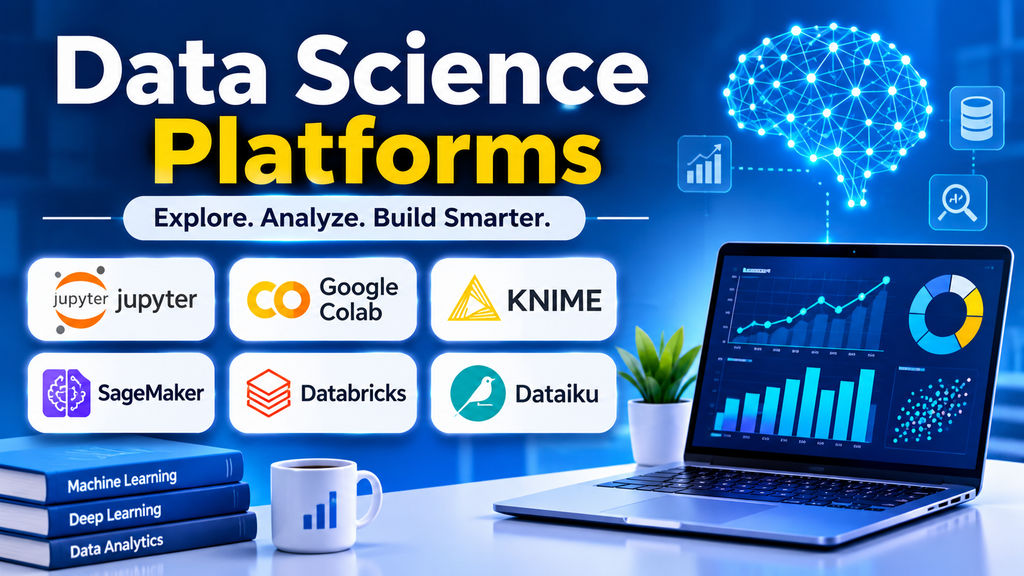
Data Science Platforms: A Complete Guide to Tools, Features, Benefits, and Applications
Introduction
Data science has become an essential part of modern businesses. Organizations use data to understand customer behavior, identify trends, improve operations, and make informed decisions.
However, working with large datasets requires specialized tools and environments. Data science platforms provide integrated solutions that help professionals collect, process, analyze, visualize, and model data efficiently.
What Are Data Science Platforms?
Data science platforms are software environments that support the complete data science lifecycle, from data preparation and exploration to machine learning model development, deployment, and collaboration.
They combine essential tools, libraries, computing resources, and workflows in one environment.
Popular Data Science Platforms
1. Jupyter Notebook
Jupyter Notebook is an open-source interactive computing environment that allows users to write and execute code, visualize data, and document experiments. It is widely used with Python and R.
2. Google Colab
Google Colab is a cloud-based notebook platform that allows users to execute Python code through a browser. It provides access to hosted computing resources, including GPUs and TPUs, subject to availability and usage limits.
3. KNIME
KNIME is a visual analytics and data science platform that enables users to build data workflows through a drag-and-drop interface. It supports data integration, analytics, and machine learning.
4. Amazon SageMaker
Amazon SageMaker is a managed AWS platform that helps developers and data scientists build, train, and deploy machine learning models. It provides tools for model development and operational workflows.
5. Databricks
Databricks is a unified data and AI platform that supports data engineering, analytics, machine learning, and collaborative development using cloud-based infrastructure.
6. Dataiku
Dataiku is a collaborative data science and AI platform that helps teams prepare data, build analytical workflows, develop machine learning models, and operationalize projects.
Key Features of Data Science Platforms
- Data preparation: Clean, organize, and transform raw datasets.
- Interactive notebooks: Write and execute code in an interactive environment.
- Data visualization: Explore information using charts, graphs, and dashboards.
- Machine learning: Develop, train, and evaluate predictive models.
- Collaboration: Allow teams to share projects and workflows.
- Scalability: Support increasing data volumes and computing requirements.
- Workflow automation: Automate repetitive analytical tasks.
- Integration: Connect with databases, cloud services, and external tools.
Benefits of Data Science Platforms
Data science platforms improve productivity by bringing multiple development tools into a unified environment.
Their major benefits include:
- Faster data analysis and experimentation.
- Reduced manual work through automation.
- Improved collaboration between data teams.
- Simplified machine learning development.
- Better data visualization and reporting.
- Scalable computing capabilities.
- More efficient business decision-making.
Cloud-based platforms can provide flexible computing resources, while visual interfaces make analytical workflows accessible to a wider range of users.
Common Applications of Data Science Platforms
1. Business Intelligence: Analyze business performance and generate reports.
2. Customer Analytics: Understand customer behavior and create customer segments.
3. Fraud Detection: Identify unusual patterns and potentially fraudulent activities.
4. Predictive Analytics: Forecast sales, demand, and future trends.
5. Recommendation Systems: Build personalized product and content recommendations.
6. Healthcare Research: Analyze medical research datasets and support scientific discoveries.
7. Artificial Intelligence: Develop and experiment with machine learning and AI applications.
How to Choose the Right Data Science Platform
Choosing a suitable platform depends on several important factors:
- Programming skills and technical expertise.
- Project requirements and complexity.
- Data volume and processing needs.
- Infrastructure and cloud compatibility.
- Pricing and available computing resources.
- Security and data governance requirements.
- Collaboration and integration capabilities.
Jupyter Notebook and Google Colab are useful for notebook-based experimentation. KNIME is suitable for visual workflows. Amazon SageMaker supports managed machine learning on AWS. Databricks is useful for unified data and AI workloads, while Dataiku emphasizes collaborative analytics and AI development.
Conclusion
Data science platforms play a major role in transforming raw data into meaningful insights. By combining data preparation, analytics, visualization, machine learning, and collaboration capabilities, these platforms help organizations accelerate innovation and make better decisions.
Choosing the right platform depends on technical requirements, business goals, and available resources. With the right tools, data science teams can develop efficient analytical workflows and unlock the full potential of their data.
