Upgrade & Secure Your Future with DevOps, SRE, DevSecOps, MLOps!
We spend hours scrolling social media and waste money on things we forget, but won’t spend 30 minutes a day earning certifications that can change our lives.
Master in DevOps, SRE, DevSecOps & MLOps by DevOps School!
Learn from Guru Rajesh Kumar and double your salary in just one year.
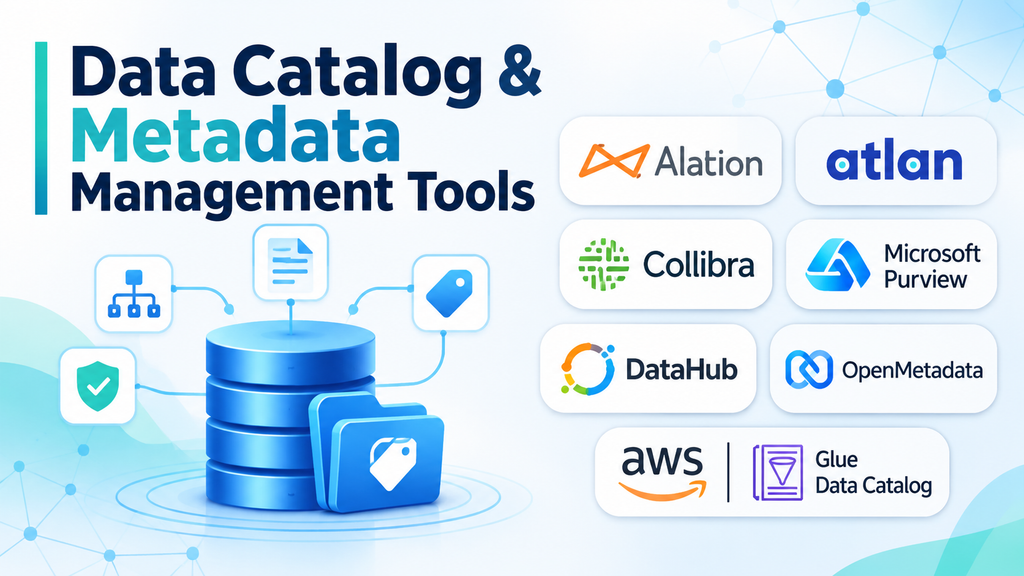
Data Catalog and Metadata Management Tools: How to Make Enterprise Data Discoverable and Trustworthy
A company can have thousands of databases, cloud storage locations, dashboards, spreadsheets, and data pipelines—and still struggle to answer a basic question: where is the correct dataset, who owns it, and can it be trusted?
This problem becomes more complicated as organizations adopt multiple cloud platforms, analytical warehouses, and business intelligence systems. Data is distributed across environments, while information about its meaning, ownership, quality, and usage remains scattered.
Data catalog and metadata management tools address this challenge by creating an organized inventory of an organization’s data assets. They help technical and business teams discover information, understand its context, identify responsible owners, and make better decisions about how data should be used.
What Data Catalog and Metadata Management Tools Actually Do
A data catalog is a searchable inventory of data assets. Metadata management is the broader practice of collecting, organizing, maintaining, and using information that describes those assets.
Metadata can include:
- Technical metadata: Table names, column definitions, schemas, file formats, database structures, and data types.
- Business metadata: Business definitions, terminology, descriptions, and relationships between organizational concepts.
- Operational metadata: Processing schedules, refresh information, usage patterns, and pipeline execution details.
- Governance metadata: Data ownership, access classifications, policies, and stewardship responsibilities.
- Quality metadata: Profiling results, validation information, and indicators that help users assess data reliability.
For example, consider a sales analytics team looking for customer purchase information. A catalog can help analysts discover the relevant dataset, understand its columns, identify its owner, review its business definition, and examine available lineage information.
Without this context, employees may select outdated tables, duplicate existing work, or use information without understanding its limitations.
Leading Data Catalog and Metadata Management Platforms
1. Alation Data Catalog
Alation focuses on helping people find and understand enterprise data. Its catalog combines searchable data assets with descriptions, business definitions, lineage, endorsements, and usage context.
It is particularly relevant to organizations with large analytical environments and multiple data sources.
An important consideration is that a discovery-focused catalog still needs active stewardship. Automatically collecting metadata does not guarantee that business definitions and ownership information remain accurate.
2. Atlan
Atlan connects metadata from data warehouses, BI applications, transformation platforms, and other parts of the data ecosystem.
Its Enterprise Data Graph connects individual data assets and their relationships. It also emphasizes making governed metadata available to AI applications and agents.
It is worth evaluating for organizations operating modern cloud data stacks, although connector coverage, metadata synchronization, and access controls should be checked carefully.
3. Collibra Data Catalog
Collibra takes a governance-oriented approach to data cataloging. It integrates technical metadata with profiling information, classifications, business context, and lineage.
It is particularly relevant to large organizations with established data stewardship responsibilities.
However, enterprise governance requires more than purchasing a platform. Ownership, approval responsibilities, glossary maintenance, and stewardship workflows must also be established.
4. Microsoft Purview
Microsoft Purview provides data governance capabilities through Data Map and Unified Catalog.
Data Map provides the technical foundation by scanning supported sources and maintaining an inventory of assets and metadata. Unified Catalog provides a business-oriented experience for organizing assets, governance domains, and data products.
It is particularly relevant to businesses using Microsoft-oriented cloud and analytics services.
Organizations should verify connector support, licensing, regional availability, and the capabilities available in their environment.
5. DataHub
DataHub is an open-source metadata platform originally developed at LinkedIn.
Its metadata model and APIs make it particularly interesting to engineering teams that want to integrate catalog functionality into existing data workflows.
It is relevant to organizations interested in open-source metadata infrastructure and automated metadata workflows.
Self-hosting introduces infrastructure, upgrades, monitoring, security, and operational responsibilities that must be included in the cost assessment.
6. OpenMetadata
OpenMetadata is an open-source platform that combines data discovery and metadata management.
It is particularly useful for organizations that want an extensible catalog with technical and business context, alongside APIs and integrations.
Its self-hosted approach provides infrastructure control, but organizations must evaluate deployment complexity, connector maintenance, upgrades, and support requirements.
7. AWS Glue Data Catalog
AWS Glue Data Catalog provides a centralized metadata repository for datasets used across AWS analytics services.
It stores information such as database definitions, table schemas, data locations, and other metadata. AWS Glue crawlers can scan supported data sources and populate the catalog.
Its primary strength is its close relationship with AWS analytics services.
Organizations with extensive non-AWS environments may need additional cataloging capabilities to provide consistent discovery and business context across platforms.
8. Google Cloud Knowledge Catalog
Google Cloud Knowledge Catalog, formerly Dataplex Universal Catalog, provides a catalog and governance environment for discovering and managing information across Google Cloud and supported partner systems.
It supports metadata aggregation, business glossary management, data lineage, data quality capabilities, and contextual information for AI applications.
It is particularly relevant to organizations using BigQuery and other Google Cloud data services.
Check individual integration availability and whether specific features depend on particular configurations.
Comparing the Platforms by Their Architectural Strengths
| Platform | Primary orientation | Particularly relevant environment |
|---|---|---|
| Alation | Search, discovery, and collaboration | Enterprise analytics |
| Atlan | Connected metadata and AI context | Modern cloud data stacks |
| Collibra | Enterprise cataloging and stewardship | Complex governance environments |
| Microsoft Purview | Technical discovery and business governance | Microsoft-oriented estates |
| DataHub | Extensible metadata infrastructure | Engineering-led environments |
| OpenMetadata | Open-source metadata management | Self-managed data ecosystems |
| AWS Glue Data Catalog | Cloud-native metadata repository | AWS analytics |
| Google Cloud Knowledge Catalog | Cloud discovery and governed context | Google Cloud |
These products overlap in several areas, but they are not interchangeable. An embedded cloud catalog and a standalone enterprise catalog may complement each other rather than compete directly.
How to Choose the Right Data Catalog Platform
Selecting a catalog should begin with the organization’s data architecture, not a vendor feature checklist.
1. Map the Existing Data Environment
Identify where important datasets currently reside:
- Cloud data warehouses and databases.
- Data lakes and object storage.
- BI dashboards and reporting platforms.
- ETL and ELT pipelines.
- Machine learning and AI environments.
- SaaS applications and business systems.
A catalog that cannot connect to important sources will create an incomplete picture of the data estate.
2. Evaluate Metadata Collection and Maintenance
Automatic metadata harvesting reduces manual documentation, but the collection process needs to be reliable.
Check whether the platform can discover new databases, synchronize metadata after schema changes, capture ownership, integrate with transformation pipelines, and preserve business descriptions.
Pay particular attention to synchronization frequency and how the platform handles renamed, deleted, or migrated assets.
3. Examine Search and Business Usability
A technically comprehensive catalog can still fail if employees cannot find useful information.
Test realistic search scenarios. For example, ask whether a finance analyst can find an approved revenue dataset without knowing its database name or technical schema.
Evaluate search filters, natural-language discovery, glossary integration, asset recommendations, and documentation quality.
4. Understand Governance and Access Boundaries
Metadata discovery should not automatically expose sensitive underlying data.
Evaluate:
- Role-based access control.
- Sensitive-data classification.
- Ownership and stewardship workflows.
- Approval processes.
- Audit capabilities.
- Integration with existing identity and access management systems.
A metadata catalog is not automatically a replacement for database security controls.
5. Consider the Total Cost of Ownership
| Cost factor | What to investigate |
|---|---|
| Licensing | Subscription, asset-based, user-based, or consumption-based pricing |
| Deployment | Cloud hosting or self-managed infrastructure |
| Integration | Connector availability and custom development |
| Maintenance | Metadata synchronization and platform upgrades |
| Governance | Stewardship and administration requirements |
| Training | Adoption across technical and business teams |
| Expansion | Costs associated with additional sources and users |
For open-source platforms, include infrastructure, engineering time, upgrades, and operational support.
Common Implementation Mistakes to Avoid
Cataloging everything without prioritization: Importing thousands of assets immediately can overwhelm users. Start with high-value business domains.
Treating metadata collection as governance: Automated scanning can identify tables and columns, but it cannot independently establish every business definition or ownership responsibility.
Ignoring business participation: Technical teams understand schemas and pipelines, while business teams understand metrics and terminology. Both perspectives are necessary.
Neglecting metadata maintenance: Ownership changes and schema modifications can make catalog information outdated. Establish responsibilities for reviewing and updating metadata.
Overlooking interoperability: Determine how existing cloud platforms, BI applications, and engineering tools will exchange information rather than creating another isolated inventory.
A Practical Pilot Before Enterprise Deployment
Before committing to a platform, run a limited pilot using one business domain, such as finance, sales, or customer analytics.
A useful pilot should include:
- Connect representative databases, warehouse assets, and BI dashboards.
- Automatically collect technical metadata.
- Assign business owners and data stewards.
- Document important business terms and critical datasets.
- Test search and discovery with actual business users.
- Examine lineage and metadata synchronization.
- Verify permissions and sensitive-data handling.
- Measure adoption, catalog completeness, and maintenance effort.
The pilot should demonstrate whether employees can find the correct information, understand its meaning, and identify who is responsible for it.
The Role of Metadata Management in AI-Ready Data
Data catalogs are becoming increasingly relevant as organizations introduce AI assistants, automated analytics, and agent-based workflows.
An AI application that can access a database does not necessarily understand the meaning of its tables, the organization’s business terminology, or the reliability of its metrics.
Governed metadata can provide this missing context.
For example, an AI assistant responding to a revenue question needs to understand which revenue definition applies, which dataset is approved, who owns the metric, and whether the underlying information is suitable for the requested analysis.
Platforms such as Atlan and OpenMetadata are developing capabilities that make metadata and business context accessible to AI applications through interfaces such as the Model Context Protocol (MCP). Google Cloud Knowledge Catalog also emphasizes providing contextual information to AI agents.
However, cataloging alone does not guarantee accurate AI responses. Data quality, access permissions, semantic consistency, and appropriate evaluation remain essential.
Frequently Asked Questions
What is the difference between a data catalog and metadata management?
A data catalog is a searchable inventory of data assets. Metadata management is the broader discipline of collecting, organizing, maintaining, and governing the information that describes those assets.
Does a data catalog store actual business data?
Most enterprise catalog platforms primarily collect and organize metadata rather than copying entire source datasets. Some may provide previews or profiling information, depending on configuration and permissions.
Are open-source data catalog platforms suitable for enterprises?
Yes. DataHub and OpenMetadata are examples of open-source platforms that can support enterprise metadata workflows. Organizations must assess deployment requirements, security, operational responsibilities, support, and scalability.
Can multiple data catalogs operate together?
Yes. An organization might use AWS Glue Data Catalog for AWS analytics, Microsoft Purview for broader governance, and a separate enterprise catalog for cross-platform discovery. Integration and metadata synchronization are important to prevent conflicting definitions.
How is a data catalog different from a data dictionary?
A data dictionary primarily describes technical data structures, such as columns, data types, and definitions. A data catalog provides a broader discovery experience that can include dictionaries, business glossaries, ownership, lineage, classifications, and governance information.
Making Data Discoverable Is Only the Beginning
A successful data catalog should do more than create an inventory of databases and tables. It should help people understand what information exists, what it means, where it comes from, and whether it is appropriate for their work.
For organizations prioritizing enterprise governance, Collibra and Microsoft Purview are worth evaluating. Alation offers a discovery-oriented approach, while Atlan focuses on connected metadata and business context. DataHub and OpenMetadata provide open-source alternatives for engineering-led environments. AWS Glue Data Catalog and Google Cloud Knowledge Catalog are particularly relevant when cloud-platform integration is central to the architecture.
The most effective choice is the platform that fits the existing data ecosystem, supports clear ownership, maintains reliable metadata, and makes trusted information genuinely easier to use.
