Upgrade & Secure Your Future with DevOps, SRE, DevSecOps, MLOps!
We spend hours scrolling social media and waste money on things we forget, but won’t spend 30 minutes a day earning certifications that can change our lives.
Master in DevOps, SRE, DevSecOps & MLOps by DevOps School!
Learn from Guru Rajesh Kumar and double your salary in just one year.
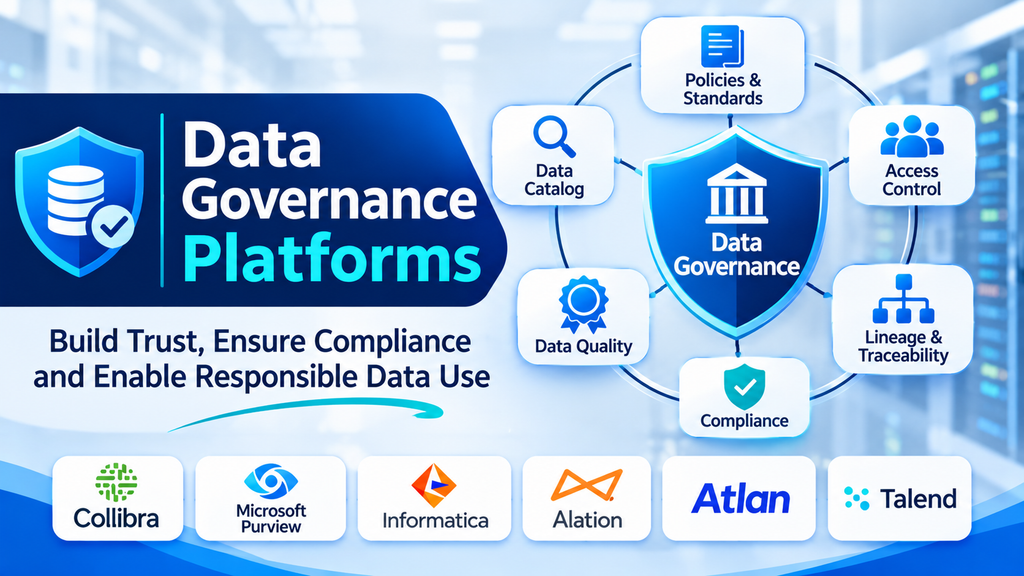
Data has become one of the most valuable assets for modern organizations. Businesses rely on data to make strategic decisions, understand customers, improve operations, meet regulatory requirements, and develop new products. However, as data spreads across cloud platforms, applications, databases, and departments, managing it consistently becomes increasingly difficult.
Data governance platforms help organizations establish control over their data assets. They provide a structured way to define data policies, assign ownership, manage access, maintain quality standards, track sensitive information, and support regulatory compliance. These platforms help ensure that data is trustworthy, secure, understandable, and used responsibly throughout its lifecycle.
What Are Data Governance Platforms?
Data governance platforms are software solutions that help organizations manage the availability, usability, integrity, security, and accountability of their data. They bring governance policies, processes, responsibilities, and technical controls into a coordinated environment.
Rather than allowing each department to manage data independently, governance platforms help create shared standards across the organization. Teams can identify who owns specific data assets, understand how information should be used, and monitor whether policies are being followed.
They are particularly valuable for organizations operating across multiple systems, business units, geographic regions, and regulatory environments.
Why Are Data Governance Platforms Important?
Without a consistent governance framework, organizations may encounter duplicate records, inconsistent definitions, unauthorized data access, poor data quality, and compliance risks.
Data governance platforms help address these challenges by providing:
- Improved data quality: Establish standards and processes to identify, monitor, and resolve data quality issues.
- Clear data ownership: Assign responsibility to data owners, stewards, and other stakeholders.
- Better data discovery: Help employees locate approved datasets and understand their meaning.
- Stronger data security: Support access policies and visibility into sensitive information.
- Regulatory compliance: Help document governance activities and support requirements related to privacy and data protection.
- Consistent business definitions: Create shared terminology so teams interpret important metrics and data elements consistently.
- Greater accountability: Maintain records of policies, decisions, approvals, and governance responsibilities.
Key Features of Data Governance Platforms
1. Data Catalog and Discovery
A data catalog provides an organized inventory of enterprise data assets. Users can search for datasets, view descriptions, understand ownership, and discover relevant information across different systems.
2. Business Glossary Management
Business glossaries define important business terms, metrics, and data concepts. They help departments use consistent definitions and reduce confusion caused by different interpretations of the same information.
3. Data Ownership and Stewardship
Governance platforms allow organizations to assign data owners and stewards. These responsibilities help ensure that datasets are maintained, reviewed, documented, and used according to established policies.
4. Data Quality Management
Data quality capabilities help organizations define quality rules, monitor important data attributes, identify inconsistencies, and coordinate remediation activities.
5. Policy and Workflow Management
Organizations can document governance policies and create workflows for approvals, access requests, issue resolution, and policy reviews.
6. Data Privacy and Compliance Support
These platforms can help identify sensitive data, document processing activities, manage governance controls, and provide evidence that supports audits and compliance programs.
7. Data Lineage and Impact Analysis
Data lineage helps users understand where data originates, how it changes, and where it is used. Impact analysis can help teams assess the consequences of modifying a dataset, pipeline, or business definition.
8. Access Control and Auditability
Access governance capabilities help organizations define who can view or use specific data assets. Audit records provide visibility into relevant governance activities and policy enforcement.
Popular Data Governance Platforms
Several established platforms provide capabilities for enterprise data governance, cataloging, metadata management, privacy, and data quality.
- Collibra: Provides enterprise data governance, data cataloging, stewardship workflows, and policy management capabilities.
- Alation: Offers data cataloging, governance workflows, data intelligence, and capabilities that help organizations improve data understanding and accountability.
- Informatica: Provides data governance and catalog capabilities through its Intelligent Data Management Cloud ecosystem, including metadata and data quality functionality.
- Microsoft Purview: Helps organizations discover, classify, govern, and manage data across supported environments, including Microsoft and multicloud data estates.
- Atlan: Provides an active metadata platform with data discovery, collaboration, lineage, and governance capabilities.
- IBM Knowledge Catalog: Supports data cataloging, governance, data classification, and management of trusted data assets.
- SAP Master Data Governance: Helps organizations manage and govern master data through centralized processes and data quality controls.
- Precisely Data360 Govern: Supports data governance, stewardship, metadata management, and policy-related workflows.
- OpenMetadata: An open-source metadata platform offering data discovery, lineage, ownership, quality, and governance-related capabilities.
- DataHub: An open-source metadata platform that supports data discovery, ownership, lineage, and governance workflows.
How Data Governance Platforms Work
Data governance platforms typically connect to an organization’s data sources, including databases, cloud storage, data warehouses, business applications, and analytics systems.
After connecting to these sources, the platform collects metadata and organizes information about available data assets. Governance teams can then document business definitions, assign ownership, establish policies, and define quality or access requirements.
Employees use the platform to discover approved data, understand its meaning, and identify the people responsible for maintaining it. Governance workflows help coordinate approvals and issue resolution, while monitoring and audit capabilities provide visibility into how governance requirements are being followed.
The exact process varies depending on the platform and the organization’s governance architecture.
Benefits Across Different Industries
Banking and Financial Services: Financial institutions use governance platforms to improve data accountability, manage sensitive information, support risk reporting, and strengthen audit readiness.
Healthcare: Healthcare organizations use governance practices to manage clinical and operational data, improve consistency, and support responsible handling of sensitive information.
Retail and E-commerce: Retail businesses use governed data to maintain consistent product, customer, inventory, and sales information across multiple systems.
Manufacturing: Manufacturers use governance to improve the consistency of supplier, production, equipment, and quality-related data.
Telecommunications: Telecom companies use governance platforms to coordinate large volumes of customer, network, billing, and operational data.
Government and Public Sector: Public organizations can use governance capabilities to improve data accountability, standardize information management, and support transparency requirements.
Challenges in Implementing Data Governance Platforms
Although these platforms offer significant benefits, successful implementation requires more than installing software.
Common challenges include:
- Unclear ownership: Governance programs may struggle when responsibility for data assets is not clearly assigned.
- Organizational resistance: Employees may be reluctant to adopt new policies, workflows, and documentation requirements.
- Complex data environments: Integrating metadata and governance processes across legacy systems, cloud services, and applications can be difficult.
- Inconsistent standards: Different departments may use conflicting definitions, formats, and quality expectations.
- Limited adoption: A governance platform delivers less value when employees do not use it as part of their daily work.
- Ongoing maintenance: Policies, ownership assignments, classifications, and business definitions need regular review.
Organizations can address these challenges by securing leadership support, starting with high-value data domains, assigning clear responsibilities, and measuring adoption and governance outcomes.
How to Choose the Right Data Governance Platform
Selecting a suitable platform requires understanding the organization’s data environment, governance maturity, and business priorities.
Important considerations include:
- Business requirements: Identify whether the main priority is data cataloging, stewardship, privacy, quality, compliance, or enterprise-wide governance.
- Integration capabilities: Check whether the platform connects with existing databases, data warehouses, cloud services, and business applications.
- Metadata management: Evaluate how effectively it collects, organizes, and maintains technical and business metadata.
- Policy management: Review support for governance policies, approval workflows, ownership, and accountability.
- Security and privacy: Examine classification, access management, auditability, and sensitive-data handling capabilities.
- Ease of use: Consider whether business users, technical teams, and data stewards can work with the platform effectively.
- Scalability: Ensure that the solution can support growing data volumes, additional systems, and evolving governance requirements.
- Total cost of ownership: Consider licensing, implementation, integration, training, and ongoing administration costs.
The Future of Data Governance Platforms
Data governance is evolving as organizations adopt artificial intelligence, cloud-native architectures, real-time analytics, and increasingly distributed data environments.
Modern platforms are placing greater emphasis on automated metadata collection, policy monitoring, data classification, and intelligent discovery. AI governance is also becoming an important area, as businesses need to understand the data used to train and operate AI systems and establish controls around responsible usage.
Another emerging direction is more integrated governance, where data quality, lineage, privacy, security, and access policies work together rather than being managed as separate activities.
Organizations are also exploring governance approaches for data products and decentralized data architectures. These approaches aim to give teams greater flexibility while maintaining shared standards and accountability.
Conclusion
Data governance platforms play an important role in helping organizations manage data as a trusted and strategic business asset. By combining data discovery, ownership, quality management, policy workflows, lineage, and compliance support, they help create a more consistent and accountable data environment.
Choosing the right platform depends on an organization’s data architecture, business objectives, regulatory requirements, and governance maturity. With clear ownership, practical policies, and strong employee adoption, data governance platforms can improve confidence in enterprise data and support better business decisions.
