Upgrade & Secure Your Future with DevOps, SRE, DevSecOps, MLOps!
We spend hours scrolling social media and waste money on things we forget, but won’t spend 30 minutes a day earning certifications that can change our lives.
Master in DevOps, SRE, DevSecOps & MLOps by DevOps School!
Learn from Guru Rajesh Kumar and double your salary in just one year.
Introduction
Modern businesses generate enormous amounts of data through applications, websites, connected devices, transactions, and digital services. Processing these events quickly is essential for organizations that need to respond to changing conditions, coordinate systems, and deliver timely services.
Event streaming platforms help organizations capture, transport, process, and distribute streams of events continuously. They provide the foundation for real-time data pipelines, event-driven applications, operational monitoring, and analytics.
What Are Event Streaming Platforms?
Event streaming platforms are software systems that enable organizations to collect, manage, process, and distribute continuous streams of data. An event represents an occurrence or change, such as a customer placing an order, a payment being processed, or a sensor reporting a new reading.
Instead of waiting for data to accumulate in batches, event streaming platforms make events available to connected applications and services as they arrive.
They are commonly used in real-time data integration, microservices communication, fraud monitoring, IoT systems, application monitoring, and streaming analytics.
Why Are Event Streaming Platforms Important?
Event streaming platforms help businesses build responsive and connected digital systems.
Key benefits include:
- Real-time data movement: Transfer events between systems as they are generated.
- Faster business responses: Enable applications to react to important events quickly.
- System integration: Connect applications, databases, and services through shared event streams.
- Scalability: Handle large volumes of events from multiple producers and consumers.
- Improved reliability: Use persistent event storage and delivery mechanisms to support dependable data flows.
- Operational visibility: Monitor business activities and system events continuously.
- Flexible architectures: Support event-driven applications and loosely coupled services.
Key Features of Event Streaming Platforms
- Event Ingestion: Collect events from applications, databases, devices, APIs, and other sources.
- Publish and Subscribe Messaging: Allow producers to publish events and consumers to receive the information they need.
- Persistent Event Storage: Retain event records for a defined period so consumers can process or replay them when supported.
- Stream Processing: Filter, transform, aggregate, and enrich events while they move through the platform.
- Scalability: Distribute event workloads across multiple servers or partitions to support growing demand.
- Fault Tolerance: Provide replication and recovery mechanisms to help maintain service availability.
- Event Ordering: Support ordering within defined scopes, such as partitions or individual event streams.
- Monitoring and Management: Provide tools to track throughput, consumer activity, processing delays, and system health.
- Security and Access Control: Protect event data through authentication, authorization, and encryption capabilities.
- Integration Support: Connect with databases, cloud services, analytics tools, and enterprise applications.
Popular Event Streaming Platforms
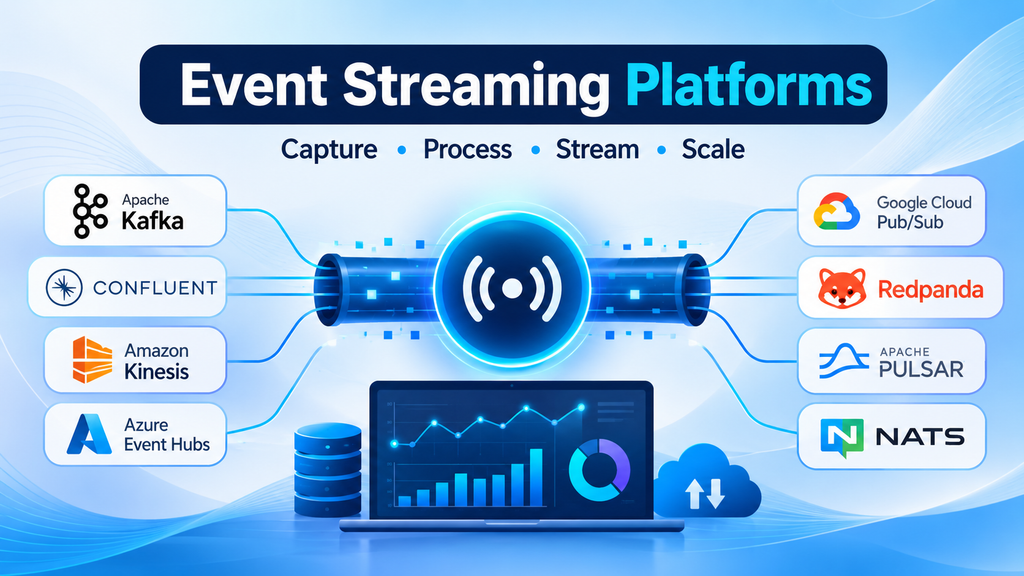
- Apache Kafka
Apache Kafka is a distributed event streaming platform designed to handle high volumes of continuous data. It supports event publishing, storage, and consumption, making it widely used for data pipelines, application integration, and event-driven architectures.
- Confluent Platform
Confluent Platform provides an enterprise event streaming environment built around Apache Kafka. It includes capabilities for managing event streams, connecting data sources, and supporting real-time data integration.
- Amazon Kinesis
Amazon Kinesis provides managed services for collecting and processing streaming data on AWS. It helps organizations build applications that analyze events from websites, applications, devices, and operational systems.
- Azure Event Hubs
Azure Event Hubs is a cloud-based event ingestion service designed to receive and process large volumes of events. It supports streaming architectures that integrate with other Azure data and analytics services.
- Google Cloud Pub/Sub
Google Cloud Pub/Sub is a messaging service that supports asynchronous communication between applications. It enables event producers and consumers to exchange messages without requiring direct connections between services.
- Redpanda
Redpanda is a distributed streaming data platform designed for high-performance event processing. It offers Kafka API compatibility and supports event-driven applications and real-time data pipelines.
- Apache Pulsar
Apache Pulsar is a distributed messaging and event streaming platform that supports persistent messaging, multi-tenancy, and geographically distributed deployments. It is suitable for applications that need scalable messaging infrastructure.
- NATS
NATS is a lightweight messaging system used for communication between distributed applications and services. Its JetStream capabilities add persistence and replay features for event-driven workloads.
- IBM Event Streams
IBM Event Streams is an enterprise event streaming offering based on Apache Kafka. It helps organizations build event-driven applications and connect data across enterprise environments.
- Solace PubSub+ Event Broker
Solace PubSub+ provides event-driven messaging and streaming capabilities for connecting applications, devices, and systems. It supports multiple messaging patterns and deployment environments.
How Event Streaming Platforms Work
- Event Generation: Applications, devices, databases, and services generate events when activities occur.
- Event Production: Producer applications publish events to the streaming platform.
- Event Storage: The platform stores events according to its retention and persistence configuration.
- Event Distribution: Events are made available to subscribed consumers or applications.
- Event Processing: Consumers or stream-processing services filter, transform, enrich, or aggregate event data.
- Business Action: Connected systems use processed events to update records, trigger workflows, send alerts, or produce analytical insights.
Common Use Cases Across Industries
- Banking and Finance: Process transaction events, support fraud monitoring, and connect financial applications.
- Retail and E-commerce: Track orders, inventory changes, payments, and customer activity.
- Healthcare: Connect healthcare applications, equipment systems, and operational data sources.
- Manufacturing: Collect machine events, production updates, and sensor information.
- Telecommunications: Process network events and monitor service activity.
- Transportation and Logistics: Share shipment updates, vehicle events, and delivery information.
- Media and Entertainment: Process user activity, content interactions, and application events.
- Software and IT Operations: Collect application logs, infrastructure events, and monitoring data.
Challenges of Event Streaming Platforms
- Architecture Complexity: Distributed event systems require appropriate configuration of producers, consumers, partitions, and storage.
- Data Schema Management: Changes to event structures can create compatibility problems between connected applications.
- Message Delivery: Organizations must understand delivery guarantees, retries, duplicate events, and processing behavior.
- Monitoring Requirements: High-volume event pipelines need continuous monitoring to identify delays and failures.
- Security Risks: Event streams may contain sensitive information that requires strong access controls and protection.
- Infrastructure Costs: Storage, network traffic, compute resources, and managed service pricing can increase as workloads grow.
- Operational Skills: Teams need knowledge of distributed systems, event design, and stream-processing practices.
Best Practices for Implementing Event Streaming
- Define clear event formats and naming conventions.
- Establish consistent data schemas and compatibility policies.
- Design producers and consumers to handle retries and duplicate messages safely.
- Configure partitions and replication based on workload requirements.
- Monitor throughput, processing delays, and consumer lag.
- Apply authentication, authorization, and encryption.
- Define appropriate event retention and replay policies.
- Test failure recovery and peak traffic scenarios.
- Document event ownership and data governance responsibilities.
How to Choose the Right Event Streaming Platform
- Throughput: Determine how many events the platform must handle per second.
- Latency: Identify how quickly events need to reach consumers.
- Scalability: Check whether the platform can grow with increasing workloads.
- Reliability: Evaluate persistence, replication, recovery, and delivery guarantees.
- Integration: Confirm compatibility with existing applications, databases, and cloud services.
- Processing Capabilities: Determine whether built-in or external stream processing is required.
- Deployment Model: Compare managed cloud services, self-hosted infrastructure, and hybrid deployments.
- Security: Review access controls, encryption, authentication, and compliance requirements.
- Cost: Consider infrastructure, storage, network usage, licensing, and operational expenses.
- Team Expertise: Choose a platform that aligns with available technical skills and support requirements.
The Future of Event Streaming Platforms
Event streaming is becoming an important foundation for modern data architectures. Organizations are increasingly combining event-driven applications with cloud-native services, real-time analytics, and artificial intelligence.
Improvements in stream processing, data governance, and managed infrastructure are making event-based systems easier to deploy and operate. Technologies that support data sharing across multiple environments are also helping organizations build more connected applications.
As businesses continue to demand faster data movement and more responsive services, event streaming platforms are expected to remain a key part of digital infrastructure.
Conclusion
Event streaming platforms enable organizations to collect, distribute, and process continuous data flows across applications and systems. They support real-time integration, event-driven architectures, operational monitoring, and responsive digital services.
Selecting the right platform requires evaluating throughput, latency, scalability, reliability, security, integration, and cost. With clear event design and effective monitoring, organizations can build dependable streaming architectures that support modern business requirements.
