Upgrade & Secure Your Future with DevOps, SRE, DevSecOps, MLOps!
We spend hours scrolling social media and waste money on things we forget, but won’t spend 30 minutes a day earning certifications that can change our lives.
Master in DevOps, SRE, DevSecOps & MLOps by DevOps School!
Learn from Guru Rajesh Kumar and double your salary in just one year.
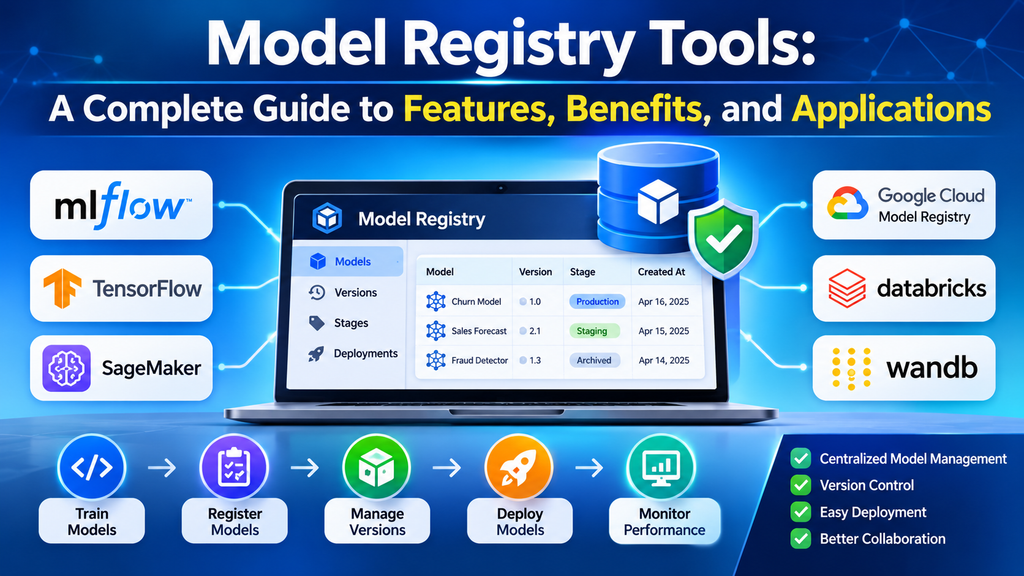
Model Registry Tools: A Complete Guide to Features, Benefits, and Applications
A model registry provides a centralized place to manage machine learning models throughout their lifecycle—from experimentation and validation to approval, deployment, and retirement.
What Are Model Registry Tools?
Model registry tools are platforms that help data scientists, machine learning engineers, and operations teams organize and manage trained models. They maintain model versions, metadata, evaluation results, approval status, and deployment information in a structured repository.
Instead of keeping model files in scattered folders or storage systems, teams can use a registry to identify which model is approved, which version is running in production, and how a model was created.
Why Model Registries Matter
Machine learning projects produce many model versions. Different experiments may generate models with different accuracy levels, parameters, datasets, and dependencies. Without a central registry, tracking these assets becomes difficult.
A model registry creates a consistent process for registering, reviewing, approving, deploying, and retiring models. It improves visibility and reduces the risk of deploying an outdated or unapproved model.
Key Features
1. Model versioning: Maintain multiple versions of a model and track changes over time.
2. Metadata management: Store model descriptions, framework details, parameters, metrics, owners, and training information.
3. Model lineage: Connect registered models to their training runs, datasets, code, and artifacts.
4. Lifecycle management: Organize models through development, staging, production, and archived states.
5. Approval workflows: Support reviews and controlled promotion before models reach production.
6. Deployment integration: Connect approved models to deployment pipelines and serving environments.
7. Access control and audit history: Help teams manage permissions and review important model lifecycle actions.
Popular Model Registry Tools
MLflow Model Registry: Provides model versioning, metadata, lineage, and lifecycle management within the MLflow ecosystem. It is useful for teams seeking an open-source approach that can integrate with different machine learning workflows.
Amazon SageMaker Model Registry: Supports cataloging, versioning, reviewing, and approving machine learning models within Amazon SageMaker workflows. It is a natural option for teams building on AWS.
Vertex AI Model Registry: Google Cloud’s model management service helps organize model versions and connect them with evaluation and deployment workflows in Vertex AI.
Azure Machine Learning Model Registry: Supports registering and managing models as assets in Azure Machine Learning, including versioning and integration with Azure-based ML workflows.
Databricks Model Registry: Model management capabilities in the Databricks ecosystem support organizing and governing model assets. Current implementations commonly use Unity Catalog for centralized governance and permissions.
Weights & Biases (W&B) Registry: Helps teams organize and share model artifacts and versions, connect them to experiment workflows, and manage transitions between development and production use.
Each platform has different hosting, governance, integration, and deployment characteristics. Selection should reflect the team’s existing infrastructure and operational needs.
Benefits of Model Registry Tools
- Centralized organization: Keep model assets and their metadata in a structured location.
- Reliable version control: Identify and retrieve the correct model version.
- Improved collaboration: Give data science and engineering teams a shared model catalog.
- Safer deployments: Add review and approval steps before production releases.
- Traceability: Understand how models were trained, evaluated, and updated.
- Governance: Support access management and lifecycle oversight.
Common Applications
Model registries are useful in fraud detection, recommendation systems, predictive maintenance, customer analytics, natural language processing, computer vision, and forecasting.
For example, a financial services team might develop several fraud detection models. Each candidate is registered with its version, training information, and evaluation metrics. After validation and approval, the selected model is promoted to production. If a new release performs poorly, the team can identify and restore a previous version.
How to Choose the Right Model Registry
Start with your machine learning infrastructure. Organizations using AWS may prefer SageMaker Model Registry, while Google Cloud teams may find Vertex AI Model Registry convenient. Azure Machine Learning and Databricks users can consider their native registry capabilities. Teams looking for a flexible, open-source option may evaluate MLflow.
Also consider versioning, lineage, access controls, approval workflows, artifact storage, deployment integration, audit requirements, scalability, and cost. Test how easily the registry fits into your existing CI/CD and MLOps processes.
Best Practices
Use consistent naming conventions and meaningful model descriptions. Record the training dataset, source-code version, parameters, evaluation metrics, and responsible owner. Establish clear criteria for promoting models between lifecycle stages. Restrict production approvals to authorized users, maintain audit records, and define a process for retiring outdated models.
A registry is most effective when it is integrated into the team’s development and deployment pipelines rather than treated as a separate file repository.
Conclusion
Model registry tools provide the structure needed to manage machine learning models reliably. Solutions such as MLflow, Amazon SageMaker, Vertex AI, Azure Machine Learning, Databricks, and Weights & Biases help teams organize versions, preserve model lineage, control approvals, and support deployment. Choosing the right registry can make model operations more transparent, collaborative, and scalable.
