Upgrade & Secure Your Future with DevOps, SRE, DevSecOps, MLOps!
We spend hours scrolling social media and waste money on things we forget, but won’t spend 30 minutes a day earning certifications that can change our lives.
Master in DevOps, SRE, DevSecOps & MLOps by DevOps School!
Learn from Guru Rajesh Kumar and double your salary in just one year.
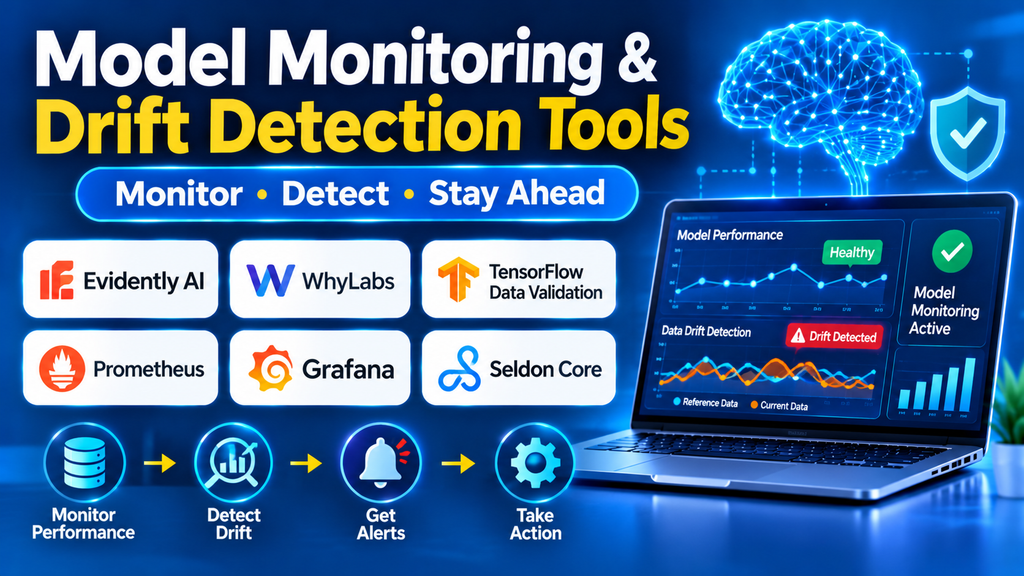
Model Monitoring & Drift Detection Tools: A Complete Guide to Features, Benefits, and Applications
Introduction
Machine learning models play an important role in modern business applications. However, deploying a model into production does not guarantee that it will continue delivering accurate predictions.
Changes in data, customer behavior, business conditions, and external environments can gradually affect model performance.
Model monitoring and drift detection tools help organizations identify these changes and maintain reliable machine learning systems.
What Are Model Monitoring and Drift Detection Tools?
Model monitoring tools continuously track the performance, reliability, and behavior of machine learning models after deployment.
They collect information about predictions, input data, system performance, and model quality.
Drift detection tools identify changes in data distributions or relationships that can affect model accuracy.
These tools help data science teams recognize problems early and determine when investigation, retraining, or model replacement may be necessary.
Popular Model Monitoring and Drift Detection Tools
1. Evidently AI
Evidently AI is an open-source tool for evaluating and monitoring machine learning models.
It provides reports and dashboards for data quality, data drift, prediction quality, and model performance.
2. WhyLabs
WhyLabs is an AI observability platform designed to monitor data pipelines and machine learning systems.
It helps identify data quality problems, anomalies, and changes in production behavior.
3. TensorFlow Data Validation
TensorFlow Data Validation is a library in the TensorFlow ecosystem that analyzes datasets, generates statistics, identifies anomalies, and validates data against defined schemas.
It is useful for maintaining reliable data pipelines.
4. Prometheus
Prometheus is an open-source monitoring and alerting toolkit that collects and stores time-series metrics.
It can monitor infrastructure and application metrics supporting machine learning services.
5. Grafana
Grafana is an analytics and visualization platform that creates dashboards using metrics from supported data sources.
It helps teams monitor model-serving infrastructure and operational performance.
6. Seldon Core
Seldon Core is an open-source machine learning deployment and serving platform for Kubernetes.
It supports production model operations and monitoring integrations.
Key Features of Model Monitoring Tools
- Model performance tracking: Measures prediction quality and model effectiveness.
- Data quality monitoring: Identifies missing values, incorrect formats, and unusual data.
- Data drift detection: Identifies changes in input data distributions.
- Prediction analysis: Tracks changes in model outputs.
- Concept drift investigation: Helps identify changes in relationships between features and target variables.
- Automated alerts: Notifies teams when monitoring thresholds are exceeded.
- Dashboard visualization: Presents monitoring results through interactive dashboards.
- Model health monitoring: Tracks operational reliability.
- MLOps integration: Connects monitoring with model deployment and management workflows.
- Historical reporting: Maintains records for performance comparisons.
Types of Model Drift
Understanding different types of drift is important for maintaining machine learning models.
1. Data Drift
Data drift occurs when the distribution of input features changes compared with the training data.
For example, an online shopping recommendation system may experience changes in customer browsing behavior.
2. Concept Drift
Concept drift occurs when the relationship between input features and the target variable changes over time.
For example, customer purchasing patterns may change due to new market conditions.
3. Prediction Drift
Prediction drift occurs when the distribution of model predictions changes over time.
It may indicate changing input data, changing user behavior, or other changes affecting the model.
4. Label Drift
Label drift occurs when the distribution of actual target values changes over time.
It can affect the assumptions used during model training and evaluation.
Benefits of Model Monitoring and Drift Detection Tools
These tools help organizations maintain model reliability and identify unexpected changes.
Major benefits include:
- Early identification of model performance problems.
- Improved prediction reliability.
- Better data quality management.
- Reduced operational risks.
- Proactive model maintenance.
- More informed retraining decisions.
- Improved production visibility.
- Better machine learning lifecycle management.
Common Applications
1. Fraud Detection: Monitor transaction patterns and identify changes affecting fraud prediction models.
2. Customer Churn Prediction: Track changes in customer behavior that influence retention predictions.
3. Recommendation Systems: Monitor changes in user preferences and recommendation quality.
4. Healthcare: Monitor predictive models used in healthcare analytics and research.
5. Credit Scoring: Identify changes in financial data that affect credit risk predictions.
6. Demand Forecasting: Monitor changes in sales patterns and market demand.
7. Predictive Maintenance: Identify changes in sensor data and equipment behavior.
8. Computer Vision: Monitor image classification and object detection models in production.
Best Practices for Model Monitoring
To maintain reliable machine learning systems, organizations should:
- Establish baseline performance metrics before deployment.
- Monitor input data and prediction distributions.
- Track latency and resource utilization.
- Define appropriate alert thresholds.
- Validate drift signals against actual model quality whenever possible.
- Maintain historical monitoring records.
- Establish retraining and rollback procedures.
- Integrate monitoring into MLOps pipelines.
It is important to remember that detecting drift does not automatically mean a model must be retrained. Teams should investigate the underlying changes and evaluate their impact first.
How to Choose the Right Model Monitoring Tool
Consider the following factors:
- Integration with existing machine learning platforms.
- Supported data types and monitoring metrics.
- Data drift and model performance capabilities.
- Scalability and processing requirements.
- Alerting and visualization features.
- Security and governance.
- Deployment environment.
- Pricing and operational costs.
Evidently AI is useful for model evaluation and drift analysis. WhyLabs supports AI observability, TensorFlow Data Validation focuses on data quality, and Prometheus and Grafana provide infrastructure monitoring and visualization. Seldon Core supports production model serving and operational integrations.
Conclusion
Model monitoring and drift detection tools are essential for maintaining reliable machine learning applications.
They help organizations identify data changes, monitor model behavior, and respond to performance problems before they create significant business risks.
Integrating these tools into MLOps workflows supports continuous improvement and dependable AI systems.
