Upgrade & Secure Your Future with DevOps, SRE, DevSecOps, MLOps!
We spend hours scrolling social media and waste money on things we forget, but won’t spend 30 minutes a day earning certifications that can change our lives.
Master in DevOps, SRE, DevSecOps & MLOps by DevOps School!
Learn from Guru Rajesh Kumar and double your salary in just one year.
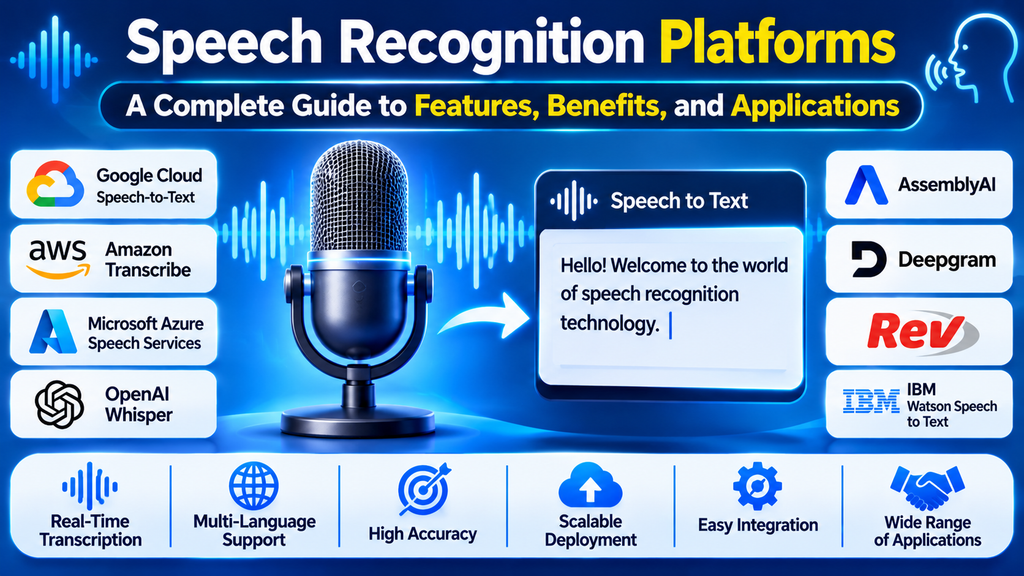
Speech Recognition Platforms: A Complete Guide to Features, Benefits, and Applications
Speech recognition platforms convert spoken language into text that computers can process. They power voice assistants, meeting transcription, automated customer support, accessibility features, and voice-controlled applications. Modern platforms use artificial intelligence and deep learning to recognize speech, handle different accents, and produce transcripts from live or recorded audio.
What Are Speech Recognition Platforms?
Speech recognition platforms are software tools and cloud services that analyze audio and identify the words being spoken. They use acoustic models, language models, and machine learning techniques to transform speech signals into written text.
Some platforms focus on real-time transcription, while others process uploaded recordings. Advanced services may also provide speaker identification, timestamps, punctuation, language detection, and domain-specific vocabulary support.
Key Features
1. Speech-to-text conversion: Turn spoken words into searchable, editable text.
2. Real-time transcription: Convert live conversations, calls, and broadcasts into text with low latency.
3. Multilingual recognition: Support transcription across multiple languages and language variants.
4. Speaker diarization: Identify and distinguish different speakers in an audio recording.
5. Punctuation and formatting: Add punctuation and organize recognized speech into readable sentences.
6. Noise handling: Improve recognition in challenging audio environments, depending on the platform and recording quality.
7. API integration: Connect speech recognition capabilities to websites, mobile applications, contact centers, and business systems.
Popular Speech Recognition Platforms
OpenAI Whisper: An automatic speech recognition model that supports transcription and multilingual speech processing. It can be used through compatible implementations and hosted services.
Google Cloud Speech-to-Text: A managed service for converting audio into text, with support for multiple languages and different audio-processing workflows.
Amazon Transcribe: An AWS speech-to-text service designed for applications such as call analytics, media transcription, and automated speech processing.
Microsoft Azure AI Speech: Provides speech-to-text capabilities, including real-time and batch transcription, custom speech options, and integration with Azure applications.
Deepgram: Offers speech recognition APIs designed for real-time and pre-recorded audio, with features for building voice-enabled applications.
AssemblyAI: Provides speech-to-text APIs and additional audio intelligence capabilities, such as summarization and content analysis.
IBM Watson Speech to Text: IBM’s speech recognition technology has supported converting audio into text. Check current IBM product availability and service options before selecting it for a new project.
Rev: Offers automated transcription technology alongside human transcription services, making it an option for workflows where transcript review and accuracy are important.
Benefits of Speech Recognition Platforms
- Time savings: Reduce the effort required to manually transcribe recordings.
- Accessibility: Make spoken information available as searchable text and captions.
- Better productivity: Help teams capture meetings, interviews, and discussions.
- Improved search: Make audio content easier to index and retrieve.
- Scalable processing: Process large volumes of recordings through automated workflows.
- Voice-driven experiences: Enable hands-free interfaces and voice-controlled applications.
Common Applications
Customer service: Transcribe support calls and help analyze customer conversations.
Healthcare: Support clinical documentation workflows, subject to appropriate privacy safeguards and professional review.
Education: Generate lecture transcripts, captions, and searchable learning materials.
Media and entertainment: Create subtitles and transcripts for podcasts, interviews, and video content.
Business meetings: Capture discussions and make meeting records easier to review.
Accessibility: Provide captions and text alternatives for people who are deaf or hard of hearing.
Voice applications: Enable spoken commands and conversational interfaces.
How to Choose the Right Platform
Start by identifying whether you need live transcription, batch processing, or both. Consider the languages and accents your users speak, the quality of available audio, and whether speaker identification or timestamps are necessary.
Compare recognition accuracy using representative recordings rather than relying only on published benchmarks. Also evaluate latency, API design, supported file formats, security, data retention, deployment options, scalability, and pricing.
For sensitive recordings, review data-processing terms and privacy controls carefully. Some applications may require human review before transcripts are used for important decisions.
Best Practices
Use clear recordings and suitable microphones whenever possible. Test different accents, speaking speeds, background noise levels, and technical vocabulary. Configure language and domain settings where supported, review important transcripts, and monitor recognition quality after deployment.
Protect audio recordings and transcripts with appropriate access controls. Establish retention policies and obtain consent where required. Remember that automated transcripts can contain errors, especially with overlapping speakers, unusual names, and noisy recordings.
Conclusion
Speech recognition platforms make spoken information easier to capture, search, analyze, and share. Solutions such as OpenAI Whisper, Google Cloud Speech-to-Text, Amazon Transcribe, Microsoft Azure AI Speech, Deepgram, AssemblyAI, IBM Watson Speech to Text, and Rev support a wide range of transcription workflows. Choosing the right platform requires balancing accuracy, language support, latency, privacy, integration, and cost.
