Upgrade & Secure Your Future with DevOps, SRE, DevSecOps, MLOps!
We spend hours scrolling social media and waste money on things we forget, but won’t spend 30 minutes a day earning certifications that can change our lives.
Master in DevOps, SRE, DevSecOps & MLOps by DevOps School!
Learn from Guru Rajesh Kumar and double your salary in just one year.
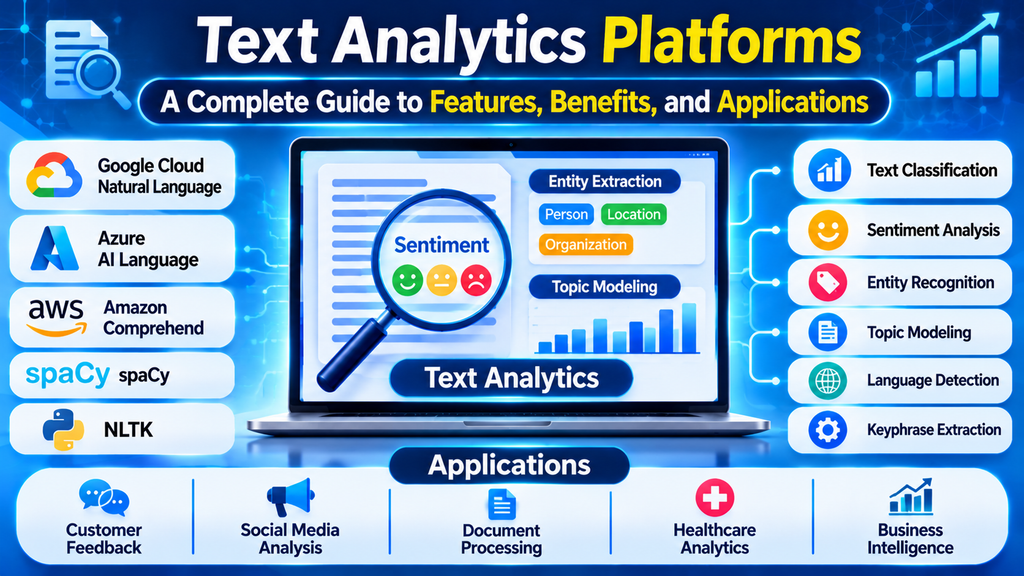
Text Analytics Platforms: A Complete Guide to Features, Benefits, and Applications
Text analytics platforms help organizations extract meaningful information from large volumes of written content. Using natural language processing (NLP), machine learning, and linguistic techniques, these tools can identify sentiment, recognize entities, classify documents, discover topics, and reveal patterns hidden in text.
What Are Text Analytics Platforms?
Text analytics platforms are software tools, libraries, and cloud services that process unstructured text and turn it into structured, actionable information.
They can analyze customer reviews, emails, surveys, social media posts, support conversations, business documents, and other text sources. Depending on the platform, users can apply ready-made analysis APIs or build custom text-processing pipelines.
Key Features
1. Sentiment analysis: Determine whether text expresses positive, negative, or neutral sentiment, and sometimes identify more nuanced emotions.
2. Entity recognition: Identify people, organizations, locations, dates, products, and other important entities.
3. Text classification: Categorize documents, messages, or feedback into predefined groups.
4. Topic modeling: Discover recurring themes and topics across large document collections.
5. Keyword and keyphrase extraction: Find the most important terms and phrases in a document.
6. Language detection: Identify the language of incoming text to support multilingual workflows.
7. Summarization: Condense long documents into shorter summaries, where supported by the platform or connected models.
Popular Text Analytics Platforms
Google Cloud Natural Language: Provides APIs for analyzing text, including sentiment analysis, entity recognition, content classification, and syntax analysis.
Azure AI Language: Microsoft’s language service offers text analysis capabilities such as sentiment analysis, named entity recognition, key phrase extraction, and language detection.
Amazon Comprehend: A managed natural language processing service that can identify entities, key phrases, sentiment, language, and document topics.
spaCy: An open-source NLP library for building efficient text-processing pipelines. It supports tokenization, linguistic analysis, named entity recognition, and custom NLP components.
NLTK: The Natural Language Toolkit is a Python library used for text processing, linguistic research, tokenization, classification, and educational NLP projects.
Gensim: An open-source Python library focused on topic modeling, document similarity, and vector-space modeling for text collections.
These platforms have different strengths. Cloud services offer managed APIs, while open-source libraries provide more control over custom processing pipelines.
Benefits of Text Analytics Platforms
- Faster analysis: Process large collections of text more efficiently than manual review.
- Customer understanding: Identify common opinions, complaints, and recurring feedback themes.
- Better decisions: Turn written information into measurable trends and insights.
- Automation: Categorize incoming messages and documents automatically.
- Improved search: Extract entities and keywords that make information easier to find.
- Scalable processing: Analyze growing volumes of text across multiple sources.
Common Applications
Customer experience: Analyze reviews, surveys, and support conversations to identify customer concerns.
Social media monitoring: Understand public reactions, discussion trends, and brand sentiment.
Financial services: Extract information from reports, disclosures, and customer communications.
Healthcare research: Analyze research documents and clinical text under appropriate privacy and professional controls.
Human resources: Organize employee feedback and identify recurring workplace themes.
Business intelligence: Turn reports, emails, and other business documents into structured insights.
How to Choose the Right Platform
Begin by identifying the type and volume of text you need to analyze. Consider whether you need sentiment analysis, entity extraction, classification, topic discovery, or a combination of capabilities.
Evaluate language coverage, accuracy, customization, integration options, processing speed, security, deployment flexibility, scalability, and pricing. Test the platform using real examples from your own data, including informal language, abbreviations, spelling errors, and domain-specific terminology.
For sensitive information, review data handling, retention policies, access controls, and compliance requirements before sending content to an external service.
Best Practices
Clean and prepare text consistently before analysis. Define clear categories and evaluation criteria, and test models on representative samples. Review ambiguous results, monitor performance as language patterns change, and avoid treating automated sentiment or classification outputs as unquestionable facts.
Protect personal and confidential information, document processing workflows, and maintain human review for high-impact decisions.
Conclusion
Text analytics platforms help transform unstructured written content into useful business and research insights. Tools such as Google Cloud Natural Language, Azure AI Language, Amazon Comprehend, spaCy, NLTK, and Gensim support different approaches to analyzing text. Choosing the right solution depends on the required capabilities, data sensitivity, technical expertise, and scale of the project.
