Upgrade & Secure Your Future with DevOps, SRE, DevSecOps, MLOps!
We spend hours scrolling social media and waste money on things we forget, but won’t spend 30 minutes a day earning certifications that can change our lives.
Master in DevOps, SRE, DevSecOps & MLOps by DevOps School!
Learn from Guru Rajesh Kumar and double your salary in just one year.
Introduction
Fraud Prevention for E-commerce tools help online businesses detect, block, review, and reduce fraudulent transactions before they create financial loss. In simple words, these platforms help merchants identify risky orders, stolen cards, fake accounts, account takeover attempts, promo abuse, chargeback fraud, bot attacks, and suspicious customer behavior.
They matter now because ecommerce fraud is becoming more automated, more global, and more difficult to detect with manual review alone. Modern fraud teams need AI scoring, device intelligence, behavioral signals, chargeback protection, identity verification, automation rules, and strong integrations with payment, ecommerce, and order systems.
Common use cases include:
- Blocking stolen-card transactions.
- Detecting account takeover attempts.
- Reducing false declines for genuine customers.
- Preventing promo code and refund abuse.
- Reviewing high-risk orders before fulfillment.
Buyers should evaluate:
- Fraud detection accuracy
- Chargeback protection
- AI and machine learning capability
- Manual review workflows
- Ecommerce and payment integrations
- Device fingerprinting
- Identity verification support
- Reporting and analytics
- Security and compliance posture
- Pricing and scalability
Best for: ecommerce brands, marketplaces, subscription businesses, digital goods sellers, online retailers, payment teams, risk teams, fraud analysts, and operations leaders handling online transactions.
Not ideal for: very small stores with low transaction volume, businesses using only basic offline payments, or teams that only need simple payment gateway fraud filters.
Key Trends in Fraud Prevention for E-commerce Tools
- AI-powered fraud scoring: Platforms are using machine learning to evaluate transaction behavior, device signals, location, history, and risk patterns in real time.
- Account takeover protection: Fraud prevention is expanding beyond checkout to protect login, account changes, loyalty points, stored cards, and refund flows.
- Behavioral intelligence: Mouse movement, typing behavior, session patterns, and user journey signals are becoming more important for detecting bots and fraud rings.
- Chargeback automation: More tools now help merchants prevent disputes, respond to chargebacks, and reduce manual evidence preparation.
- False-decline reduction: Businesses want to stop fraud without blocking genuine customers, especially in high-value retail and cross-border ecommerce.
- Bot and abuse protection: Promo abuse, credential stuffing, inventory hoarding, fake account creation, and refund abuse are major concerns.
- API-first risk engines: Growing businesses want fraud logic embedded into checkout, payment, onboarding, and account workflows.
- Global compliance expectations: Fraud tools must support privacy-aware risk decisions, data security, and regional compliance needs.
- Marketplace fraud prevention: Multi-sided platforms need fraud tools for buyers, sellers, listings, payouts, and identity risk.
- Fraud plus identity convergence: Fraud prevention is increasingly connected with KYC, identity verification, device intelligence, and trust scoring.
How We Selected These Tools
The following tools were selected using practical ecommerce fraud evaluation criteria:
- Recognition in ecommerce, payment risk, fraud detection, and chargeback prevention markets.
- Breadth of fraud coverage across checkout, account, payment, and post-purchase workflows.
- AI, machine learning, rules, and behavioral risk capabilities.
- Ability to reduce fraud while controlling false declines.
- Support for ecommerce platforms, payment gateways, APIs, and enterprise systems.
- Chargeback protection, dispute management, or risk guarantee availability.
- Suitability for SMB, mid-market, and enterprise businesses.
- Security, compliance, and governance posture where publicly known.
- Reporting, analytics, case management, and manual review workflows.
- Fit across physical goods, digital goods, marketplaces, subscriptions, and global commerce.
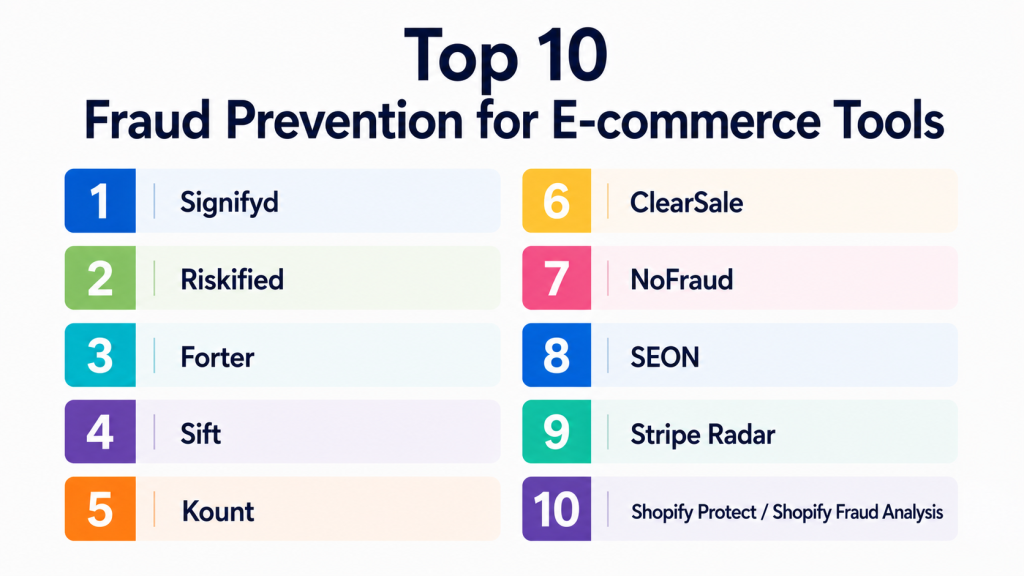
Top 10 Fraud Prevention for E-commerce Tools
#1 — Signifyd
Short description:
Signifyd is an ecommerce fraud protection platform built for online retailers, marketplaces, and omnichannel businesses. It helps merchants detect fraud, approve more legitimate orders, reduce chargeback risk, and automate order decisioning. The platform is widely known for commerce protection, order risk scoring, and chargeback-related workflows. It is especially useful for brands that want fraud prevention connected directly with checkout and order fulfillment. Signifyd is a strong choice for growing and enterprise ecommerce companies handling large order volumes.
Key Features
- Real-time order risk scoring.
- Chargeback protection workflows.
- Automated approve, decline, and review decisions.
- Account protection and abuse detection.
- Policy abuse and refund abuse support.
- Ecommerce and payment integrations.
- Fraud analytics and reporting.
Pros
- Strong fit for ecommerce fraud protection.
- Helps reduce manual review workload.
- Useful for improving approval rates while managing risk.
Cons
- May be more advanced than needed for very small stores.
- Pricing and guarantee terms should be reviewed carefully.
- Implementation quality depends on data and workflow setup.
Platforms / Deployment
Web-based platform; Cloud deployment; API support.
Security & Compliance
SSO/SAML, MFA, encryption, audit logs, RBAC, SOC 2, ISO 27001, GDPR, HIPAA: Not publicly stated.
Integrations & Ecosystem
Signifyd works with ecommerce, payment, and order systems.
- Ecommerce platforms
- Payment gateways
- Order management systems
- Fraud review workflows
- API integrations
- Customer service systems
Support & Community
Documentation, onboarding, and customer support are available. Community strength is high among ecommerce fraud and risk teams.
#2 — Riskified
Short description:
Riskified is an ecommerce fraud prevention platform focused on helping merchants approve more legitimate transactions while reducing fraud losses. It uses machine learning, identity signals, merchant data, and transaction analysis to assess risk. Riskified is suitable for large ecommerce merchants, marketplaces, and global retailers that need automated order decisions. It is often used where false declines are a major business concern. The platform is strong for businesses that want fraud prevention tied closely to revenue protection.
Key Features
- Machine learning fraud decisions.
- Chargeback protection options.
- Order approval optimization.
- Account protection capabilities.
- Policy abuse prevention.
- Fraud analytics.
- Ecommerce and payment integrations.
Pros
- Strong for high-volume ecommerce.
- Helps reduce false declines.
- Good fit for global online merchants.
Cons
- May not be ideal for low-volume stores.
- Requires careful evaluation of commercial model.
- Advanced workflows may require onboarding support.
Platforms / Deployment
Web-based platform; Cloud deployment; API support.
Security & Compliance
SSO/SAML, MFA, encryption, audit logs, RBAC, SOC 2, ISO 27001, GDPR, HIPAA: Not publicly stated.
Integrations & Ecosystem
Riskified integrates with commerce and payment workflows.
- Ecommerce platforms
- Payment processors
- Order systems
- Marketplace workflows
- APIs
- Fraud operations tools
Support & Community
Riskified provides onboarding and support resources. Community awareness is strong among enterprise ecommerce and fraud teams.
#3 — Forter
Short description:
Forter is a digital commerce fraud prevention platform that helps businesses make real-time trust decisions across the customer journey. It supports transaction fraud prevention, account protection, abuse prevention, and identity-based risk evaluation. Forter is useful for ecommerce companies, marketplaces, travel businesses, and digital platforms with high transaction volume. The platform focuses on identifying trusted customers and reducing friction while blocking fraud. Forter is best suited for businesses that want fraud prevention beyond checkout alone.
Key Features
- Real-time fraud decisions.
- Identity and trust network signals.
- Account takeover protection.
- Payment fraud prevention.
- Policy and promo abuse detection.
- Chargeback-related support.
- Risk analytics and reporting.
Pros
- Strong for full customer journey protection.
- Useful for reducing friction for trusted users.
- Good fit for enterprise and marketplace use cases.
Cons
- May be too advanced for small ecommerce stores.
- Implementation may require technical alignment.
- Pricing and use-case fit need careful review.
Platforms / Deployment
Web-based platform; Cloud deployment; API support.
Security & Compliance
SSO/SAML, MFA, encryption, audit logs, RBAC, SOC 2, ISO 27001, GDPR, HIPAA: Not publicly stated.
Integrations & Ecosystem
Forter connects with digital commerce environments.
- Ecommerce platforms
- Payment systems
- Identity workflows
- Marketplace systems
- Account login flows
- API integrations
Support & Community
Forter offers enterprise-oriented onboarding and support. Community strength is high in digital commerce fraud prevention.
#4 — Sift
Short description:
Sift is a fraud prevention and digital trust platform used by ecommerce companies, fintech businesses, marketplaces, and digital platforms. It helps detect payment fraud, account takeover, fake accounts, spam, abuse, and other risky behaviors. Sift is useful for companies that need flexible fraud detection across multiple user actions, not just checkout. It combines machine learning, workflows, rules, and case management. The platform is a good fit for product-led, marketplace, and digital-first businesses.
Key Features
- Payment fraud detection.
- Account takeover protection.
- Fake account and abuse detection.
- Machine learning risk scoring.
- Rules and workflow automation.
- Case management.
- Reporting and investigation tools.
Pros
- Strong coverage beyond payment fraud.
- Useful for marketplaces and digital platforms.
- Flexible for complex abuse patterns.
Cons
- Setup may require fraud strategy and tuning.
- Smaller merchants may not need full platform depth.
- Value depends on data quality and workflow design.
Platforms / Deployment
Web-based platform; Cloud deployment; API support.
Security & Compliance
SSO/SAML, MFA, encryption, audit logs, RBAC, SOC 2, ISO 27001, GDPR, HIPAA: Not publicly stated.
Integrations & Ecosystem
Sift supports risk workflows across digital products.
- Ecommerce platforms
- Custom applications
- Payment systems
- Marketplace workflows
- Account systems
- APIs and event streams
Support & Community
Documentation, onboarding, and customer support are available. Community strength is strong among fraud, trust, and safety teams.
#5 — Kount
Short description:
Kount is a fraud prevention platform focused on identity trust, payment fraud detection, account protection, and digital risk decisioning. It is used by ecommerce merchants, financial services companies, and digital businesses that need automated fraud controls. Kount helps evaluate transactions, devices, identities, and behavioral patterns to reduce fraud. It is suitable for businesses that want risk scoring, rules, and decisioning integrated into commerce workflows. Kount is a strong option for companies needing mature fraud prevention capabilities.
Key Features
- Transaction fraud detection.
- Device and identity intelligence.
- Account takeover protection.
- AI-based risk scoring.
- Rules and policy management.
- Chargeback and dispute support.
- Reporting and analytics.
Pros
- Strong identity and device intelligence.
- Useful for ecommerce and financial risk workflows.
- Suitable for mature fraud teams.
Cons
- Implementation may need technical support.
- May be more than basic stores require.
- Pricing and features should be validated by use case.
Platforms / Deployment
Web-based platform; Cloud deployment; API support.
Security & Compliance
SSO/SAML, MFA, encryption, audit logs, RBAC, SOC 2, ISO 27001, GDPR, HIPAA: Not publicly stated.
Integrations & Ecosystem
Kount works with commerce, payment, and risk systems.
- Payment gateways
- Ecommerce platforms
- Account systems
- Risk operations workflows
- API integrations
- Data and reporting tools
Support & Community
Support resources and onboarding are available. Community strength is solid in fraud prevention and payment risk markets.
#6 — ClearSale
Short description:
ClearSale is an ecommerce fraud prevention and chargeback protection platform that combines automated fraud scoring with human review. It is useful for merchants that want to reduce fraud while avoiding unnecessary order declines. ClearSale is often considered by ecommerce businesses that need a balance of automation and expert review. The platform can help protect revenue, reduce chargebacks, and improve approval rates. It is especially useful for retailers that want external fraud operations support.
Key Features
- Fraud scoring and decisioning.
- Manual review support.
- Chargeback prevention workflows.
- Order approval optimization.
- Ecommerce platform integrations.
- Fraud analytics.
- International fraud support.
Pros
- Human review can help reduce false declines.
- Useful for ecommerce merchants without large internal fraud teams.
- Good for balancing automation and expert review.
Cons
- Human review may add workflow dependency.
- Not always ideal for businesses wanting fully internal control.
- Service model and pricing should be reviewed carefully.
Platforms / Deployment
Web-based platform; Cloud deployment.
Security & Compliance
SSO/SAML, MFA, encryption, audit logs, RBAC, SOC 2, ISO 27001, GDPR, HIPAA: Not publicly stated.
Integrations & Ecosystem
ClearSale works with ecommerce and payment workflows.
- Ecommerce platforms
- Payment gateways
- Order systems
- Fraud review processes
- Reporting tools
- Customer support workflows
Support & Community
ClearSale provides support and fraud review resources. Community strength is good among ecommerce merchants seeking managed fraud services.
#7 — NoFraud
Short description:
NoFraud is an ecommerce fraud prevention platform that helps merchants review orders, prevent chargebacks, and automate fraud decisions. It is designed for online retailers that want fraud protection without building a large internal risk team. NoFraud focuses on order screening, chargeback protection, and customer verification workflows. It is suitable for SMB and mid-market ecommerce businesses that want practical fraud prevention. The platform is useful when merchants want a managed or semi-managed fraud review approach.
Key Features
- Order fraud screening.
- Chargeback protection support.
- Manual review workflow.
- Customer verification.
- Ecommerce integrations.
- Fraud analytics.
- Decision automation.
Pros
- Good for merchants needing practical fraud review.
- Helps reduce internal review workload.
- Useful for SMB and mid-market ecommerce.
Cons
- May not match enterprise-level custom fraud architecture.
- Review workflow and terms should be evaluated.
- Less suitable for non-ecommerce fraud use cases.
Platforms / Deployment
Web-based platform; Cloud deployment.
Security & Compliance
SSO/SAML, MFA, encryption, audit logs, RBAC, SOC 2, ISO 27001, GDPR, HIPAA: Not publicly stated.
Integrations & Ecosystem
NoFraud connects with ecommerce stores and order workflows.
- Shopify
- BigCommerce
- Magento / Adobe Commerce
- WooCommerce
- Payment gateways
- Order management systems
Support & Community
Support and managed review resources are available. Community awareness is strongest among ecommerce merchants.
#8 — SEON
Short description:
SEON is a fraud prevention and risk management platform focused on digital identity, device intelligence, email and phone intelligence, IP analysis, and behavioral signals. It is used by ecommerce, fintech, marketplaces, gaming, and online platforms. SEON is useful for businesses that want flexible fraud detection across account creation, login, payments, and transactions. The platform is especially relevant for teams that want data enrichment and risk scoring. It can support both ecommerce fraud and broader digital risk workflows.
Key Features
- Digital identity enrichment.
- Device fingerprinting.
- Email and phone risk analysis.
- IP and geolocation checks.
- Transaction risk scoring.
- Rules and automation.
- API integrations.
Pros
- Strong data enrichment capabilities.
- Useful beyond checkout fraud.
- Flexible for different digital risk use cases.
Cons
- Teams may need to design fraud rules carefully.
- Not always a complete chargeback guarantee solution.
- Requires good workflow integration for best results.
Platforms / Deployment
Web-based platform; Cloud deployment; API support.
Security & Compliance
SSO/SAML, MFA, encryption, audit logs, RBAC, SOC 2, ISO 27001, GDPR, HIPAA: Not publicly stated.
Integrations & Ecosystem
SEON is suitable for API-driven risk workflows.
- Ecommerce systems
- Payment workflows
- Account registration flows
- Fintech platforms
- Marketplace systems
- Custom applications
Support & Community
Documentation, onboarding, and technical support are available. Community strength is growing across fraud, risk, and digital trust teams.
#9 — Stripe Radar
Short description:
Stripe Radar is a fraud prevention tool built into the Stripe payments ecosystem. It helps businesses detect and block fraudulent payments using machine learning trained on payment signals across Stripe’s network. It is especially useful for businesses already using Stripe for online payments. Stripe Radar supports automated risk scoring, rules, reviews, and payment-level fraud controls. It is a strong option for startups and SMBs that want fraud prevention directly inside their payment workflow.
Key Features
- Payment fraud detection.
- Machine learning risk scoring.
- Custom fraud rules.
- Review workflows.
- Stripe payment integration.
- Risk insights.
- Chargeback-related payment signals.
Pros
- Easy fit for businesses already using Stripe.
- Strong payment-level fraud detection.
- Good starting point for startups and SMBs.
Cons
- Mostly tied to Stripe payment workflows.
- May not cover all account abuse or marketplace fraud needs.
- Advanced fraud operations may need additional tools.
Platforms / Deployment
Web-based platform; Cloud deployment within Stripe ecosystem; API support.
Security & Compliance
Security details depend on Stripe platform controls. Specific SSO/SAML, audit logs, SOC 2, ISO 27001, GDPR, HIPAA details for Radar workflows: Not publicly stated.
Integrations & Ecosystem
Stripe Radar works best inside Stripe payment infrastructure.
- Stripe Payments
- Stripe Checkout
- Stripe APIs
- Ecommerce platforms connected to Stripe
- Custom payment flows
- Review and rules workflows
Support & Community
Stripe provides documentation, support resources, and a large developer community. Community strength is high among startups and payment teams.
#10 — Shopify Protect / Shopify Fraud Analysis
Short description:
Shopify offers fraud analysis features for merchants using Shopify, and Shopify Protect may be available for eligible orders and payment workflows depending on merchant setup and region. These tools help Shopify merchants identify risky orders, review fraud indicators, and reduce chargeback risk in supported cases. It is useful for small and mid-sized Shopify sellers that want built-in fraud visibility without adding a separate enterprise platform immediately. Shopify’s fraud tools are best for merchants operating mainly inside the Shopify ecosystem. For higher-risk stores, a dedicated fraud platform may still be needed.
Key Features
- Order fraud analysis.
- Risk indicators.
- Shopify checkout integration.
- Eligible order protection workflows.
- Merchant review support.
- Payment and order signals.
- Built-in Shopify admin visibility.
Pros
- Convenient for Shopify merchants.
- No separate fraud dashboard needed for basic review.
- Good starting point for smaller stores.
Cons
- Limited compared with dedicated fraud prevention platforms.
- Availability and protection terms may vary.
- Not ideal for complex multi-platform fraud operations.
Platforms / Deployment
Web-based platform; Cloud deployment within Shopify ecosystem.
Security & Compliance
Security depends on Shopify platform controls. Specific SSO/SAML, audit logs, SOC 2, ISO 27001, GDPR, HIPAA details for fraud analysis workflows: Not publicly stated.
Integrations & Ecosystem
Shopify fraud tools work inside Shopify commerce workflows.
- Shopify admin
- Shopify checkout
- Shopify Payments where applicable
- Order management
- Customer order history
- Shopify app ecosystem
Support & Community
Shopify provides documentation, support, and a large merchant community. Support level depends on Shopify plan and merchant configuration.
Comparison Table
| Tool Name | Best For | Platform(s) Supported | Deployment | Standout Feature | Public Rating |
|---|---|---|---|---|---|
| Signifyd | Ecommerce fraud and chargeback protection | Web / API | Cloud | Automated commerce protection | N/A |
| Riskified | High-volume online merchants | Web / API | Cloud | Approval optimization and fraud decisions | N/A |
| Forter | Enterprise digital commerce trust | Web / API | Cloud | Customer journey trust decisions | N/A |
| Sift | Marketplaces and digital platforms | Web / API | Cloud | Fraud, abuse, and account protection | N/A |
| Kount | Payment risk and identity trust | Web / API | Cloud | Device and identity intelligence | N/A |
| ClearSale | Managed ecommerce fraud review | Web | Cloud | Automation plus human review | N/A |
| NoFraud | SMB and mid-market ecommerce | Web | Cloud | Practical order screening | N/A |
| SEON | Digital identity and risk enrichment | Web / API | Cloud | Email, phone, IP, and device intelligence | N/A |
| Stripe Radar | Stripe payment users | Web / API | Cloud | Built-in Stripe payment fraud detection | N/A |
| Shopify Fraud Analysis | Shopify merchants | Web | Cloud | Native Shopify order risk indicators | N/A |
Evaluation & Scoring of Fraud Prevention for E-commerce Tools
| Tool Name | Core (25%) | Ease (15%) | Integrations (15%) | Security (10%) | Performance (10%) | Support (10%) | Value (15%) | Weighted Total (0–10) |
|---|---|---|---|---|---|---|---|---|
| Signifyd | 9 | 8 | 9 | 8 | 9 | 8 | 7 | 8.30 |
| Riskified | 9 | 7 | 9 | 8 | 9 | 8 | 7 | 8.20 |
| Forter | 9 | 7 | 9 | 8 | 9 | 8 | 7 | 8.20 |
| Sift | 9 | 7 | 9 | 8 | 8 | 8 | 7 | 8.05 |
| Kount | 8 | 7 | 8 | 8 | 8 | 8 | 7 | 7.75 |
| ClearSale | 8 | 8 | 7 | 7 | 8 | 8 | 7 | 7.65 |
| NoFraud | 7 | 8 | 7 | 7 | 8 | 8 | 8 | 7.55 |
| SEON | 8 | 7 | 9 | 7 | 8 | 7 | 8 | 7.80 |
| Stripe Radar | 7 | 9 | 8 | 8 | 8 | 8 | 9 | 8.00 |
| Shopify Fraud Analysis | 6 | 9 | 7 | 7 | 7 | 8 | 9 | 7.35 |
These scores are comparative and should be interpreted based on business context. Enterprise platforms usually score higher in depth, integrations, and advanced risk logic, while built-in tools may score higher in ease and value. A Shopify-only store may prefer Shopify’s built-in fraud tools first, while a high-volume merchant may need Signifyd, Riskified, Forter, or Sift. Always test fraud tools against real order patterns, false declines, chargebacks, and operational workflows.
Which Fraud Prevention for E-commerce Tool Is Right for You?
Solo / Freelancer
Solo sellers and very small ecommerce stores should usually start with built-in fraud tools from their payment gateway or ecommerce platform. Stripe Radar and Shopify Fraud Analysis can be practical starting points if the business already uses Stripe or Shopify.
At this stage, the goal is simple: flag suspicious orders, reduce obvious fraud, and avoid shipping risky orders without adding too much cost or complexity.
SMB
SMBs need better fraud controls when order volume increases, chargebacks become costly, or manual review starts taking too much time. NoFraud, ClearSale, Stripe Radar, and Shopify-native fraud tools can be useful depending on the store setup.
SMBs should focus on order review, chargeback reduction, simple dashboards, ecommerce integrations, and support availability.
Mid-Market
Mid-market merchants need more advanced decisioning, fewer false declines, better reporting, and stronger integrations with ecommerce, payment, OMS, and customer support systems. Signifyd, Riskified, Kount, SEON, and Sift are strong candidates.
At this level, fraud prevention should not only block bad orders. It should also help approve more good customers and protect revenue.
Enterprise
Enterprise businesses need real-time risk decisions, account protection, policy abuse detection, global coverage, APIs, fraud operations workflows, and reliable support. Forter, Riskified, Signifyd, Sift, and Kount are strong enterprise options.
Enterprises should validate scalability, data handling, compliance, fraud model transparency, API performance, case management, and service-level support.
Budget vs Premium
Budget-friendly options are best when fraud risk is moderate and transaction volume is low. Built-in tools like Stripe Radar and Shopify Fraud Analysis can be enough for simple stores.
Premium platforms are better when fraud losses, chargebacks, false declines, account abuse, or policy abuse directly affect revenue and operations.
Feature Depth vs Ease of Use
Simple tools are easier to launch but may not detect sophisticated fraud. Advanced tools provide deeper decisioning, behavioral analysis, identity intelligence, and abuse detection, but require more setup.
Choose ease of use for low-risk stores. Choose feature depth when fraud is frequent, expensive, or tied to multiple customer journey points.
Integrations & Scalability
Fraud prevention must connect with checkout, payment gateways, ecommerce platforms, order systems, account systems, customer support, and analytics. Poor integration can delay decisions and increase manual work.
Before choosing a tool, validate integration with your current commerce stack and future growth plans.
Security & Compliance Needs
Fraud platforms process sensitive transaction, customer, device, and behavioral data. Businesses should ask vendors about encryption, MFA, SSO, RBAC, audit logs, data retention, privacy policies, and compliance documentation.
If your business handles regulated data, operates globally, or has strict security reviews, confirm details directly with the vendor before implementation.
Frequently Asked Questions
1. What is fraud prevention for ecommerce?
Fraud prevention for ecommerce is the process of detecting, blocking, and managing risky online transactions before they cause chargebacks, lost goods, refund abuse, or account compromise. It uses rules, AI, identity signals, device data, and behavioral analysis.
2. How do ecommerce fraud tools work?
These tools analyze transaction data, device signals, customer history, IP location, payment behavior, order details, and risk patterns. They then score the order and recommend approval, decline, or manual review.
3. What pricing models are common?
Common pricing models include monthly subscriptions, transaction-based pricing, percentage-based pricing, chargeback guarantee pricing, custom enterprise contracts, and usage-based API pricing. Pricing often depends on order volume and risk level.
4. What is a false decline?
A false decline happens when a legitimate customer is incorrectly blocked as fraud. This can hurt revenue and customer trust. Good fraud tools should reduce fraud while also helping merchants approve more genuine orders.
5. Do small ecommerce stores need fraud prevention tools?
Small stores may not need an advanced platform immediately, but they should still use basic fraud checks from payment gateways or ecommerce platforms. As order volume grows, dedicated fraud prevention becomes more important.
6. What are common ecommerce fraud types?
Common fraud types include stolen-card fraud, account takeover, refund abuse, chargeback fraud, promo abuse, fake accounts, bot attacks, reseller abuse, and friendly fraud. Different tools handle these risks with different depth.
7. Are fraud prevention tools secure?
Most serious fraud tools are designed for sensitive commerce workflows, but security details vary by vendor. Buyers should ask about encryption, access controls, audit logs, SSO, data retention, and compliance documentation.
8. Can fraud tools integrate with Shopify, Stripe, Magento, or WooCommerce?
Yes, many fraud tools integrate with major ecommerce platforms and payment systems. However, integration depth varies, so businesses should test order flow, review workflow, decision timing, and data sync before full rollout.
9. Can fraud prevention tools stop chargebacks completely?
No tool can guarantee that all chargebacks will disappear. However, strong fraud prevention can reduce preventable chargebacks, improve order screening, provide evidence support, and help identify risky patterns earlier.
10. What are alternatives to dedicated fraud prevention tools?
Alternatives include payment gateway fraud filters, manual order review, basic ecommerce platform risk indicators, identity verification tools, chargeback management tools, and custom rules. Dedicated platforms are better when fraud risk is frequent or costly.
Conclusion
Fraud Prevention for E-commerce tools are essential for businesses that want to protect revenue, reduce chargebacks, prevent abuse, and maintain customer trust. The best platform depends on transaction volume, fraud exposure, business model, payment stack, ecommerce platform, and internal review capacity. Smaller stores may start with Stripe Radar or Shopify Fraud Analysis, while growing merchants may choose NoFraud, ClearSale, SEON, or Kount. Larger ecommerce brands and marketplaces may need deeper platforms like Signifyd, Riskified, Forter, or Sift. There is no universal winner because each tool solves fraud differently.
