Upgrade & Secure Your Future with DevOps, SRE, DevSecOps, MLOps!
We spend hours scrolling social media and waste money on things we forget, but won’t spend 30 minutes a day earning certifications that can change our lives.
Master in DevOps, SRE, DevSecOps & MLOps by DevOps School!
Learn from Guru Rajesh Kumar and double your salary in just one year.
Introduction
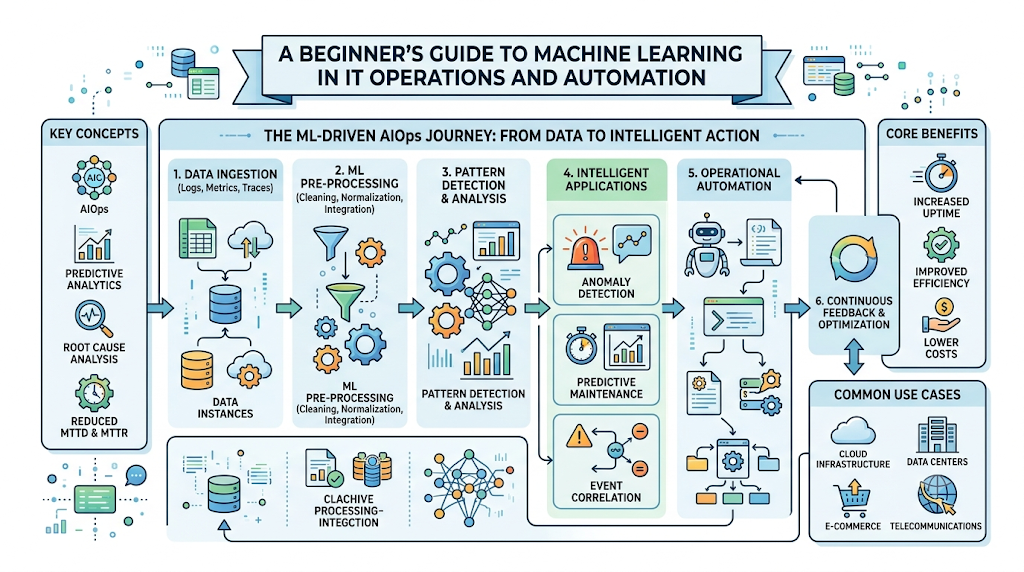
Modern enterprise IT environments are growing at an unprecedented scale. With the rise of multi-cloud architectures, microservices, and continuous deployment pipelines, systems generate billions of data points every single day. Logs, metrics, traces, and alerts flood operations centers constantly, making it physically impossible for human teams to parse through the noise manually. To keep up with this digital explosion, engineering teams are shifting away from traditional, manual oversight. There is a critical, growing need for machine learning to improve IT operations by turning chaotic raw data into actionable, real-time insights. Without algorithmic assistance, modern tech stacks quickly become unmanageable black boxes. This comprehensive guide breaks down how algorithms convert operational noise into structured intelligence. As you navigate your learning journey, platforms like TheAIOps.com serve as an educational learning resource to help professionals master these shifting paradigms.
What Is Machine Learning in IT Operations?
Featured Snippet Definition: Machine Learning in IT Operations is the practice of applying advanced data science models, statistical algorithms, and data engineering patterns to ingest, analyze, and act upon infrastructure data. Its purpose is to automate routine tasks, predict system failures before they impact users, and isolate the root causes of complex software incidents without manual human investigation.
As digital footprints expand, understanding the role of machine learning in IT operations becomes essential for maintaining high availability. This practice sits at the very heart of AIOps (Artificial Intelligence for IT Operations). While traditional monitoring tools simply tell you when a server breaks based on static rules, machine learning answers why it broke, what will break next, and how to fix it automatically.
Core Concepts
Understanding this space requires mastering a few foundational pillars:
- Machine Learning: The use of algorithms that look at historical infrastructure data, find hidden patterns, and make decisions with minimal human intervention.
- AIOps: Short for Artificial Intelligence for IT Operations. It is the broader practice of combining big data, machine learning, and automation to streamline corporate IT tasks.
- Event Correlation: The process of taking thousands of isolated alerts from different servers and linking them together into a single, cohesive narrative.
- Anomaly Detection: Mathematically identifying operational data points that deviate significantly from standard baseline behavior, signaling a potential problem.
- Predictive Analytics: Using historical performance metrics to forecast future resource consumption, capacity bottlenecks, or imminent hardware failures.
- Root Cause Analysis: Investigating a system crash to identify the exact technical trigger that started the domino effect across the infrastructure.
The Role of Machine Learning in IT Operations
[Raw Operational Data] ---> [Machine Learning Models] ---> [Intelligent Actions]
- Application Logs          - Anomaly Detection             - Auto-Scaling Resources
- Network Metrics           - Event Correlation             - Deduplicated Alerts
- Infrastructure Traces     - Predictive Analytics          - Automated Self-Healing
Intelligent Infrastructure Monitoring
Traditional monitoring uses rigid thresholds, such as alerting a team if CPU usage exceeds 85%. However, a database executing a planned batch job on Sunday night might hit 90% CPU normally, while the same database hitting 70% on Tuesday morning could signal a massive application deadlock. Machine learning implements intelligent monitoring by establishing dynamic, fluid baselines that adjust automatically based on time, day, and historical patterns.
Automated Event Correlation
Consider an e-commerce platform during a flash sale. An underlying storage volume fails. Instantly, the database throws errors, the API gateway logs timeouts, the checkout microservice fails, and the frontend displays a 500 error. Instead of flooding engineers with 500 separate alerts for one issue, machine learning algorithms cluster these related events together, presenting the on-call engineer with a single, clear problem ticket.
Detecting Performance Anomalies
An application memory leak often builds up slowly over days, escaping standard tracking tools until the system suddenly runs out of memory and crashes. Machine learning for AIOps continuously scans performance metrics, recognizing subtle, upward trajectories in RAM usage that do not align with natural traffic scaling. It flags these micro-anomalies early, allowing engineers to patch code before users experience slowdowns.
Predicting System Failures
Using predictive analytics, machine learning tracks subtle indicators of physical or virtual degradation. For example, by analyzing disk read-write latency variations and temperature spikes over time in a private cloud data center, the model can predict that a specific hard drive array has an 85% chance of failing within the next 48 hours, triggering an automated maintenance ticket to swap the hardware safely.
Supporting Capacity Planning
Infrastructure management requires balancing budget constraints with application performance. Instead of guessing how many cloud instances to purchase for the next quarter, machine learning analyzes historical seasonal spikes, business growth trends, and compute usage data. This allows it to generate precise capacity models, ensuring companies do not overpay for idle servers or suffer outages from under-provisioning.
Accelerating Root Cause Analysis
When an enterprise application fails, finding the origin point across thousands of interconnected microservices is like finding a needle in a haystack. Machine learning traces dependencies, calculates mathematical probabilities, and highlights the exact configuration change or code deployment that initiated the system degradation, reducing troubleshooting time from hours to seconds.
Reducing Manual Operational Work
Routine maintenance—such as clearing full disk drives, restarting frozen background services, or scaling up Kubernetes clusters during high traffic—consumes valuable engineering time. Machine learning feeds actionable insights directly into automation engines, enabling self-healing loops where the system detects an issue, identifies the solution, and executes the fix completely unattended.
TheAIOps.com Guide to Machine Learning in IT Operations
Understanding AIOps Fundamentals
Transitioning to an intelligent infrastructure requires a firm grasp of how data flows from production servers into algorithmic pipelines. Learning how telemetry data is structured helps engineering teams configure systems that allow machine learning models to ingest, process, and clean data with high efficiency.
Learning Predictive Monitoring
Predictive approaches require moving away from the classic “break-fix” mindset. Teams must learn to interpret confidence scores and probability margins provided by ML models. Understanding these indicators allows engineers to comfortably trust algorithmic flags before an actual system outage occurs.
Improving Incident Response
An ML model is only as effective as the action it triggers. Improving incident response means wiring your machine learning insights directly into modern ticketing systems and communication platforms. This ensures that the right data reaches the right on-call engineer instantly, with full context.
Building Intelligent IT Operations
Building a resilient system requires breaking down silos between data science teams and core systems engineers. Operations teams do not necessarily need to write complex neural networks from scratch, but they must understand how to train, evaluate, and tune standard infrastructure models to handle real-world scenarios.
Scaling Enterprise Infrastructure
As organizations grow from managing dozens of servers to maintaining thousands of cloud-native components, manual oversight becomes impossible. Scaling modern enterprise infrastructure successfully depends on offloading the burden of routine analysis to automated algorithms, allowing human talent to focus on high-level architecture.
Real-World Applications
- Cloud Infrastructure: Auto-scaling groups use machine learning to forecast cloud traffic spikes, spinning up virtual machines minutes before a rush of users arrives, rather than reacting after latency climbs.
- Data Centers: Intelligent cooling systems monitor server rack heat outputs and ambient weather metrics to dynamically adjust HVAC systems, saving millions of dollars in utility costs.
- Financial Services: High-frequency trading applications use anomaly detection to spot microsecond delays in network pipelines, resolving infrastructure friction before it ruins financial transactions.
- Healthcare Systems: Electronic health record networks leverage intelligent monitoring to guarantee zero downtime for critical patient data access across distributed hospital networks.
- Telecommunications: 5G cell towers run local predictive models to distribute user bandwidth loads evenly across regional antennas, preventing localized network congestion.
- E-Commerce Platforms: Massive digital storefronts use automated event correlation during major holiday shopping events to instantly isolate inventory database bugs from payment gateway dropouts.
Benefits of Machine Learning in IT Operations
Faster Incident Detection
By continuously analyzing live streams of telemetry data, machine learning identifies anomalies long before traditional monitoring systems trigger a standard alarm, keeping businesses ahead of impending failures.
Reduced Downtime
Catching anomalies early and predicting hardware failures means your operations team can schedule maintenance during off-peak hours, keeping your customer-facing applications up and running.
Improved Operational Efficiency
Automating event sorting eliminates the grueling process of digging through text-based logs, liberating your engineering teams to focus on building new software features rather than fighting production fires.
Better Resource Utilization
By applying machine learning to IT infrastructure management, companies can eliminate waste, downsize over-provisioned cloud servers, and run lean, green, highly optimized tech deployments.
Enhanced Decision-Making
Instead of relying on gut feelings or frantic guesswork during an active outage, leadership and technical teams get clear, data-driven answers backed by comprehensive historical analysis.
Lower Operational Costs
Fewer major outages, minimized cloud waste, and highly efficient engineering teams directly translate to reduced corporate overhead and protected revenue streams.
Traditional IT Operations vs. Machine Learning-Driven IT Operations
| Feature | Traditional IT Operations | ML-Driven IT Operations |
| Monitoring | Manual, static threshold alerts | Intelligent, dynamic baseline tracking |
| Event Analysis | Rule-Based, prone to human error | Machine Learning clusters and patterns |
| Incident Detection | Reactive, alerting after a crash | Predictive, warning before an outage |
| Root Cause Analysis | Time-Consuming, digging through raw logs | Automated Assistance with deep paths |
| Operational Efficiency | Moderate, bottlenecked by human limits | High, driven by continuous computing |
Common Challenges
Data Quality
- The Challenge: Machine learning models require clean, comprehensive operational data to learn effectively. If your systems output fragmented logs or missing metrics, the models will yield inaccurate results.
- The Recommendation: Implement strict, standardized logging schemas across all software teams and build unified data pipelines to centralize information before passing it to your AIOps platform.
Alert Noise
- The Challenge: If an anomaly detection model is configured too sensitively, it will flag minor, harmless spikes as critical threats, creating a new wave of alert fatigue for engineers.
- The Recommendation: Implement feedback loops within your monitoring dashboard where engineers can mark alerts as “false positives,” allowing the underlying model to adapt and quiet down over time.
Model Accuracy
- The Challenge: Software stacks change constantly due to frequent code updates. A machine learning model trained on last month’s architecture might misinterpret new, intentional application behaviors as errors.
- The Recommendation: Treat your machine learning models like living assets. Set up automated pipelines that retrain models regularly using the most recent weeks of production telemetry data.
Integration Complexity
- The Challenge: Connecting a modern machine learning engine to legacy, on-premise infrastructure often results in complex, fragile software integrations.
- The Recommendation: Adopt a phased approach. Start by routing your data to cloud-friendly, modern observability platforms first, then apply machine learning models to those centralized data streams.
Skills Gap
- The Challenge: Traditional IT operations engineers may not understand data science principles, while data scientists often lack practical systems administration experience.
- The Recommendation: Invest in cross-training initiatives. Use clear, accessible learning platforms like TheAIOps.com to give your systems engineers the practical context they need to manage machine learning tools confidently.
Best Practices
- Collect high-quality operational data: Ensure your metrics, logs, and traces are time-synchronized perfectly across all distributed servers to maintain accurate chronological modeling.
- Continuously monitor ML model performance: Audit your algorithmic predictions against real-world infrastructure outcomes to ensure models remain accurate over long periods.
- Integrate machine learning with observability tools: Do not isolate your AI engine; connect it directly to your core dashboards and telemetry streams for a unified operational view.
- Reduce alert fatigue using intelligent filtering: Set up rules that group duplicate minor events together, passing only validated, contextualized incidents to your on-call response teams.
- Continuously improve operational workflows: Regularly review how your engineers interact with machine learning suggestions, using their practical experience to fine-tune automation rules.
Key Performance Metrics
To prove the return on investment for machine learning in IT operations, track these core metrics:
- Mean Time to Detect (MTTD): How fast your systems spot an anomaly after it starts. ML should bring this number down to minutes or seconds.
- Mean Time to Resolve (MTTR): The average time it takes to fix a production issue. Automated root cause tracking drastically shortens this window.
- Alert Accuracy: The percentage of generated alerts that point to genuine operational problems rather than harmless system noise.
- Incident Volume: The absolute number of separate, high-priority issues escalating to your teams. This should trend downward as predictive maintenance catches issues early.
- Infrastructure Availability: Your overall system uptime percentage. Machine learning helps engineering teams maintain higher availability tiers.
- Operational Efficiency: A measure of how much routine maintenance work is successfully handed off to automated self-healing scripts.
Career Opportunities
The intersection of data science and systems engineering has birthed an array of lucrative, future-proof career paths:
- AIOps Engineer: Specializes in building, tuning, and scaling the machine learning frameworks that monitor enterprise platforms.
- Site Reliability Engineer (SRE): Uses automated code and statistical models to ensure large-scale systems remain highly reliable and fault-tolerant.
- DevOps Engineer: Focuses on streamlining the intersection of software development and system infrastructure using modern automation tools.
- Cloud Operations Engineer: Manages corporate infrastructure assets deployed across multi-cloud environments, optimizing performance and costs.
- Machine Learning Engineer: Designs and deploys the underlying mathematical models that process real-time operations data.
- IT Operations Analyst: Reviews historical platform telemetry to find long-term trends, optimize budgets, and improve team workflows.
Future of Machine Learning in IT Operations
The long-term horizon for operations engineering points toward fully Autonomous IT Operations. In this future ecosystem, infrastructures will become entirely self-healing environments. If a regional network data link breaks, the underlying AI will instantly re-route global application traffic, spin up backup nodes, patch the software bugs, and file a detailed incident report for human review—all without waking up an engineer in the middle of the night.
Additionally, we will see deep, AI-powered observability platforms that do not just display dashboard charts, but communicate naturally with engineers, explaining architectural problems via conversational text and generating verified fix scripts on the fly.
Common Misconceptions
Machine Learning Replaces IT Professionals
- The Reality: Machine learning is built to eliminate boring, repetitive tasks like digging through text files and sorting spam alerts. It handles the manual labor, empowering human engineers to spend their time designing better, more creative system architectures.
AIOps Is Only for Large Enterprises
- The Reality: While massive tech companies pioneered this space, mid-sized businesses and growing startups can easily implement out-of-the-box machine learning for AIOps through modern, affordable cloud observability tools.
Machine Learning Eliminates Every Alert
- The Reality: Machine learning filters out the noise and groups duplicates, but it does not completely delete alerts. Its goal is to deliver highly accurate, contextual alerts so your engineers know exactly where to look.
AI Works Without High-Quality Data
- The Reality: An AI model is only as smart as the data you feed it. If your infrastructure documentation is messy and your logs are unformatted, your machine learning insights will be equally unreliable.
FAQ Section
- What is the difference between traditional monitoring and AIOps?
Traditional monitoring relies heavily on rigid, human-defined thresholds that generate alerts after something breaks. AIOps utilizes machine learning to continuously analyze data trends, adaptively track changing system patterns, and predict infrastructure failures before they impact end-users.
- How does machine learning reduce alert fatigue for operations teams?
Machine learning models ingest thousands of disparate, noisy alerts from different software layers and correlate them automatically based on timing and system dependencies. This condenses hundreds of redundant alarms into a single, cohesive incident package for the engineer.
- Can small companies benefit from machine learning in IT operations?
Yes, small companies can easily leverage machine learning advantages by utilizing modern, SaaS-based observability tools that have pre-trained algorithmic models built into their core platforms, eliminating the need to hire a dedicated data science team.
- What types of data do machine learning models look at in IT operations?
These models process three primary types of telemetry data: metrics (such as CPU, memory, and network throughput speeds), logs (structured or unstructured text outputs generated by applications), and traces (the end-to-end journey of a user request through microservices).
- Do I need to be a data scientist to use machine learning for AIOps?
No, modern AIOps platforms provide intuitive, user-friendly dashboards and automated configurations that abstract away the complex mathematical algorithms, allowing systems administrators and DevOps engineers to operate them with ease.
- What is dynamic thresholding in intelligent monitoring?
Dynamic thresholding is a machine learning feature that calculates normal infrastructure performance baselines by studying historical habits, adjusting its alert parameters automatically based on temporal factors like hour, day of the week, or seasonal demand shifts.
- How does predictive analytics help with enterprise capacity planning?
Predictive analytics models scan historical resource usage data to project future computing demand patterns, giving engineering managers clear, data-backed insights on when to purchase additional server capacity or downsize idle instances to save money.
- What does self-healing infrastructure mean?
Self-healing infrastructure refers to an automated setup where a machine learning engine detects an anomaly, identifies the root cause, and immediately executes a targeted remediation script—such as restarting a leaked service—without human intervention.
- How often should machine learning models for IT operations be retrained?
Models should be retrained regularly—often weekly or monthly—depending on how fast your underlying software code changes. Frequent retraining ensures the machine learning algorithm understands your updated application behavior and infrastructure architecture.
- Where can I learn more about using machine learning for AIOps?
Educational platforms such as TheAIOps.com offer comprehensive, approachable learning resources, conceptual guides, and industry articles designed to help technology enthusiasts and enterprise professionals master the fundamentals of intelligent IT automation.
Final Summary
The modern scale of enterprise tech deployments has pushed traditional, manual IT management strategies beyond their functional limits. Today, understanding the role of machine learning in IT operations is no longer an optional advantage—it is a foundational requirement for survival in a cloud-first landscape. By converting chaotic, high-volume telemetry data into predictable, actionable, and correlated insights, machine learning empowers engineering teams to build resilient, self-healing software infrastructures. As platforms evolve and computing complexities grow, educational platforms like TheAIOps.com remain dedicated to helping engineers, students, and technology leaders build a strong foundational grasp of automated operations. Embracing these advanced methodologies ensures your organization minimizes costly downtime, keeps pace with rapid software delivery cycles, and operates with maximum efficiency.
