Upgrade & Secure Your Future with DevOps, SRE, DevSecOps, MLOps!
We spend hours scrolling social media and waste money on things we forget, but won’t spend 30 minutes a day earning certifications that can change our lives.
Master in DevOps, SRE, DevSecOps & MLOps by DevOps School!
Learn from Guru Rajesh Kumar and double your salary in just one year.
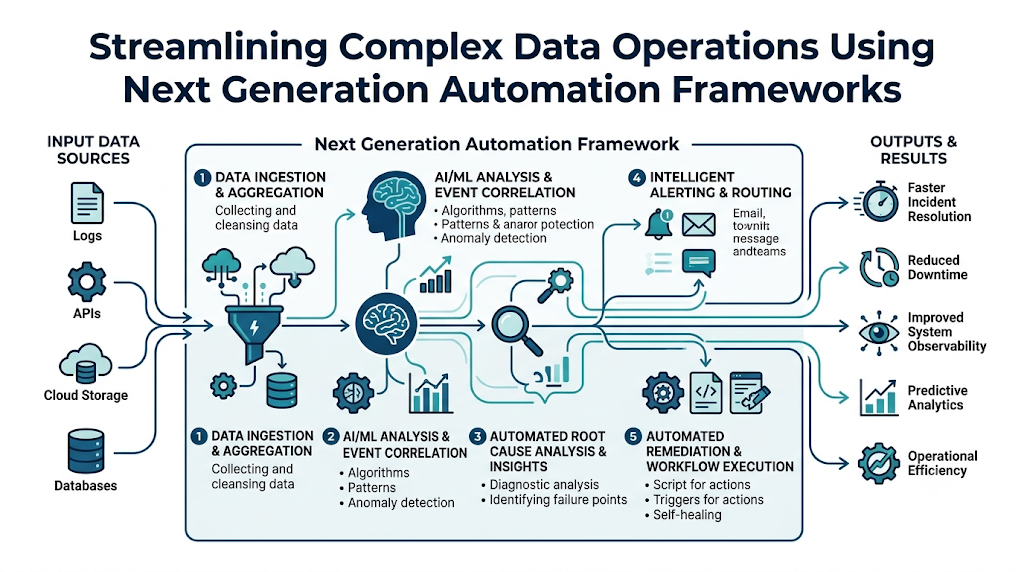
In the modern enterprise landscape, traditional IT operations (ITOps) are hitting a breaking point. The rapid evolution of multi-cloud architectures, microservices, and hybrid infrastructure has created an unprecedented volume of data. Operations teams are constantly bombarded with logs, metrics, traces, and alerts, leading to severe alert fatigue and extended Mean Time to Resolution (MTTR). By applying intelligent automation to IT operations, enterprises can shift from reactive troubleshooting to proactive optimization. This comprehensive guide outlines the operational framework of AIOps, explores core features, and provides a vendor-neutral review of top industry platforms to help architectural leaders make informed deployment decisions. For additional context on implementation strategies, readers can review comprehensive insights on the dynamic capabilities of modern enterprise automation directly at TheAIOps.com.
What Is AIOps?
AIOps, a term originally coined by Gartner, stands for Artificial Intelligence for IT Operations. It represents the intersection of big data, machine learning, and automation to enhance and partially replace traditional ITOps processes.
[Telemetry Data] + [Machine Learning] ---> [Event Correlation] ---> [Automated Remediation]
At its core, AIOps functions by collecting vast quantities of data from disparate IT environments and analyzing it to extract actionable insights.
Core Concepts of AIOps
- Big Data Ingestion: Aggregating unstructured and structured telemetry data—including logs, metrics, network packets, and API traces—into a unified analytical layer.
- Machine Learning (ML): Applying mathematical algorithms to establish historical baselines, identify behavioral anomalies, and forecast system capacity trends.
- Automation: Executing algorithmic or scripted responses to known operational conditions without human intervention, thereby streamlining the lifecycle of system events.
By inserting artificial intelligence directly into the operations pipeline, IT organizations transition away from static, threshold-based monitoring toward dynamic, context-aware systems that adapt to shifting system behaviors in real time.
What Is IT Operations Automation?
IT operations automation refers to the practice of using software tools to execute repeatable processes, manage infrastructure, and resolve system anomalies with minimal human intervention.
Historically, infrastructure management relied heavily on manual processes. Sysadmins manually inspected system dashboards, executed diagnostic scripts via command-line interfaces, and filed manual incident response tickets when components failed.
Manual vs. Automated Operations
- Manual Operations: Characterized by slow response times, human configuration errors, siloed engineering teams, and high operational overhead.
- Automated Operations: Defined by rapid event detection, programmatic configuration management, standardized incident paths, and systemic consistency.
Business Value
The primary business value of IT operations automation lies in operational scale and risk reduction. By offloading routine maintenance tasks—such as software patching, log rotation, and server provisioning—to software agents, engineering resources are freed up to focus on core product architecture. Furthermore, eliminating manual configuration loops significantly reduces human error, which remains a leading cause of production downtime.
Why Organizations Need AIOps
As enterprises adopt cloud-native technologies, their operational footprints expand exponentially. Traditional monitoring tools, built for static on-premises data centers, fail to maintain visibility over highly dynamic environments.
+-------------------------------------------------------------+
|               Why Organizations Need AIOps                  |
+-------------------------------------------------------------+
|  1. Infrastructure Complexity (Microservices & Kubernetes)  |
|  2. Rapid Cloud Ingestion and Hybrid Implementations        |
|  3. Explosive Telemetry Volumes (Logs, Traces, Metrics)      |
|  4. Rising Need for Near-Zero Incident Response Times       |
|  5. Driving Operational Efficiency & Eliminating Waste      |
+-------------------------------------------------------------+
Organizations require AIOps to address several critical modern challenges:
- Increasing Infrastructure Complexity: Modern applications run on containerized clusters (e.g., Kubernetes) distributed across thousands of ephemeral nodes, generating highly fragmented environments.
- Cloud Adoption & Hybrid Environments: Managing split architectures that cross legacy on-premises mainframes and public cloud ecosystems requires a centralized layer capable of normalizing disparate data formats.
- Large-Scale Telemetry Ingestion: The sheer volume of telemetry data generated per second exceeds human processing capacity. AIOps tools act as intelligence filters, reducing noise.
- Faster Incident Response: Customers demand near-continuous availability. AIOps allows teams to catch degradations before they impact end-user transaction loops.
- Operational Efficiency: Eliminating duplicate alerts reduces the burden on on-call engineers, preventing burnout and decreasing team operational overhead.
How AIOps Automates IT Operations
The transformation of raw system data into an automated fix follows a structured, continuous pipeline. This automated workflow operates through several progressive stages:
[Data Ingestion]
       │
       ▼
[Log Aggregation] ──► [Event Correlation] ──► [AI / ML Analysis]
                                                      │
                                                      ▼
[Automated Fix] ◄── [Intelligent Alerts] ◄── [Root Cause Identification]
Step 1: Data Ingestion and Log Aggregation
The platform continuously streams metrics, logs, configuration files, and tracing telemetry from servers, networks, databases, and application entry points into a high-throughput data repository.
Step 2: Event Correlation and Suppression
The platform deduplicates incoming signals. For example, if a database failure triggers 500 downstream application alerts, the AIOps framework suppresses the redundant alerts and groups them into a single, cohesive parent incident.
Step 3: AI Analysis and Root Cause Detection
Machine learning algorithms evaluate the correlated incident data against baseline models. The system tracks dependencies across application components to isolate the specific root cause—such as a corrupted configuration file or a faulty memory leak—rather than just reporting the symptoms.
Step 4: Predictive Analytics and Intelligent Alerting
By calculating data trajectories, the system predicts potential capacity issues or node failures before they occur, routing a context-rich alert to the relevant engineering squad along with suggested mitigation steps.
Step 5: Automated Remediation
In mature implementations, the system initiates programmatic scripts (e.g., executing an Ansible playbook or trigger webhooks) to fix the problem automatically, such as restarting a dead service or scaling a cluster, closing the incident loop without manual on-call intervention.
Core Features of Modern AIOps Tools
Enterprise-grade AIOps platforms must possess a comprehensive suite of capabilities to deliver measurable operational outcomes:
- Real-Time Event Correlation: Intelligent clustering algorithms that analyze context, timing, and structural topology to group distinct alerts into logical incidents.
- Advanced Log Analytics: The capability to parse unstructured textual log formats at scale, highlighting unusual log lines or string errors automatically.
- Dynamic Anomaly Detection: Replacing fixed thresholds with algorithmic baselines that adjust dynamically based on temporal factors like time of day, weekly cycles, or seasonal demand spikes.
- Predictive Maintenance Models: Algorithmic forecasting engines that analyze disk wear, memory exhaustion, or storage limits to provide advance warnings.
- Topological Root Cause Analysis: Mapping physical and logical infrastructure dependencies to trace the exact lineage of an outage down to the specific microservice or hardware component.
- Intelligent Routing and Alerting: Integration with operational directories to route high-priority tickets to the exact engineer on call, enriching alerts with diagnostic logs.
- Self-Healing Actions: Native runtime integrations that support event-driven scripts to automatically address common infrastructure faults.
- Unified Observability Dashboards: Single-pane-of-glass user interfaces that bring together multi-vendor metrics, operational health scores, and business transaction paths.
Recommended AIOps Tools
Selecting an appropriate platform requires understanding how different tools address specific architecture requirements. The following educational overviews detail widely used corporate AIOps solutions.
ServiceNow ITOM
- Overview: An enterprise-scale cloud operations management solution that extends traditional IT Service Management (ITSM) tracking into active infrastructure orchestration.
- Key Features: Automated Service Mapping, machine learning discovery engines, predictive intelligence routing, and central configuration databases (CMDB).
- Advantages: Native synchronization between incident management workflows and real-time operational alerts. Excellent dependency mapping capabilities.
- Limitations: Complex deployment phases requiring substantial professional integration services; high entry costs.
- Best For: Large enterprises seeking to unify infrastructure monitoring directly with structured IT ticket management systems.
Dynatrace
- Overview: A comprehensive, full-stack observability platform built around its proprietary Davis AI deterministic processing engine.
- Key Features: Automated dependency discovery (Smartscape), continuous full-stack root cause analysis, application security checking, and cloud-native code tracing.
- Advantages: Zero-configuration anomaly detection that pinpoints precise failure dependencies automatically without relying on broad statistical correlation.
- Limitations: Subscription costs can escalate rapidly as infrastructure footprints expand; complex feature customization interfaces.
- Best For: Distributed organizations running complex, microservice-heavy Kubernetes applications across multi-cloud infrastructure.
Splunk IT Service Intelligence (ITSI)
- Overview: A machine learning-powered analytics solution built on top of Splunk’s widely adopted log collection engine.
- Key Features: Service health monitoring scores, predictive anomaly forecasting thresholds, large-scale log analysis, and custom operational dashboarding engines.
- Advantages: Unrivaled capabilities for deep forensic investigations across large volumes of unstructured textual log data.
- Limitations: High resource requirements for index management; significant administrative effort needed to tune custom dashboards.
- Best For: Data-driven enterprises already relying heavily on Splunk for log centralization that need an overlay for operational event intelligence.
Datadog AIOps
- Overview: An observability platform that integrates machine learning workflows seamlessly into a unified software monitoring toolset.
- Key Features: Watchdog AI automated analysis, log and metric correlation, outlier detection algorithms, and cloud integration hooks.
- Advantages: Fast deployment via lightweight, unified collection agents; rapid time-to-value for modern engineering groups.
- Limitations: Long-term log storage costs can be high; feature sets update quickly, requiring ongoing configurations.
- Best For: Agile engineering teams and DevOps organizations looking for cloud-native infrastructure monitoring combined with built-in AI insights.
BigPanda
- Overview: A specialized AIOps platform focused entirely on event correlation, alert noise reduction, and central operational routing.
- Key Features: Open Integration Hub architecture, algorithmic alert clustering, topological data parsing, and root cause insight generation.
- Advantages: Agnostic data processing that aggregates signals from hundreds of third-party monitoring tools without forcing platform lock-in.
- Limitations: Lacks native telemetry collectors; depends entirely on existing third-party monitoring systems to feed it data.
- Best For: Large enterprises with fragmented legacy monitoring toolsets that need a central engine to reduce noise and orchestrate alert flows.
Top AIOps Tools Comparison
The following table provides a matrix comparing the operational profiles, primary features, and targeted deployment cases for these platforms:
| Tool | Deployment Model | Major Features | Best For | Limitations |
| ServiceNow ITOM | Hybrid Cloud / SaaS | Service Mapping, CMDB Integration, Native ITSM Routing | Large Corporate ITSM Alignments | High Upfront Costs & Setup Complexity |
| Dynatrace | SaaS / Managed On-Prem | Davis AI Engine, Smartscape Topology, Code Tracing | Complex Multi-Cloud Microservices | Premium Pricing Model at Scale |
| Splunk ITSI | SaaS / On-Premises | Predictive Analytics, Service Health Scores, Log Mining | Log Analytics & Forensic Analysis | High Infrastructure Index Costs |
| Datadog AIOps | SaaS Only | Watchdog Anomaly Detection, Unified Tracing, Metric Alerts | Cloud-Native DevOps Environments | Variable Multi-Variable Cost Scale |
| BigPanda | SaaS Only | Alert Deduplication, Agnostic Event Correlation | Consolidating Multi-Tool Monitoring | Fully Dependent on Third-Party Data |
Traditional IT Operations vs. AIOps
This table contrasts the architectural paradigms of legacy systems with modern, AI-driven approaches:
| Feature | Traditional IT Operations | AIOps | Business Impact |
| Alerting Baseline | Static, manual threshold rules. | Dynamic, algorithmic behavior tracking. | Eliminates false-positive operational noise. |
| Issue Analysis | Manual log inspection across silos. | Algorithmic topology root cause isolation. | Drastically drops Mean Time to Resolution (MTTR). |
| Operational Stance | Reactive posture post-outage. | Proactive and predictive forecasting. | Prevents systemic service interruptions. |
| Data Processing | Fragmented tools, isolated views. | Centralized stream data aggregation. | Complete visibility across the enterprise stack. |
| Incident Response | Human routing and script execution. | Automated workflow orchestration. | Minimizes operational overhead and human error. |
Benefits of Using AIOps Tools
Implementing an AIOps framework yields several core technical and business advantages:
- Faster Incident Resolution: By pointing directly to the structural root cause of an issue, AIOps eliminates hours of manual diagnostic triage, helping teams resolve incidents much faster.
- Reduced Systems Downtime: Predictive alerting models identify operational capacity limits or hardware faults early, letting teams fix issues before they cause customer-facing outages.
- Improved Engineering Productivity: Automating alert filtering and grouping shields engineering teams from alert fatigue, allowing them to focus on high-priority design tasks rather than sorting through operational noise.
- Enhanced Customer Experiences: Near-continuous application uptime and consistent response times directly protect user transaction paths and preserve digital service revenue.
- Lower Total Operational Costs: Automating routine tasks and optimizing resource distribution minimizes waste, helping enterprises lower overall operational expenses.
Common Challenges
Despite the clear benefits, integrating artificial intelligence into enterprise operations comes with several real-world challenges:
- Integration Complexity: Legacy enterprise components and custom software engines often lack standardized API structures, making initial data collection and integration difficult.
- Poor Telemetry Data Quality: Machine learning systems rely heavily on the quality of their input data. Fragmented, missing, or misconfigured application logging standards can break correlation models.
- Legacy System Resistance: Older on-premises applications may not support continuous data streaming, requiring custom collection pipelines or middle-layer adapters.
- High Initial Investments: The total cost of buying licenses, training staff, and setting up complex software platforms can be high for smaller companies.
- Internal Skills Gap: Managing an AIOps framework requires engineers who understand both traditional systems administration and foundational data science principles.
- AI Trust Issues: Teams are often hesitant to hand over control to automated systems, preferring manual sign-offs before allowing scripts to modify production infrastructure.
Best Practices
To overcome these roadblocks, deployment teams should follow these implementation guidelines:
- Define a Narrow Initial Scope: Avoid trying to automate the entire enterprise environment at once. Start by applying AIOps to a single application line or one specific Kubernetes cluster.
- Standardize Enterprise Logging Practices: Enforce uniform structural logging models (such as JSON layouts) across internal software teams to ensure clean data ingestion.
- Implement Gradual Automation Loops: Build confidence by running remediation scripts in advisory mode first—where the AI recommends a fix for human approval—before enabling full, automated self-healing.
- Keep the Topology Map Updated: Regularly update configuration management rules to ensure the AI engine uses accurate application dependency maps.
- Invest in Ongoing Training: Provide operations teams with targeted training on data analysis and automated script design to bridge the internal skills gap.
Real-World Enterprise Use Cases
Banking Sector
A global retail banking group implemented event correlation tools to process alerts across its core transaction ledger. By grouping thousands of duplicate database queries, the engineering team reduced alert volume by 85% and successfully prevented transaction processing slowdowns during peak hours.
Healthcare Systems
A regional hospital network used predictive analytics to monitor telemetry streams from patient scheduling and digital record systems. The platform flagged memory leaks in the primary database hours ahead of time, allowing engineers to patch the system safely without disrupting medical staff access.
Cloud Providers
A multi-region logistics platform deployed real-time anomaly detection to manage variable server scaling. The AIOps system automated node provisioning during unexpected traffic surges, keeping web APIs responsive without requiring intervention from on-call personnel.
Telecommunications
A telecom provider utilized automated root cause mapping across its network routing hardware. When a core fiber line failed, the platform automatically isolated the downstream switch disruptions and rerouted traffic, protecting data connections for millions of active users.
E-Commerce Operations
An international online retailer integrated full-stack tracing tools ahead of a major seasonal sale. The AI engine automatically caught database deadlocks during checkout loops and modified scaling groups, preserving customer purchases without manual troubleshooting delays.
Manufacturing Logistics
An industrial manufacturing facility deployed AIOps data collectors to monitor its supply chain warehouse hardware. By tracking telemetry patterns, the platform predicted storage server drive failures in advance, enabling maintenance teams to replace hardware during planned downtime.
Future Trends
The AIOps space continues to evolve rapidly, driven by several key technology shifts:
- Agentic AI Integration: Modern AIOps platforms are moving beyond basic statistical anomaly detection toward agentic AI models capable of building custom, step-by-step remediation plans.
- Autonomous IT Operations: Systems are shifting toward fully autonomous execution, where platforms manage infrastructure updates, provisioning, and self-healing with minimal human oversight.
- Intelligent Observability Architectures: Future tools will automatically deploy and tune their own collection agents based on shifting application loads, removing the need for manual monitoring setups.
- Natural Language Operations (ChatOps): AI assistants are increasingly integrated into team collaboration spaces, allowing engineers to query system status and trigger fixes using natural language.
FAQs
Q1: What is the main difference between standard IT monitoring and AIOps?
A1: Standard monitoring simply collects data and triggers alerts based on static, manual thresholds. AIOps applies machine learning to analyze that data, group related events, find root causes, and automate fixes.
Q2: Can AIOps tools completely replace human operations teams?
A2: No. AIOps tools are designed to automate routine tasks, filter out alert noise, and assist engineers, allowing human teams to focus on complex architecture decisions rather than basic troubleshooting.
Q3: How does alert deduplication work within large enterprise networks?
A3: AIOps platforms use machine learning to look at alert timing, error messages, and system relationships, grouping hundreds of related alerts down into a single, actionable root cause ticket.
Q4: Is AIOps suitable for small infrastructure footprints?
A4: While smaller organizations can use AIOps, the technology provides the highest value in large, complex environments where the volume of data has outgrown human management capabilities.
Q5: What is Mean Time to Resolution (MTTR), and how does AI affect it?
A5: MTTR measures the average time it takes to fix a system failure. AIOps reduces this metric by pointing engineers directly to the root cause of an issue, cutting out hours of manual debugging.
Q6: Can AIOps software run on legacy on-premises systems?
A6: Yes, most enterprise platforms use middleware or custom APIs to pull logs from older systems, allowing organizations to monitor hybrid environments from a single dashboard.
Q7: What is dynamic thresholding in system performance monitoring?
A7: Dynamic thresholding uses machine learning to set flexible baselines that adapt to normal usage patterns—like regular daytime traffic peaks or weekend drops—instead of relying on fixed limits.
Q8: How do automated remediation workflows handle security access?
A8: Remediation platforms integrate with secure access management systems, running predefined operational scripts using limited, audited service privileges to ensure safety.
Q9: What data types do AIOps platforms require to work effectively?
A9: AIOps systems yield the best results when they ingest full-stack telemetry data, including system metrics, application logs, network packets, and execution traces.
Q10: Are cloud-native AIOps tools secure enough for regulated industries?
A10: Yes. Major enterprise platforms maintain compliance certifications like SOC2, ISO 27001, and HIPAA, providing data encryption and strict access controls for sensitive sectors like healthcare and finance.
Conclusion
AIOps has evolved from an emerging trend into a core element of modern enterprise infrastructure. By combining big data, machine learning, and automated workflows, these tools help organizations turn massive amounts of telemetry noise into clear, actionable insights. This shift allows IT teams to move away from constant firefighting and adopt a proactive, efficient approach to system reliability. Choosing the right platform is not a one-size-fits-all decision. The best choice depends on your organization’s size, existing tools, architecture complexity, and automation goals. Whether you need a deep tracing tool like Dynatrace for distributed systems or a central coordinator like BigPanda to connect existing platforms, the goal remains the same: building a scalable, reliable, and intelligent automation engine.
