Upgrade & Secure Your Future with DevOps, SRE, DevSecOps, MLOps!
We spend hours scrolling social media and waste money on things we forget, but won’t spend 30 minutes a day earning certifications that can change our lives.
Master in DevOps, SRE, DevSecOps & MLOps by DevOps School!
Learn from Guru Rajesh Kumar and double your salary in just one year.
Introduction
Asset Tracking RFID Software helps organizations identify, monitor, and manage physical assets using RFID tags, readers, antennas, mobile scanners, and software dashboards. In simple words, it lets teams know what asset they have, where it is, who used it, when it moved, and whether it is available, missing, damaged, or due for maintenance.
This matters more in modern operations because businesses are managing more equipment, tools, inventory, vehicles, IT assets, medical devices, returnable containers, warehouse items, and high-value materials across multiple locations. Manual tracking through spreadsheets, paper logs, or barcode-only systems can create errors, delays, asset loss, and poor visibility.
Common use cases include tracking warehouse inventory, managing hospital equipment, monitoring manufacturing tools, controlling IT assets, tracking construction equipment, managing returnable containers, and improving supply chain visibility.
Buyers should evaluate RFID hardware compatibility, mobile app quality, real-time visibility, asset history, reporting, integration options, scalability, data accuracy, security controls, implementation effort, and total cost.
Best for: Operations leaders, warehouse managers, facility managers, IT asset managers, healthcare equipment teams, manufacturers, logistics companies, construction businesses, retail operations, and enterprises managing high-value or high-volume assets.
Not ideal for: Very small teams with only a few assets, businesses that only need simple barcode labels, or organizations that do not need location visibility, movement tracking, or automated asset scanning.
Key Trends in Asset Tracking RFID Software
- Real-time asset visibility is becoming standard: Businesses increasingly want live or near-real-time visibility instead of periodic manual inventory checks.
- AI-powered asset intelligence: Advanced systems are starting to use AI to detect usage patterns, missing asset risks, unusual movement, and replenishment needs.
- RFID plus IoT convergence: RFID tracking is becoming more connected with IoT sensors, BLE tags, GPS devices, environmental sensors, and smart gateways.
- Mobile-first asset audits: Teams now expect mobile apps for asset scanning, location updates, maintenance checks, and instant verification from the field.
- Hybrid tracking models: Many organizations are combining RFID with barcode, QR code, BLE, GPS, and NFC tracking depending on asset type and location.
- Stronger compliance and audit trails: Healthcare, manufacturing, government, logistics, and regulated industries need better proof of asset movement, custody, and usage history.
- Cloud-based asset tracking growth: Cloud deployment is increasing because it supports multi-site access, faster rollout, and easier reporting across locations.
- ERP and warehouse system integration: RFID asset tracking is increasingly connected with ERP, WMS, CMMS, procurement, finance, and supply chain platforms.
- More focus on loss prevention: Companies are using RFID software to reduce theft, misplaced assets, duplicate purchases, and unnecessary rentals.
- Flexible pricing models: Vendors commonly price based on users, assets, locations, hardware, modules, implementation services, or enterprise requirements.
How We Selected These Tools
The following tools were selected using a practical SaaS and asset tracking software evaluation approach:
- Recognition and adoption in RFID, asset tracking, inventory, or enterprise asset management categories
- Strength of RFID tracking, asset visibility, scanning, and reporting features
- Support for different business sizes, from small teams to enterprise operations
- Compatibility with mobile devices, RFID readers, scanners, tags, and related hardware
- Ability to support asset history, location tracking, audits, and lifecycle management
- Integration potential with ERP, WMS, CMMS, ITSM, finance, procurement, and operations tools
- Fit for industries such as manufacturing, healthcare, warehousing, logistics, construction, retail, and facilities
- Security posture signals such as user roles, access permissions, audit logs, and administrative controls
- Support, onboarding, documentation, and implementation assistance
- Practical value for organizations replacing spreadsheets, manual asset registers, or disconnected tracking systems
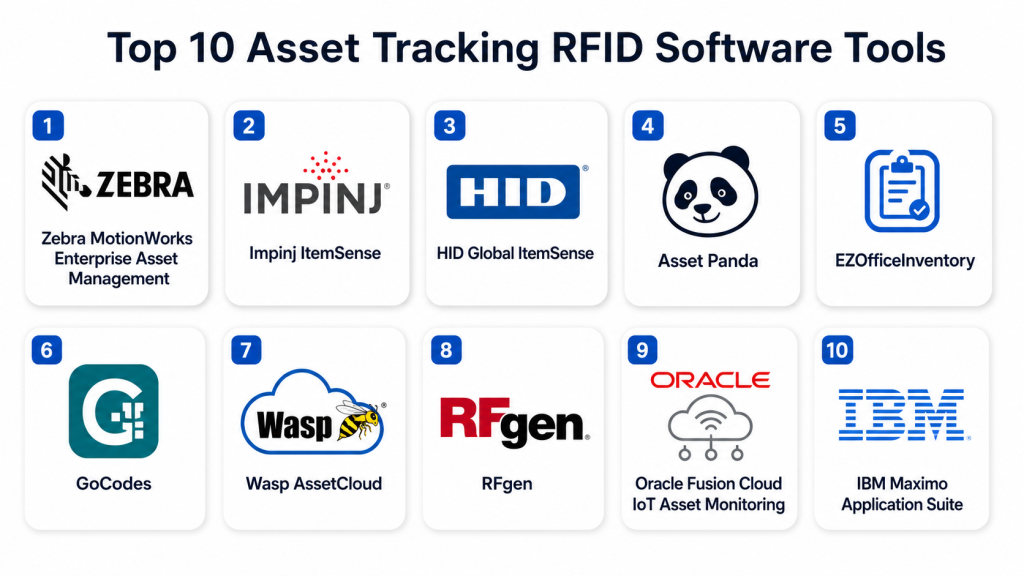
Top 10 Asset Tracking RFID Software Tools
#1 — Zebra MotionWorks Enterprise Asset Management
Short description:
Zebra MotionWorks Enterprise Asset Management is designed for organizations that need advanced asset visibility using RFID and real-time location technologies. It is especially useful for warehouses, manufacturing plants, healthcare facilities, logistics teams, and large enterprises that manage high-value or high-volume assets. The platform helps teams track asset movement, improve utilization, reduce search time, and support operational visibility. It works well where RFID hardware, scanners, tags, and location data are part of daily operations. Zebra is a strong option for businesses that need enterprise-grade RFID tracking supported by a broad hardware ecosystem.
Key Features
- RFID-based asset tracking and visibility
- Support for enterprise asset movement monitoring
- Integration with Zebra RFID hardware and devices
- Location and utilization tracking
- Asset status and event history
- Reporting and operational dashboards
- Support for complex multi-site environments
Pros
- Strong fit for enterprise RFID environments
- Broad hardware ecosystem for scanning and tracking
- Useful for high-volume and high-value asset operations
Cons
- May require professional implementation
- Can be more complex than simple asset tracking tools
- Best suited for organizations ready to invest in RFID infrastructure
Platforms / Deployment
Web / Mobile support may vary
Cloud / Hybrid / Varies by implementation
Security & Compliance
Enterprise access controls and administrative features may be available depending on deployment and configuration. Specific certifications such as SOC 2, ISO 27001, GDPR, or HIPAA should be verified directly with the vendor. If not confirmed, use Not publicly stated.
Integrations & Ecosystem
Zebra MotionWorks fits well in environments where RFID hardware, scanners, enterprise systems, and operational workflows need to work together.
- Zebra RFID readers and mobile devices
- ERP and WMS integration possibilities
- Enterprise asset and operations systems
- APIs or integration options may vary
- Supports asset visibility across complex locations
Support & Community
Zebra has a mature enterprise hardware and software ecosystem with implementation partners, support resources, and documentation. Support depth depends on product package, contract, region, and deployment model.
#2 — Impinj ItemSense
Short description:
Impinj ItemSense is an RFID software platform focused on connecting, managing, and interpreting RFID reader data for asset and inventory visibility. It is useful for organizations that need to collect RFID events from connected readers and turn those events into actionable asset location and movement information. The platform is often considered in retail, supply chain, logistics, manufacturing, and warehouse environments. It is especially relevant when teams need reliable RFID infrastructure and item-level visibility. Impinj is a strong option for businesses building RFID solutions around reader networks and tagged assets.
Key Features
- RFID reader connectivity and management
- Item-level visibility through RFID event data
- Asset and inventory movement tracking
- RFID infrastructure management
- Data filtering and event processing
- Enterprise integration support
- Useful for supply chain and warehouse visibility
Pros
- Strong RFID-focused technology foundation
- Useful for item-level visibility use cases
- Good fit for organizations building RFID-driven systems
Cons
- May require technical implementation expertise
- Not a lightweight plug-and-play asset tool
- Best suited for RFID-focused environments
Platforms / Deployment
Web / Varies by implementation
Cloud / Self-hosted / Hybrid options may vary
Security & Compliance
Security features may depend on deployment and integration architecture. Specific certifications and compliance details should be verified directly with the vendor. If not confirmed, use Not publicly stated.
Integrations & Ecosystem
Impinj ItemSense is designed to work within RFID ecosystems where reader data needs to connect with asset, inventory, warehouse, and enterprise systems.
- RFID reader management
- Enterprise integration possibilities
- Supply chain and warehouse data workflows
- API or data export options may vary
- Supports RFID event processing
Support & Community
Impinj has a strong RFID technology ecosystem and partner network. Support and implementation assistance may depend on vendor engagement, solution partners, and deployment complexity.
#3 — HID Global ItemSense
Short description:
HID Global ItemSense is an RFID software platform designed to help organizations track assets, inventory, and tagged items with better visibility and automation. It supports RFID-enabled workflows where businesses need to monitor item movement, improve inventory accuracy, and reduce manual tracking effort. The platform can be useful in manufacturing, logistics, healthcare, retail, and enterprise asset environments. It is a strong option for organizations that already use or plan to use RFID infrastructure at scale. ItemSense helps convert RFID reads into useful operational information.
Key Features
- RFID item and asset tracking
- Reader and event data management
- Inventory visibility and movement tracking
- Support for RFID-enabled workflows
- Asset history and item-level insights
- Enterprise integration potential
- Useful for operational visibility and automation
Pros
- Strong RFID-focused platform
- Useful for organizations needing automated tracking
- Good fit for item-level visibility requirements
Cons
- Implementation may require RFID expertise
- May be more advanced than simple asset tracking needs
- Hardware and integration planning are important
Platforms / Deployment
Web / Varies by implementation
Cloud / Hybrid / Varies by offering
Security & Compliance
Security and compliance capabilities should be verified directly with the vendor based on deployment model and industry needs. If not confirmed, write Not publicly stated.
Integrations & Ecosystem
HID Global ItemSense can support RFID ecosystems where asset and item data need to connect with enterprise operations.
- RFID readers and tag ecosystems
- ERP, WMS, and operations system connectivity
- Data integration options may vary
- RFID event processing
- Asset and inventory visibility workflows
Support & Community
HID Global has a broad identity, RFID, and tracking technology ecosystem. Support depends on product scope, implementation partner, region, and enterprise agreement.
#4 — Asset Panda
Short description:
Asset Panda is a flexible asset tracking platform that can support barcode, QR code, and RFID-related workflows depending on configuration and implementation. It is designed for teams that need customizable asset records, mobile access, maintenance history, check-in/check-out workflows, and audit visibility. Asset Panda is suitable for IT teams, schools, healthcare organizations, construction companies, facilities, and operations teams managing many asset types. It is especially useful when asset tracking needs are broader than RFID alone. The platform gives teams flexibility to design workflows around their assets and processes.
Key Features
- Asset tracking and lifecycle records
- Custom fields and configurable workflows
- Mobile asset lookup and updates
- Barcode, QR code, and RFID-related tracking support may vary
- Check-in/check-out workflows
- Maintenance and service history
- Reporting and audit visibility
Pros
- Highly flexible asset tracking structure
- Useful across many asset categories
- Good mobile experience for field updates
Cons
- RFID depth should be validated before purchase
- May require configuration to match business workflows
- Not always a dedicated RFID-only platform
Platforms / Deployment
Web / iOS / Android
Cloud
Security & Compliance
User permissions and administrative controls may be available. Specific certifications such as SOC 2, ISO 27001, GDPR, or HIPAA should be verified directly with the vendor. If not confirmed, use Not publicly stated.
Integrations & Ecosystem
Asset Panda can support teams that need asset data to connect with reporting, operations, and business workflows.
- API availability may vary
- Barcode and QR workflows
- RFID-related support should be validated
- Reporting exports
- Integrations with business systems may vary
Support & Community
Asset Panda provides onboarding and support resources. Buyers should confirm implementation help, training options, data import support, and response expectations before rollout.
#5 — EZOfficeInventory
Short description:
EZOfficeInventory is an asset tracking and inventory management platform designed for businesses that need to manage equipment, tools, IT assets, rentals, and shared resources. It supports asset reservations, check-ins, check-outs, maintenance records, inventory visibility, and mobile scanning workflows. The platform is useful for schools, offices, construction teams, event teams, IT departments, and operations teams. RFID support and hardware compatibility should be validated based on the buyer’s specific use case. It is a practical choice for teams that need structured asset management with inventory and equipment control.
Key Features
- Asset tracking and inventory management
- Check-in/check-out workflows
- Reservations and custody tracking
- Maintenance and service records
- Mobile scanning workflows
- Reporting and audit trails
- User roles and access controls
Pros
- Good fit for equipment and shared asset management
- Useful for teams managing reservations and custody
- Practical for SMB and mid-market operations
Cons
- RFID-specific depth should be confirmed before purchase
- Advanced enterprise workflows may need review
- Hardware compatibility should be validated early
Platforms / Deployment
Web / iOS / Android
Cloud
Security & Compliance
User roles, access controls, and audit-related features may be available. Specific certifications such as SOC 2, ISO 27001, GDPR, or HIPAA should be verified directly with the vendor. If not confirmed, use Not publicly stated.
Integrations & Ecosystem
EZOfficeInventory can support asset operations where equipment data needs to connect with business workflows.
- API availability may vary
- IT and operations workflows
- Mobile scanning and asset audits
- Reporting exports
- Integration options should be validated
Support & Community
EZOfficeInventory generally provides documentation, onboarding resources, and customer support. Buyers should confirm training, migration support, and enterprise assistance if needed.
#6 — GoCodes
Short description:
GoCodes is an asset tracking platform commonly used for tracking tools, equipment, IT assets, and field assets. It is known for asset tags, mobile scanning, location updates, check-in/check-out workflows, and asset history. While it is often associated with QR and barcode-based tracking, buyers should validate RFID support based on their exact requirements. GoCodes is useful for construction companies, schools, facilities, field service teams, and organizations that need simple asset visibility. It is a good option for teams that want practical asset tracking without heavy enterprise complexity.
Key Features
- Asset tracking and item records
- Mobile scanning and updates
- Location tracking workflows
- Check-in/check-out history
- Maintenance and service notes
- Inventory and equipment visibility
- Reporting for asset audits
Pros
- Simple and practical for field asset tracking
- Good fit for tools and equipment management
- Easy for teams moving from spreadsheets
Cons
- RFID-specific capabilities should be verified
- May not fit complex enterprise RFID environments
- Advanced integrations may be limited compared with larger platforms
Platforms / Deployment
Web / iOS / Android
Cloud
Security & Compliance
Access control and user management features may be available. Specific compliance certifications should be confirmed with the vendor. If not confirmed, use Not publicly stated.
Integrations & Ecosystem
GoCodes works well for teams that need practical asset visibility and mobile updates.
- Mobile scanning workflows
- Asset tag-based tracking
- Reporting and audit exports
- Integration options may vary
- RFID support should be validated
Support & Community
GoCodes provides customer support and help resources. Buyers should confirm onboarding, data import assistance, and support response options based on plan.
#7 — Wasp AssetCloud
Short description:
Wasp AssetCloud is an asset tracking platform designed for organizations that need to manage equipment, IT assets, tools, and physical inventory. It supports asset records, check-in/check-out, barcode scanning, reporting, and lifecycle tracking. RFID-related functionality or hardware compatibility should be validated based on business needs and available packages. Wasp is suitable for schools, government offices, IT teams, warehouses, and small to mid-sized businesses. It is a practical option for organizations that want asset visibility with scanning and inventory control.
Key Features
- Asset tracking and inventory visibility
- Barcode and scanning workflows
- Check-in/check-out tracking
- Asset lifecycle management
- Reporting and audit support
- User permissions and roles
- Mobile and desktop access options may vary
Pros
- Practical for SMB asset tracking
- Good for equipment and IT asset management
- Helps replace manual asset registers
Cons
- RFID capability should be confirmed before purchase
- May not match advanced enterprise RFID platforms
- Hardware and software package details should be reviewed carefully
Platforms / Deployment
Web / Windows / Mobile support may vary
Cloud / Varies by offering
Security & Compliance
User permissions and administrative controls may be available. Specific certifications and compliance claims should be verified directly with the vendor. If not confirmed, write Not publicly stated.
Integrations & Ecosystem
Wasp AssetCloud is useful for asset teams that need scanning, reporting, and inventory workflows.
- Barcode and scanning hardware support
- Reporting and audit exports
- Asset lifecycle workflows
- Integration options may vary
- RFID support should be validated
Support & Community
Wasp provides documentation, support, and product resources. Buyers should check onboarding help, hardware support, and training availability before implementation.
#8 — RFgen
Short description:
RFgen is a mobile data collection and barcode/RFID automation platform used by organizations that need real-time inventory, warehouse, manufacturing, and supply chain data capture. It is especially relevant for teams that want to connect scanning workflows with ERP systems. RFgen can help businesses improve inventory accuracy, asset visibility, warehouse transactions, and operational data capture. It is not only an asset tracking tool, but it can support RFID and mobile scanning workflows in asset-heavy environments. It is a good fit for mid-market and enterprise teams with ERP-centered operations.
Key Features
- Mobile data collection
- Barcode and RFID workflow support may vary by implementation
- ERP-connected inventory and asset workflows
- Warehouse and supply chain data capture
- Offline mobile capabilities may be available
- Transaction automation
- Custom workflow configuration
Pros
- Strong fit for ERP-integrated operations
- Useful for warehouse and manufacturing environments
- Supports operational scanning and automation
Cons
- More technical than simple asset tracking tools
- Implementation may require planning and configuration
- Best value appears in ERP-connected environments
Platforms / Deployment
Web / Windows / Mobile support may vary
Cloud / On-premises / Hybrid options may vary
Security & Compliance
Security capabilities depend on deployment, ERP integration, and configuration. Specific certifications and compliance details should be verified directly with the vendor. If not confirmed, use Not publicly stated.
Integrations & Ecosystem
RFgen is often used where mobile data capture needs to connect with ERP and operational systems.
- ERP integration focus
- Warehouse and inventory workflows
- Barcode and RFID scanning workflows
- Custom mobile data collection
- Integration scope may vary by deployment
Support & Community
RFgen provides implementation and support resources for business and enterprise customers. Buyers should evaluate configuration services, ERP integration support, and training options.
#9 — Oracle Fusion Cloud IoT Asset Monitoring
Short description:
Oracle Fusion Cloud IoT Asset Monitoring is designed for organizations that need to monitor assets using connected devices, sensors, and enterprise data. While it is broader than RFID-only tracking, it can support asset visibility strategies where RFID, IoT, and enterprise systems work together. It is best suited for larger organizations already invested in Oracle cloud and enterprise applications. The platform can help teams monitor asset performance, detect issues, and connect asset data with operations. It is a strong option for enterprise buyers that need asset intelligence rather than basic tag scanning.
Key Features
- IoT-based asset monitoring
- Asset condition and performance visibility
- Enterprise asset data integration
- Event and alert workflows
- Analytics for asset operations
- Connection with Oracle enterprise ecosystem
- Support for advanced asset monitoring use cases
Pros
- Strong fit for Oracle-centered enterprise environments
- Useful for asset monitoring beyond basic tracking
- Good for complex asset operations and analytics
Cons
- May be too advanced for small teams
- RFID-specific use cases need validation
- Implementation requires enterprise planning
Platforms / Deployment
Web
Cloud
Security & Compliance
Oracle enterprise cloud security features may be available depending on product configuration and customer agreement. Specific certifications and compliance needs should be verified directly. If not confirmed for the exact deployment, use Not publicly stated.
Integrations & Ecosystem
Oracle Fusion Cloud IoT Asset Monitoring is useful when asset data needs to connect with enterprise systems, operations, and analytics.
- Oracle Fusion ecosystem
- IoT and sensor workflows
- Enterprise analytics
- ERP and operations integration
- RFID-related workflows should be validated
Support & Community
Oracle provides enterprise documentation, support, implementation partners, and customer success resources. Support experience depends on contract, deployment scope, and implementation partner.
#10 — IBM Maximo Application Suite
Short description:
IBM Maximo Application Suite is an enterprise asset management platform that can support asset tracking, maintenance, inspections, monitoring, and asset lifecycle management. While it is broader than RFID software, it is highly relevant for organizations that need asset visibility connected with maintenance and enterprise operations. Maximo is best suited for utilities, manufacturing, transportation, energy, infrastructure, and large facilities. RFID tracking may be used as part of a broader asset management strategy depending on implementation. It is a strong choice for enterprises that need asset data, maintenance history, reliability workflows, and operational governance in one ecosystem.
Key Features
- Enterprise asset management
- Work order and maintenance management
- Asset lifecycle tracking
- Inspection and reliability workflows
- Monitoring and analytics capabilities
- Complex asset hierarchy support
- Enterprise integration potential
Pros
- Strong fit for complex enterprise asset environments
- Supports asset tracking with maintenance and lifecycle context
- Useful for regulated and asset-intensive industries
Cons
- More complex than simple RFID tracking tools
- Implementation can be resource-intensive
- Small teams may not need its depth
Platforms / Deployment
Web
Cloud / Hybrid / Enterprise deployment options may vary
Security & Compliance
Enterprise security features may include identity management, access controls, auditability, and administrative governance depending on deployment. Specific compliance certifications should be verified directly. If not confirmed, use Not publicly stated.
Integrations & Ecosystem
IBM Maximo is suitable for enterprise environments where asset data needs to connect with maintenance, finance, IoT, analytics, and operational systems.
- ERP and enterprise system integration
- IoT and asset monitoring use cases
- Maintenance and reliability workflows
- APIs and extensibility
- Partner implementation ecosystem
Support & Community
IBM Maximo has enterprise support options, documentation, implementation partners, and a mature user ecosystem. Support quality depends on deployment model, contract, and partner involvement.
Comparison Table
| Tool Name | Best For | Platform(s) Supported | Deployment | Standout Feature | Public Rating |
|---|---|---|---|---|---|
| Zebra MotionWorks Enterprise Asset Management | Enterprise RFID asset visibility | Web, mobile support may vary | Cloud / Hybrid / Varies | RFID-enabled enterprise asset tracking | N/A |
| Impinj ItemSense | RFID reader and item-level visibility | Web, varies by implementation | Cloud / Self-hosted / Hybrid | RFID event processing and reader management | N/A |
| HID Global ItemSense | RFID-enabled item and inventory tracking | Web, varies by implementation | Cloud / Hybrid / Varies | RFID item visibility workflows | N/A |
| Asset Panda | Flexible asset tracking workflows | Web, iOS, Android | Cloud | Configurable asset records and mobile tracking | N/A |
| EZOfficeInventory | Equipment and inventory management | Web, iOS, Android | Cloud | Asset reservations and custody tracking | N/A |
| GoCodes | Simple field asset tracking | Web, iOS, Android | Cloud | Mobile asset scanning and location updates | N/A |
| Wasp AssetCloud | SMB asset and inventory control | Web, Windows, mobile support may vary | Cloud / Varies | Asset lifecycle and scanning workflows | N/A |
| RFgen | ERP-connected scanning and data collection | Web, Windows, mobile support may vary | Cloud / On-premises / Hybrid | ERP-integrated mobile data capture | N/A |
| Oracle Fusion Cloud IoT Asset Monitoring | Enterprise IoT asset monitoring | Web | Cloud | Connected asset monitoring and analytics | N/A |
| IBM Maximo Application Suite | Enterprise asset lifecycle management | Web | Cloud / Hybrid / Varies | Deep enterprise asset management | N/A |
Evaluation & Scoring of Asset Tracking RFID Software
| Tool Name | Core (25%) | Ease (15%) | Integrations (15%) | Security (10%) | Performance (10%) | Support (10%) | Value (15%) | Weighted Total (0–10) |
|---|---|---|---|---|---|---|---|---|
| Zebra MotionWorks Enterprise Asset Management | 9.2 | 7.2 | 8.5 | 8.0 | 9.0 | 8.3 | 7.5 | 8.36 |
| Impinj ItemSense | 9.0 | 7.0 | 8.3 | 7.8 | 8.8 | 8.0 | 7.5 | 8.18 |
| HID Global ItemSense | 8.8 | 7.2 | 8.0 | 7.8 | 8.5 | 8.0 | 7.5 | 8.08 |
| Asset Panda | 7.8 | 8.5 | 7.3 | 7.5 | 8.0 | 8.0 | 8.3 | 7.93 |
| EZOfficeInventory | 7.6 | 8.4 | 7.2 | 7.4 | 7.8 | 7.8 | 8.2 | 7.78 |
| GoCodes | 7.0 | 8.7 | 6.8 | 7.2 | 7.5 | 7.8 | 8.0 | 7.50 |
| Wasp AssetCloud | 7.4 | 8.0 | 7.0 | 7.3 | 7.8 | 7.7 | 7.8 | 7.56 |
| RFgen | 8.2 | 7.0 | 8.8 | 7.8 | 8.4 | 8.0 | 7.4 | 8.00 |
| Oracle Fusion Cloud IoT Asset Monitoring | 8.7 | 6.8 | 9.2 | 8.5 | 8.8 | 8.5 | 7.0 | 8.32 |
| IBM Maximo Application Suite | 9.0 | 6.8 | 9.2 | 8.5 | 9.0 | 8.5 | 7.0 | 8.42 |
These scores are comparative and not public ratings. They are designed to help buyers compare tools across RFID/asset tracking depth, ease of use, integrations, security, reliability, support, and value. A higher score does not automatically mean the tool is the best choice for every company. Enterprise platforms may score higher for depth and integrations, while simpler platforms may be better for fast adoption and lower operational complexity.
Which Asset Tracking RFID Software Tool Is Right for You?
Solo / Freelancer
Solo users or very small operators usually do not need advanced RFID infrastructure unless they manage expensive tools, rental equipment, or mobile assets. For smaller needs, a simple asset tracking system with mobile scanning may be enough.
Good options include:
- GoCodes for simple field asset tracking
- Asset Panda for flexible asset records
- EZOfficeInventory for equipment check-in and check-out
- Wasp AssetCloud for structured asset inventory
A full RFID system may not be worth the cost unless asset loss, audit pressure, or scanning volume is high.
SMB
Small and mid-sized businesses often need better asset visibility but may not have the budget or technical team for complex RFID deployments. They should focus on ease of use, mobile scanning, reporting, and practical asset controls.
Good options include:
- Asset Panda for configurable workflows
- EZOfficeInventory for equipment and inventory management
- GoCodes for field teams and simple tracking
- Wasp AssetCloud for SMB asset management
SMBs should validate whether RFID is truly needed or whether barcode, QR code, or hybrid tracking is enough.
Mid-Market
Mid-market organizations usually manage more assets, more locations, and more users. They may need stronger integrations with ERP, warehouse systems, finance tools, and maintenance platforms.
Good options include:
- Zebra MotionWorks Enterprise Asset Management for RFID visibility
- Impinj ItemSense for RFID infrastructure and item visibility
- HID Global ItemSense for RFID-based item tracking
- RFgen for ERP-connected mobile data collection
- Asset Panda for configurable asset workflows
Mid-market buyers should run a pilot in one location before rolling out RFID across the business.
Enterprise
Enterprise organizations often need real-time asset visibility, multi-site tracking, integration with ERP or WMS, compliance reporting, and strong governance. For this segment, RFID asset tracking is usually part of a bigger digital operations strategy.
Good options include:
- IBM Maximo Application Suite for enterprise asset lifecycle management
- Oracle Fusion Cloud IoT Asset Monitoring for IoT-based asset monitoring
- Zebra MotionWorks Enterprise Asset Management for RFID-enabled asset visibility
- Impinj ItemSense for RFID event processing
- RFgen for ERP-connected scanning workflows
Enterprise buyers should involve IT, security, operations, finance, and compliance teams before final selection.
Budget vs Premium
Budget-conscious teams should avoid overbuilding. If the main goal is to reduce asset loss and improve audits, a simpler asset tracking tool may be enough.
Budget-friendly options may include:
- GoCodes
- EZOfficeInventory
- Wasp AssetCloud
- Asset Panda
Premium or enterprise-grade options may include:
- Zebra MotionWorks Enterprise Asset Management
- Impinj ItemSense
- HID Global ItemSense
- Oracle Fusion Cloud IoT Asset Monitoring
- IBM Maximo Application Suite
The right choice depends on whether the business needs basic visibility or advanced RFID automation.
Feature Depth vs Ease of Use
If ease of use is the priority, select a system that non-technical users can operate quickly from mobile devices.
Best for ease of use:
- GoCodes
- EZOfficeInventory
- Asset Panda
- Wasp AssetCloud
Best for feature depth:
- Zebra MotionWorks Enterprise Asset Management
- Impinj ItemSense
- HID Global ItemSense
- RFgen
- IBM Maximo Application Suite
Feature-rich tools are powerful, but they often require stronger implementation planning.
Integrations & Scalability
RFID asset tracking becomes more valuable when it connects with the systems already used by the business. This may include ERP, WMS, CMMS, finance, procurement, ITSM, and analytics tools.
Strong options for integration-heavy environments include:
- RFgen
- IBM Maximo Application Suite
- Oracle Fusion Cloud IoT Asset Monitoring
- Zebra MotionWorks Enterprise Asset Management
- Impinj ItemSense
Before purchase, buyers should confirm API availability, data export formats, connector support, and implementation services.
Security & Compliance Needs
Security is important when asset data includes regulated equipment, healthcare devices, IT assets, government property, production tools, or critical infrastructure.
Buyers should ask about:
- SSO and SAML
- MFA
- RBAC
- Audit logs
- Encryption
- Data backup
- Data residency
- User activity tracking
- Device access controls
- Compliance certifications
Enterprise-focused platforms may offer stronger governance, but every security claim should be verified directly during procurement.
Frequently Asked Questions (FAQs)
1. What is RFID asset tracking software?
RFID asset tracking software helps businesses track physical assets using RFID tags, readers, and software dashboards. It allows teams to identify assets faster, monitor movement, reduce loss, and maintain accurate asset records.
2. How is RFID different from barcode tracking?
Barcode tracking usually requires line-of-sight scanning, while RFID can read tagged assets without direct visual contact. RFID is better for faster bulk scanning, automated reads, and environments where manual scanning is slow.
3. Is RFID asset tracking expensive?
RFID costs vary based on tags, readers, antennas, software, implementation, and number of locations. Simple asset tracking may be affordable, but real-time enterprise RFID deployments can require a larger investment.
4. What businesses benefit most from RFID asset tracking?
RFID asset tracking is useful for warehouses, manufacturers, hospitals, logistics companies, construction firms, retail operations, government teams, and businesses managing high-value or high-volume assets.
5. Can RFID asset tracking software integrate with ERP systems?
Yes, many RFID asset tracking platforms can integrate with ERP, WMS, CMMS, finance, and procurement systems. However, integration depth varies, so buyers should validate APIs, connectors, data sync, and implementation support.
6. What are common mistakes when implementing RFID tracking?
Common mistakes include choosing the wrong tag type, ignoring reader placement, skipping pilot testing, poor asset data cleanup, weak user training, and underestimating integration complexity.
7. Is RFID tracking secure?
RFID tracking can be secure when the software includes user permissions, encryption, audit logs, access controls, and secure integrations. Buyers should verify security features directly with vendors before implementation.
8. Can RFID tracking work across multiple locations?
Yes, many RFID asset tracking platforms support multi-location tracking. However, buyers should confirm site-level reporting, reader coverage, user permissions, network requirements, and location-based workflows.
9. Do I need RFID, barcode, QR code, or GPS tracking?
It depends on the use case. RFID is useful for fast scanning and automated identification, barcode and QR are simpler and cheaper, and GPS is better for outdoor vehicle or mobile equipment tracking.
10. How long does RFID implementation take?
Implementation time depends on asset count, tag selection, reader setup, software configuration, integrations, and training. A small pilot can be faster, while a multi-site RFID rollout needs careful planning.
Conclusion
Asset Tracking RFID Software helps organizations improve asset visibility, reduce manual tracking, prevent loss, support audits, and make better operational decisions. However, the best tool depends on the business size, asset type, scanning volume, compliance needs, budget, and integration requirements. Zebra MotionWorks, Impinj ItemSense, and HID Global ItemSense are strong choices for RFID-focused environments. Asset Panda, EZOfficeInventory, GoCodes, and Wasp AssetCloud are practical options for teams that need easier asset tracking and mobile workflows. RFgen is useful when RFID or scanning workflows must connect with ERP operations. Oracle Fusion Cloud IoT Asset Monitoring and IBM Maximo Application Suite are better suited for larger enterprise asset strategies.
