Upgrade & Secure Your Future with DevOps, SRE, DevSecOps, MLOps!
We spend hours scrolling social media and waste money on things we forget, but won’t spend 30 minutes a day earning certifications that can change our lives.
Master in DevOps, SRE, DevSecOps & MLOps by DevOps School!
Learn from Guru Rajesh Kumar and double your salary in just one year.
Introduction
Imagine running an online store during the busiest shopping holiday of the year. Hundreds of customers are adding items to their carts when suddenly, the payment gateway freezes. Within minutes, frustrated users leave the site, reviews plummet, and thousands of dollars in revenue vanish. In the past, IT teams only found out about these system failures after the damage was already done. They had to scramble in the dark, looking through thousands of text logs to figure out what went wrong while the business suffered. Unexpected IT incidents cause severe downtime, drain company budgets, and frustrate users. As digital systems grow larger and more complex, fixing problems after they crash is no longer enough. This is why predicting incidents before they actually happen has become essential for modern IT operations. By catching subtle warning signs early, companies can fix software and hardware issues before users ever notice a glitch. For those looking to understand these concepts, platforms like TheAIOps.com offer foundational resources to make sense of this shifting technology landscape.
What Is IT Incident Prediction?
Definition
IT Incident Prediction is the practice of using data, historical patterns, and smart software algorithms to forecast hardware failures, software bugs, or network slowdowns before they disrupt business operations.
Purpose and Importance
The main purpose of predicting incidents is to shift an IT organization from a defensive posture to an offensive one. Instead of waiting for a server to crash, IT teams use data analytics to pinpoint exactly when and where a failure is likely to occur. It matters because modern applications rely on web microservices, cloud databases, and global networks. When one piece of this massive puzzle cracks, the entire system can stall.
Predictive vs. Reactive Operations
To understand why this matters, consider how IT work has traditionally been done:
- Reactive Operations: A server runs out of memory, the website goes down, an alarm sounds, and the engineer wakes up at 2:00 AM to reboot the machine. The business loses money while the engineer fixes the broken part.
- Predictive Operations: Software watches the server’s memory usage over several weeks. It notices a slow, steady leak that will cause a crash in three days. It alerts the team during normal business hours, allowing them to patch the software cleanly without any downtime.
What Is AIOps?
Definition and Core Concepts
AIOps stands for Artificial Intelligence for IT Operations. It is a term that describes how IT teams use big data, machine learning, and advanced analytics to automate the way they monitor systems and fix problems.
Instead of forcing human engineers to look at twenty different computer monitors displaying thousands of streaming data points, AIOps handles the heavy lifting. It acts like a smart assistant that watches everything happening across a company’s computers, separates the important data from the digital noise, and tells the engineers exactly what they need to focus on.
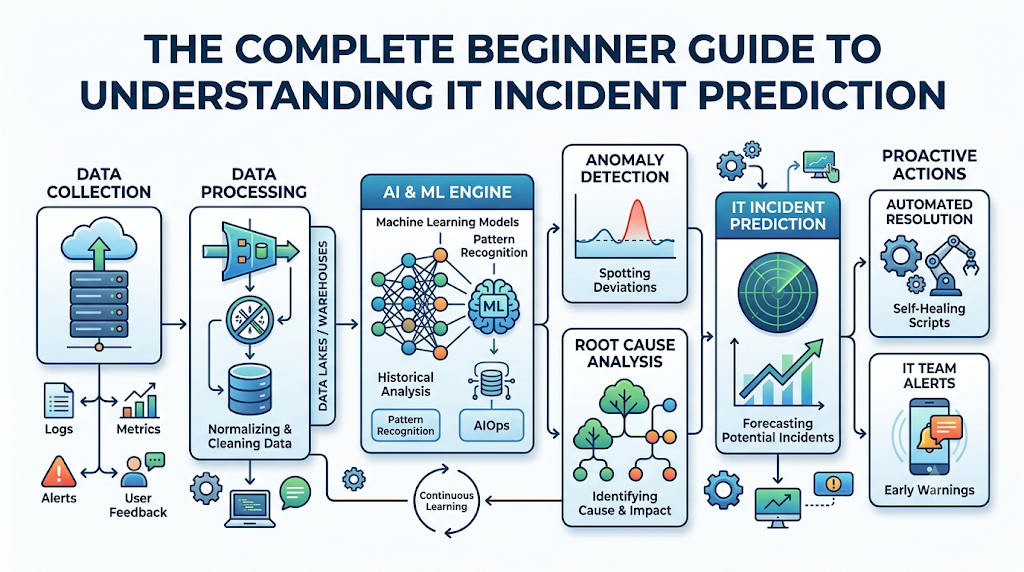
[System Logs, Metrics, & Traces]
               │
               ▼
   [AIOps Engine (ML & AI)] ───► [Pattern & Anomaly Detection]
               │
               ▼
[Predictive Incident Alerts & Automation]
AI and Machine Learning in IT Operations
Modern IT setups generate millions of data points every second. Humans cannot process this scale of information. Machine Learning algorithms excel here. They study past data, learn what “normal” behavior looks like for a specific system, and spot tiny variations that humans would overlook.
The Relationship Between AIOps and Incident Prediction
AIOps is the engine, and incident prediction is the output. You cannot easily have accurate prediction without AIOps. The AI analyzes historical logs, finds the patterns that led to past failures, and uses those models to watch current operations. When the system sees the same pattern starting to form today, it flags it as an upcoming incident.
Why IT Incident Prediction Matters
- Reducing Downtime: The most obvious benefit is keeping applications running. When systems stay online, businesses keep making money and operations run smoothly.
- Faster Response Time: Even if an incident cannot be completely avoided, knowing it is coming gives teams time to prepare. They can have patches ready, spin up backup systems, and isolate the problem area instantly.
- Better Service Availability: For modern applications, availability is everything. Consistent uptime builds long-term trust with users.
- Improved Customer Experience: Customers expect applications to work instantly. Predicting glitches means users never have to encounter broken checkout pages or frozen video streams.
- Lower Operational Costs: Emergency fixes are expensive. They require overtime pay, pull senior developers away from building new features, and hurt brand value. Predictive maintenance is far cheaper to plan and execute.
How TheAIOps.com Helps You Learn IT Incident Prediction
Navigating the world of machine learning, automated scripts, and system telemetry can feel overwhelming if you are just starting out. This is where dedicated educational platforms play a key role. TheAIOps.com acts as an educational guide, breaking down complex topics into clear, digestible concepts for students, system engineers, and technology leaders alike.
Rather than selling software tools, the platform focuses on spreading clear knowledge through a variety of educational channels:
- Learning Articles: Easy-to-read guides that explain the basics of data collection, alert systems, and modern IT infrastructure.
- AIOps Concepts: Detailed breakdowns of core terminologies like mathematical anomalies, data correlation, and telemetry pipelines.
- Training Resources: Structured content designed to take you from a complete beginner to someone who understands how automated operations work in real companies.
- Certifications & Industry Best Practices: Insights into what skills companies look for when hiring modern site reliability engineers (SREs) and DevOps specialists.
By focusing on practical examples over dense academic theory, these resources help technology learners build the confidence needed to discuss, design, and implement predictive frameworks in real-world scenarios.
How IT Incident Prediction Works
The journey from raw systems data to a smart, predictive alert follows a structured workflow:
1. Data Collection  ──►  2. Log Analysis  ──►  3. Event Correlation
                                                        │
                                                        ▼
6. Alert Generation ◄──  5. Prediction     ◄──  4. Anomaly Detection
        │
        ▼
7. Automated Response
Step 1: Data Collection
First, the system gathers information from every corner of the IT environment. This includes performance metrics (like CPU speed), system logs (records of what programs did), and network traces.
Step 2: Log Analysis
The collected data is cleaned and sorted. Text files and system logs are read by parsing tools to understand what actions the software components took.
Step 3: Event Correlation
An enterprise system might generate ten thousand alerts for a single root issue. Event correlation connects these dots. It groups related alerts together so engineers see one clear problem story instead of thousands of isolated notifications.
Step 4: Anomaly Detection
The AIOps tool establishes a baseline of normal operation. If a database usually handles 500 requests per second on a Tuesday morning, but suddenly jumps to 5,000 requests, the system flags this as an anomaly.
Step 5: Pattern Recognition & Prediction
The software compares the current anomaly to historical records. It recognizes that every time this specific data pattern occurred in the past, the database crashed exactly forty minutes later.
Step 6: Alert Generation
Once a match is found, the system creates a high-priority alert. This notification tells the on-call engineer what is about to break, why it is going to happen, and how long they have to fix it.
Step 7: Automated Response
In advanced setups, the system triggers an IT Automation script. It might automatically allocate extra cloud storage or restart a stuck background process, solving the problem without requiring any human intervention.
Technologies Used
To build a reliable predictive operation pipeline, several cutting-edge technologies must work together seamlessly:
- Machine Learning (ML): The core algorithms that learn from historical data patterns without being explicitly programmed for every scenario.
- Artificial Intelligence (AI): The broader reasoning systems that help make smart choices, prioritize alerts, and recommend fixes.
- Big Data Analytics: Large-scale storage and computing frameworks capable of processing terabytes of streaming system data every single day.
- Monitoring and Observability Tools: Software engines that track the internal states of applications by measuring outputs like metrics, logs, and traces.
- Predictive Analytics engines: Statistical modules that calculate the probability of future outcomes based on past trends.
Benefits of IT Incident Prediction
Implementing predictive operations brings several tangible advantages to an IT team:
- Faster Issue Detection: Finding vulnerabilities weeks before they turn into major outages.
- Reduced Overall Downtime: Keeping critical business systems available around the clock.
- Better System Reliability: Making digital platforms stable, predictable, and resilient against unexpected spikes in usage.
- Improved Operational Efficiency: Engineers spend less time fighting fires and more time building useful software features.
- Smarter Decision-Making: Relying on clear data and trends rather than guesswork to plan infrastructure upgrades.
Common Challenges
While the benefits are clear, setting up these predictive environments comes with real obstacles:
- Poor Data Quality: If system logs are messy, incomplete, or incorrectly formatted, the predictive algorithms will make wrong guesses.
- Alert Fatigue: If the system is tuned too sensitively, it will flood engineers with thousands of minor warnings, causing them to ignore the alerts entirely.
- Complex IT Environments: Mixing old physical office servers with new public cloud platforms makes it difficult to track data consistently.
- Integration Issues: Getting older legacy software tools to share data cleanly with modern AI engines can take significant time.
- Skills Gap: Many traditional IT teams lack deep training in data science and machine learning concepts.
- False Positives: Dealing with harmless spikes in traffic that the AI mistakenly flags as a dangerous system error.
Best Practices
To successfully introduce predictive analytics into your IT operations, consider these practical guidelines:
- Start Small: Do not try to predict failures across your entire company on day one. Pick one critical application or database, master it, and scale out from there.
- Clean Your Data First: Spend time formatting your logs and metrics cleanly. High-quality data inputs always lead to high-quality predictions.
- Combine Human Insight with AI: Trust your experienced engineers. Use their domain knowledge to double-check and tune the AI models so the software learns accurately.
- Invest in Ongoing Education: Ensure your operations teams understand how machine learning works. Utilizing educational websites like TheAIOps.com can help get everyone onto the same page.
- Regularly Review Alerts: Audit your predictive rules every month to eliminate false positives and keep your alert system sharp.
Real-World Use Cases
Predictive IT operations are actively transforming major global industries:
- Banking: A large bank uses predictive analytics to monitor transactions. The AI spots a sudden micro-slowdown in a database cluster and reroutes traffic before ATM networks lock up.
- Healthcare: Hospital networks monitor patient-tracking databases. Predicting a storage drive failure ensures doctors can access critical patient charts without delay.
- Cloud Services: Cloud host providers track server rack temperatures and power usage to predict hardware failures, migrating virtual workloads away before a physical blade burns out.
- E-commerce: Digital retailers track checkout funnels. If a payment API starts delaying by a fraction of a second, the system spots the trend and scales up instances before shoppers experience checkout failures.
- Telecommunications: Telecom networks analyze cell tower traffic patterns to forecast congestion during large public events, dynamically adjusting signal distribution.
- Manufacturing: Factory floor management applications monitor IoT sensor data pipelines, predicting communication drops before automated assembly lines stop moving.
Comparison Tables
Traditional Incident Management vs. AI-Based Incident Prediction
| Feature | Traditional Approach | AI-Based Prediction | Business Impact |
| Strategy | Reactive (Fix after failure) | Proactive (Fix before failure) | Eliminates unexpected downtime costs. |
| Data Analysis | Manual log searching | Automated machine learning | Reduces problem resolution times from hours to minutes. |
| Alert Volume | Thousands of isolated alarms | Correlated, single-story alerts | Eliminates developer alert fatigue completely. |
| Fix Method | Manual troubleshooting | Automated script triggers | Lowers engineering operational workloads. |
Common AIOps Capabilities for Incident Prediction
| Capability | Purpose | Business Benefit | Example Use Case |
| Anomaly Detection | Finds unusual changes in telemetry data | Catches silent system bugs early | Spotting a slow memory leak on a web server. |
| Event Correlation | Groups thousands of alerts into one issue | Saves time during system outages | Matching network drops with database errors. |
| Root Cause Analysis | Pinpoints the exact origin of a failure | Prevents issues from happening again | Identifying a bad software update line. |
| Predictive Monitoring | Projects future resource consumption trends | Prevents resource starvation outages | Warning that a hard drive will fill up in 48 hours. |
Future Trends
The field of automated operations is moving quickly, driven by several key developments:
- Generative AI Integration: Future systems will use large language models to write custom automation scripts on the fly, explaining complex system errors to human engineers in plain English.
- Autonomous IT Operations: Systems that self-heal completely without needing human approval for standard infrastructure fixes.
- Predictive Observability: Tools that evaluate the health of code while it is still being written by developers, predicting bugs before the software is deployed to customers.
- AI-Assisted Root Cause Analysis: Instantly mapping out dependencies across millions of cloud microservices to isolate the exact line of code causing an issue.
FAQs
Q: What is the main difference between monitoring and observability?
A: Monitoring tells you when something is broken by tracking pre-defined metrics. Observability allows you to understand why it broke by analyzing the internal state of the system through logs, metrics, and traces.
Q: Do I need to be a data scientist to learn AIOps?
A: No. While data scientists build the underlying machine learning models, IT professionals, DevOps engineers, and system admins only need to understand how to apply, configure, and manage these tools within their environments.
Q: How does machine learning predict an IT incident?
A: Machine learning algorithms analyze historical system data to discover patterns that occurred right before past crashes. When the software spots similar data patterns in real-time operations, it flags it as an upcoming incident.
Q: Can predictive IT operations eliminate 100% of system downtime?
A: While it dramatically cuts down unexpected outages, no system can promise zero downtime. Unexpected physical hardware failures or major third-party internet outages can still happen without early warning patterns.
Q: What is alert fatigue in IT operations?
A: Alert fatigue happens when monitoring tools send thousands of low-priority or false alarms to engineers. Over time, overwhelmed workers become desensitized and may accidentally ignore an important, high-priority alert.
Q: How does event correlation help on-call engineers?
A: Event correlation bundles hundreds of related system notifications into a single clear incident report. This stops the engineers from being flooded with alarms, letting them focus on fixing the root cause quickly.
Q: Is AIOps only useful for massive enterprise companies?
A: While large enterprises benefit significantly due to their scale, medium-sized businesses running cloud applications also use AIOps to keep their platforms reliable without needing a massive, expensive round-the-clock engineering team.
Q: What is a false positive in predictive monitoring?
A: A false positive happens when the predictive software flags a harmless event, like a normal, expected spike in website visitors, as a dangerous system anomaly or an impending crash.
Q: How do automated self-healing systems work?
A: When a predictive tool identifies an oncoming incident, it triggers a pre-written script that automatically fixes the issue, such as clearing a temporary cache or restarting a service, without human intervention.
Q: Where can a complete beginner start learning about AIOps concepts?
A: Beginners can use educational websites like TheAIOps.com, which offer accessible learning articles, conceptual breakdowns, and training resources tailored to clear up operational complexities.
Conclusion
Moving from a reactive “fix-it-when-it-breaks” approach to predictive IT operations is a major milestone for modern organizations. By relying on Artificial Intelligence for IT Operations, companies can stop chasing down errors after an outage and start preventing them entirely. This shift keeps platforms stable, saves significant capital, and ensures users enjoy a seamless experience. Building a strong understanding of these advanced methodologies is the first step toward masterfully managing today’s complex cloud landscapes. Educational platforms like TheAIOps.com serve as an invaluable space for tech learners, providing clear, structured insights into anomaly detection, machine learning applications, and modern operational frameworks. Embracing these predictive strategies ensures your skills, and your infrastructure, remain highly resilient for the future.
