Upgrade & Secure Your Future with DevOps, SRE, DevSecOps, MLOps!
We spend hours scrolling social media and waste money on things we forget, but won’t spend 30 minutes a day earning certifications that can change our lives.
Master in DevOps, SRE, DevSecOps & MLOps by DevOps School!
Learn from Guru Rajesh Kumar and double your salary in just one year.
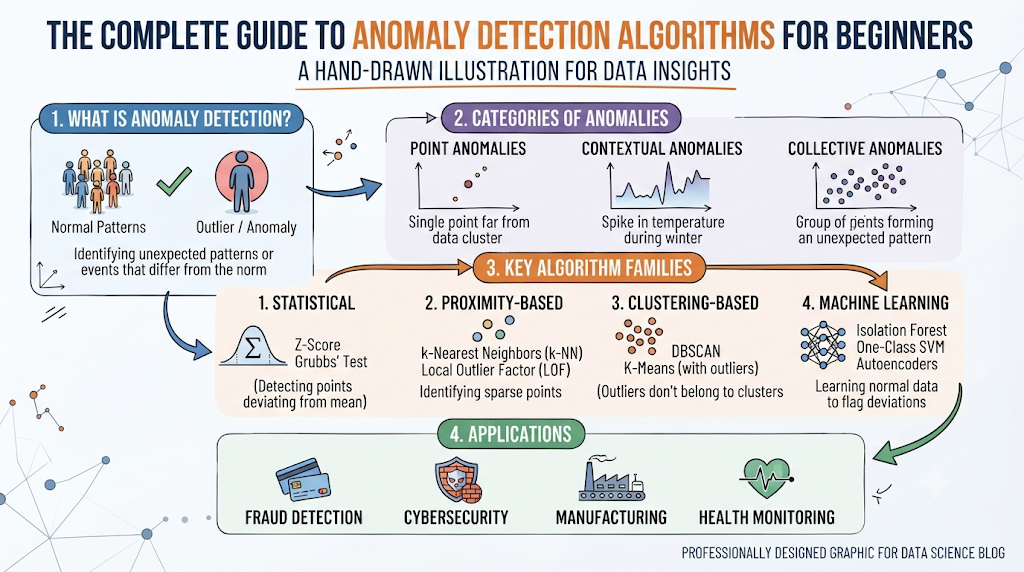
The digital landscape is expanding at a dizzying pace. Modern corporate networks, cloud platforms, and software applications do not sleep. Every time a customer logs into a mobile banking app, buys a product online, or streams a video, thousands of hidden background processes launch instantly. These digital activities generate a staggering amount of data, including server logs, network traffic metrics, database speeds, and memory usage statistics. This is exactly why automated software systems are becoming essential for modern businesses. To keep services running smoothly, companies are turning toward AIOps, which stands for Artificial Intelligence for IT Operations. At the absolute center of this technology sits a crucial tool: anomaly detection algorithms. These specialized smart systems act like digital security guards that monitor data patterns 24/7. They are designed to spot unusual system behaviors the exact moment they start, allowing engineering teams to fix minor glitches long before they turn into major digital disasters.
What Is Anomaly Detection?
At its core, anomaly detection is the automated process of identifying events, data points, or behaviors that do not match what is expected. In the tech world, an anomaly is anything that strays significantly from the norm. Think of it like a smart home security system. If your front door opens at 2:00 PM on a Tuesday while you are at work, the system recognizes this as normal family behavior. But if the back window opens at 3:00 AM on a rainy holiday weekend, the system instantly recognizes a dangerous variation from the standard routine and flags it immediately.
For a long time, tech teams relied on traditional threshold-based monitoring tools. These older systems operated on strict, manual rules. A human engineer would log into a dashboard and set a rigid limit, such as: “Send an email alert if the central processing unit (CPU) usage goes above 85%.”
While this approach worked well for simple setups years ago, it causes massive headaches in modern cloud environments for several reasons:
- Static rules are brittle: System activity changes naturally throughout the day. A web server might hit 90% utilization during a planned Friday afternoon sales rush, which is perfectly fine. Conversely, if utilization drops to 3% on a busy Monday morning, it could mean the login screen is broken, but a static threshold won’t trigger an alert because it never crossed the high 85% mark.
- Alert fatigue: Rigid rules often create thousands of false alarms, causing engineers to ignore their notification feeds entirely.
- High maintenance: Human operators must constantly update thousands of rules by hand as the software environment grows.
AIOps solves this dilemma by making intelligent monitoring the standard practice. Instead of waiting for a human to set a rigid limit, an AIOps platform uses data to understand the natural rhythm of a business. It looks at historical trends, notices how systems act during different seasons, and dynamically adjusts its expectations. AIOps depends entirely on anomaly detection because it provides the eyes and ears needed to watch millions of changing data streams simultaneously without needing constant human intervention.
What Are Anomaly Detection Algorithms?
If AIOps is the brain of modern system monitoring, then anomaly detection algorithms are the specific thought patterns that make the brain work. An algorithm is simply a step-by-step set of instructions given to a computer to solve a problem. In this case, the problem is figuring out what looks normal and what looks suspicious.
These mathematical procedures work by recognizing complex patterns within data. Imagine teaching a young child how to spot a real strawberry. You do not give them a complex document detailing the biological cell structures of fruit. Instead, you show them dozens of pictures of real strawberries. The child naturally learns the common traits: they are red, shaped like small hearts, and covered in tiny seeds. Once the child understands that baseline, if you hand them a blue plastic grape, they will instantly point at it and say, “That is not a strawberry!”
Anomaly detection algorithms do something very similar with data from corporate servers:
- Learning from history: The algorithm reads through weeks or months of past IT performance data to see how the systems behave under various conditions.
- Establishing a baseline: It maps out a clear picture of normal behavior. It learns that traffic spikes at noon when people eat lunch, drops low at midnight, and ebbs during weekends.
- Spotting deviations: As new real-time data flows in, the algorithm compares it against the established baseline. If a metric deviates too far from the standard pattern, the system flags it as abnormal.
- Continuous adaptation: The algorithm does not stay static. It keeps learning every single day. If a company permanently doubles its customer base, the algorithm slowly adjusts its baseline upward to accept the new higher traffic levels as the new normal.
Common Types of Anomaly Detection Algorithms
Engineers use several different algorithmic approaches to hunt down irregularities. Each approach looks at IT operations through a slightly different lens.
Statistical Methods
These are the oldest and simplest forms of automated detection. They rely on basic mathematical properties like averages, medians, and standard deviations. The algorithm calculates the average value of an active system metric over time. If a new data point lands way outside the historical average range, it is flagged. Think of this like tracking the outdoor temperature. If the average temperature in July is 80 degrees, a day that hits 82 degrees is normal, but a day that drops to 40 degrees is instantly flagged as a statistical outlier.
Rule-Based Detection
While AIOps focuses on machine learning, basic rule-based logic still plays a supportive role. This method uses conditional “if-then” statements written by humans or generated by software. For example: “If a user attempts to log into an administrative account five times in ten seconds from different countries, then block the account.” It is highly precise for known threats but fails to find new, unexpected system bugs.
Machine Learning-Based Detection
This approach uses advanced computer models to analyze data without being explicitly programmed where to look. These models examine multiple factors at once, comparing variables like memory use, network traffic, and hard drive speeds simultaneously. They can find hidden connections that a human would never notice, such as realizing a server is failing because its internal temperature rises slightly every time the network speed drops.
Time-Series Anomaly Detection
Most IT operations data is tied directly to time. Time-series algorithms specialize in tracking data points that are collected chronally. They look for three main things: long-term trends, seasonal patterns, and sudden unexpected shifts. If your website always gets a traffic bump at 7:00 PM, a time-series algorithm knows not to panic. But if a massive spike happens at 3:00 AM on a Tuesday, the algorithm identifies it as a true time-based anomaly.
Clustering-Based Detection
This method works by grouping similar data points together into virtual crowds or clusters. The algorithm assumes that normal system activities will cluster closely together because they share similar behaviors. Any data point that sits far away from these crowded groups, isolated in its own digital space, is viewed as a lonely outlier and flagged for investigation.
Deep Learning Approaches
Deep learning mimics the structure of the human brain using artificial neural networks. These are highly advanced systems used by large enterprises to process massive, chaotic data streams like raw system logs or live video feeds. Deep learning algorithms are excellent at discovering deeply buried structural issues across thousands of interconnected cloud servers, though they require significant computing power to run.
How Anomaly Detection Works in AIOps
To truly appreciate the value of this technology, it helps to look at the step-by-step journey data takes as it moves through an AIOps platform.
[Data Collection] ➔ [Log & Metric Analysis] ➔ [Pattern Recognition] ➔ [Event Correlation] ➔ [Intelligent Alerting] ➔ [Root Cause Investigation]
Step 1: Data Collection
The process begins with widespread ingestion. The AIOps system gathers live information from every corner of the corporate empire. It pulls data from cloud servers, physical hard drives, employee software apps, database systems, and network routers.
Step 2: Log Analysis and Metrics Monitoring
Once gathered, the platform splits the data into two main buckets: metrics and logs. Metrics are numbers that tell you how much or how fast things are going (like percentage scales or speed rates). Logs are text diaries written by the computers explaining what they just did. The algorithms read both simultaneously to get a complete picture of operational health.
Step 3: Pattern Recognition and Baseline Matching
The algorithm actively compares the incoming live streams against historical baselines. It checks if the current memory usage, data transmission speeds, and user login counts match what usually happens at this exact hour and day of the week.
Step 4: Event Correlation
If the algorithm spots several anomalies happening at the same time across different servers, it doesn’t send separate alerts. Instead, it groups them together. For instance, if a database slows down, an application errors out, and a network switch overheats simultaneously, event correlation links them as a single connected incident.
Step 5: Intelligent Alert Generation
Instead of blowing up an engineer’s phone with fifty separate texts for fifty minor errors, the AIOps platform creates a single, clean, comprehensive alert notification. This alert tells the team exactly what is broken, why it matters, and how urgent the issue is.
Step 6: Root Cause Investigation and Continuous Learning
The platform doesn’t just say something is broken; it guides engineers toward the root cause by highlighting the exact line of code or piece of hardware that failed first. Once human engineers fix the issue, the algorithm records the entire lifecycle, learning from the resolution to handle similar events even faster next time.
Comparison Table 1: Traditional Monitoring vs. AI-Based Anomaly Detection
| Feature | Traditional Monitoring | AI-Based Anomaly Detection | Business Benefit |
| Setup Process | Manual configuration of rigid threshold rules. | Automatic discovery of system patterns. | Saves hours of developer setup time. |
| Adaptability | Remains completely static until a human changes it. | Learns continuously and adapts to updates. | Prevents broken alerts during system updates. |
| Alert Accuracy | High numbers of false alarms (alert fatigue). | High precision by filtering out background noise. | Engineers stay focused on real problems. |
| Issue Resolution | Reacts only after a severe breach occurs. | Flags subtle early warning indicators early. | Prevents minor bugs from crashing systems. |
| Analysis Depth | Monitors individual data metrics in total isolation. | Correlates thousands of metrics at the same time. | Discovers deep, hidden root causes instantly. |
Benefits of Anomaly Detection in AIOps
Investing in intelligent AIOps platforms brings massive advantages to companies that rely on digital infrastructure to make money and serve clients.
- Early Issue Detection: Algorithms spot system decay days before it causes a crash. They notice a memory leak when it has consumed only a tiny fraction of extra space, giving teams plenty of time to deploy a fix during normal working hours.
- Reduced System Downtime: When critical corporate applications stay online consistently, companies avoid losing thousands of dollars per minute in transaction fees or operational halts.
- Faster Incident Response: Because the platform handles the tedious work of reading logs and connecting events, human engineers can jump straight into fixing the problem rather than spending hours trying to figure out what went wrong.
- Reduced Alert Fatigue: By filtering out harmless data spikes and grouping related errors together, IT professionals receive fewer, more meaningful alerts, which dramatically reduces workplace burnout.
- Predictive Maintenance: Using predictive analytics, the system can look at current wear-and-tear trends on virtual hardware and warn managers that a storage drive is likely to run out of space in three weeks.
- Better Customer Experience: Customers enjoy fast, responsive websites and apps that rarely experience unexpected outages or sluggish load times.
Common Challenges in Anomaly Detection
While the technology is incredibly powerful, it is not a magic wand that works perfectly out of the box without care. Organizations must navigate several ongoing challenges.
False Positives and Negatives
A false positive occurs when the algorithm sounds the alarm for a completely harmless event. For instance, if a company runs a sudden, highly successful flash marketing campaign, traffic will skyrocket. A basic algorithm might mistake this good news for a malicious cyberattack. A false negative is worse: it happens when the algorithm misses a real, dangerous issue because the malicious activity successfully disguised itself as normal day-to-day background data.
Data Quality Issues
Algorithms are only as smart as the data you feed them. If a company’s data streams are messy, incomplete, broken, or constantly missing large chunks of time, the algorithm will build a warped baseline. This leads to inaccurate monitoring and unreliable alerts.
Changing Environments and Model Drift
Modern cloud systems change constantly. Software developers push new feature updates to production multiple times a day. If an update fundamentally changes how an application uses memory, the algorithm’s old baseline becomes instantly obsolete. This issue is called model drift, and it requires systems to regularly refresh their learning models to keep pace with business growth.
Comparison Table 2: Common Anomaly Detection Approaches
| Detection Approach | How It Works | Best Use Case | Primary Advantage |
| Statistical Methods | Tracks simple mathematical averages and mathematical variances. | Monitoring highly stable, simple server environments. | Uses very little computer processing power. |
| Time-Series Models | Analyzes data trends over historical hours, days, and weeks. | Tracking website traffic patterns and retail sales trends. | Excellent at accounting for predictable seasons. |
| Clustering Algorithms | Groups similar activities together to isolate distant outliers. | Spotting unusual user account behaviors or security breaches. | Does not require pre-labeled historical data to work. |
| Deep Learning | Uses multi-layered neural networks to analyze chaotic data. | Scanning vast, complex enterprise multi-cloud setups. | Finds incredibly deep, well-hidden system bugs. |
Real-World Applications
To see how these concepts function in daily operations, let us explore how diverse industries apply anomaly detection to protect their bottom lines.
Cloud Infrastructure
- Monitoring Challenge: A global tech enterprise operates tens of thousands of virtual cloud servers. Manually tracking the health of every single operating system is physically impossible for their engineering team.
- How Anomaly Detection Helps: The AIOps platform constantly tracks resource utilization across the entire global grid, instantly flagging any server that exhibits strange behavior compared to its cluster peers.
- Business Outcome: The enterprise prevents costly service outages and automatically balances its server workloads, saving millions in unnecessary cloud hosting bills.
Banking and Finance
- Monitoring Challenge: A banking application processes millions of transaction requests every hour. They must spot automated fraud attempts instantly without delaying legitimate customer transfers.
- How Anomaly Detection Helps: Clustering algorithms review transactional velocities, geographic locations, and transfer amounts simultaneously to identify unusual spending spikes.
- Business Outcome: The bank stops fraudulent thefts in real time while ensuring regular customers experience zero friction when purchasing everyday items.
E-Commerce Platforms
- Monitoring Challenge: During massive global online shopping events, web traffic increases by ten times the normal volume, making traditional fixed alert thresholds useless.
- How Anomaly Detection Helps: Time-series algorithms adapt instantly to the massive holiday influx, ignoring the high traffic volume while remaining alert for broken checkout buttons or slow database connections.
- Business Outcome: Retailers keep their digital storefronts open and responsive during their most profitable days of the year, maximizing revenue.
Best Practices for Implementing Anomaly Detection
If your organization wants to adopt intelligent AIOps monitoring, keep these practical guidelines in mind to ensure long-term success.
- Prioritize High-Data Quality: Clean up your log formats and fix broken network links before turning on an algorithm. High-quality inputs yield high-quality insights.
- Build Comprehensive Observability: Don’t just monitor one metric. Integrate your logs, metrics, and application traces together into a unified observability strategy so your algorithm has the context it needs to see the big picture.
- Combine AI with Human Expertise: Do not automate everything blindly. Use the algorithm to gather insights and make recommendations, but keep human engineers in the loop to make the final decisions on critical infrastructure changes.
- Consistently Combat Alert Noise: If an algorithm flags a specific benign behavior repeatedly, tune its parameters. Continually refine your models to keep your notification feeds clean, reliable, and actionable.
Future Trends in AIOps Monitoring
As computer science advances, the capabilities of anomaly detection algorithms continue to evolve rapidly.
- Explainable AI: Older machine learning models often operated as mysterious “black boxes,” leaving engineers confused about why a specific alert triggered. The future belongs to explainable AI, where systems clearly outline the logic, data points, and reasons behind every single anomaly alert they generate.
- Generative AI Integration: Emerging AIOps platforms are combining anomaly detection with generative AI engines. Soon, a system will not only identify a system anomaly but also automatically type out a detailed, human-readable summary explaining how to fix the code instantly.
- Autonomous Self-Healing Systems: We are moving toward autonomous incident management. In the coming years, when an anomaly detection algorithm spots a failing cloud server, it will coordinate with automated scripts to restart the broken service, fix the configuration error, and verify the patch all on its own without waking up an on-call engineer in the middle of the night.
FAQs
What is an anomaly in IT operations?
An anomaly is any data point, event, or behavior within a corporate computer network or software system that deviates significantly from what is expected as normal behavior. Examples include sudden drops in database speeds, weird spikes in web traffic, or an unusual cluster of error messages.
How do anomaly detection algorithms differ from traditional alerts?
Traditional tools require human engineers to manually set rigid, static numbers as limits. AI-driven anomaly detection algorithms study historical data to automatically figure out normal patterns, adapting their thresholds continuously without human intervention.
Do these algorithms require machine learning to work?
Not always. Basic anomaly detection can be done using simple statistical formulas like calculating historical averages. However, advanced machine learning is required to monitor complex, modern cloud networks that feature thousands of changing variables.
What is a false positive in system monitoring?
A false positive happens when an anomaly detection tool mistakenly flags a harmless system behavior as a dangerous incident. An example would be an algorithm sounding the alarm over a safe, expected spike in website traffic caused by a successful holiday sale.
What is model drift and why does it matter?
Model drift happens when a machine learning system becomes less accurate over time because the real-world environment has changed compared to the historical data it originally studied. To fix this, algorithms must regularly retrain on fresh, updated operational data.
Can anomaly detection stop cyberattacks?
Yes. By learning the normal behavioral habits of employees, servers, and data systems, these algorithms can instantly spot unusual data movements, unauthorized login attempts, or bizarre file deletions, helping security teams stop threats fast.
Why is event correlation important in AIOps?
When a major infrastructure failure occurs, it often triggers hundreds of separate errors across different servers. Event correlation automatically connects those separate alerts into a single cohesive story, saving engineers from wading through repetitive notifications.
What industries benefit most from AIOps anomaly detection?
Any industry that relies heavily on digital systems to run its operations benefits immensely. This includes global banking platforms, fast-moving e-commerce websites, cloud computing providers, telecommunication carriers, and modern healthcare networks.
Will AI completely replace human IT engineers?
No. Anomaly detection algorithms act as powerful assistants that handle the tedious chore of scanning data and finding patterns. Human engineers are still absolutely vital for making strategic decisions, solving complex bugs, and managing overall architecture.
How does anomaly detection improve customer satisfaction?
By spotting hidden technical bugs and system slowdowns early, engineering teams can fix issues long before they trigger an official outage. This keeps corporate websites and apps fast, stable, and completely reliable for the everyday end user.
Conclusion
Anomaly detection algorithms serve as a cornerstone capability of modern AIOps infrastructure. By shifting away from rigid, manual threshold rules and embracing systems that learn organically from historical data, enterprises can maintain deep visibility into their complex digital ecosystems. These intelligent tools protect companies from unexpected downtime, reduce daily alert fatigue for overstressed engineering teams, and ensure that software applications remain fast and reliable for global consumers.
Ultimately, technology works best when artificial intelligence and human experience collaborate closely. By pairing the speed and pattern-recognition capabilities of modern algorithms with the strategic problem-solving skills of seasoned IT professionals, organizations can build resilient, self-aware infrastructure capable of thriving in our fast-paced digital world.
