Upgrade & Secure Your Future with DevOps, SRE, DevSecOps, MLOps!
We spend hours scrolling social media and waste money on things we forget, but won’t spend 30 minutes a day earning certifications that can change our lives.
Master in DevOps, SRE, DevSecOps & MLOps by DevOps School!
Learn from Guru Rajesh Kumar and double your salary in just one year.

Are you a tech enthusiast? Do you want to learn about two popular terminologies in the tech world that are AIOps and NoOps? If yes, then you are in the right place. In this article, we will discuss the difference between AIOps vs NoOps. So, let’s dive into it.
Introduction to AIOps and NoOps
Before we start discussing the difference between AIOps and NoOps, let’s have a brief look at what these terminologies mean.
AIOps
AIOps stands for Artificial Intelligence for IT Operations. It is the practice of using artificial intelligence and machine learning to automate IT operations tasks. AIOps can help IT teams to improve their efficiency and productivity by automating tedious and time-consuming tasks.
NoOps
NoOps stands for No Operations. It is the practice of automating the entire infrastructure and operations stack. With NoOps, developers are responsible for the entire application lifecycle, from building to deployment, monitoring, and maintenance.
What is the Difference between AIOps and NoOps?
Now, let’s move on to the main topic of this article, which is the difference between AIOps and NoOps.
Scope
The scope of AIOps is limited to IT operations tasks only. It uses artificial intelligence and machine learning to automate these tasks. On the other hand, NoOps is a broader concept that includes the entire infrastructure and operations stack.
Responsibility
In AIOps, the IT operations team is responsible for managing the infrastructure and operations stack. They use AIOps tools to automate the tasks. In NoOps, developers are responsible for the entire application lifecycle.
Automation
AIOps uses artificial intelligence and machine learning to automate IT operations tasks. It can help IT teams to improve their efficiency and productivity. On the other hand, NoOps automates the entire infrastructure and operations stack. With NoOps, developers are responsible for the entire application lifecycle.
Complexity
AIOps is less complex as compared to NoOps. It only automates the IT operations tasks, while NoOps automates the entire infrastructure and operations stack. NoOps requires more advanced skills and knowledge.
Advantages
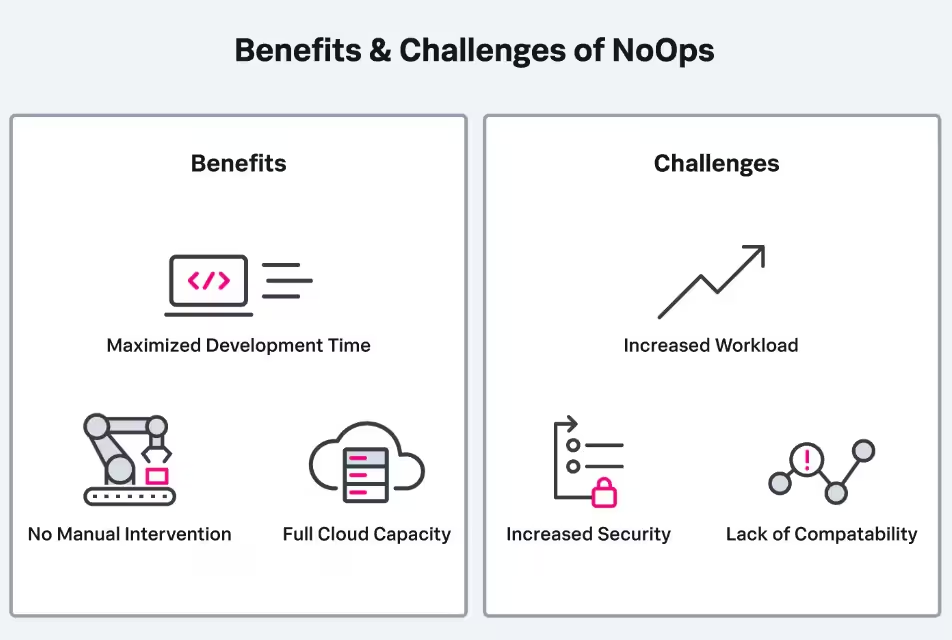
AIOps can help IT teams to improve their efficiency and productivity by automating tedious and time-consuming tasks. It can also help them to identify and resolve issues quickly. On the other hand, NoOps can help organizations to deploy applications faster and improve their agility.
Disadvantages
AIOps can be expensive to implement and may require significant investment in infrastructure and tools. It may also require specialized skills and knowledge. On the other hand, NoOps may not be suitable for all organizations. It requires a high level of automation and may not be practical for some applications.
Conclusion
In conclusion, AIOps and NoOps are two popular terminologies in the tech world. AIOps is the practice of using artificial intelligence and machine learning to automate IT operations tasks. NoOps is the practice of automating the entire infrastructure and operations stack. The main difference between AIOps vs NoOps is their scope, responsibility, automation, complexity, advantages, and disadvantages. Both AIOps and NoOps have their own benefits and drawbacks, and organizations should carefully consider their needs before implementing either of these practices.