Upgrade & Secure Your Future with DevOps, SRE, DevSecOps, MLOps!
We spend hours scrolling social media and waste money on things we forget, but won’t spend 30 minutes a day earning certifications that can change our lives.
Master in DevOps, SRE, DevSecOps & MLOps by DevOps School!
Learn from Guru Rajesh Kumar and double your salary in just one year.
Introduction
Data is no longer just a byproduct of business; it is the heartbeat of modern engineering. Over the decades, I have watched the industry transition from manual database management to automated pipelines. However, even with the best tools, many organizations still struggle with “Data Silos” and slow delivery cycles. This is where DataOps comes in. DataOps is not just a buzzword; it is a fundamental shift in how we handle data environments. It brings the agility of DevOps to the world of data science and engineering. If you are looking to master this craft, the DataOps Certified Professional (DOCP) is the gold standard. This guide will walk you through everything you need to know to navigate this certification and elevate your career.
The Evolution of Data Management
In the early days, data management was a slow, rigid process. Data engineers worked in isolation, and insights took weeks to reach decision-makers. We lived in a world of “Waterfall” data. Today, that model is broken. Modern businesses require real-time insights. They need data that is clean, reliable, and instantly available. DataOps bridges the gap between data providers and data consumers. By applying version control, automated testing, and continuous integration to data workflows, we can finally achieve the speed that the modern market demands. The DOCP certification is designed to validate that you don’t just know how to write a query, but you know how to build a sustainable, scalable data factory.
DataOps Certified Professional (DOCP) Overview
The DOCP is a comprehensive program provided by DevOpsSchool. It focuses on the intersection of people, processes, and technology. It ensures that data professionals can automate the data lifecycle while maintaining high quality and security standards.
DataOps Certification Details
| Track | Level | Who it’s for | Prerequisites | Skills Covered | Recommended Order |
| DataOps | Professional | Data Engineers, Managers, Architects | Basic Data Knowledge & Linux | Automation, CI/CD for Data, Quality, Orchestration | 1st in Data Track |
Deep Dive into DataOps Certified Professional (DOCP)
What it is
The DOCP is a professional-level certification that focuses on the methodologies of DataOps. It covers the automation of data integration, the implementation of data quality checks, and the orchestration of complex data pipelines using modern DevOps tools.
Who should take it
This certification is ideal for Data Engineers, Data Architects, Database Administrators, and Engineering Managers who want to reduce the cycle time of data analytics. It is also highly beneficial for Software Engineers moving into data-centric roles.
Skills you’ll gain
- Mastery of DataOps principles and the Data Life Cycle.
- Ability to implement CI/CD pipelines specifically for data workflows.
- Expertise in data orchestration tools and automated testing for data.
- Knowledge of monitoring data pipelines and ensuring high data observability.
- Understanding of data governance and security in an automated environment.
Real-world projects you should be able to do after it
- Build an end-to-end automated data pipeline that triggers on code changes.
- Implement an automated “Data Quality Gate” that prevents bad data from entering a warehouse.
- Set up a monitoring dashboard that alerts the team when data latency exceeds thresholds.
- Create a “Self-Service” data infrastructure for data scientists to spin up environments.
Preparation plan
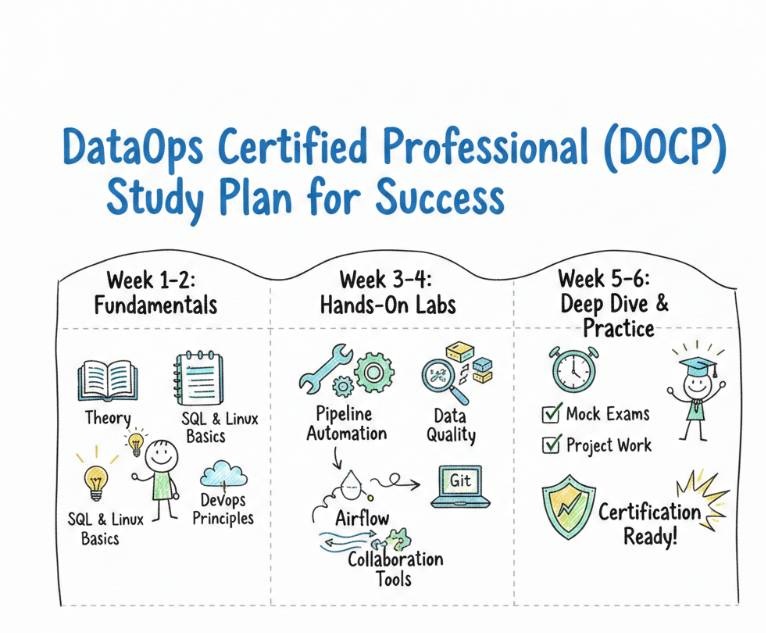
- 7–14 days: Focus on core DataOps theory, understanding the manifesto, and learning the difference between DevOps and DataOps.
- 30 days: Start hands-on labs with orchestration tools (like Airflow or Prefect) and version control for data (like DVC).
- 60 days: Deep dive into advanced topics like Data Observability, Governance, and scaling pipelines in a multi-cloud environment. Perform at least three full-scale mock projects.
Common mistakes
- Treating DataOps as just “DevOps with a different name.”
- Ignoring data quality and focusing only on the speed of the pipeline.
- Failing to involve the end “data consumers” (analysts/scientists) in the pipeline design.
- Over-complicating the toolstack before the team understands the culture.
Best next certification after this
After completing the DOCP, the best move is usually toward AIOps/MLOps to handle the complexities of machine learning models, or FinOps to manage the massive cloud costs associated with modern data processing.
Choose Your Path: 6 Learning Journeys
In my years of mentoring engineers, I’ve found that a clear path is the difference between a stalled career and a promotion. Here are the six primary paths in the modern ecosystem:
- DevOps Path: Focuses on the general software delivery lifecycle. It is the foundation for everything else.
- DevSecOps Path: Integrates security into every step. Crucial for those in finance, healthcare, or government sectors.
- SRE (Site Reliability Engineering) Path: Focuses on the availability and reliability of large-scale systems. Perfect for those who love high-scale problem solving.
- AIOps/MLOps Path: The bridge between data science and production. It’s about making AI models reliable and repeatable.
- DataOps Path: The focus of this guide. It ensures data is treated as code, with speed, quality, and automation at its core.
- FinOps Path: The newest frontier. It’s about cloud financial management and ensuring your infrastructure doesn’t bankrupt the company.
Role → Recommended Certifications Mapping
| Your Current Role | Target Expertise | Recommended Certification Journey |
| DevOps Engineer | Core Automation | CDE (Certified DevOps Engineer) → Kubernetes Specialist → DOCP |
| SRE | Systems Reliability | SRE Certified Professional (SRECP) → AIOps → Chaos Engineering |
| Platform Engineer | Infrastructure | Kubernetes (CKA) → Terraform Associate → DOCP |
| Cloud Engineer | Cloud Architecture | AWS/Azure/GCP Architect → FinOps Practitioner → DOCP |
| Security Engineer | DevSecOps | DSOCP (DevSecOps Certified Professional) → Cloud Security → DOCP |
| Data Engineer | Data Pipelines | DOCP (DataOps Certified Professional) → MLOps → Big Data Architect |
| FinOps Practitioner | Cost Management | FinOps Certified Practitioner → Cloud Cost Optimization → DOCP |
| Engineering Manager | Strategic Leadership | Certified DevOps Leader (CDL) → FinOps for Managers → DOCP |
Next Certifications to Take
Once you have mastered the DOCP, you should look toward one of these three options to broaden your expertise:
- Same Track (Advanced Data): MLOps Certified Professional. This allows you to take the clean data from your DataOps pipeline and feed it into production-grade Machine Learning models.
- Cross-Track (Efficiency): FinOps Certified Professional. Data processing is expensive. Learning how to optimize the costs of your Snowflake, BigQuery, or Databricks environments is a massive value-add.
- Leadership: DevOps Leader / Director of Engineering. If you want to move into management, you need to understand how to lead teams through these cultural shifts.
Top Training & Certification Institutions for DOCP
Choosing the right partner for your learning journey is critical. In my experience, these institutions provide the best blend of theory and hands-on practice:
DevOpsSchool
DevOpsSchool is a pioneer in the DataOps space. They provide deep, instructor-led training that focuses on real-world scenarios rather than just exam questions. Their curriculum for DOCP is updated frequently to reflect the latest tools in the industry. They are highly recommended for those who want a guided, mentorship-based learning experience.
Cotocus
Cotocus specializes in high-end technical training for corporate teams and individual engineers. Their approach to DataOps focuses heavily on the implementation of CI/CD for data and automated testing. They provide excellent lab environments that simulate complex enterprise data architectures, making them a great choice for working professionals.
Scmgalaxy
Scmgalaxy is a massive community-driven platform that offers extensive resources for DataOps. They focus on the technical execution of pipelines and version control. For engineers who prefer a resource-rich environment with plenty of community support and documentation, Scmgalaxy is an outstanding option.
BestDevOps
BestDevOps focuses on the “Best Practices” aspect of the industry. Their training modules are designed to help engineers move from “knowing the tool” to “owning the process.” They offer specialized bootcamps for DOCP that are intensive and highly effective for career switchers.
Other Specialized Schools
- devsecopsschool: Best for adding a security layer to your data pipelines.
- sreschool: Ideal for learning how to make data platforms highly available.
- aiopsschool: The place to go if you want to use AI to manage your data operations.
- dataopsschool: A dedicated niche school focusing exclusively on the DataOps lifecycle.
- finopsschool: Essential for learning how to manage the budget of large data projects.
FAQs (General & Career Outcomes)
- How difficult is the DOCP certification?
It is a professional-level certification. It requires a solid understanding of both data engineering and DevOps principles. It is challenging but very achievable with focused study. - How much time does it take to prepare?
For a working professional, 30 to 60 days of consistent study (5-10 hours a week) is usually sufficient to master the material and pass the exam. - Are there any prerequisites?
While there are no strict barriers, having a basic understanding of SQL, Linux, and at least one cloud platform (AWS/Azure/GCP) will make your journey much smoother. - Should I do DevOps before DataOps?
It helps, but it is not mandatory. If your primary job is data engineering, you can start directly with DataOps, as the course will cover the necessary DevOps concepts. - What is the value of DOCP in the current market?
Companies are desperate for “Full Stack Data Engineers.” Being certified proves you can handle the entire lifecycle, making you a top-tier candidate for high-paying roles. - Will this certification help me get a remote job?
Yes. DataOps is a role that is highly conducive to remote work, as it involves managing cloud-based infrastructure and automated pipelines. - Is this certification recognized globally?
Absolutely. The principles of DataOps are universal, and the DOCP curriculum follows global industry standards used by top tech firms. - Does it cover specific tools like Airflow or Spark?
Yes, it covers the popular tools used for orchestration and processing, but more importantly, it teaches the framework that applies to any tool you might use. - What is the career growth after DOCP?
You can move into roles like Senior Data Engineer, DataOps Architect, or even Head of Data Engineering. - How does this differ from a standard Data Engineering certificate?
Standard certificates focus on “how to use a tool.” DOCP focuses on “how to build a reliable, automated system” using those tools. - Can managers benefit from this?
Yes. Managers learn how to structure their teams, reduce bottlenecks, and measure the ROI of data initiatives. - What is the passing score for the exam?
Typically, you need to score at least 70% to pass, ensuring you have a strong grasp of the core concepts.
FAQs (Specific to DOCP Certification)
- What is the official URL for the DOCP exam?
You can find all official details and registration here: DataOps Certified Professional (DOCP) - Who is the primary provider of this certification?
The certification is provided and managed by DevOpsSchool. - Does the course include hands-on labs?
Yes, the training provided by the recommended institutions includes extensive hands-on labs to simulate real-world data environments. - Is the exam online or offline?
The exam is conducted online, allowing you to take it from anywhere in the world. - How long is the certification valid?
Like most professional certifications, it is recommended to refresh your knowledge every 2-3 years due to the rapid pace of technological change. - Are there mock tests available?
Yes, most training providers like Scmgalaxy and DevOpsSchool offer mock exams to help you prepare. - What kind of support is provided during training?
Instructors usually provide 24/7 lab support and dedicated Q&A sessions to clear any technical doubts. - Can I get a refund if I don’t like the course?
Each provider has its own policy, but most offer a clear refund or rescheduling policy within the first few days of training.
Testimonials
Ananya R., Senior Data Engineer (Bangalore):
“I had been working with Spark and Hadoop for years, but our deployments were a mess. The DOCP course changed how I look at my job. I realized that data should be treated like code. We implemented a CI/CD pipeline for our ETL jobs, and our deployment errors dropped by 80%.”
Marcus T., Engineering Manager (Berlin):
“Managing a team of data scientists and engineers was difficult because they spoke different languages. DataOps gave us a common framework. The DOCP certification helped my team standardize our processes and deliver insights to our stakeholders much faster.”
Siddharth V., Cloud Architect (Hyderabad):
“The move to the cloud made our data costs skyrocket. By combining the principles of DataOps with the optimization techniques I learned, we were able to build a much more efficient and cost-effective data platform.”
Conclusion
The journey to becoming a DataOps Certified Professional is a journey toward excellence. In a world that is drowning in data but starving for insights, the ability to build fast, reliable, and automated data pipelines is the most valuable skill you can possess. Whether you are an engineer looking to climb the ladder or a manager looking to optimize your team, the DOCP certification provides the roadmap you need. It isn’t just about passing an exam; it’s about adopting a mindset that prioritizes quality, speed, and collaboration. The data revolution is here—make sure you have the credentials to lead it.
