Upgrade & Secure Your Future with DevOps, SRE, DevSecOps, MLOps!
We spend hours scrolling social media and waste money on things we forget, but won’t spend 30 minutes a day earning certifications that can change our lives.
Master in DevOps, SRE, DevSecOps & MLOps by DevOps School!
Learn from Guru Rajesh Kumar and double your salary in just one year.
Introduction
The cloud has evolved from a simple hosting platform into a sophisticated ecosystem that demands precision and automation. In my journey through the various eras of IT, I have seen many technologies come and go, but the move toward automated, self-healing infrastructure is the most significant shift yet. This guide is built to help you navigate one of the most respected credentials in the industry today. The AWS DevOps Engineer – Professional is designed for those who want to move beyond basic cloud management. It requires a deep understanding of how to weave security, scalability, and reliability into every line of code you deploy. If you are looking to solidify your standing as a leader in the cloud space, this is the path you need to follow.
The Certification Landscape
Understanding the full spectrum of cloud certifications is the first step in planning your career trajectory. While it is tempting to jump straight into the most difficult exams, a structured approach ensures you have no gaps in your fundamental knowledge. The table below outlines the core tracks that modern engineers should consider to remain competitive in a rapidly changing market.
Certification Overview Table
| Track | Level | Who it’s for | Prerequisites | Skills Covered | Recommended Order |
| AWS DevOps | Professional | Senior Engineers, SREs | Associate Cert + Exp | CI/CD, IaC, HA, Monitoring | After SysOps/Developer |
| DevSecOps | Specialist | Security Engineers | DevOps Fundamentals | Security Automation, Compliance | After DevOps Pro |
| SRE | Professional | Operations Leads | Systems Admin knowledge | Reliability, Error Budgets | Parallel to DevOps Pro |
| DataOps | Professional | Data Engineers | Basic Data Engineering | Pipeline Automation, Quality | After Data Associate |
| FinOps | Practitioner | Managers, Architects | Cloud Cost basics | Cloud Economics, Tagging | Any time |
Deep Dive: AWS Certified DevOps Engineer – Professional
What it is
This certification is the pinnacle for those who specialize in the operational side of the AWS cloud. It validates your technical expertise in provisioning, operating, and managing distributed application systems on the AWS platform. It is less about “knowing” the services and more about “implementing” them in a complex, multi-account production environment.
Who should take it
This credential is aimed at individuals who have been in the trenches of cloud operations or software development for several years. It is perfect for those who are responsible for the delivery and stability of large-scale applications. If your goal is to move into a Senior DevOps or Lead Architect role, this certification acts as a powerful endorsement of your skills.
Skills you’ll gain
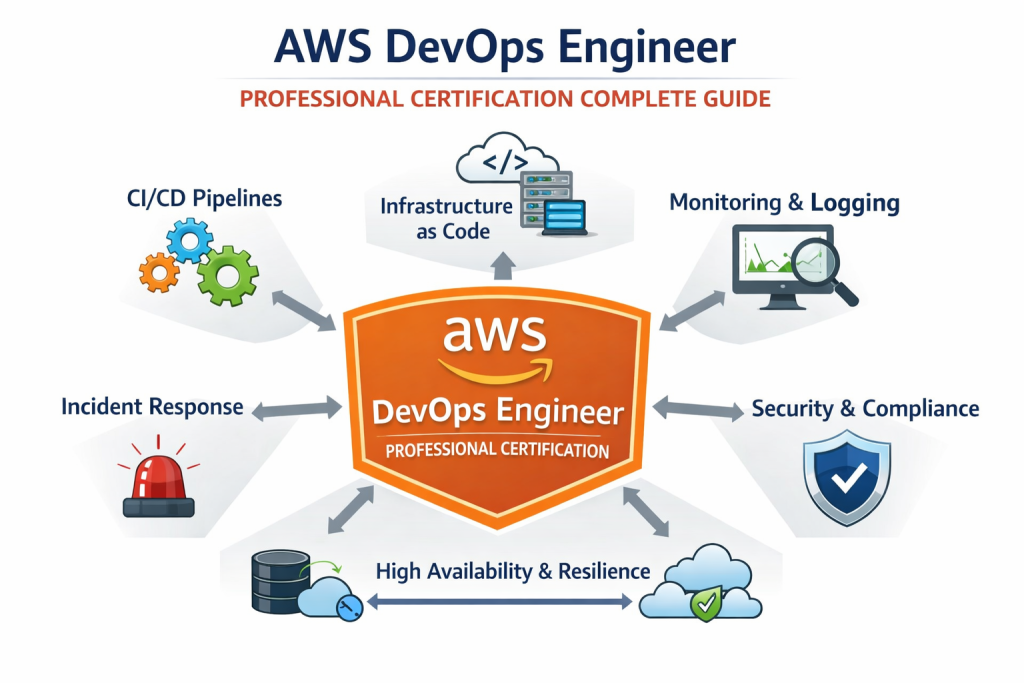
- SDLC Automation: You will learn how to design and automate complex CI/CD pipelines that can handle everything from simple code commits to global multi-region deployments.
- Infrastructure as Code: You will master tools like CloudFormation and the CDK to ensure that your infrastructure is as repeatable and version-controlled as your application code.
- Monitoring and Logging: This path teaches you how to implement deep observability, allowing you to catch and fix issues before your users even notice they exist.
- High Availability: You will gain the ability to build systems that automatically scale and heal themselves, ensuring maximum uptime for critical business services.
- Security & Compliance: You will learn to automate security guardrails, ensuring that every resource you deploy meets the strict compliance standards of modern enterprises.
Real-world projects you should be able to do
- Blue/Green Deployments: You should be able to orchestrate a deployment strategy that allows for instant rollbacks and zero downtime for millions of users.
- Automated Remediation: You will be capable of writing scripts and policies that automatically detect and fix security vulnerabilities or performance bottlenecks in real-time.
- Centralized Logging: You should be able to build a robust logging architecture that aggregates data from hundreds of microservices into a single, actionable dashboard.
- Disaster Recovery: You will have the skills to automate a full regional failover, ensuring that your business stays online even during a major cloud provider outage.
Preparation Plan
| Timeline | Focus Area |
| 7–14 Days | This “Sprint” mode is for those who already use AWS Professional services daily. The focus here is strictly on understanding the exam’s unique question patterns and taking several high-quality practice tests to find any hidden knowledge gaps. |
| 30 Days | This “Standard” path is best for most working professionals. It allows for a balanced mix of reviewing official whitepapers during the week and spending your weekends performing deep-dive hands-on labs on services like AWS CodePipeline and OpsWorks. |
| 60 Days | The “Deep Dive” is for those who want to truly master every corner of the syllabus. This timeline allows you to build multiple real-world projects from scratch, ensuring that your knowledge is rooted in practical experience rather than just theory. |
Common Mistakes
- Skipping the Labs: Many candidates rely too heavily on reading documentation without actually building anything. In a professional-level exam, the questions are designed to test your “muscle memory” of how services behave under pressure.
- Ignoring CloudWatch: A large portion of the exam focuses on monitoring, logging, and metrics. If you don’t understand the nuances of custom metrics and log filters, you will struggle with the observability questions.
- Underestimating Multi-Account Governance: In a real professional environment, we rarely work in a single account. Many fail because they don’t study how to manage permissions and resources across an entire AWS Organization.
- Poor Time Management: Each question is a long, complex scenario that can take minutes to read. If you don’t practice your pacing, you may find yourself rushing through the final ten questions, which are often the most critical.
Best next certification after this
1. Same Track: AWS Certified Security – Specialty
Since you’ve mastered the “Dev” and “Ops” of AWS, the most natural progression is to perfect the “Sec.” This certification focuses on advanced security topics like specialized data encryption, incident response, and automated security monitoring at scale. By adding this specialty, you transition into a high-level DevSecOps role, making you the primary guardian of both speed and safety within your organization.
2. Cross-Track: Site Reliability Engineering (SRE) Professional
While DevOps focuses on the delivery pipeline, SRE focuses on the long-term health and reliability of the system once it’s live. Moving into this track allows you to apply a software engineering mindset to operational problems, focusing on concepts like error budgets, service level objectives (SLOs), and eliminating toil. It’s an excellent choice for engineers who want to specialize in keeping massive, globally distributed systems running with five-nines availability.
3. Leadership Track: Certified DevOps Manager
If your goal is to transition from individual contributor to a leadership role, this path bridges the gap between technical excellence and business strategy. You will focus on team scaling, resource optimization, and aligning DevOps transformations with broader organizational goals. It is designed for those who want to lead engineering departments, manage multi-million dollar cloud budgets, and mentor the next generation of DevOps engineers.
Choose Your Path: 6 Specialized Learning Tracks
1. DevOps Path
This is the foundational track for anyone looking to master the modern delivery lifecycle. It focuses on the cultural and technical shifts needed to break down silos between development and operations teams. By following this path, you become an expert in creating a seamless flow from a developer’s laptop to the production environment.
2. DevSecOps Path
In today’s world, security cannot be an afterthought; it must be integrated into every step of the process. This path teaches you how to “shift left” by automating security scans and compliance checks directly into your CI/CD pipelines. It is the ideal choice for those who want to protect their organization from ever-evolving cyber threats.
3. SRE (Site Reliability Engineering)
This path focuses on the “Ops” side of the house, emphasizing reliability, scalability, and service level objectives. You will learn how to use software engineering principles to solve operational problems and manage the “Error Budget” of your applications. It is perfect for those who enjoy making complex systems more stable and efficient.
4. AIOps/MLOps
As machine learning becomes a standard part of business, the need for automated ML pipelines is exploding. This track teaches you how to automate the training, deployment, and monitoring of machine learning models at scale. It is a forward-looking path for engineers who want to be at the intersection of AI and automation.
5. DataOps
Data is the lifeblood of the modern enterprise, and DataOps is the practice of bringing DevOps agility to data engineering. This path focuses on automating data pipelines to ensure high data quality and faster delivery of insights to the business. It is essential for anyone working in large-scale data warehousing or real-time analytics.
6. FinOps
Cloud costs can quickly spiral out of control if they aren’t managed with a clear strategy. This path bridges the gap between engineering, finance, and business teams to ensure every dollar spent on the cloud is optimized for value. It is a critical track for senior leaders and architects who are responsible for the bottom line.
Role → Recommended Certifications Mapping
| If your role is… | You should target these certifications: |
| DevOps Engineer | AWS DevOps Pro, DevSecOps Specialist |
| SRE | AWS DevOps Pro, SRE Professional |
| Platform Engineer | AWS Solutions Architect Pro, DevOps Pro |
| Cloud Engineer | AWS SysOps Associate, DevOps Pro |
| Security Engineer | AWS Security Specialty, DevSecOps |
| Data Engineer | AWS Data Engineer Associate, DataOps Pro |
| FinOps Practitioner | FinOps Certified Practitioner, Cloud Practitioner |
| Engineering Manager | DevOps Pro (for context), FinOps (for budget) |
Top Institutions for Training
DevOpsSchool
This is the primary leader in the field, offering a very deep and comprehensive curriculum tailored for the AWS DevOps Professional track. Their programs are known for being led by instructors who bring years of real-world industry experience into the classroom. They provide extensive lab environments that allow you to practice complex scenarios until they become second nature.
Cotocus
Cotocus is highly regarded for its hands-on approach and its focus on industrial-grade automation scenarios. Their training is designed to help engineers transition from theoretical knowledge to solving actual problems found in production environments. It is an excellent choice for those who want to see exactly how these tools are used in large-scale enterprises.
Scmgalaxy
This is a massive community-driven platform that has been a cornerstone of the SCM and DevOps world for many years. They offer a wealth of resources, including tutorials, blogs, and specialized training programs that cover the entire DevOps lifecycle. It is a great place to connect with other professionals and stay updated on the latest industry trends.
BestDevOps
BestDevOps offers highly focused bootcamps that are specifically designed to help students clear the Professional-level exams. Their curriculum is streamlined to focus on the most critical domains, ensuring that you are well-prepared for the rigors of the AWS certification process. It is ideal for those who want an intensive, results-oriented training experience.
Specialized Niche Schools
For those looking to go beyond general DevOps, portals like devsecopsschool and sreschool offer targeted training in security and reliability. Similarly, aiopsschool, dataopsschool, and finopsschool provide specialized tracks for the newest and most in-demand areas of the cloud ecosystem. These niche institutions are perfect for engineers looking to differentiate themselves in a crowded market.
General FAQs on Cloud & Career
- Is the AWS DevOps Pro exam very hard?
Yes, it is widely considered one of the top 3 hardest AWS exams because it tests deep scenario-based logic rather than simple facts. - How much time should I study?
If you are working in the cloud every day, a focused 30 to 45-day study plan is usually enough to cover the material. - Are there prerequisites?
While AWS no longer requires it, I strongly recommend having a SysOps or Developer Associate certification first to build a solid foundation. - What is the passing score?
You need a score of at least 750 out of 1000 to pass, which requires a high degree of accuracy across all domains. - Is this certification valued in India?
Absolutely; it is a major requirement for senior-level cloud roles in top tech hubs like Bengaluru, Pune, and Hyderabad. - Does it expire?
Yes, the certification is valid for three years, after which you must recertify to show you are still current with the latest AWS features. - What is the career outcome?
Most professionals report better job security, higher salaries, and the ability to lead more complex and interesting cloud projects. - Can a Software Engineer take this?
Yes, and they should. Modern software engineering increasingly requires developers to understand the full deployment and operational lifecycle of their code. - Which is better: Architect Pro or DevOps Pro?
They serve different purposes. Architect Pro is about high-level “Design,” while DevOps Pro is about the “Delivery” and “Operation” of those designs. - Do I need to know coding?
You don’t need to be a full-stack developer, but you must be comfortable with scripting languages like Python or Bash and data formats like JSON and YAML. - How much does the exam cost?
The standard price is $300 USD, though you often get a 50% discount voucher after passing an earlier AWS exam. - What if I fail?
You can retake the exam after 14 days, giving you enough time to review the score report and focus on your weaker areas.
Specific FAQs: AWS DevOps Engineer – Professional
- Does this cert cover Kubernetes?
The exam focuses on AWS-native container services like ECS and EKS, especially how they are integrated into automated pipelines. - Is Terraform covered?
The exam is focused on AWS CloudFormation, but the core principles of Infrastructure as Code that you learn will apply directly to Terraform as well. - How much focus is on Security?
A significant portion of the exam—roughly 15%—is dedicated to security, identity, and compliance automation. - Is it a multiple-choice exam?
It contains both multiple-choice and multiple-response questions where you must select two or more correct options from a list. - Can I take it from home?
Yes, AWS provides the option for online proctored exams, allowing you to take the test from your own home or office. - How relevant is Jenkins?
While the exam emphasizes AWS CodePipeline, it often includes questions about integrating third-party tools like Jenkins into an AWS environment. - Do I need to know about Chef or Puppet?
You should have a basic understanding of how AWS OpsWorks uses these tools for configuration management and application deployment. - Will this help me get a remote job?
High-level cloud automation is one of the most in-demand skills for remote roles, as it allows you to manage global infrastructure from anywhere.
Testimonials
“Moving from manual operations to full-scale automation was a massive challenge, but this certification path provided the structure I needed. The hands-on labs at DevOpsSchool were the key to my success.” — Amit S., Cloud Architect
“Even after years in the industry, the Professional exam pushed me to think about governance and cost-efficiency in ways I hadn’t before. It is an essential credential for anyone leading a technical team.” — Priya R., Engineering Manager
Conclusion
Earning your AWS Certified DevOps Engineer – Professional credential is a significant milestone that sets you apart as a true expert in the field. It proves that you have the discipline and the technical depth to manage the most complex cloud environments with confidence. Whether you are aiming for a career move in India or looking to work globally, this is the path that will get you there. Success in the cloud requires constant learning and a willingness to embrace new ways of working. Start your journey today by choosing a training partner and setting a clear goal for your exam date.
