Upgrade & Secure Your Future with DevOps, SRE, DevSecOps, MLOps!
We spend hours scrolling social media and waste money on things we forget, but won’t spend 30 minutes a day earning certifications that can change our lives.
Master in DevOps, SRE, DevSecOps & MLOps by DevOps School!
Learn from Guru Rajesh Kumar and double your salary in just one year.
Introduction
Certificate management tools help organizations discover, issue, renew, monitor, and control digital certificates used across websites, applications, servers, APIs, cloud systems, and internal services. In simple terms, these tools prevent certificate-related outages, expired TLS certificates, weak configurations, and unmanaged certificate sprawl.
Certificate management matters because modern businesses depend on encrypted communication everywhere. A single expired or misconfigured certificate can break customer-facing websites, APIs, payment systems, VPNs, Kubernetes workloads, and internal applications.
Common use cases include:
- TLS certificate discovery and renewal
- Public and private certificate management
- Certificate lifecycle automation
- Kubernetes certificate automation
- Compliance and audit reporting
- Preventing certificate expiry outages
Buyers should evaluate:
- Certificate discovery
- Renewal automation
- CA integrations
- Cloud and Kubernetes support
- Policy management
- Audit logs
- Role-based access control
- API support
- Reporting dashboards
- Ease of deployment
Best for: security teams, DevOps teams, platform teams, IT operations, cloud engineers, compliance teams, enterprises, SaaS companies, banks, healthcare organizations, and any business managing many certificates.
Not ideal for: very small websites with only one or two certificates, teams using fully managed hosting with automatic TLS, or businesses that do not need centralized visibility and governance.
Key Trends in Certificate Management Tools
- Certificate lifecycle automation is becoming a core requirement because manual renewal creates outage risk.
- Cloud-native certificate management is growing as teams manage certificates across AWS, Azure, Google Cloud, Kubernetes, and hybrid environments.
- Machine identity security is becoming more important as certificates are used by applications, workloads, APIs, containers, and devices.
- Kubernetes certificate automation is now a major use case because modern workloads need secure service-to-service communication.
- Centralized certificate inventory is becoming essential for audit readiness and operational visibility.
- Policy-based certificate governance helps teams control certificate types, key strength, ownership, and renewal processes.
- CA-agnostic management is valuable because many organizations use more than one certificate authority.
- API-first workflows are important for DevOps teams that want certificates managed through pipelines and infrastructure automation.
- Expiry monitoring and alerting remain critical because certificate outages can directly affect revenue and customer trust.
- Zero-trust and identity-driven security are increasing the need to manage certificates as part of broader machine identity programs.
How We Selected These Tools
The following tools were selected based on practical certificate management requirements:
- Market adoption and recognition in security, DevOps, and IT operations
- Certificate discovery and lifecycle management strength
- Support for public and private certificates
- Renewal automation and policy control
- Cloud, Kubernetes, and hybrid environment compatibility
- Security posture, access control, and audit capabilities
- Integration ecosystem with CAs, DevOps tools, and IT platforms
- Fit for SMB, mid-market, and enterprise environments
- Documentation, support, and community availability
- Practical value for reducing certificate outage and compliance risk
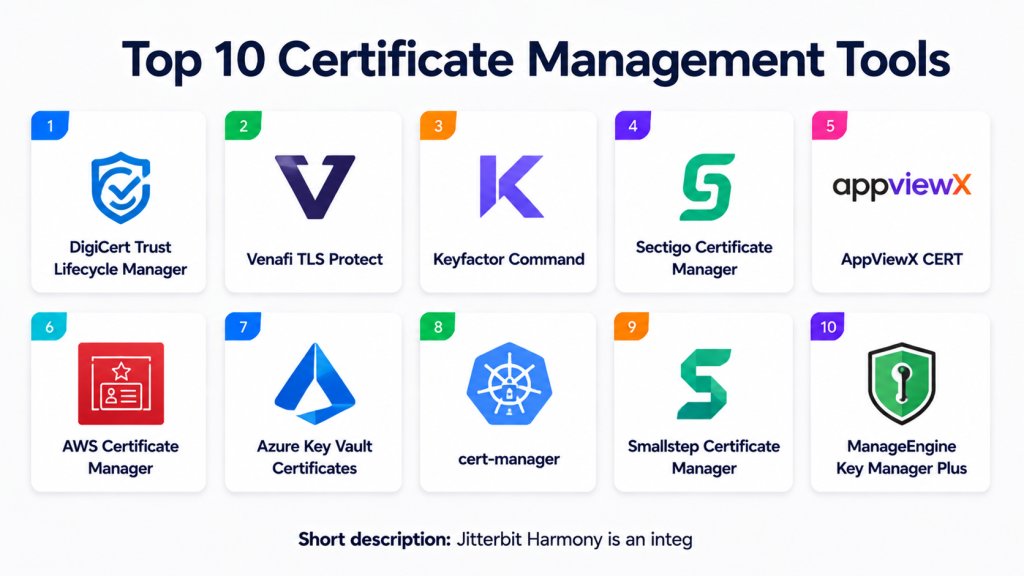
Top 10 Certificate Management Tools
#1 — DigiCert Trust Lifecycle Manager
Short description: DigiCert Trust Lifecycle Manager helps organizations manage digital certificates and trusted identities across complex environments. It is suited for enterprises that need centralized visibility, automation, and certificate governance.
Key Features
- Certificate discovery and inventory
- Lifecycle automation
- Public and private certificate management
- Policy-based governance
- Reporting and audit visibility
- Integration with enterprise systems
- Support for machine identity workflows
Pros
- Strong enterprise certificate management capabilities
- Useful for reducing certificate expiry risk
- Good fit for organizations using DigiCert certificates
Cons
- May be more than small teams need
- Enterprise setup can require planning
- Pricing is not always simple for smaller use cases
Platforms / Deployment
Web
Cloud / Enterprise options may vary
Security & Compliance
Supports enterprise security controls such as role-based access, audit visibility, and certificate policy management. Specific compliance certifications should be verified directly by buyers.
Integrations & Ecosystem
DigiCert works well in enterprise PKI and certificate lifecycle workflows.
- DigiCert certificate services
- Public certificate authority workflows
- Enterprise identity systems
- DevOps automation workflows
- API-based integrations
- IT operations processes
Support & Community
DigiCert provides enterprise documentation, onboarding resources, account support, and certificate lifecycle guidance.
#2 — Venafi TLS Protect
Short description: Venafi TLS Protect is a machine identity and certificate lifecycle management platform for organizations that need deep visibility and policy control across large certificate environments.
Key Features
- Certificate discovery
- TLS certificate lifecycle management
- Machine identity protection
- Policy enforcement
- Automated renewal workflows
- CA integrations
- Enterprise reporting and audit support
Pros
- Strong for large enterprise environments
- Excellent fit for machine identity security programs
- Helps reduce certificate outage and misconfiguration risk
Cons
- Can be complex for small teams
- Requires proper implementation planning
- Cost and packaging may vary
Platforms / Deployment
Web
Cloud / Self-hosted / Hybrid options may vary
Security & Compliance
Supports enterprise access control, auditability, policy enforcement, and machine identity governance. Specific certifications are not assumed here.
Integrations & Ecosystem
Venafi integrates across certificate authorities, DevOps pipelines, cloud systems, and security platforms.
- Public and private CAs
- Kubernetes workflows
- DevOps pipelines
- ITSM tools
- Cloud platforms
- Security operations workflows
Support & Community
Venafi provides enterprise support, technical documentation, partner ecosystem resources, and implementation guidance.
#3 — Keyfactor Command
Short description: Keyfactor Command is a certificate lifecycle automation and PKI management platform for enterprises managing certificates across hybrid and multi-cloud environments.
Key Features
- Certificate discovery and inventory
- Certificate lifecycle automation
- PKI management support
- Policy enforcement
- Reporting and compliance visibility
- CA integration
- API-driven automation
Pros
- Strong for enterprise PKI and certificate governance
- Good automation and reporting capabilities
- Useful for hybrid environments
Cons
- May require PKI knowledge for best use
- Enterprise deployment can take time
- Not ideal for teams needing only basic TLS renewal
Platforms / Deployment
Web
Cloud / Self-hosted / Hybrid options may vary
Security & Compliance
Supports role-based access, audit logs, policy control, and enterprise governance features. Specific compliance certifications should be verified by the buyer.
Integrations & Ecosystem
Keyfactor integrates with enterprise PKI, DevOps, cloud, and IT operations systems.
- Public and private CAs
- Microsoft PKI environments
- DevOps tools
- Cloud platforms
- Service management systems
- API-based workflows
Support & Community
Keyfactor offers enterprise documentation, onboarding, support plans, and professional services depending on customer requirements.
#4 — Sectigo Certificate Manager
Short description: Sectigo Certificate Manager helps organizations issue, monitor, renew, and manage certificates from a centralized platform. It is suited for businesses that need certificate visibility and automation across teams.
Key Features
- Centralized certificate management
- Public and private certificate support
- Automated issuance and renewal
- Certificate discovery
- Policy management
- Reporting and dashboards
- Multi-user administration
Pros
- Good fit for organizations using Sectigo services
- Helps reduce manual certificate work
- Useful for audit and visibility needs
Cons
- Best value may depend on existing Sectigo usage
- Enterprise configuration may require planning
- Some advanced details may vary by package
Platforms / Deployment
Web
Cloud / Enterprise options may vary
Security & Compliance
Supports enterprise certificate administration and access control features. Specific security certifications should be verified directly.
Integrations & Ecosystem
Sectigo supports certificate lifecycle workflows across IT and security environments.
- Sectigo certificate services
- Public certificate workflows
- Enterprise directory systems
- APIs
- DevOps workflows
- IT operations processes
Support & Community
Sectigo provides documentation, account support, certificate lifecycle resources, and enterprise assistance based on plan.
#5 — AppViewX CERT+
Short description: AppViewX CERT+ is a certificate lifecycle automation platform designed for enterprises that need visibility, workflow automation, and certificate control across complex environments.
Key Features
- Certificate discovery and monitoring
- Certificate lifecycle automation
- Workflow-based approvals
- Policy enforcement
- Expiry alerting
- CA integrations
- Reporting and dashboards
Pros
- Strong workflow automation capabilities
- Good fit for enterprise certificate operations
- Helps improve visibility across distributed systems
Cons
- May be too advanced for small teams
- Implementation requires process alignment
- Pricing and packaging may vary
Platforms / Deployment
Web
Cloud / Self-hosted / Hybrid options may vary
Security & Compliance
Supports enterprise controls such as role-based access, audit logs, and policy workflows. Specific certifications are not publicly stated here.
Integrations & Ecosystem
AppViewX integrates with certificate authorities, IT systems, and DevOps workflows.
- Public and private CAs
- ITSM tools
- Load balancers
- Cloud platforms
- DevOps pipelines
- API-based automation
Support & Community
AppViewX provides documentation, customer support, implementation assistance, and enterprise onboarding resources.
#6 — AWS Certificate Manager
Short description: AWS Certificate Manager helps users provision, manage, and renew TLS certificates for AWS services. It is a strong choice for teams running workloads primarily on AWS.
Key Features
- TLS certificate provisioning
- Automatic renewal for supported certificates
- Integration with AWS services
- Public and private certificate options
- Centralized certificate visibility in AWS
- Managed certificate lifecycle for supported services
- Useful for cloud-native applications
Pros
- Easy for AWS-based teams
- Reduces manual renewal effort
- Works well with common AWS services
Cons
- Best suited for AWS environments
- Less ideal for broad multi-cloud certificate governance
- External certificate visibility may be limited
Platforms / Deployment
Web
Cloud
Security & Compliance
Uses AWS identity and access management controls. Security and compliance depend on AWS service configuration and customer implementation.
Integrations & Ecosystem
AWS Certificate Manager integrates deeply with AWS-native services.
- Elastic Load Balancing
- Amazon CloudFront
- API Gateway
- AWS Private CA
- AWS IAM
- AWS automation workflows
Support & Community
AWS provides documentation, support options, cloud training resources, and a large community ecosystem.
#7 — Azure Key Vault Certificates
Short description: Azure Key Vault Certificates helps teams manage certificates, keys, and secrets within Microsoft Azure environments. It is useful for cloud teams that need secure certificate storage and lifecycle support.
Key Features
- Certificate storage and management
- Key and secret management
- Azure identity integration
- Certificate import and creation
- Access control policies
- Automation support
- Integration with Azure services
Pros
- Strong fit for Azure-based workloads
- Combines certificates, keys, and secrets
- Works well with Microsoft identity controls
Cons
- Best suited for Azure environments
- May not replace full enterprise certificate discovery tools
- Requires cloud security configuration knowledge
Platforms / Deployment
Web
Cloud
Security & Compliance
Supports Azure identity-based access control, encryption, access policies, and audit-related capabilities through Azure services. Specific compliance depends on service usage and configuration.
Integrations & Ecosystem
Azure Key Vault Certificates integrates with Azure services and DevOps workflows.
- Azure App Service
- Azure Kubernetes Service
- Azure DevOps
- Microsoft Entra ID
- Azure automation
- Application Gateway
Support & Community
Microsoft provides documentation, support plans, cloud learning resources, and a large technical community.
#8 — cert-manager
Short description: cert-manager is an open-source certificate management controller for Kubernetes. It automates certificate issuance and renewal inside Kubernetes clusters.
Key Features
- Kubernetes-native certificate automation
- Automatic certificate renewal
- Integration with certificate issuers
- Supports ACME workflows
- Works with Kubernetes secrets
- Declarative configuration
- Strong fit for cloud-native workloads
Pros
- Excellent for Kubernetes environments
- Open-source and widely adopted
- Automates certificate lifecycle inside clusters
Cons
- Focused mainly on Kubernetes
- Requires Kubernetes knowledge
- Not a full enterprise certificate inventory platform
Platforms / Deployment
Kubernetes / Linux
Self-hosted within Kubernetes
Security & Compliance
Security depends on Kubernetes configuration, RBAC, secret management, and issuer setup. Formal compliance certifications are not publicly stated for the open-source project.
Integrations & Ecosystem
cert-manager integrates with Kubernetes-native and certificate issuer workflows.
- Kubernetes
- ACME issuers
- Let’s Encrypt
- HashiCorp Vault
- Private CAs
- Ingress controllers
Support & Community
cert-manager has strong open-source documentation, community support, and broad adoption in Kubernetes environments.
#9 — Smallstep Certificate Manager
Short description: Smallstep Certificate Manager helps teams automate private certificate authority workflows and manage certificates for internal systems, workloads, and devices.
Key Features
- Private certificate authority workflows
- Certificate issuance and renewal
- Developer-friendly tooling
- Identity-based certificate automation
- Internal TLS support
- API and CLI workflows
- Useful for zero-trust environments
Pros
- Strong for internal PKI and developer workflows
- Good fit for modern infrastructure teams
- Useful for private certificates and workload identity
Cons
- May require PKI and identity planning
- Not always needed for simple public TLS use cases
- Advanced enterprise requirements may vary by plan
Platforms / Deployment
Web / CLI
Cloud / Self-hosted options may vary
Security & Compliance
Supports secure certificate workflows and access control features depending on deployment. Specific certifications are not assumed here.
Integrations & Ecosystem
Smallstep integrates well with developer, infrastructure, and identity workflows.
- Kubernetes
- SSH workflows
- Internal services
- DevOps automation
- APIs
- Private PKI environments
Support & Community
Smallstep provides documentation, developer resources, community materials, and support options depending on edition or plan.
#10 — ManageEngine Key Manager Plus
Short description: ManageEngine Key Manager Plus is a key and certificate management solution for IT teams that need certificate discovery, expiry tracking, SSH key management, and centralized control.
Key Features
- SSL certificate discovery
- Certificate expiry monitoring
- Certificate inventory
- SSH key management
- Alerts and reporting
- Access control
- Centralized administration
Pros
- Useful for IT operations teams
- Combines certificate and key management
- Good for visibility and expiry prevention
Cons
- May not be as DevOps-native as some tools
- Advanced cloud-native use cases may need additional tools
- User experience depends on environment setup
Platforms / Deployment
Web / Windows / Linux
Self-hosted
Security & Compliance
Supports access control, audit-related visibility, and centralized administration. Specific compliance certifications are not publicly stated here.
Integrations & Ecosystem
ManageEngine Key Manager Plus works well with IT operations and infrastructure workflows.
- Windows and Linux servers
- Network systems
- Certificate stores
- SSH key environments
- IT operations processes
- Reporting workflows
Support & Community
ManageEngine provides documentation, support resources, product updates, and customer assistance options.
Comparison Table
| Tool Name | Best For | Platform(s) Supported | Deployment | Standout Feature | Public Rating |
|---|---|---|---|---|---|
| DigiCert Trust Lifecycle Manager | Enterprise certificate governance | Web | Cloud / Enterprise options vary | Centralized certificate lifecycle control | N/A |
| Venafi TLS Protect | Machine identity and TLS security | Web | Cloud / Self-hosted / Hybrid varies | Enterprise machine identity protection | N/A |
| Keyfactor Command | PKI and certificate lifecycle automation | Web | Cloud / Self-hosted / Hybrid varies | Strong PKI automation | N/A |
| Sectigo Certificate Manager | Centralized certificate management | Web | Cloud / Enterprise options vary | Public and private certificate management | N/A |
| AppViewX CERT+ | Workflow-driven certificate operations | Web | Cloud / Self-hosted / Hybrid varies | Certificate workflow automation | N/A |
| AWS Certificate Manager | AWS cloud certificate management | Web | Cloud | AWS-native certificate automation | N/A |
| Azure Key Vault Certificates | Azure certificate, key, and secret workflows | Web | Cloud | Azure-native certificate storage | N/A |
| cert-manager | Kubernetes certificate automation | Kubernetes / Linux | Self-hosted | Kubernetes-native certificate renewal | N/A |
| Smallstep Certificate Manager | Internal PKI and workload certificates | Web / CLI | Cloud / Self-hosted varies | Developer-friendly private PKI | N/A |
| ManageEngine Key Manager Plus | IT certificate and SSH key management | Web / Windows / Linux | Self-hosted | Certificate expiry and key visibility | N/A |
Evaluation & Scoring of Certificate Management Tools
| Tool Name | Core (25%) | Ease (15%) | Integrations (15%) | Security (10%) | Performance (10%) | Support (10%) | Value (15%) | Weighted Total (0–10) |
|---|---|---|---|---|---|---|---|---|
| DigiCert Trust Lifecycle Manager | 9 | 8 | 8 | 9 | 8 | 9 | 7 | 8.30 |
| Venafi TLS Protect | 10 | 7 | 9 | 10 | 9 | 9 | 7 | 8.75 |
| Keyfactor Command | 9 | 7 | 9 | 9 | 8 | 8 | 7 | 8.25 |
| Sectigo Certificate Manager | 8 | 8 | 8 | 8 | 8 | 8 | 8 | 8.00 |
| AppViewX CERT+ | 9 | 7 | 9 | 9 | 8 | 8 | 7 | 8.25 |
| AWS Certificate Manager | 8 | 9 | 8 | 8 | 9 | 8 | 9 | 8.40 |
| Azure Key Vault Certificates | 8 | 8 | 8 | 9 | 9 | 8 | 8 | 8.25 |
| cert-manager | 8 | 7 | 8 | 7 | 8 | 7 | 9 | 7.75 |
| Smallstep Certificate Manager | 8 | 8 | 8 | 8 | 8 | 7 | 8 | 7.95 |
| ManageEngine Key Manager Plus | 7 | 8 | 7 | 7 | 8 | 8 | 8 | 7.55 |
These scores are comparative and should not be treated as universal rankings. A tool with a lower score may still be the best fit for a specific environment. For example, cert-manager is excellent for Kubernetes even if it is not a full enterprise certificate governance platform. AWS Certificate Manager and Azure Key Vault Certificates are strong for cloud-native teams, while Venafi, Keyfactor, DigiCert, and AppViewX are better suited for broader enterprise certificate lifecycle needs.
Which Certificate Management Tool Is Right for You?
Solo / Freelancer
Solo users usually need simple certificate issuance and renewal without complex governance. AWS Certificate Manager, Azure Key Vault Certificates, cert-manager, or Smallstep may be practical depending on the environment.
For a simple website or cloud application, a native cloud certificate service is often enough. For Kubernetes projects, cert-manager is usually a practical option.
SMB
Small and medium businesses should focus on certificate visibility, renewal alerts, and simple automation. Sectigo Certificate Manager, ManageEngine Key Manager Plus, AWS Certificate Manager, Azure Key Vault Certificates, and Smallstep Certificate Manager can be good options.
The right choice depends on whether the business is cloud-native, IT-operations focused, or running hybrid infrastructure.
Mid-Market
Mid-market teams often manage certificates across applications, internal systems, APIs, cloud environments, and development pipelines. AppViewX CERT+, Keyfactor Command, DigiCert Trust Lifecycle Manager, Sectigo Certificate Manager, and Smallstep Certificate Manager are worth evaluating.
Teams using Kubernetes should also consider cert-manager as part of their platform automation strategy.
Enterprise
Enterprises usually need discovery, automation, policy enforcement, audit logs, CA integrations, access control, and workflow governance. Venafi TLS Protect, Keyfactor Command, DigiCert Trust Lifecycle Manager, AppViewX CERT+, and Sectigo Certificate Manager are strong enterprise options.
Large organizations should prioritize tools that support multi-CA environments, hybrid infrastructure, APIs, reporting, and ownership tracking.
Budget vs Premium
Budget-focused teams may prefer cert-manager, cloud-native certificate services, or self-hosted IT tools. These can work well when the team has enough technical skill to manage configuration and operations.
Premium-focused teams should evaluate Venafi, Keyfactor, DigiCert, AppViewX, and Sectigo when they need advanced governance, enterprise support, compliance reporting, and large-scale automation.
Feature Depth vs Ease of Use
For ease of use, AWS Certificate Manager, Azure Key Vault Certificates, Sectigo Certificate Manager, and ManageEngine Key Manager Plus are strong options depending on environment.
For feature depth, Venafi TLS Protect, Keyfactor Command, DigiCert Trust Lifecycle Manager, and AppViewX CERT+ provide stronger enterprise certificate lifecycle capabilities.
Integrations & Scalability
Organizations should check integration with certificate authorities, cloud providers, CI/CD pipelines, Kubernetes, load balancers, secrets managers, ITSM systems, and monitoring tools.
For cloud-first teams, AWS Certificate Manager and Azure Key Vault Certificates are strong. For Kubernetes-first teams, cert-manager is practical. For large enterprise environments, Venafi, Keyfactor, DigiCert, and AppViewX offer broader integration potential.
Security & Compliance Needs
Security-focused teams should prioritize role-based access, audit logs, certificate ownership, automated renewal, policy enforcement, and certificate discovery.
Compliance-focused organizations should also evaluate reporting, approval workflows, inventory completeness, and support for internal PKI requirements.
Frequently Asked Questions
What is a certificate management tool?
A certificate management tool helps teams issue, renew, monitor, and control digital certificates. It reduces the risk of expired, misconfigured, or unmanaged certificates.
Why is certificate management important?
Certificates protect encrypted communication between systems. If a certificate expires or is mismanaged, websites, APIs, applications, and internal services may fail.
What types of certificates can these tools manage?
Many tools manage TLS certificates, private certificates, internal PKI certificates, and certificates used by applications, servers, devices, and cloud services.
Do small businesses need certificate management tools?
Small businesses may need them if they manage multiple websites, applications, servers, or cloud services. If they only have one simple site with automatic TLS, a full platform may not be necessary.
What is certificate lifecycle automation?
Certificate lifecycle automation means automating certificate issuance, renewal, deployment, monitoring, and replacement. It helps prevent manual errors and outages.
What is the difference between public and private certificates?
Public certificates are issued by public certificate authorities and are commonly used for websites. Private certificates are used internally for systems, applications, devices, and private services.
Can certificate management tools work with Kubernetes?
Yes, some tools support Kubernetes directly or through integrations. cert-manager is especially popular for Kubernetes-native certificate automation.
What are common mistakes in certificate management?
Common mistakes include relying on spreadsheets, missing renewal dates, not assigning certificate ownership, using weak policies, and failing to monitor certificates across all environments.
Can cloud-native tools replace enterprise certificate platforms?
Cloud-native tools are useful inside specific cloud environments. Enterprises with multi-cloud, hybrid, or multi-CA needs may still require broader certificate lifecycle platforms.
How should teams choose a certificate management tool?
Teams should review certificate volume, cloud strategy, compliance needs, CA requirements, automation goals, and integration needs before choosing a tool.
Are certificate management tools only for security teams?
No. They are useful for security, DevOps, platform engineering, IT operations, cloud teams, compliance teams, and application owners.
What is the best alternative to a paid certificate management platform?
Open-source or cloud-native options may work for smaller teams. However, larger organizations often need enterprise governance, support, reporting, and policy control.
Conclusion
Certificate management tools are essential for organizations that rely on secure digital communication across websites, APIs, cloud systems, internal applications, Kubernetes workloads, and enterprise infrastructure. The right tool can reduce outage risk, improve certificate visibility, automate renewal, support compliance, and strengthen machine identity security.Venafi TLS Protect, Keyfactor Command, DigiCert Trust Lifecycle Manager, AppViewX CERT+, and Sectigo Certificate Manager are strong options for enterprise certificate lifecycle management. AWS Certificate Manager and Azure Key Vault Certificates are practical for cloud-native teams. cert-manager is a strong Kubernetes-focused choice, while Smallstep Certificate Manager supports modern internal PKI workflows. ManageEngine Key Manager Plus is useful for IT teams that need certificate and key visibility.
