Upgrade & Secure Your Future with DevOps, SRE, DevSecOps, MLOps!
We spend hours scrolling social media and waste money on things we forget, but won’t spend 30 minutes a day earning certifications that can change our lives.
Master in DevOps, SRE, DevSecOps & MLOps by DevOps School!
Learn from Guru Rajesh Kumar and double your salary in just one year.
Introduction
Log management tools are platforms that collect, store, analyze, and visualize log data generated by applications, servers, networks, and cloud systems. In plain English, these tools help teams understand system behavior, troubleshoot issues, and gain insights from raw log data in real time.
With complex, distributed architectures, hybrid clouds, and microservices, log management has become critical for maintaining uptime, performance, and security. Logs provide the context needed for troubleshooting incidents, monitoring compliance, and detecting anomalies.
Common real-world use cases include:
- Aggregating logs from multiple sources for centralized visibility
- Troubleshooting errors and system failures
- Monitoring application and infrastructure performance
- Security monitoring and anomaly detection
- Compliance reporting and audit trails
Buyers should evaluate:
- Log collection and ingestion capabilities
- Storage and retention policies
- Real-time search and analytics
- Alerting and notification systems
- Scalability for large data volumes
- Security and access control
- Integration with cloud, containers, and CI/CD
- Query and visualization features
- Ease of deployment and use
- Cost and licensing model
Best for: DevOps teams, SREs, IT operations, cloud engineers, security teams, mid-market and enterprise organizations, and businesses running multi-cloud or distributed environments.
Not ideal for: very small applications with minimal logging needs, teams that only require local log files, or organizations that do not require centralized logging and analytics.
Key Trends in Log Management Tools
AI-driven log analysis is increasingly used to detect anomalies, errors, and patterns automatically.
- Integration with observability platforms allows combined metrics, traces, and logs for full-stack visibility.
- Cloud-native log collection is becoming essential as workloads migrate to Kubernetes, serverless, and hybrid clouds.
- Scalable storage and retention enables organizations to maintain long-term logs for auditing and compliance.
- Predictive analytics are applied to log trends for proactive incident management.
- Enhanced security and compliance features ensure logs are tamper-proof and audit-ready.
- Open-source log collection adoption remains strong, especially with ELK and Fluentd ecosystems.
- Centralized dashboards and visualization improve operational insights and cross-team collaboration.
- Automated alerting and incident response integrates log data into DevOps workflows.
- Interoperable logging standards like OpenTelemetry enable consistent collection across multiple platforms.
How We Selected These Tools
The “Top 10” log management platforms were chosen based on:
- Market adoption and user mindshare
- Completeness of features for log ingestion, analysis, and visualization
- Performance and reliability signals for high-volume log environments
- Security posture, including access control, encryption, and auditability
- Integration support with cloud, CI/CD, and DevOps pipelines
- Flexibility across SMB, mid-market, and enterprise environments
- Support for AI-driven insights and anomaly detection
- Developer and operational team usability
- Compatibility with containerized and microservices workloads
- Community and vendor support resources
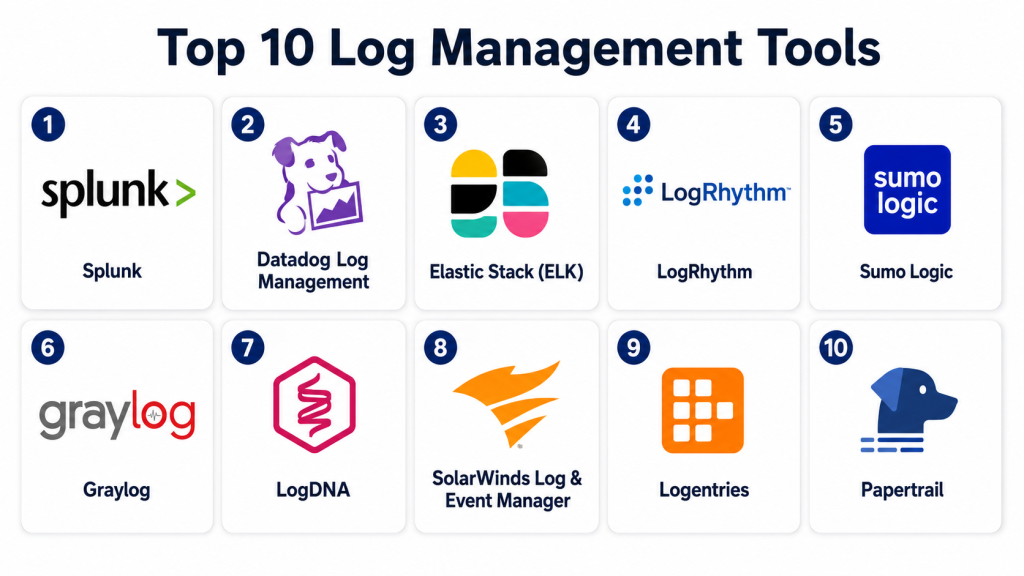
Top 10 Log Management Tools
#1 — Splunk
Short description: Splunk provides a comprehensive platform for collecting, indexing, and analyzing machine-generated log data. Ideal for large enterprises requiring real-time insights and analytics.
Key Features
- Centralized log aggregation
- Real-time search and analytics
- AI-driven anomaly detection
- Dashboarding and visualization
- Alerts and notifications
- Security monitoring capabilities
- API access for automation
Pros
- Scalable for large log volumes
- Powerful analytics and search features
- Enterprise-grade security and compliance support
Cons
- High cost for extensive data volumes
- Steep learning curve for advanced features
- On-premises setup can be complex
Platforms / Deployment
Web / Linux / Windows / macOS
Cloud / Self-hosted / Hybrid
Security & Compliance
Supports SSO, RBAC, encryption, audit logs, SOC 2, ISO 27001, GDPR.
Integrations & Ecosystem
- AWS, Azure, GCP
- CI/CD pipelines
- Security platforms
- ITSM tools
- Custom API integrations
Support & Community
Enterprise support, professional services, extensive documentation, active user community.
#2 — Datadog Log Management
Short description: Datadog offers centralized log management integrated with monitoring and observability features. Suited for cloud-native and containerized workloads.
Key Features
- Centralized log aggregation
- Real-time analytics
- Integrated metrics and traces
- AI-based anomaly detection
- Dashboarding and visualization
- Alerts and monitoring
- CI/CD integration
Pros
- Unified observability with logs, metrics, and traces
- Strong SaaS platform with cloud-native support
- AI-assisted insights for quick troubleshooting
Cons
- Cost can scale with data ingestion
- Complexity in setting up alert rules for large teams
- Enterprise policies may require configuration
Platforms / Deployment
Web / Linux / Windows / macOS
Cloud / Hybrid
Security & Compliance
Supports SSO, MFA, RBAC, encryption, SOC 2, ISO 27001.
Integrations & Ecosystem
- AWS, Azure, GCP
- Kubernetes and Docker
- Slack, Jira, PagerDuty
- Terraform, Ansible
- REST APIs for automation
Support & Community
Comprehensive documentation, enterprise support, active community, and onboarding resources.
#3 — Elastic Stack (ELK)
Short description: ELK Stack (Elasticsearch, Logstash, Kibana) is an open-source log management solution providing collection, indexing, and visualization of logs. Ideal for developers and SMBs.
Key Features
- Log ingestion via Logstash or Beats
- Scalable indexing and search via Elasticsearch
- Visualization with Kibana dashboards
- Alerting and anomaly detection
- Multi-source log aggregation
- Open-source extensibility
- Integration with monitoring pipelines
Pros
- Flexible and open-source
- Strong community support
- Customizable for diverse workflows
Cons
- Requires operational expertise to deploy and maintain
- Scaling large environments may need additional resources
- Advanced features may require paid subscriptions
Platforms / Deployment
Linux / Windows / macOS
Self-hosted / Cloud
Security & Compliance
SSO, RBAC, encryption supported. Certifications depend on deployment.
Integrations & Ecosystem
- Kubernetes, Docker
- CI/CD pipelines
- Alerting platforms
- Cloud providers
- APIs and custom plugins
Support & Community
Open-source community, documentation, professional subscriptions available.
#4 — LogRhythm
Short description: LogRhythm provides security-focused log management and SIEM capabilities. Best for organizations needing centralized log analysis with security analytics.
Key Features
- Centralized log aggregation
- Security event correlation
- Real-time monitoring and alerts
- Dashboard and reporting
- Compliance management
- AI-based anomaly detection
- Threat detection workflows
Pros
- Strong SIEM and security integration
- Good for compliance reporting
- Real-time threat detection
Cons
- More expensive than open-source solutions
- Complex configuration for large environments
- Learning curve for full SIEM features
Platforms / Deployment
Web / Linux / Windows
Cloud / Self-hosted / Hybrid
Security & Compliance
Supports SSO, MFA, RBAC, encryption, audit logs, SOC 2, ISO 27001.
Integrations & Ecosystem
- Cloud providers
- Security platforms
- ITSM tools
- CI/CD pipelines
- API automation
Support & Community
Documentation, enterprise support, professional services, and community forums.
#5 — Sumo Logic
Short description: Sumo Logic is a cloud-native log management and analytics platform offering real-time monitoring, alerting, and AI-driven insights. Ideal for DevOps teams.
Key Features
- Real-time log aggregation
- Cloud-native analytics
- AI-based anomaly detection
- Custom dashboards and alerts
- Multi-source log collection
- Compliance reporting
- API-driven automation
Pros
- SaaS-based with minimal setup
- AI-assisted analytics
- Scalable for cloud-native environments
Cons
- May have subscription costs for high volume
- Advanced analytics require expertise
- Some integrations may need configuration
Platforms / Deployment
Web
Cloud
Security & Compliance
SSO, MFA, RBAC, encryption, SOC 2, ISO 27001 supported.
Integrations & Ecosystem
- AWS, Azure, GCP
- Kubernetes, Docker
- Slack, Jira, PagerDuty
- CI/CD pipelines
- APIs and custom integrations
Support & Community
Enterprise support, documentation, professional services, and community forums.
#6 — Graylog
Short description: Graylog is an open-source log management platform designed for centralizing logs, analyzing data, and enabling alerts. Suited for SMBs and developers.
Key Features
- Centralized log storage
- Search and analytics
- Alerting and notification
- Dashboards and visualization
- Scalable architecture
- Multi-source log ingestion
- API access for automation
Pros
- Open-source flexibility
- Easy to deploy for small to medium environments
- Strong community support
Cons
- Scaling very large environments requires careful planning
- Enterprise features require paid subscription
- Setup may require technical expertise
Platforms / Deployment
Linux / Windows / macOS
Self-hosted / Cloud
Security & Compliance
Supports SSO, RBAC, encryption. Compliance certifications vary by deployment.
Integrations & Ecosystem
- CI/CD pipelines
- Kubernetes, Docker
- Alerting tools
- Cloud providers
- APIs for custom workflows
Support & Community
Open-source community, documentation, enterprise support plans.
#7 — LogDNA
Short description: LogDNA provides cloud-based log aggregation, search, and analysis for modern applications. Ideal for DevOps and cloud-native teams.
Key Features
- Centralized log collection
- Real-time search and filtering
- Alerting and monitoring
- Dashboard visualization
- Kubernetes and container support
- API and SDK integrations
- Retention and archival options
Pros
- SaaS-based and easy to deploy
- Strong for cloud-native applications
- Integrates with CI/CD pipelines
Cons
- Data ingestion costs can increase with volume
- Limited on-premises deployment options
- Advanced analytics may require technical setup
Platforms / Deployment
Web / Linux / Windows / macOS
Cloud
Security & Compliance
SSO, RBAC, encryption supported. Certifications depend on plan.
Integrations & Ecosystem
- Kubernetes, Docker
- AWS, Azure, GCP
- Slack, PagerDuty
- CI/CD pipelines
- API access for automation
Support & Community
Documentation, professional support, onboarding resources, and community forums.
#8 — SolarWinds Log & Event Manager
Short description: SolarWinds Log & Event Manager offers log collection, analysis, and SIEM capabilities. Best for IT operations and security teams.
Key Features
- Centralized log aggregation
- Event correlation
- Real-time alerts
- Dashboards and reporting
- Security analytics
- Compliance management
- Automated responses
Pros
- Strong security and compliance focus
- Enterprise IT operations support
- Automated alerts reduce manual monitoring
Cons
- On-premises deployment can be complex
- Licensing cost may be high
- Advanced features require configuration
Platforms / Deployment
Windows / Linux / Web
Self-hosted / Hybrid
Security & Compliance
Supports SSO, MFA, RBAC, encryption, SOC 2, ISO 27001.
Integrations & Ecosystem
- Cloud platforms
- Security and ITSM tools
- CI/CD pipelines
- API integrations
- Alerting workflows
Support & Community
Enterprise support, documentation, training, and professional services.
#9 — Logentries
Short description: Logentries is a cloud-based log management and analytics platform designed for DevOps and SaaS teams needing real-time log insights.
Key Features
- Centralized log aggregation
- Real-time search and filtering
- Alerts and notifications
- Dashboarding
- API access for automation
- Multi-source log ingestion
- Cloud-native architecture
Pros
- SaaS-based with quick setup
- Ideal for cloud-native workloads
- Provides real-time monitoring
Cons
- High ingestion costs for large log volumes
- Limited on-premises support
- Advanced analytics features may require paid plan
Platforms / Deployment
Web / Linux / Windows / macOS
Cloud
Security & Compliance
SSO, RBAC, encryption supported. Formal compliance certifications vary by plan.
Integrations & Ecosystem
- Kubernetes, Docker
- AWS, Azure, GCP
- CI/CD pipelines
- Alerting tools
- APIs for custom integration
Support & Community
Documentation, professional support, cloud onboarding resources, and community forums.
#10 — Papertrail
Short description: Papertrail provides cloud-hosted log aggregation and real-time search for applications, servers, and cloud systems. Ideal for SMBs and development teams.
Key Features
- Log aggregation from multiple sources
- Real-time search and tailing
- Alerts and notifications
- Cloud-based dashboards
- Integration with DevOps tools
- Simple API and web interface
- Retention and archival
Pros
- Easy to deploy and use
- SaaS-based with minimal setup
- Good for small to medium teams
Cons
- Limited advanced analytics
- SaaS-only may not suit all compliance needs
- Scaling for high-volume enterprise use requires plan adjustment
Platforms / Deployment
Web / Linux / Windows / macOS
Cloud
Security & Compliance
Supports encryption, RBAC, SSO. Certifications depend on SaaS provider.
Integrations & Ecosystem
- AWS, Azure, GCP
- CI/CD pipelines
- Slack, PagerDuty
- APIs for automation
- Cloud-native services
Support & Community
Documentation, onboarding resources, professional support options, and community forums.
Comparison Table
| Tool Name | Best For | Platform(s) Supported | Deployment | Standout Feature | Public Rating |
|---|---|---|---|---|---|
| Splunk | Enterprise log analytics | Web / Linux / Windows / macOS | Cloud / Self-hosted / Hybrid | Scalable log analytics | N/A |
| Datadog Log Management | Cloud-native observability | Web / Linux / Windows / macOS | Cloud / Hybrid | Unified logs with metrics/traces | N/A |
| ELK Stack | Open-source log collection | Linux / Windows / macOS | Self-hosted / Cloud | Open-source extensibility | N/A |
| LogRhythm | Security-focused logging | Web / Linux / Windows | Cloud / Self-hosted / Hybrid | SIEM integration | N/A |
| Sumo Logic | Cloud-native analytics | Web | Cloud | Real-time AI-assisted log insights | N/A |
| Graylog | Open-source log analytics | Linux / Windows / macOS | Self-hosted / Cloud | Flexible open-source log management | N/A |
| LogDNA | Cloud-based logs | Web / Linux / Windows / macOS | Cloud | Cloud-native log aggregation | N/A |
| SolarWinds LEM | IT and security ops | Windows / Linux / Web | Self-hosted / Hybrid | Security and compliance-focused | N/A |
| Logentries | SaaS log management | Web / Linux / Windows / macOS | Cloud | Real-time log search | N/A |
| Papertrail | SMB and developer logs | Web / Linux / Windows / macOS | Cloud | Easy setup and real-time tailing | N/A |
Evaluation & Scoring of Log Management Tools
| Tool Name | Core (25%) | Ease (15%) | Integrations (15%) | Security (10%) | Performance (10%) | Support (10%) | Value (15%) | Weighted Total (0–10) |
|---|---|---|---|---|---|---|---|---|
| Splunk | 9 | 7 | 8 | 9 | 9 | 8 | 7 | 8.25 |
| Datadog | 9 | 8 | 9 | 8 | 8 | 8 | 7 | 8.35 |
| ELK Stack | 8 | 7 | 8 | 7 | 8 | 6 | 9 | 7.75 |
| LogRhythm | 9 | 7 | 8 | 9 | 8 | 8 | 7 | 8.20 |
| Sumo Logic | 8 | 8 | 8 | 8 | 8 | 8 | 7 | 8.00 |
| Graylog | 8 | 8 | 7 | 7 | 8 | 6 | 8 | 7.60 |
| LogDNA | 8 | 8 | 8 | 7 | 8 | 7 | 7 | 7.75 |
| SolarWinds LEM | 9 | 7 | 7 | 9 | 8 | 8 | 7 | 8.10 |
| Logentries | 8 | 8 | 7 | 7 | 8 | 7 | 7 | 7.65 |
| Papertrail | 7 | 8 | 7 | 7 | 7 | 6 | 8 | 7.40 |
These scores are comparative and indicate the relative strengths of each tool across features, ease of use, integrations, security, and value.
Which Log Management Tool Is Right for You?
Solo / Freelancer
Prometheus, Papertrail, and Logentries are lightweight options for small-scale deployments, easy to set up, and cost-effective.
SMB
Graylog, LogDNA, Sumo Logic, and ELK Stack provide centralized log aggregation with dashboards and alerts suitable for SMBs.
Mid-Market
Datadog, Sumo Logic, LogRhythm, and ELK Stack are ideal for teams needing distributed logging, real-time alerts, and cloud-native integration.
Enterprise
Splunk, Datadog, LogRhythm, Sumo Logic, and SolarWinds LEM provide enterprise-grade security, scalability, AI insights, and compliance features.
Budget vs Premium
Open-source and SaaS tools like ELK Stack, Graylog, Papertrail, and Logentries suit budget-conscious teams. Premium tools offer advanced analytics, AI-driven insights, and enterprise support.
Feature Depth vs Ease of Use
For simplicity, LogDNA, Papertrail, and Logentries are practical. For full analytics, correlation, and compliance workflows, Splunk, Datadog, Sumo Logic, and LogRhythm are better suited.
Integrations & Scalability
Teams should evaluate cloud, container, CI/CD, and third-party integrations. Splunk, Datadog, Sumo Logic, and ELK Stack provide strong integration ecosystems.
Security & Compliance Needs
Teams with compliance requirements should prioritize Splunk, LogRhythm, Sumo Logic, and SolarWinds LEM for enterprise-grade auditing, RBAC, and encryption.
Frequently Asked Questions
What is a log management tool?
A log management tool collects, stores, and analyzes system and application logs for troubleshooting, monitoring, and security.
Why is log management important?
Logs provide visibility into system behavior, performance, and security. Proper management prevents downtime and aids incident response.
Can these tools monitor cloud-native environments?
Yes. Most modern log management tools support cloud, containers, and Kubernetes environments.
Do these tools support real-time alerting?
Yes. They can send notifications and alerts for anomalies, errors, and predefined thresholds.
Are open-source tools sufficient?
Open-source tools like ELK Stack and Graylog can meet basic requirements. Enterprises often need additional analytics and support from premium platforms.
Can these tools integrate with CI/CD?
Yes. Log management tools can integrate with CI/CD pipelines to track deployments and detect issues early.
How scalable are log management platforms?
Premium tools like Splunk, Datadog, and Sumo Logic scale well for large, high-volume environments. Open-source solutions may require additional infrastructure.
Do these tools support compliance reporting?
Many platforms support SOC 2, ISO 27001, and GDPR reporting, depending on deployment and subscription.
What is the difference between log management and observability?
Log management focuses on collecting and analyzing logs, while observability combines logs, metrics, and traces to provide full system visibility.
How should I choose the right log management tool?
Evaluate log volume, environment complexity, integration needs, budget, and security/compliance requirements before selecting a tool.
Conclusion
Log management tools are vital for maintaining visibility, performance, and security in modern software environments. Splunk, Datadog, and Sumo Logic excel for enterprises with large-scale, cloud-native deployments. ELK Stack, Graylog, and Papertrail are effective for SMBs or open-source use. LogRhythm and SolarWinds LEM provide strong security and compliance integration. The best tool depends on deployment scale, environment, budget, and required integrations.
