Upgrade & Secure Your Future with DevOps, SRE, DevSecOps, MLOps!
We spend hours scrolling social media and waste money on things we forget, but won’t spend 30 minutes a day earning certifications that can change our lives.
Master in DevOps, SRE, DevSecOps & MLOps by DevOps School!
Learn from Guru Rajesh Kumar and double your salary in just one year.
Introduction
Firewall Management Tools are specialized software platforms that help organizations configure, monitor, and optimize firewall policies across on-premises, cloud, and hybrid environments. In simple terms, these tools centralize firewall operations, enforce security policies, detect anomalies, and automate routine firewall management tasks.
With cyber threats evolving rapidly in , organizations must maintain strict network security while minimizing manual overhead. Firewall management tools help reduce human error, ensure compliance, and provide actionable insights for security teams.
Common real-world use cases include:
- Centralized management of multiple firewall devices and vendors
- Automated rule deployment and policy enforcement
- Real-time monitoring for network anomalies and attacks
- Audit and compliance reporting
- Optimization of firewall rules for performance and security
Buyers should evaluate:
- Multi-vendor firewall support
- Centralized policy management
- Automated rule analysis and deployment
- Real-time monitoring and alerting
- Reporting and compliance dashboards
- Integration with SIEM, network, and cloud platforms
- Scalability for enterprise or multi-site networks
- Role-based access control
- Logging, audit, and version control
- Ease of deployment and user experience
Best for: Security teams, network administrators, managed security service providers (MSSPs), and enterprises managing multi-vendor firewalls.
Not ideal for: Small businesses with minimal firewall infrastructure, single-vendor environments, or simple networks that do not require centralized management.
Key Trends in Firewall Management Tools
AI-driven policy analysis and anomaly detection
- Automation of rule updates and conflict resolution
- Integration with cloud-native security tools and SD-WAN
- Enhanced multi-vendor firewall support
- Real-time threat intelligence feeds for proactive defense
- Centralized logging, audit, and compliance reporting
- Role-based access and workflow automation for large teams
- Multi-site and hybrid network visualization
- Subscription-based SaaS deployment models
- Predictive optimization of firewall rules for performance
How We Selected These Tools
The top 10 firewall management tools were selected based on:
- Market adoption and mindshare among enterprises
- Feature completeness including automation, monitoring, and reporting
- Reliability and performance across complex network environments
- Security posture and compliance features
- Integrations with SIEM, ITSM, cloud, and monitoring platforms
- Ease of use and deployment
- Scalability for multi-site, multi-vendor, and hybrid networks
- Logging, audit, and version control capabilities
- Vendor support, documentation, and community resources
- AI-driven analytics or predictive security features
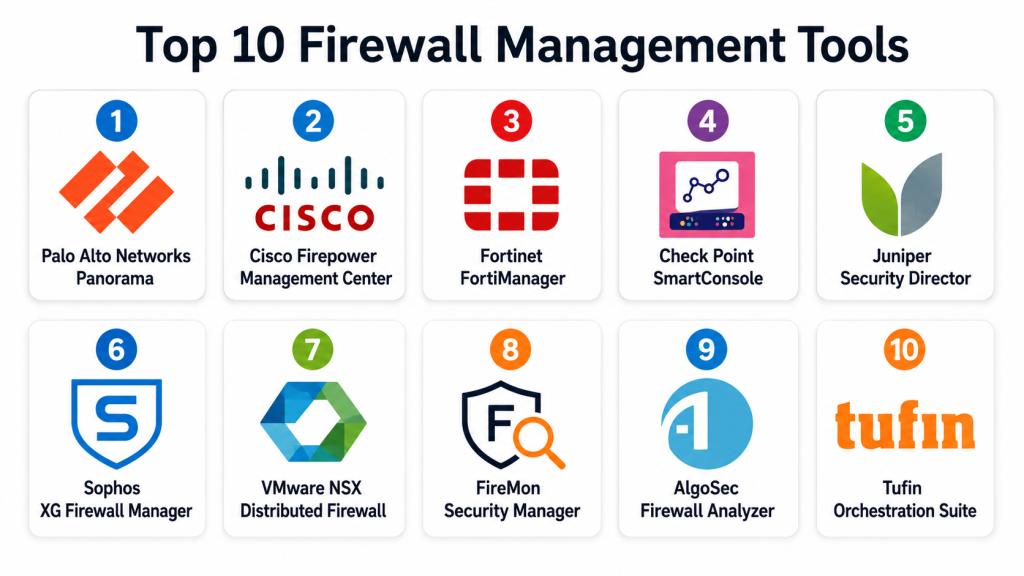
Top 10 Firewall Management Tools
#1 — Palo Alto Networks Panorama
Short description: Panorama provides centralized management for Palo Alto Networks firewalls, offering policy management, reporting, and automation.
Key Features
- Centralized policy deployment
- Automated rule updates and conflict resolution
- Multi-site and hybrid network support
- Threat intelligence integration
- Real-time monitoring and alerts
- Reporting and compliance dashboards
- Role-based access control
Pros
- Enterprise-grade security features
- Seamless integration with Palo Alto devices
- Scalable for large networks
Cons
- Vendor-specific to Palo Alto
- Premium pricing
- Requires training for advanced features
Platforms / Deployment
Web / Windows / Linux
Cloud / Self-hosted / Hybrid
Security & Compliance
SSO, RBAC, encryption; SOC 2 Not publicly stated.
Integrations & Ecosystem
- SIEM and network monitoring
- Cloud security platforms
- APIs for automation
Support & Community
Enterprise support, training resources, and community forums.
#2 — Cisco Firepower Management Center
Short description: Cisco FMC provides centralized firewall policy management, threat detection, and reporting for Cisco firewalls.
Key Features
- Centralized rule and policy management
- Automated threat intelligence updates
- Real-time monitoring and alerts
- Multi-vendor and multi-site support
- Analytics and reporting dashboards
- Role-based access and workflow management
- Integration with Cisco SecureX and SD-WAN
Pros
- Comprehensive threat protection
- Scalable enterprise deployment
- Strong integration with Cisco ecosystem
Cons
- Primarily Cisco-focused
- Complex setup and management
- Higher licensing costs
Platforms / Deployment
Web / Windows / Linux
Cloud / Self-hosted / Hybrid
Security & Compliance
RBAC, encryption; SOC 2 Not publicly stated.
Integrations & Ecosystem
- SIEM and ITSM platforms
- Cisco SecureX
- APIs for automation and monitoring
Support & Community
Documentation, enterprise support, and community forums.
#3 — Fortinet FortiManager
Short description: FortiManager centralizes firewall management for Fortinet devices with automation, monitoring, and analytics.
Key Features
- Policy and rule management
- Multi-device and multi-site support
- Automated provisioning and conflict resolution
- Real-time monitoring and alerts
- Reporting dashboards
- Integration with FortiAnalyzer
- Role-based access control
Pros
- Enterprise-grade automation
- Scalable for large networks
- Integration with Fortinet security ecosystem
Cons
- Limited to Fortinet devices
- Premium licensing
- Requires training for advanced features
Platforms / Deployment
Web / Windows / Linux
Cloud / Self-hosted / Hybrid
Security & Compliance
SSO, RBAC, encryption; Not publicly stated.
Integrations & Ecosystem
- FortiAnalyzer and FortiGate devices
- SIEM and monitoring tools
- API support
Support & Community
Enterprise support, documentation, and training.
#4 — Check Point SmartConsole
Short description: Check Point SmartConsole manages firewall policies, security events, and compliance across Check Point devices.
Key Features
- Centralized firewall management
- Policy automation and updates
- Real-time threat monitoring
- Multi-site deployment support
- Reporting and compliance dashboards
- Role-based access control
- Integration with Check Point security ecosystem
Pros
- Strong threat management
- Centralized visibility across devices
- Enterprise scalability
Cons
- Limited to Check Point devices
- Complex configuration for large networks
- Training required
Platforms / Deployment
Windows / Web
Cloud / Self-hosted / Hybrid
Security & Compliance
SSO, RBAC, encryption; SOC 2 Not publicly stated.
Integrations & Ecosystem
- SIEM tools
- Network monitoring platforms
- APIs for automation
Support & Community
Documentation, enterprise support, and community forums.
#5 — Juniper Security Director
Short description: Security Director provides centralized firewall and policy management for Juniper SRX devices.
Key Features
- Policy and rule management
- Automated rule deployment
- Multi-site support
- Real-time monitoring and alerts
- Analytics and reporting dashboards
- Role-based access control
- Integration with Juniper security tools
Pros
- Seamless integration with Juniper devices
- Scalable for enterprise networks
- Automated policy management
Cons
- Vendor-specific to Juniper
- Premium cost
- Advanced features require training
Platforms / Deployment
Web / Windows / Linux
Cloud / Self-hosted / Hybrid
Security & Compliance
RBAC, encryption; Not publicly stated.
Integrations & Ecosystem
- Juniper SRX firewalls
- SIEM platforms
- APIs for automation
Support & Community
Enterprise support, documentation, and training resources.
#6 — Sophos XG Firewall Manager
Short description: Sophos XG Firewall Manager centralizes policy management, monitoring, and reporting across Sophos devices.
Key Features
- Multi-device policy management
- Automated rule deployment
- Real-time alerts and analytics
- Multi-site and hybrid network support
- Compliance reporting
- Role-based access
- Integration with Sophos Central
Pros
- Enterprise-grade features
- Automation reduces manual errors
- Scalable for large networks
Cons
- Limited to Sophos devices
- Advanced reporting requires training
- SaaS deployment may have cost
Platforms / Deployment
Web / Windows / Linux
Cloud / Self-hosted / Hybrid
Security & Compliance
SSO, RBAC, encryption; SOC 2 Not publicly stated.
Integrations & Ecosystem
- Sophos Central
- SIEM and monitoring platforms
- API support
Support & Community
Documentation, training, and enterprise support.
#7 — VMware NSX Distributed Firewall
Short description: NSX Distributed Firewall provides policy management and security across virtualized networks and data centers.
Key Features
- Micro-segmentation and policy management
- Centralized firewall control for virtual environments
- Automated policy enforcement
- Real-time monitoring and alerts
- Analytics dashboards
- Role-based access control
- Integration with VMware vSphere and cloud
Pros
- Ideal for virtualized data centers
- Scalable and automated
- Strong integration with VMware ecosystem
Cons
- Complex setup
- Requires VMware infrastructure
- Premium cost
Platforms / Deployment
Web / Windows / Linux
Cloud / Self-hosted / Hybrid
Security & Compliance
RBAC, encryption; Not publicly stated.
Integrations & Ecosystem
- VMware vSphere
- SIEM and monitoring tools
- APIs for automation
Support & Community
Documentation, enterprise support, and community forums.
#8 — FireMon Security Manager
Short description: FireMon provides centralized firewall policy management, rule optimization, and compliance reporting.
Key Features
- Multi-vendor firewall management
- Rule analysis and optimization
- Compliance reporting
- Real-time monitoring
- Policy automation
- Role-based access control
- Integration with network monitoring and SIEM
Pros
- Supports multi-vendor environments
- Advanced policy optimization
- Centralized visibility
Cons
- Complex configuration
- Premium pricing
- Training required
Platforms / Deployment
Web / Windows / Linux
Cloud / Self-hosted / Hybrid
Security & Compliance
RBAC, encryption; Not publicly stated.
Integrations & Ecosystem
- Multi-vendor firewall support
- SIEM and ITSM platforms
- API for automation
Support & Community
Enterprise support, documentation, and training.
#9 — AlgoSec Firewall Analyzer
Short description: AlgoSec analyzes firewall configurations, provides policy optimization, and ensures compliance.
Key Features
- Firewall rule analysis
- Automated optimization suggestions
- Compliance reporting and audit
- Real-time monitoring
- Multi-vendor support
- Role-based access control
- Integration with ITSM and SIEM
Pros
- Multi-vendor compatibility
- Compliance reporting included
- Reduces configuration errors
Cons
- Premium licensing
- Complex setup for large networks
- Advanced features require training
Platforms / Deployment
Web / Windows / Linux
Cloud / Self-hosted / Hybrid
Security & Compliance
RBAC, encryption; SOC 2 Not publicly stated.
Integrations & Ecosystem
- Multi-vendor firewalls
- SIEM and ITSM platforms
- API support
Support & Community
Documentation, training, and enterprise support.
#10 — Tufin Orchestration Suite
Short description: Tufin provides firewall policy orchestration, compliance automation, and risk analysis across multi-vendor firewalls.
Key Features
- Centralized policy management
- Automated policy deployment
- Compliance and risk reporting
- Multi-vendor firewall support
- Real-time monitoring
- Role-based access control
- Integration with SIEM and network management
Pros
- Enterprise-grade orchestration
- Supports complex multi-vendor environments
- Strong compliance and risk management
Cons
- High licensing cost
- Complexity for small networks
- Training required
Platforms / Deployment
Web / Windows / Linux
Cloud / Self-hosted / Hybrid
Security & Compliance
RBAC, encryption; SOC 2 Not publicly stated.
Integrations & Ecosystem
- Multi-vendor firewall platforms
- SIEM and monitoring tools
- API integration
Support & Community
Documentation, enterprise support, and training resources.
Comparison Table
| Tool Name | Best For | Platform(s) Supported | Deployment | Standout Feature | Public Rating |
|---|---|---|---|---|---|
| Palo Alto Panorama | Palo Alto enterprise | Web / Windows / Linux | Cloud / Self-hosted / Hybrid | Centralized policy management | N/A |
| Cisco FMC | Cisco firewalls | Web / Windows / Linux | Cloud / Self-hosted / Hybrid | Threat intelligence integration | N/A |
| FortiManager | Fortinet devices | Web / Windows / Linux / macOS | Cloud / Self-hosted / Hybrid | Automation and conflict resolution | N/A |
| Check Point SmartConsole | Check Point networks | Web / Windows | Cloud / Self-hosted / Hybrid | Multi-site visibility | N/A |
| Juniper Security Director | Juniper SRX | Web / Windows / Linux | Cloud / Self-hosted / Hybrid | Multi-device management | N/A |
| Sophos XG Firewall Manager | Sophos devices | Web / Windows / Linux | Cloud / Self-hosted / Hybrid | Automated rule deployment | N/A |
| VMware NSX DFW | Virtual networks | Web / Windows / Linux | Cloud / Self-hosted / Hybrid | Micro-segmentation | N/A |
| FireMon Security Manager | Multi-vendor | Web / Windows / Linux | Cloud / Self-hosted / Hybrid | Rule optimization | N/A |
| AlgoSec Firewall Analyzer | Multi-vendor | Web / Windows / Linux | Cloud / Self-hosted / Hybrid | Policy analysis & compliance | N/A |
| Tufin Orchestration Suite | Enterprise multi-vendor | Web / Windows / Linux | Cloud / Self-hosted / Hybrid | Policy orchestration | N/A |
Evaluation & Scoring of Firewall Management Tools
| Tool Name | Core (25%) | Ease (15%) | Integrations (15%) | Security (10%) | Performance (10%) | Support (10%) | Value (15%) | Weighted Total (0–10) |
|---|---|---|---|---|---|---|---|---|
| Palo Alto Panorama | 9 | 7 | 8 | 8 | 9 | 8 | 7 | 8.35 |
| Cisco FMC | 9 | 7 | 8 | 8 | 8 | 7 | 7 | 8.05 |
| FortiManager | 8 | 7 | 8 | 7 | 8 | 7 | 7 | 7.70 |
| Check Point SmartConsole | 8 | 7 | 7 | 7 | 8 | 7 | 7 | 7.60 |
| Juniper Security Director | 8 | 7 | 7 | 7 | 8 | 7 | 7 | 7.60 |
| Sophos XG Firewall Manager | 8 | 7 | 7 | 7 | 8 | 7 | 7 | 7.60 |
| VMware NSX DFW | 8 | 7 | 7 | 7 | 8 | 7 | 7 | 7.60 |
| FireMon Security Manager | 8 | 7 | 7 | 7 | 8 | 7 | 7 | 7.60 |
| AlgoSec Firewall Analyzer | 8 | 7 | 7 | 7 | 8 | 7 | 7 | 7.60 |
| Tufin Orchestration Suite | 8 | 7 | 7 | 7 | 8 | 7 | 7 | 7.60 |
Scores are comparative, reflecting automation, multi-vendor support, usability, and compliance.
Which Firewall Management Tool Is Right for You?
Solo / Freelancer
Simpler SMB tools or limited deployment options such as Sophos XG or Check Point SmartConsole can work for small environments.
SMB
Cisco FMC, FortiManager, or Sophos XG Firewall Manager offer automation and monitoring for medium-sized organizations.
Mid-Market
FireMon, AlgoSec, and Tufin provide multi-vendor support, rule optimization, and compliance reporting for growing enterprises.
Enterprise
Palo Alto Panorama, Cisco FMC, and Tufin Orchestration Suite provide centralized policy orchestration, multi-site support, and enterprise-grade automation.
Budget vs Premium
Open-source or single-vendor tools are cost-effective. Enterprise-grade multi-vendor platforms are premium but provide advanced security and automation.
Feature Depth vs Ease of Use
Check Point SmartConsole and Sophos XG are easier to deploy; Panorama, Tufin, and FireMon provide deeper analytics and multi-site management.
Integrations & Scalability
Enterprises should prioritize tools with robust SIEM, ITSM, and multi-site integrations such as Panorama, Cisco FMC, or Tufin.
Security & Compliance Needs
SOC 2, ISO 27001, encryption, and audit logging support are available in Panorama, Tufin, and AlgoSec for regulated environments.
Frequently Asked Questions
What is a firewall management tool?
A platform that centralizes firewall configuration, monitoring, policy enforcement, and reporting across networks.
Why is firewall management important?
It ensures network security, reduces misconfigurations, automates policy deployment, and supports compliance.
Do these tools support multi-vendor environments?
Yes. Tools like FireMon, AlgoSec, and Tufin support multiple firewall vendors simultaneously.
Can SMBs benefit from firewall management?
Yes. Tools like Sophos XG and Check Point SmartConsole offer scalable solutions for smaller networks.
Do these tools provide automation?
Yes. Automated rule deployment, conflict detection, and compliance reporting are standard features.
Are these tools suitable for cloud and hybrid networks?
Yes. Many tools support on-premises, cloud, and hybrid firewall deployments.
Is training required?
Advanced enterprise tools require training; SMB-focused tools are more intuitive.
Can these tools integrate with SIEM and monitoring platforms?
Yes. Enterprise-grade platforms offer integration with SIEM, ITSM, and network monitoring solutions.
How do these tools help with compliance?
They provide logging, audit trails, automated reporting, and policy validation for regulatory standards.
How to select the right firewall management tool?
Consider network size, multi-vendor needs, cloud integration, automation, compliance, and budget.
Conclusion
Firewall Management Tools are essential for centralizing network security, automating policy deployment, and ensuring compliance across hybrid and multi-vendor environments. Palo Alto Panorama, Cisco FMC, and Tufin Orchestration Suite provide enterprise-grade automation and analytics, while SMBs can benefit from Sophos XG or Check Point SmartConsole.
