Upgrade & Secure Your Future with DevOps, SRE, DevSecOps, MLOps!
We spend hours scrolling social media and waste money on things we forget, but won’t spend 30 minutes a day earning certifications that can change our lives.
Master in DevOps, SRE, DevSecOps & MLOps by DevOps School!
Learn from Guru Rajesh Kumar and double your salary in just one year.
Introduction
RAG (Retrieval-Augmented Generation) tooling platforms are specialized frameworks that combine large language models (LLMs) with external knowledge retrieval mechanisms. In simple terms, RAG tools allow AI systems to fetch relevant information from structured or unstructured data sources and integrate it into generated responses. This approach significantly improves accuracy, relevance, and contextual understanding in AI-driven applications. In and beyond, RAG tooling has become essential for enterprises aiming to build intelligent, real-time systems that can answer complex questions or provide dynamic insights.
Real-world use cases include:
- AI-powered chatbots and virtual assistants with access to organizational knowledge bases
- Automated summarization of large document repositories with context-aware generation
- Intelligent research assistants combining live data and LLM outputs
- Customer support automation enriched with product manuals and FAQs
- Dynamic content creation integrating verified external knowledge sources
Buyers should evaluate:
- Integration with existing databases, APIs, and vector stores
- Multi-LLM orchestration capabilities
- Retrieval accuracy and latency
- Monitoring and observability of pipelines
- Scalability for high-volume queries
- Security and compliance features
- Customization of retrieval strategies
- Logging, auditing, and analytics
- Ease of use and deployment flexibility
- Community support and ecosystem maturity
Best for: AI engineers, data scientists, ML engineers, enterprise AI teams, SaaS companies, and organizations building knowledge-intensive AI applications.
Not ideal for: Teams with minimal AI usage, small projects without retrieval needs, or non-technical users relying only on prebuilt solutions.
Key Trends in RAG Tooling
- Integration of multiple LLMs with structured and unstructured data retrieval
- Real-time vector search and semantic retrieval for faster responses
- Workflow orchestration and automated multi-step reasoning
- Observability dashboards for pipeline performance and usage metrics
- Enterprise-grade security: encryption, RBAC, SSO, and audit logging
- Prebuilt connectors for SaaS tools, APIs, and cloud data sources
- Hybrid and cloud-native deployment flexibility
- Automated bias detection and relevance scoring
- AI-assisted query rewriting and optimization
- Open-source and commercial ecosystems driving innovation
How We Selected These Tools
- Market adoption and mindshare among AI developers and enterprises
- Feature completeness: multi-LLM support, retrieval, orchestration, and observability
- Reliability and performance signals under production workloads
- Security posture and compliance capabilities
- Integration ecosystem with vector stores, databases, APIs, and SaaS platforms
- Customer fit across solo developers, SMBs, mid-market, and enterprise
- Documentation, support, and community strength
- Open-source extensibility and commercial support options
- Ease of deployment and learning curve
- Demonstrated real-world impact on knowledge-intensive AI applications
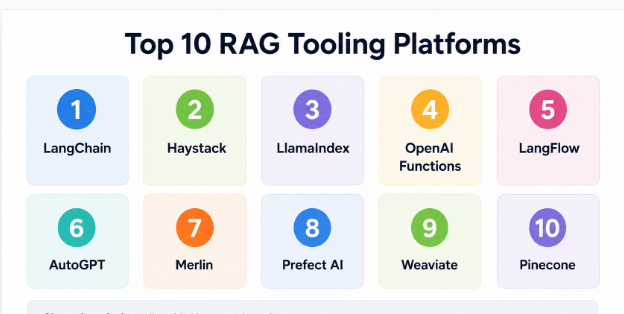
Top 10 RAG Tooling Platforms
#1 — LangChain
Short description: LangChain is a flexible framework for building RAG pipelines and multi-step AI applications. It allows integration of multiple LLMs with external data sources, vector stores, and APIs. LangChain supports memory management, prompt chaining, and orchestration, making it ideal for building AI chatbots, content generation systems, and knowledge-based applications. Developers can extend it through open-source plugins, making it suitable for enterprise and research use.
Key Features
- Multi-LLM orchestration
- Vector store integration (FAISS, Pinecone)
- Prompt chaining and memory management
- API and database connectors
- Workflow automation
- Open-source extensibility
- Logging and monitoring
Pros
- Strong developer ecosystem
- Flexible pipeline orchestration
- Supports multiple data sources
Cons
- Requires technical expertise
- Enterprise-level security requires setup
- No native GUI for non-technical users
Platforms / Deployment
Windows / macOS / Linux / Cloud / Self-hosted
Security & Compliance
Not publicly stated
Integrations & Ecosystem
- OpenAI, Hugging Face, Anthropic models
- SQL, MongoDB, vector stores
- API integrations
- Custom connectors supported
Support & Community
Active open-source community, GitHub discussions, tutorials.
#2 — Haystack
Short description: Haystack is a robust RAG framework optimized for NLP tasks like question answering and document retrieval. It orchestrates multiple LLMs and provides pipelines for retrieval, summarization, and reasoning. Haystack is suitable for enterprises creating knowledge-based AI assistants, search engines, or internal research tools.
Key Features
- Retrieval-Augmented Generation pipelines
- Multi-LLM orchestration
- Document and vector store integration
- Pipeline monitoring and logging
- API endpoints for deployment
- Open-source and extensible
- Data preprocessing support
Pros
- Strong for document-heavy workflows
- Enterprise scalability
- Active open-source development
Cons
- Requires coding knowledge
- Setup complexity for large pipelines
- Limited visual interface
Platforms / Deployment
Windows / macOS / Linux / Cloud / Self-hosted
Security & Compliance
Not publicly stated
Integrations & Ecosystem
- OpenAI, Hugging Face, Cohere
- ElasticSearch, Pinecone, FAISS
- API and SaaS integrations
Support & Community
Documentation, tutorials, active developer forums.
#3 — LlamaIndex
Short description: LlamaIndex specializes in connecting LLMs to structured and unstructured data for RAG pipelines. It integrates vector databases, documents, and APIs, providing retrieval-augmented answers with context. It is ideal for knowledge management, enterprise search, and AI research assistants.
Key Features
- Retrieval-Augmented Generation pipelines
- Vector database integration
- Document ingestion and retrieval
- Multi-LLM support
- Prompt versioning and memory management
- Logging and monitoring
- API and custom connectors
Pros
- Excellent for knowledge-intensive workflows
- Open-source flexibility
- Multi-model orchestration
Cons
- Technical expertise required
- Limited GUI options
- Enterprise support may require custom setup
Platforms / Deployment
Windows / macOS / Linux / Cloud / Self-hosted
Security & Compliance
Not publicly stated
Integrations & Ecosystem
- OpenAI, Hugging Face, Cohere
- Pinecone, FAISS, Weaviate
- API integrations and SaaS connectors
Support & Community
Documentation, tutorials, active community support.
#4 — OpenAI Functions
Short description: OpenAI Functions allows RAG pipelines with LLMs integrated with external APIs and structured workflows. It is used to orchestrate multi-step tasks, connect AI outputs to data sources, and automate agent workflows. Ideal for developers building AI automation, knowledge agents, or task-oriented AI systems.
Key Features
- Multi-step RAG orchestration
- API integration and external data retrieval
- Structured function execution
- Workflow automation
- Logging and monitoring
- Model versioning
- Agent-style task execution
Pros
- Tight OpenAI integration
- Supports autonomous agent pipelines
- Simplifies API orchestration
Cons
- Requires coding expertise
- Tied to OpenAI services
- Limited offline capabilities
Platforms / Deployment
Windows / macOS / Linux / Cloud
Security & Compliance
- SOC 2, encryption
- RBAC
- Audit logging supported
Integrations & Ecosystem
- OpenAI models
- API connectors
- SaaS integrations
- Custom pipeline support
Support & Community
OpenAI documentation, developer community forums.
#5 — LangFlow
Short description: LangFlow provides a visual interface for designing RAG pipelines. Developers can orchestrate LLMs, connect APIs, and manage workflows using drag-and-drop features. It is particularly useful for prototyping and visualizing complex RAG workflows without heavy coding.
Key Features
- Visual workflow editor
- Multi-LLM orchestration
- API integration
- Prompt versioning and memory management
- Monitoring and logging
- Open-source extensibility
Pros
- Intuitive visual interface
- Rapid prototyping of workflows
- Supports multiple data sources
Cons
- Less suitable for very large-scale deployments
- Enterprise-level security may require customization
- Some coding required for advanced workflows
Platforms / Deployment
Windows / macOS / Linux / Cloud
Security & Compliance
Not publicly stated
Integrations & Ecosystem
- OpenAI, Hugging Face, Anthropic
- APIs and vector stores
- Custom connectors
Support & Community
Open-source, GitHub community, tutorials.
#6 — AutoGPT
Short description: AutoGPT is an autonomous agent framework for RAG workflows. It orchestrates LLMs to achieve multi-step goals, integrate data sources, and execute tasks. Suitable for experimental AI projects, autonomous research assistants, or complex automated workflows.
Key Features
- Autonomous multi-step RAG orchestration
- API and database integration
- Task and goal-oriented execution
- Logging and debugging
- Multi-LLM support
- Open-source extensibility
Pros
- Supports autonomous agent workflows
- Flexible and extensible
- Strong developer community
Cons
- Requires technical expertise
- Experimental for enterprise-scale workflows
- Limited enterprise support
Platforms / Deployment
Windows / macOS / Linux / Cloud / Self-hosted
Security & Compliance
Not publicly stated
Integrations & Ecosystem
- OpenAI, Hugging Face
- API and SaaS integrations
- Custom pipeline support
Support & Community
Open-source documentation, GitHub, forums.
#7 — Merlin
Short description: Merlin orchestrates RAG pipelines with multi-LLM workflows. It is designed for agents, knowledge retrieval, and automated task execution. It supports API and database connections and provides monitoring for AI governance and observability.
Key Features
- Multi-LLM orchestration
- API and data integration
- Workflow automation
- Logging and monitoring
- Open-source and extensible
Pros
- Supports complex AI workflows
- Open-source flexibility
- Agent workflow support
Cons
- Technical expertise needed
- Enterprise-level deployment may require setup
- Minimal GUI
Platforms / Deployment
Windows / macOS / Linux / Cloud / Self-hosted
Security & Compliance
Not publicly stated
Integrations & Ecosystem
- LLM providers
- Vector databases and APIs
- Custom pipelines
Support & Community
Open-source, documentation, community forums.
#8 — Prefect AI
Short description: Prefect AI integrates RAG orchestration with workflow automation. Teams can build AI pipelines that combine LLMs with structured data sources, automate retrieval, and generate enriched outputs. Suitable for AI-driven ETL, knowledge automation, and content generation workflows.
Key Features
- Workflow automation with RAG pipelines
- Multi-LLM orchestration
- Data source and API integration
- Scheduling and monitoring
- Logging and alerts
- Open-source extensibility
Pros
- Combines workflow automation and RAG
- Flexible for data-driven AI applications
- Open-source support
Cons
- Learning curve for complex pipelines
- Enterprise security setup required
- Coding knowledge needed for advanced workflows
Platforms / Deployment
Windows / macOS / Linux / Cloud / Self-hosted
Security & Compliance
Not publicly stated
Integrations & Ecosystem
- APIs and SaaS connectors
- Vector databases
- Workflow tools
Support & Community
Documentation, tutorials, forums, active contributions.
#9 — Weaviate
Short description: Weaviate is a vector database with RAG capabilities. It enables LLMs to retrieve context from vectorized documents and structured data. It is ideal for semantic search, knowledge-intensive AI, and RAG pipelines in enterprise and research applications.
Key Features
- Vector database with RAG integration
- Multi-LLM orchestration
- Semantic search and retrieval
- API integration
- Schema and data management
- Logging and monitoring
Pros
- Strong semantic retrieval
- Scalable vector database
- Flexible AI pipeline integration
Cons
- Technical expertise required
- Less GUI-focused
- Enterprise deployment may need custom setup
Platforms / Deployment
Windows / macOS / Linux / Cloud / Self-hosted
Security & Compliance
Not publicly stated
Integrations & Ecosystem
- OpenAI, Hugging Face
- APIs, SaaS, ML pipelines
- Custom connectors
Support & Community
Documentation, active community, GitHub.
#10 — Pinecone
Short description: Pinecone is a vector database optimized for RAG pipelines. It allows LLMs to access high-dimensional embeddings for retrieval, enhancing AI responses with context. It is used for knowledge search, recommendation engines, and retrieval-augmented generation in real-time applications.
Key Features
- Vector storage and retrieval
- High-dimensional embedding support
- API integration for RAG pipelines
- Real-time search and querying
- Multi-LLM support
- Logging and monitoring
Pros
- High-performance vector retrieval
- Scalable for large datasets
- Easy integration with LLM pipelines
Cons
- Technical setup required
- Cloud-only deployment
- Premium pricing for large-scale usage
Platforms / Deployment
Windows / macOS / Linux / Cloud
Security & Compliance
- SOC 2, ISO 27001
- Encryption and RBAC
- Audit logs supported
Integrations & Ecosystem
- OpenAI, Hugging Face, LangChain
- APIs and SaaS integration
- Custom RAG workflows
Support & Community
Enterprise support, documentation, active community.
Comparison Table
| Tool Name | Best For | Platform(s) Supported | Deployment | Standout Feature | Public Rating |
|---|---|---|---|---|---|
| LangChain | Multi-LLM pipelines | Windows / macOS / Linux | Cloud / Self-hosted | Prompt chaining & memory | N/A |
| Haystack | NLP search & QA | Windows / macOS / Linux | Cloud / Self-hosted | RAG pipelines & QA workflows | N/A |
| LlamaIndex | Knowledge-focused RAG | Windows / macOS / Linux | Cloud / Self-hosted | Document & vector integration | N/A |
| OpenAI Functions | API-connected RAG tasks | Windows / macOS / Linux | Cloud | Multi-step API orchestration | N/A |
| LangFlow | Visual workflow orchestration | Windows / macOS / Linux | Cloud | Drag-and-drop RAG pipelines | N/A |
| AutoGPT | Autonomous AI agents | Windows / macOS / Linux | Cloud / Self-hosted | Goal-driven agent workflows | N/A |
| Merlin | Multi-step agent orchestration | Windows / macOS / Linux | Cloud / Self-hosted | LLM agent workflow support | N/A |
| Prefect AI | AI pipeline automation | Windows / macOS / Linux | Cloud / Self-hosted | Workflow + RAG integration | N/A |
| Weaviate | Semantic search & retrieval | Windows / macOS / Linux | Cloud / Self-hosted | Vector database for RAG | N/A |
| Pinecone | Real-time vector retrieval | Windows / macOS / Linux | Cloud | High-performance vector search | N/A |
Evaluation & Scoring of RAG Tooling
| Tool Name | Core (25%) | Ease (15%) | Integrations (15%) | Security (10%) | Performance (10%) | Support (10%) | Value (15%) | Weighted Total (0–10) |
|---|---|---|---|---|---|---|---|---|
| LangChain | 9 | 7 | 9 | 6 | 8 | 7 | 8 | 7.85 |
| Haystack | 8 | 7 | 8 | 6 | 8 | 7 | 8 | 7.50 |
| LlamaIndex | 8 | 6 | 7 | 6 | 7 | 6 | 7 | 7.00 |
| OpenAI Functions | 8 | 7 | 8 | 7 | 8 | 7 | 8 | 7.70 |
| LangFlow | 7 | 8 | 7 | 6 | 7 | 6 | 7 | 7.05 |
| AutoGPT | 8 | 6 | 7 | 6 | 7 | 6 | 7 | 7.00 |
| Merlin | 7 | 6 | 6 | 6 | 7 | 6 | 7 | 6.75 |
| Prefect AI | 8 | 7 | 8 | 6 | 8 | 7 | 7 | 7.55 |
| Weaviate | 8 | 6 | 7 | 6 | 7 | 6 | 7 | 7.00 |
| Pinecone | 8 | 7 | 8 | 7 | 9 | 7 | 8 | 7.70 |
Interpretation: Scores reflect relative capabilities in multi-LLM orchestration, retrieval accuracy, integration flexibility, and enterprise readiness. Higher scores indicate more mature frameworks for knowledge-intensive AI workflows.
Which RAG Tool Is Right for You?
Solo / Freelancer
LangChain, LangFlow, and AutoGPT are ideal for experimentation and lightweight RAG pipelines. LlamaIndex provides flexibility for document-based retrieval.
SMB
Haystack, LangChain, and Prefect AI are suited for small teams needing multi-model pipelines and structured RAG workflows.
Mid-Market
OpenAI Functions, LangChain, and Merlin provide scalable orchestration, monitoring, and pipeline automation for mid-sized teams.
Enterprise
Vertex-scale enterprises benefit from Weaviate, Pinecone, OpenAI Functions, and Prefect AI for robust, secure, and high-throughput RAG workflows.
Budget vs Premium
Open-source frameworks like LangChain and LlamaIndex reduce cost but require setup. Cloud-native tools offer advanced monitoring and enterprise support at higher cost.
Feature Depth vs Ease of Use
LangChain, OpenAI Functions, and Pinecone offer deep orchestration capabilities; LangFlow and AutoGPT provide visual or autonomous workflows.
Integrations & Scalability
Evaluate API, vector store, database, and SaaS connectors. Ensure high throughput and multi-LLM orchestration for production-scale deployment.
Security & Compliance Needs
Check RBAC, SSO, encryption, audit logs, and deployment options for enterprise and regulated applications.
Frequently Asked Questions
1. What is RAG tooling?
RAG tools combine LLM outputs with retrieval from structured and unstructured data sources for accurate, context-aware AI responses.
2. How do RAG pipelines improve AI applications?
They enhance relevance, reduce hallucination, and allow AI to access verified knowledge in real time.
3. Are these tools secure for enterprise use?
Security depends on deployment and provider. Features like RBAC, SSO, encryption, and audit logs are important for enterprise deployments.
4. Can multiple LLMs be orchestrated?
Yes, most RAG frameworks support multi-model orchestration and model swapping.
5. How complex is setup?
Frameworks like LangChain, OpenAI Functions, and Pinecone require programming knowledge. Visual tools like LangFlow simplify setup.
6. Can these integrate with existing data sources?
Yes, they support APIs, vector databases, document repositories, and SaaS connectors.
7. Are they suitable for small projects?
Open-source options like LangChain, LlamaIndex, and LangFlow are suitable for small teams and experimentation.
8. Do they support real-time retrieval?
Yes, tools like Pinecone and Weaviate provide low-latency vector search for real-time applications.
9. How do I monitor pipeline performance?
Most frameworks provide logging, dashboards, and observability tools to track queries, latency, and retrieval quality.
10. Which RAG tool is best for autonomous agents?
AutoGPT and Merlin excel in multi-step, goal-driven RAG workflows with API and data integration.
Conclusion
RAG tooling frameworks are essential for building AI applications that require accurate, context-rich outputs from LLMs combined with external knowledge. LangChain, OpenAI Functions, and Pinecone excel in enterprise-scale orchestration, while LangFlow, LlamaIndex, and AutoGPT provide flexibility for experimentation and prototyping. Selection depends on project scale, team expertise, integration needs, and compliance requirements.
